
Shambhala Constitution

July 19, 2010 by RFS Editors    Print This Post Print This Post
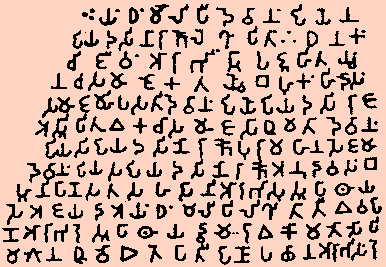
Edicts of Ashoka

Edicts of Aśoka

What would the constitution of an enlightened society, country, state look like?

How could it offer a better balance of care, authority, transparency, monarchy, democracy, socialism, checks-and-balances, church and state?

Topics studied could include study of past and current societies, constitutions, and political theories.

Resources identified here will be collected into a Vajra Politics class style curriculum, published on this site.

This table is an initial gathering point around such aspirations.

Comments

669 Responses to “Shambhala Constitution”

  1. John Tischer on July 19th, 2010 4:45 pm

    Shambhala was described by the Vidyadhara as a type of umbrella under which “authentic” spiritual traditions could find a place of refuge…could be
    preserved. One question is…who decides what’s an “authentic” tradiition
    and what’s not? The Vidyadhara himself chose some Tibetians for his
    students to relate to, and some he told them to avoid. In the current situation, we find an exclusivity based on the current Sakyong’s desire to have his students follow Shambhala Buddhism alone, while at the same time allowing a “teacher” who’s authenticity is questioned by even many in his own “tradition, to hold sway over a number of his students. My question here would be what would be the balance of power between a monarchy and whatever such a constitution would establish? Would that be based on how “enlightened” the ruler is? My bottom line is, if you have
    an enlightened society, you have to have an enlightened ruler…..can’t have it without one. It’s what the Vidyadhara talked about. Is the purpose of
    a constitution to establish checks and balances against autocratic rule?
    Has that ever anywhere happened before?

  2. Ash on July 19th, 2010 6:30 pm

    First, the recently created Consitutiion of the Kingdom of Bhutan is worth studying.

    Their site seems down right now so I can’t access the direct pdf link, but last night it was fine and hopefully will soon be back up:
    http://www.constitution.bt/

    I might be wrong on this, but I believe the King who launched this initiative did so against the wishes of the people who preferred he continue as Monarch without the democratic additions he insisted upon. Also, I believe he was one of the Vidyadhara’s first students in that for a while he served as his tutor. If this is a different person, then someone in a subsequent post can correct this error.

    Furthermore, he is, I believe, the only living tantric and Buddhist King of an internationally recognised Nation, i.e. a Chakravartin. So as someone holding that sort of position and who had a living connection with the Vidyadhara, and someone who furthermore unified Monarchic with Democratic principles in the form of this Constitution, it is worth examining.

  3. Ash on July 19th, 2010 6:30 pm

    There are 35 sections over 75 pages:

    Table of contents
    Article 1 ……………………………………………………………………………. 1
    Kingdom of Bhutan …………………………………………………………… 1
    Article 2 ……………………………………………………………………………. 2
    The Institution of Monarchy………………………………………………. 2
    Article 3 ……………………………………………………………………………. 9
    Spiritual Heritage ……………………………………………………………… 9
    Article 4 ………………………………………………………………………….. 10
    Culture ……………………………………………………………………………. 10
    Article 5 ………………………………………………………………………….. 11
    Environment……………………………………………………………………. 11
    Article 6 ………………………………………………………………………….. 12
    Citizenship ………………………………………………………………………. 12
    Article 7 ………………………………………………………………………….. 13
    Fundamental Rights ………………………………………………………… 13
    Article 8 ………………………………………………………………………….. 16
    Fundamental Duties ………………………………………………………… 16
    Article 9 ………………………………………………………………………….. 18
    Principles of State Policy ………………………………………………….. 18
    Article 10 ………………………………………………………………………… 21
    Parliament ………………………………………………………………………. 21
    Article 11 …………………………………………………………………………. 25
    The National Council……………………………………………………….. 25
    Article 12 ………………………………………………………………………… 26
    The National Assembly …………………………………………………….. 26
    Article 13 ………………………………………………………………………… 27
    Passing of Bills ………………………………………………………………… 27
    Article 14 ………………………………………………………………………… 28
    Finance, Trade and Commerce…………………………………………. 28
    Article 15 ………………………………………………………………………… 30
    Political Parties ……………………………………………………………….. 30
    Article 16 ………………………………………………………………………… 34
    Public Campaign Financing …………………………………………….. 34
    Article 17 ………………………………………………………………………… 35
    Formation of Government ……………………………………………….. 35
    Article 18 ………………………………………………………………………… 36
    The Opposition Party ………………………………………………………. 36
    Article 19 ………………………………………………………………………… 37
    Interim Government………………………………………………………… 37
    Article 20 ………………………………………………………………………… 38
    The Executive ………………………………………………………………….. 38
    Article 21 ………………………………………………………………………… 39
    The Judiciary ………………………………………………………………….. 39
    Article 22 ………………………………………………………………………… 42
    Local Governments………………………………………………………….. 42
    Article 23 ………………………………………………………………………… 46
    Elections ………………………………………………………………………….. 46
    Article 24 ………………………………………………………………………… 49
    Election Commission ……………………………………………………….. 49
    Article 25 ………………………………………………………………………… 50
    The Royal Audit Authority ………………………………………………. 50
    Article 26 ………………………………………………………………………… 51
    The Royal Civil Service Commission ………………………………… 51
    Article 27 ………………………………………………………………………… 53
    The Anti-Corruption Commission ……………………………………. 53
    Article 28 ………………………………………………………………………… 54
    Defence ……………………………………………………………………………. 54
    Article 29 ………………………………………………………………………… 55
    The Attorney General ………………………………………………………. 55
    Article 30 ………………………………………………………………………… 56
    The Pay Commission ……………………………………………………….. 56
    Article 31 ………………………………………………………………………… 56
    Holders of Constitutional Offices ……………………………………… 56
    Article 32 ………………………………………………………………………… 58
    Impeachment…………………………………………………………………… 58
    Article 33 ………………………………………………………………………… 58
    Emergency ………………………………………………………………………. 58
    Article 34 ………………………………………………………………………… 60
    National Referendum ………………………………………………………. 60
    Article 35 ………………………………………………………………………… 61
    Amendment & Authoritative Text…………………………………….. 61
    First Schedule ………………………………………………………………….. 62
    The National Flag and the National Emblem of Bhutan ……. 62
    The National Flag ……………………………………………………………. 62
    The National Emblem ……………………………………………………… 62
    Second Schedule ………………………………………………………………. 63
    The National Anthem of Bhutan ………………………………………. 63
    Third Schedule ………………………………………………………………… 63
    Oath or Affirmation of Office …………………………………………… 63
    Fourth Schedule ………………………………………………………………. 63
    Oath or Affirmation of Secrecy ………………………………………… 63
    Glossary ………………………………………………………………………….. 64

  4. Ash on July 19th, 2010 6:33 pm

    Clearly this is a far more complete document than anything we could aspire to develop here (I suspect), but I think the structure is interesting if one highlights, in order, some of them to reveal the logical progression:

    1. Monarchy – definition, nature, function and successsion
    2. Spirituality,Culture and Environment
    3. Citizenship, Rights, Duties.
    4. State, Parliament, National Council, National Assembly, Bills
    5. Aspects and various Procedures down to Impeachment and National Referendum
    6. Appended: National Flag, Oaths.

    Now I don’t know the background as to why His Majesty the Druk Gyalpo Jigme Khesar Namgyel Wangchuck insisted on creating this Constitution, i.e.personal conviction, international pressure to maintain independent status or whatever. But I suspect the above 6 point structure is not a bad template to use, i.e. we could try to come up with something that has the same sort of sections and progression, starting with the monarchy and ending with procedural type setup, functionally speaking.

  5. Ash on July 19th, 2010 6:38 pm

    Recommended pith instructions on nature of Sakyong in context of drala: Being on Time 1981 Kalapa Assembly.

    Basic root guideline for Citizenry: Shambhala Edict on Wholesome Human Conduct.

    (Am not sure what is public domain, what not, so simply citing reference.)

  6. Ash on July 19th, 2010 7:31 pm

    Clarification:

    HM Jigme Singye Wangchuk studied with VCTR in England before ascending the throne in 1972. He was the main instigator of the new Constitution and after promulgating it, abdicated in favor of his son, the current Monarch mentioned above as ‘His Majesty the Druk Gyalpo Jigme Khesar Namgyel Wangchuck’.

    Historical Note:
    In days of yore in the Ziji and other such dharma retail outlets, there was a photograph of CTR on a horse with three cushions. I believe this was taken on his way to the retreat at which he composed the Sadhana of Mahamudra, but it was during that visit in Bhutan for sure. VCTR told me that the three cushions designated Royalty and the horse had been provided by Her Majesty, the mother of his student Jigme Wangchuk.

  7. Ash on July 19th, 2010 7:47 pm

    John, I think defining enlightenment or judging whether or not a Monarch is ‘enlightened’ is a false piste. Also, enlightened society could simply mean a society whose core values cluster around the notion of human life being a precious opportunity to develop virtue.

    In terms of checks and balances, one section proposes how Parliament can instigate abdication:

    The Druk Gyalpo shall abdicate the Throne for willful
    violations of this Constitution or for being subject to permanent
    mental disability, on a motion passed by a joint sitting of
    Parliament in accordance with the procedure as laid down in
    sections 21, 22, 23, 24 and 25 of this Article.
    21. The motion for abdication shall be tabled for discussion at a
    joint sitting of Parliament if not less than two-thirds of the
    total number of the members of Parliament submits such a
    motion based on any of the grounds in section 20 of this Article.
    22. The Druk Gyalpo may respond to the motion in writing or by
    addressing the joint sitting of Parliament in person or through
    a representative.
    9
    23. The Chief Justice of Bhutan shall preside over the joint sitting
    of Parliament mentioned in section 21 of this Article.
    24. If, at such joint sitting of Parliament, not less than three-fourths
    of the total number of members of Parliament passes the
    motion for abdication, then such a resolution shall be placed
    before the people in a National Referendum to be approved or
    rejected.
    25. On such a resolution being approved by a simple majority of
    the total number of votes cast and counted from all the
    Dzongkhags in the Kingdom, the Druk Gyalpo shall abdicate
    in favour of the heir apparent.
    26. Parliament shall make no laws or exercise its powers to amend
    the provisions of this Article and section 2 of Article 1 except
    through a National Referendum.

    (page 8)

    +++++++++

    Now, there are various aspects to Parliament in this constitution and I shall dig into that area to see to what degree there is an echo of the Deleg/Dekyong structure.

  8. rita ashworth on July 20th, 2010 4:43 am

    Dear John and Ash

    Thanks for your posts.

    I have not done my reading as of yet –wanted to concentrate on the American constitution and the English Bill of Rights in the seventeenth century.

    However some things striking my mind re Johns post about ‘authenticity’ as to teachers.

    I dont know in the western context if you look at how things have developed in a religious and secular sense its always been a march away from what was termed authentic teachings at the time. For example Luther with the Reformation and of course the French revolution so debating the power and authenticity of enlightened teachers in the 21st century is somewhat strange in the western sense where ones religious beliefs/secular conceptions rest on ones conscience.

    It seems to me that we had the Vidyadhara here as prime example of a realised Tibetan master in the west in terms of the Kagyu and Nyingmpa teachings but in the context of the shambhala teachings he did not demand people should convert to Buddhism to receive these teachings in fact quite the opposite he just advised people to follow a practice-orientated tradition when practicing these teachings (see FAQ on this site). So that was a pretty open delivery of the teachings for people –so I dont know do ‘we’ need to decide who is authentic or not in delivery of these teachings to people.

    Me personally I would only require that you follow certain ethical principles (to be constructed hopefully in a constitution) which allow you to have access to the shambhala terma and to teach it. Yes I dont think we should sit in judgement on others and put up any fences to the dispersal of these teachings in the world. Religious bodies, governmental bodies have done this through the ages and always there is conflict as to who is right and who is wrong or who ‘correctly’ interprets the said scriptures.

    Now the concept of the enlightened ruler –well to me it has the sense of teaching with an open hand like the Buddha did to freely teach to whoever requests the teachings. Of course if they want the vajrayana teachings set guidelines could be set out for that too. We could be very matter of fact in this matter.

    Also in terms of an enlightened ruler –well if you are to have a diverse enlightened society –some people will see the ruler one way and others another way –how could that not be so. For if you look at the example of a Shambhalian Christian he will be living with loyalties to several things –yes this argument is pretty much like the arguments going on in the UK at the present when people ask can immigrants be loyal to the country? Or can we indeed have a multicultural society and make the thing work. Well despite all these questions the UK, the US and indeed Europe are still functioning –so liberalism and secularism has worked to this extent. Yes we can have allegiance to several things and survive and prosper.

    Heres my own personal take on an enlightened ruler -I could see the present Sakyong much in terms of the Japanese Emperor uniting Heaven and Earth that would be a good way to go for me and should be enough of a recognition of him and hopefully eventually her to have access to the shambhala terma. But if that does not work for the present administration ‘we’ will have to go forward with the shambhala teachings as we have got them and see what materialises through the power of karma. As I said before I think things will develop here in an organic fashion anyway.

    Well will get back to some reading when I can-again much thanks for all the contributions and I will try and check them all out.

    Best

    Rita Ashworth

  9. john perks on July 20th, 2010 9:04 am

    Dear Friends,

    Well this is quite amazing. The extraordinary knowledge of many people.
    Ash, you must have been sitting on this information already to go!

    I have a question: How would one, in this constitution, express the sanctity of all life? And in expressing that, would that mean that John Tischer’s shamam who practices animal sacrifices could not apply for Shambhala citizenship?
    And further, how would one settle the current debate between right-to-lifers and abortionists that is always coming up in the USA? And further, not to complicate things, would Shambhalians be vegetarians? And if not, how would butchers and fishermen be treated? …. not with contempt, I hope.

    So these are some of the questions I wanted to ask.
    Thank you.

    John Perks

  10. Ash on July 20th, 2010 9:22 am

    Well, I have thought about this a little before, but never considered trying to write out something sort of like a ‘constitution’. I don’t have any knowledge of it, simply went to the document because I did read about it’s creation years ago and thought it interesting.

    The interplay between the local governments and the National Assembly and the areas where HM appoints members of the civil service is still a little opaque, esp. since he uses many Bhutanese terms describing the local governments. Which is interesting in itself: the more local the topic the more local the lingo used. But I am not sure exactly what power and influence they have, also what share of the purse.

    In terms of your questions: first, well part of this exercise is for you to supply the answers, no? My initial contribution is/was to suggest some sort of framework on which to hang an attempt at drafting a constitution of sorts to start with, i.e. the main six sections.

    Second, this is part of why decision-making organs exist in a body politic, to adjudicate such issues, no? Such adjudications are called laws and the main purpose of a legislative body is to determine such laws.

    As to some of the Sakyong issues above, I thought it interesting that in the BC it clearly states that Buddhism is the national religion but that all faiths are equally protected and HM, as Head of State, protects them all within the kingdom.

    Now Shambhala is not an internationally recognised kingdom with particular territory, rather a church with affiliate churches around the world, much like the RC church. But that is a religious model, albeit the institution of the Vatican is very much a secular operation in that it used the Christian faith as a way to provide an authority on earth above that of the Kings. Indeed, one could argue that Christianity, by design or not, first built up and then, with its own internal split, essentially destroyed Monarchical power in Western Civilisation. Even though both institutions still command much of the residual wealth in both $$ and institutional influence, culturally they have faded into the background in terms of overt contribution.

    In our case, the challenge here it so consider what a Shambhala Constitution would look like which means defining the role of State and Citizen and Governance structures in functional terms, which is a different exercise from considering the spiritual nitty gritties alone.

    In terms of the butchers, I well remember your querying Rinpoche about this on Inglis St. Halifax in 1981 around a pot of bouillabaisse you had made using, I presume, some live or very recently live participant ingredients, so again, I think you can supply that answer!

    But the challenge here, I think, has to do with framing HOW (procedurally) the answer is determined and promulgated more than exactly what the answer is per se.

  11. Ash on July 20th, 2010 9:35 am

    Although not necessarily endorsing the BC, I suspect it will be hard for us to find anything as close to our type of vision so find myself quite comfortable referring to it as the first source of reference. The British constitution is largely ‘unwritten’; the US constitution, as Goedel noticed, is flawed and in any case no longer in effect because of such flaws.

    But note how it starts, and it starts very well imho:

    Article 1
    Kingdom of Bhutan
    1. Bhutan is a Sovereign Kingdom and the Sovereign power
    belongs to the people of Bhutan.

    I think this might be an area where some people are having problems with the Sakyong. He inherits the position, which is both spiritual and temporal in our set up. His spiritual authority in the vajrayana context is beyond question. Once a citizen has taken an oath to him as Sakyong – which I am not sure is done but it used to be done I believe – the two samayas become virtually inseparable.

    This is the rub in the debates about the nature and function of the Shambhala teachings.

    Does Shambhala’s fruitional expression and practice by definition essentially involve tantric samayas binding the life force in various ways (i.e. is a cult in the positive sense) ?

    Or is the Shambhala Way a stand alone spiritual path and discipline whose purpose is to bind the life force to the naturally arising energies of the phenomenal world including human cultural flows, wherein pretty much any and all cultural conventions, including religious ones, can combine as Mark S eloquently expressed above, as two wings of the bird.

    But if Shambhala is just one wing, what is the bird?

  12. Ash on July 20th, 2010 9:43 am

    My editor function is not working so:

    in terms of the power of the people issue: the only power it seems the people have in our setup is electing whether or not to play ball in terms of samaya and/or to contribute in various ways, including taxes (contributions) which are voluntary. But apart from that, constitutionally speaking, there is little or none. This is why the inheritance model with such a setup is problematic because the whole thing boils down to whether or not one is sufficiently connected pyschologically to feel loyal in an uplifted, enriching way. If that sense of connection wavers for whatever reason, there is little other binding factor ‘belonging’, as it were, to the citizenry. Everything seems focused on the centralised leadership function of the Sakyong which, again, is blended inseparably with that of a samaya-bound master in a tantric cult. Or in ‘national’ terms such as those addressed in a ‘constitution’, the local entities, be they individual or collective as with a local sangha, by themselves have no basis.

    Now this is partly because the current situation is that of a church rather than a kingdom literally grounded on specific geographic territory (such as the Kingdom of Bhutan for example), but that’s not the whole picture. When the principal bond is to one figure at the top (or center using mandalic lingo), this is a highly centralised model which disempowers the local (or fringe) elements, which ultimately comprise the majority of the population (aka the masses). So structurally there is a disconnect.

    My point is that the BC Article Nr. 1 is not a bad place to start, constitutionally speaking. Clearly it was a deliberate decision on HM’s part to lead off with this: ‘the sovereign power belongs to the people of Bhutan.’

    It is not just a philosophical or legal statement: it is also a dharma, a truth because of course a leader without followers is a leader of nothing, no matter what the title, i.e. the followers – or in this case general population – are ultimately the ones who create and empower the leaders. This is also true in dictatorships, oligarchies, kleptocracies (as we have now), and basically all systems. The real issue, therefore, is the degree of intelligence and virtue involved and how that is nurtured, protected and furthered, which process is probably akin to what is referred to as ‘enlightened’.

    Part of the job of a constitution, or whatever, is to define power flows so that on the one hand clear authority can be established, and on the other there are good flows between centre and fringe with all elements therein able to regulate such flows both procedurally and in terms of specific legislative and other decisions.

    Another resource – which might be too hard to access – is the rule of law promulgated by Genghis Khan. It was, apparently, mainly encapsulated in 2-3 pages and it worked well even in conquered territories (such as Persia) for many centuries after his death. I have read that he regarded this as his greatest contribution but have not been able to read exactly what this law was!

  13. Rob Graffis on July 20th, 2010 11:34 am

    I would like to remind people that there is no check or balances on Radio Free Shambhala, and a minority can take over this site, and declare a Constitution.
    If you know anything about the Tea Party currently, it’s in shambles because there is no real hierarchy within the system, though I think it started out with good intentions.
    Ashley, don’t get too worked up here. I would say start your own Shambhala within first.
    Also, as I know it, any of the heart felt proposals presented at previous Shambhala Congresses were non binding.

  14. Ash on July 20th, 2010 12:44 pm

    Rob, thanks for the caution. I don’t think there is any sense that a Constitution would be written here and ‘declared’. In any case, the Sakyong would have to declare it.

    But contemplating what such a Constitution could/might be is a worthy exercise which would require addressing many issues – often tossed around emotionally – in a quasi pragmatic, functional fashion.

    One element that might help conceptually is to take the view that a national Constitution of an actual country is being drafted. This of course has little to do with the current S.I. community, but it makes it easier to work with straightforwardly, at least on the conceptual/envisioning level.

  15. John Tischer on July 20th, 2010 2:04 pm

    ” (1)John, I think defining enlightenment or judging whether or not a Monarch is ‘enlightened’ is a false piste.(2) Also, enlightened society could simply mean a society whose core values cluster around the notion of human life being a precious opportunity to develop virtue.”

    As for 1, I agree…very hard to determine, and who has the authority to do so…Other than the Karmapa in VCTR’s example?. 2. You may think that, but what I think is what the Vidyadhara said about enlightened society, which must have someone capable of manifesting as Universal Monarch. It’s a mandala…no center, no fringe. IMHO

  16. Ash on July 20th, 2010 3:08 pm

    Do you have context and citation for that?

    But also: the enlightened manifestation of the Chakravartin/Sakyong is partly the result/manifestation of the relative realisation of the population as a whole who have sufficient merit to see a Sakyong as such.

    The enlightened qualities, in other words, in this Shambhalian context are not merely the product, so to speak, of the individual in the role of Sakyong. Or put another way: without the ability to perceive with sacred perception, outer and inner drala etc., no such enlightened manifestation would be seen, let alone appreciated.

    Finally, mandala by definition means ‘centre and fringe’. It’s a whole, but the whole consists of center and fringe which is what makes the concept meaningful/helpful.

    We tend to think of hierarchy as leadership on top with masses on the bottom, i.e. a pyramid. This works well in corporate, military and other hierarchies, but in terms of traditional views of Emperor/Monarch, as I understand it, he/she is more akin to the Heart in the Body/Mind matrix, which, although ultimately the Ruler, is the deep within the central torso rather than simply the highest functions in the upper brain. Even in Western fairy tales about Royalty and suchlike, often you see the Monarch portrayed as the Heart principle because it is at the level of the Heart, or realized bodhicitta speaking Buddhistically, that there is unity in the societal ‘mandala’.

    But let us take an Enlightened Monarch as the assumption without getting into how to judge such a thing (and in any case there are many levels of enlightenment). In terms of his exposure and manifestation, the current Sakyong has to be in the top .01% in the world manifesting such qualities, so even if he might not be regarded as perfectly, completely and impeccably enlightened, he sure ain’t bad! (I know you disagree with this).

    It sounds like you might be implying that without a perfectly and completely enlightened Monarch that there is no point even considering enlightened society or how to constitute it. I find that a rather lack luster approach, indeed part of the problem. Surely the Shambhala warrior society does not need to depend solely upon a super-enlightened Fuhrer principle for its existence?

    That said, John T, I personally have always felt a half-halt when considering this issue, again referencing the seminal 1981 ‘Being on Time’ talk in which he basically describes the role of the Sakyong as being the inner/secret drala principle via which the citizen/student perceives true dralic reality. If this is a reasonable take on his description, it sounds virtually identical to the role of guru in the tantric tradition.

    I remember asking the new Sakyong about this at a Vaj program in 1997 (?) at RMDC. The teachings were about the three lineages (also mentioned in the 81 talks) which is what I was thinking about because one of the Tibetan lamas was insisting that nobody, including VCTR, had ever introduced such stuff before (he must have been poorly informed of course). I asked the Sakyong what connection there was between this level of dzogchen type structure and Shambhala and found myself interlocuting with a very, very powerful tulku right there on the spot. It was as if I was talking to an eighth century king; my knees started to buckle and I had a hard time breathing, something which has never happened before or since. His reply – which I barely heard or remember – was that all these things come right out of the mind of Padmasambhava and are fundamentally inseparable. The experience felt akin to that described by DDM in the Being on Time talk viz (one aspect of) the role of Sakyong.

    In any case, although I personally have drifted away for reasons I cannot explain or justify even to myself, let alone others, I do not feel that we are dealing with total corruption (as some here do), rather a mandalic obstacle connected to the times we live in, along with the collective obstacles of our population living in those times. Fixating the whole thing on one person, or even one institutional aspect (such as the S.I. administration), is I think a bit of a false piste as well.

    It’s all much bigger and deeper than that.

  17. damchö on July 20th, 2010 3:26 pm

    Hi Ash–I’m wondering if you can elaborate further on this: “Although not necessarily endorsing the BC, I suspect it will be hard for us to find anything as close to our type of vision so find myself quite comfortable referring to it as the first source of reference…. the US constitution, as Goedel noticed, is flawed and in any case no longer in effect because of such flaws.”

    Which flaws in the US Constitution are you thinking of in particular? Certainly it is flawed in that: a) everything is; and b) we clearly see the ways in which it is being subverted today. But I feel you are being too dismissive of it here. In terms of it being subverted, we know this can happen to any constitution, however well-designed. With regard to the US, it seems to me that since it is often hard to find an overarching sacred View in the culture today (to the extent it had one to begin with), the Constitution has lost a lot of its lungta, as it were. To many people it has become simply a legal document, mere words to be manipulated in the service of ideology and profit.

    But… this doesn’t negate its brilliance, does it? Rather, it reminds us that unless sacred View has permeated a culture it is going to be in trouble.

    Myself, I find the US Constitution a remarkably “enlightened” (small “e”!) work, and the process through which it came to be a beautiful object-lesson in itself. I always think: well, all the great old cultures of Asia, Africa, Europe, and the (native) Americas have all these deep contributions to make to Shambhala vision, but what does this 235-year-old mere invention of a country have to offer? This purely constructed political entity. But it seems to me that the Constitution–in particular its ingenious balance of powers and that still astounding and revolutionary First Amendment, especially Freedom of Speech and separation of Church and State–is precisely it! This is what the US has to offer, along with another thing (now tragically being threatened as well): its wide-openness to the immigrant.

    The US also, as a secular, nonsectarian culture, might be considered a closer model in that respect. Bhutan is a Vajrayana Buddhist society, which makes the majority of people who visit this site feel more at home perhaps, but doesn’t *necessarily* have to be the best model for Shambhala. ? I’m not disagreeing with you Ash about the BC–I haven’t had a chance to delve into it yet–just keeping open our possibilities here. Great ideas so far, by the way!

  18. Jim Hartz on July 20th, 2010 3:26 pm

    Dear Common Sense,

    Before a Constitution, wouldn’t it be a good idea—and more clarifying of where we stand (or sit)—to consider creating a Declaration of Independence? A basically sane “Tea Party” gesture?

    That is, distill down the very particular grievances that have brought us to this “painful point,” and do so ALWAYS in the context of the particular teaching of the Vidyadhara the New Dispensation clearly has contradicted or violated (that would raise them above the level of mere “complaint” and make them indestructible, something that would endure, and people could look at, on-line, or tacked to the front doors of the Boulder and Halifax Shambhala Centers—at least for a few seconds, anyway! I have a good friend in the Bay Area who is one of the last fine letterpress printers. Maybe he could do a run of several hundred and we could present one to “King George” for him to contemplate? Just a thought. A number of Ginsbergian publicity stunts come to mind, here, but I’ll leave those to your imagination: I’m not really an “activist” in the conventional sense, and the Vidyadhara certainly was not a Beatnik!)

    The guiding logic here—it’s a suggestion—is from the first talk of the first mandala seminar ever presented by someone who knew what they were talking about on the subject—on the North American continent. That would be the Vidyadhara, and the seminar was ORDERLY CHAOS. The passage I’m referring as the “guiding logic” for a Declaration would be:

    “If we do not understand the samsaric aspect of mandala, there is no nirvanic aspect of mandala at all.”

    This passage, of course, represents one of the finest of the Vidyadhara’s Vajrayana Buddhist teachings. It seems appropriate to start with an articulation of our grievances in the context of the Vidyadhara’s teachings, than to start with how we might prevent—or at least work more skillfully with—such occurrences from happening again in the future: that is, how to protect the heart of his teachings from the worms (Chihuahuas or King of Chihuahuas) in the future.

    I see Declaration and Constitution inseparable the way Samsara and Nirvana are inseparable. I think the Constitution would naturally grow out the Declaration—or, at least, provide some useful nuances that would be helpful in the articulation of what we want to become the Supreme Protector of the Vidyadhara’s teachings against “worms,” the Constitution.

    I think a great place to start with what I’m getting at by a particular “declaration”—a model—would be Zer-me Dri’med’s “What Has Changed” somewhere on the RFS site. Maybe someone could provide us with the link for that? I’m a tech klutz. But she was the first person in my experience to have the ovaries to step out of the “Cocoon of Conformity” (which is actually constitutive of a “Great Leap Backwards”) into the light of the Great Eastern Sun, and provide some straight forward and direct feedback to The Kongma Sakyong, Jampal Trinley Dradul, about what grated on her basic intelligence concerning the imposition of Shambhala Buddhism onto what was already there: the Vidyadhara’s peerless teachings. (Think “Victory Over War.” Think “raging diamond which cuts aggression, eternally with corruption.”)

    Sherap Paine

  19. Ash on July 20th, 2010 5:24 pm

    damcho, well now you press me I must confess this is why, although quite interested, I hesitated to get involved, namely because I doubt I will be willing to do the due diligence that such an endeavour should involve. But as the direct descendant of a couple of the Dec. of Ind. signers, as well as one of the framers, perhaps I should! (Joseph Howes/Hewes, John Adams).

    But – he replies snidely – since you think it enlightened, perhaps you could explain a little why. I have found that every time I try to read it – as I just did before penning this reply – I become distracted and disinterested with a few paragraphs. In short, there is little vision, let alone description of anything approaching sacred outlook.

    Let’s look at the introduction:

    Preamble
    We the People of the United States, in Order to form a more perfect Union, establish Justice, insure domestic Tranquility, provide for the common defence, promote the general Welfare, and secure the Blessings of Liberty to ourselves and our Posterity, do
    ordain and establish this Constitution for the United States of America.

    The first goal is to form a ‘more perfect Union’, which basically means creating a Legislature and attendant infrastructure that trumps the States. Of course banding together in order to form a cohesive nation no longer subject to being colonial serfs was a necessary thing – probably. But it’s rather utilitarian when all is said and done. Liberty here simply means reaffirming the sovereignty of the individual which is already – in theory – enshrined in Common Law down from Magna Carta. But it is barely defined.

    As to Goedel, this remains a mystery. But he had a brilliant mind, studied for his citizenship exam assiduously, and was disturbed to find logical flaws in the setup which would allow fascism to emerge. I believe this has never been fully explained.

    You are right, though, that I was being overly dismissive. I guess I am so disgusted with how America – and the West – has turned into a fascist enterprise that I feel leery of examining its constitution. (One of the early definitions of fascism is ‘the union of State and Corporate power.’ Witness how Google is a product of the intelligence industry etc. etc. etc.

    Also, check out how even the UK, a supposed Constitutional Monarchy, is also set up as a corporation, with each individual MP being a separate corporate body with legal rights attached thereto. In other words, current Western models are so corrupted, and evolved from their various and sundry constitutions, that the immediate result lends one to suspect that the constitutions in question leave much to be desired.

    The reason for liking the BC constitution in principle does indeed involve the vajrayana buddhist aspect, I suppose, but principally because presumably the heart of that aspect is sacred perception derived from dharma practice, i.e. experientally based. With sacredness as the spiritual ground ‘uniting’ the population, this feels very close to the Shambhala vision essentially even though technically it’s a little different.

    I have not studied the Thai constitution and set up, but there too you have a Buddhist monarchy, albeit the Buddhadharma there is Hinayanist and many of them regard the Tibetan tantrics as demonic perversions. But their Royal Family (some of whom I knew growing up) are very royal indeed, not at all Hinayanist. But anyway.

  20. Ash on July 20th, 2010 5:30 pm

    Jim, feel free, but I think a Dec of Ind is a very different project and also one that makes no sense unless one is attempting to set up a different religious school or Shambhala-inspired territory. If the former, no need to declare anything. If the latter, since there is no such territory, let alone population already there, what’s the point? If one wants out, one simply goes out. If one wants or still feels in – as I suspect nearly all of us do in however disgruntled and confused a fashion – then the challenge is more about how to finagle the mandala to include its more quirkily dispersed members somehow, and therein (hopefully) also achieve some breakthroughs in that the obstacles broached will reveal further levels of wisdom and power which will be of benefit to all – not to mention sundry.

  21. Ash on July 20th, 2010 5:37 pm

    The Bhutanese Constitution Preamble (to compare with US above):

    Preamble
    WE, the people of Bhutan:
    BLESSED by the Triple Gem, the protection of our
    guardian deities, the wisdom of our leaders, the
    everlasting fortunes of the Pelden Drukpa and the
    guidance of His Majesty the Druk Gyalpo Jigme
    Khesar Namgyel Wangchuck;
    SOLEMNLY pledging ourselves to strengthen the
    sovereignty of Bhutan, to secure the blessings of
    liberty, to ensure justice and tranquillity and to
    enhance the unity, happiness and well-being of the
    people for all time;
    DO HEREBY ordain and adopt this Constitution for
    the Kingdom of Bhutan on the Fifteenth Day of the
    Fifth Month of the Male Earth Rat Year corresponding
    to the Eighteenth Day of July, Two Thousand and
    Eight.”

    Of interest: opening paragraph starts with ‘blessed by the Triple Gem’ and ends with ‘the guidance of HM the Sakyong. The Triple Gem provides blessings, HM provides guidance.

    Now the US also goes for ‘blessings of Liberty’, but there is no Heaven principle to that. So essentially this constitution worships at the shrine of Man and I think remains at a rather Nyen level throughout. There is much more lha, nyen and lu progression in the BC. Also, since it has both a monarchical and a democratic/legislative component, AND was written quite recently in our current era, it is intriguing.

  22. Ash on July 20th, 2010 5:41 pm

    Hmm, what I might try to attempt in the next 7-14 days is simply to take the BC text into a file and then edit it down to something closer to Shambhala and then see how that looks. If so, I can publish the six sections in different comments and then others here can see if it is of any interest at all or a false piste.

  23. Ash on July 20th, 2010 6:36 pm

    It occurs to me going through the document and substituting English equivalents for the many Bhutanese terms that one thing we simply do not have – apart from a functioning Parliament – is an Opposition Party. The purpose of the opposition is to provide a respectable means of debating policies and other matters of importance so that dissent is not necessarily a form of creating schism in the mandala.

    Personally, I have never liked Party Politics, but having some sort of body formally allowed to offer regular challenge seems like a very worthy principle, and something missing. In fact, this might be the main (if not only) virtue of the Parliamentary approach since otherwise there is simply no respectable, open way to have substantive debate, demonstrate there are important differences, raise vital issues which the current Authorities might be avoiding or exacerbating etc. Furthermore, such a body is obliged to think for itself, i.e. not necessarily follow any official line.

  24. Ash on July 20th, 2010 7:24 pm

    I have gone through the BC and anglicised as much as possible, also substituting Shambhalian terms and names where easy to do. This will make the document far easier to read for our purposes.

    I suspect the sections of greatest interest will be those pertaining to monarchy within the context of the State along with political representation. Much of the document goes into rather detailed explanations of various departments and functions which is a little beyond our scope right now, but they are important in terms of understanding how the various elements balance each other.

    I will try to make a stripped down version highlighting interplay between monarch, subjects, representation and various checks and balances and publish that later.

    http://www.frenchroadbakery.tk/Shambhala%20Constitution%20Anglicised%20Version%201.htm

  25. damchö on July 20th, 2010 10:41 pm

    Ash–Great work.

    Comparing the Preambles to the Bhutanese and US Constitutions is interesting. Clearly the middle paragraph of the former has borrowed a great deal from the latter.

    BC: “…to secure the blessings of liberty, to ensure justice and tranquillity and to enhance the unity, happiness and well-being of the people for all time…”

    directly derives from: “…in Order to form a more perfect Union, establish Justice, insure domestic Tranquility, provide for the common defence, promote the general Welfare, and secure the Blessings of Liberty to ourselves and our Posterity…” (USC)

    As for the first paragraph, indeed that of the BC adds a dimension of lha lacking in the USC. I say this as someone still agnostic about the idea of monarchy, as mentioned before–whenever I see a reference to someone with a long string of titles I hold my nose, I can’t help it! More to say and ask about this at some other point. But certainly the references to the Triple Gem, guardian deities, and wise leadership create a desired quality of lha / sacred view.

    I went back to the Declaration of Independence also: “We hold these truths to be self-evident, that all men are created equal, that they are endowed by their Creator with certain unalienable Rights, that among these are Life, Liberty and the pursuit of Happiness. That to secure these rights, Governments are instituted among Men, deriving their just powers from the consent of the governed.”

    Of course Shambhala does not think in terms of a Creator, but can there not be a sense in which this paragraph contains a Heaven principle? A more Shambhalian version might be something like this: “We hold these truths to be self-evident, that all human beings arise out of primordial goodness and therefore dwell in equality, and that this equality manifests in certain unalienable rights, among which are life, liberty, and the pursuit of happiness… etc” That’s off the top of my head and not necessarily very good at all, but just to suggest that it is possible to change the language from this direction also.

    By “enlightened” document of course I’m referencing the relative virtues of the European “Enlightenment”. What is impressive to me about it is its clear-eyed realism and practicality regarding the kleshas and the exercise of power, combined with at least a theoretical affirmation of equality (obviously we are still waiting for full racial equality).

  26. John Perks on July 21st, 2010 2:22 am

    Yes fine work Ash,I think what we are here,is -we are the Loyal Opposition Party….and are acting as such…
    Thanks
    JP

  27. John Perks on July 21st, 2010 2:48 am

    And why don’t we just start The Loyal Opposition Party of The kingdom of Shambhala..as a legal organization?we are doing it anyhow……

  28. Ash on July 21st, 2010 8:11 am

    D, yes I agree the Dec of Ind is much better. And personally, I have no problem with God in general esp. when used as an Absolute Principle, which is the case in much Christian and Islamic theology, though of course we won’t use it. But the Dec of Ind is not a constitution.

    Clearly also he borrowed.

    Lord P: I don’t know why that never occurred to me before, but really there is significant merit in having a formal opposition element. In the BC, for example, he specifically sets it up that of the various Parties competing for election, only the top two get into Parliament, one as the current leadership and the other as Opposition, the other Parties who come short simply not making the cut, the point being, I suppose, to have a strong opposition. In any case, that opposition function was clearly highlighted in the BC, enough so that I woke up to it. Now that he got from the British system. The US system is all back-room arm-twisting with very little debate. Perhaps the British is now the same, but at least it retains form from days of yore.

    Before forming a LOP, let’s draft a Constitution as a working basis!

    I’ll try to boil down the framework of the BC into something like six sections, each one greatly shortened so that we have something to work with together. For me right now it’s not so important to get the lha elements of the language correct, rather to contemplate the core skeleton on which the flesh and blood later flourish, i.e. principally the roles of and relationships between Monarch, State, People and Legislative Procedures.

    I think what we have in S.I. right now, even with the best intentions in the world on the part of all involved, is an almost complete lack of ownership of both process and assets on the part of the People. There is something very unbalanced about this making a genuine two-way flow virtually impossible and skewing everything towards being a large cult (which is not necessarily a negative word). It’s a problem.

  29. Ash on July 21st, 2010 8:16 am

    More about Loyal Opposition:
    a) its officials – after election – are paid salaries by the State whilst sitting in Parliament as MP’s (dekyongs)
    b) HM, as Head of State, is not biased towards any Party as long as all Parties are working towards the welfare of the State which includes all people therein. This keeps him above the fray, which also means he is not the one and only focus for all policies in the Kingdom, as is currently the case. It makes for a more influential, and liberated, Monarch, better able to deepen the influence on the Heart level in the society, which is of great and significant benefit to all.

    Additionally, if HM, as Head of State, feels that the entire direction of the Parliament is wrong, he can step in with suggestions, even directives.

    Or if the People feel that HM has overstepped his authority or is incompetent, they can instigate procedures which can lead to (forced) abdication although only a member of the Royal Family by blood can succeed to the Throne as the next Head of State.

    I also find the balance between many of the Officials appointed directly by HM versus the Executive run via the Prime Minister within Parliament of great interest.

    There is authority from on high, as it were, exercised by His Majesty and his immediately appointed officials in the Civil Service (again from the British system), and then authority from below, as it were, via the elections, the local and regional Councils leading up to the National Assembly and Councils into Parliament and the Civil service.

    It reminds me of a plant or tree. Things come down from above and up from below and where exactly they meet is hard to say, doesn’t even exist in the sense that there is no clear definable spot or middle, but nevertheless that dynamic is essential. Indeed, it is hard to say whether a tree is growing up or down because it is always, every second, doing both. That’s a good dynamic and I think an essential one for any societal set up or constitutional framework.

    In this analogy, the role of the Monarch is to hold the Center, i.e. is the Man Principle par excellence whereas we tend to think of it as the Supreme High Holy One at the Top even though we have studied Heaven, Earth, Man and Universal Monarch principles – albeit mainly only in the context of Dharma Art. But these things derive from classic Confucian thought which itself came from old daoist notions which go deep into the mists of time, presumably before the ice age, and are inseparably connected to a ‘Yellow Emperor’ principle who is said to have instigated the entire thing from wisdom-insight, i.e. ultimately even the very amorphous and deeply open – not to mention yogic/tantric – daoist system is a Royal Lineage of sorts.

  30. Ash on July 21st, 2010 8:35 am

    Swiss Constitution:

    Preamble
    In the name of God Almighty!Invocatio_Dei
    We, the Swiss People and the Cantons,being mindful of our responsibility towards creation,
    in renewing our alliance to strengthen liberty and democracy, independence and peace in solidarity and openness towards the world,
    determined, with mutual respect and recognition, to live our diversity in unity,
    conscious of our common achievements and our responsibility towards future generations,
    certain that free is only who uses his freedom, and that the strength of a people is measured by the welfare of the weak,
    hereby adopt the following Constitution:

    Title 1 General Provisions

    Article 1 Swiss Federation
    The Swiss People and the Cantons of Zurich, Berne, Lucerne, Uri, Schwyz, Obwald, Nidwald, Glarus, Zug, Fribourg, Solothurn, Basel-City, Basel-Land, Schaffhausen, Appenzell Outer-Rhodes, Appenzell Inner-Rhodes, St. Gall, Grisons, Aargau, Thurgau, Ticino, Vaud, Valais, Neuchâtel, Geneva, and Jura form the Swiss Federation.

    Article 2 Purpose
    (1) The Swiss Federation protects the liberty and rights of the people and safeguards the independence and security of the country.
    (2) It promotes common welfare, sustainable development, inner cohesion, and cultural diversity of the country.
    (3) It ensures the highest possible degree of equal opportunities for all citizens.
    (4) It strives to safeguard the long-term preservation of natural resources and to promote a just and peaceful international order.

    Article 3 Cantons
    The Cantons are sovereignFederalism insofar as their sovereignty is not limited by the Federal Constitution; they exercise all rights not transferred to the Federation.

    Article 4 National Languages
    The National LanguagesNational_Languages are German, French, Italian, and Romansh.

    Article 5 Rule of Law
    (1) The law is the basis for and limitation of state activity.
    (2) State activity must be in the public interestPublic_Interest and proportionalPrinciple_of_Proportionality.
    (3) State institutions and privat entities must act in good faithGood_Faith.
    (4) Federation and Cantons respect international law.

    Article 6 Individual and Social Responsibility
    Every person is responsible for him- or herself and advances, according to his or her abilities, the goals of state and society.

    http://www.servat.unibe.ch/icl/sz00000_.html

    I was not able to dig up older versions. The Swiss cantons are said to be the oldest continuous democratic systems in post Dark Age Europe. Older models, such as Greek and Roman, don’t really count because so many of the People were not ‘citizens’, so really it was an Upper Class only system with more or less egalitarian (i.e. democratic) principles exercised from within that class.

    The US was initially set up in the same way, with only Free Men getting the vote, and that didn’t just mean those who were not slaves, but also those without Property and suchlike. ( I am hazy on the details so please correct me if this is wrong.) In any case, modern notions of Democracy in which all the People ‘rule’ are mistaken and naive.

  31. Ash on July 21st, 2010 8:41 am

    Magna Carta:

    http://www.fordham.edu/halsall/source/magnacarta.html

    (Seemingly mainly about balancing Monarch and Barons in the feudal system. In this document, a ‘Free Man’ is an Aristocrat essentially since all others in a feudal system, are bound by feudal obligations (i.e. to their local feudal Lord as decided by the Monarch) and are therefore, by definition, not free. I believe this notion of ‘free man’ carried over into the US constitution and I doubt that they would approve of universal suffrage with populations as large as they are today, but who knows?

  32. Ash on July 21st, 2010 9:15 am

    The Yassa of Genghis Khan:

    http://www.coldsiberia.org/webdoc9.htm

    a concise list from wikipedia:

    http://en.wikipedia.org/wiki/Yassa

    Commentary:
    A.
    ..the Great Yasa of Chingis Khan, which was not a mere book of laws. Naturally, it also was that, since it contained codification of ancient Mongol customs. The Yasa was however much more than this. It was the philosophical and spiritual content of the work that gave it its impact. This work was, in addition to being a guide in practical matters, also a magical work of great power, a talisman, and contained secret magical formulas as well as philosophical and ethical guidelines for the Mongol people. For this reason it was only a small, select group of people who was allowed to read it directly.

    B.
    We now go on and take a look at what social patterns were introduced to the Mongols by Chingis Khan. Two main features are immediately obvious:

    First: the principle of equality that reigned under Chingis. George Vernadsky describes on page 92 in “The Mongols and Russia”: “It was the imperial [ideological] idea which was the distinctive trait in the Mongol drive of conquest, overcoming, as it did, the primitive mentality of a feudalized clan society. The Mongols waged their wars with the professed aim of achieving universal peace and international stability. The goal achieved, the price for the security of mankind would be permanent service to the state on the part of each and all, this would establish and orderly way of life and social equality. The rich would serve the state to the same extent as the poor, and the poor would be protected from injustice and exploitation by the rich.” On page 105 in the same book Vernadsky again quotes Juwaini, who observed: “There is equality. Each man works as much as another, there is no difference. No attention is paid to a man’s wealth or importance.”

    Second: the demands for high endeavor that was placed upon every member of society. Each and everyone had to commit himself to the fullest. Sloth and incompetence were made punishable, and during wartime the order was that the leader who is incompetent shall without fail be put to death. Appointments to positions of influence and power were made by ability alone. Moreover, and uniquely, Chingis Khan ruled that everybody must be given the same opportunities, regardless of birth, race or social position. This principle was forcefully symbolized by Chingis’ order that every soldier in his army must carry a marshal’s baton in his knapsack. (This point is described in Paul Ratchnevsky’s biography.) The implication was that everyone had the possibility of promotion to the highest rank, according to his ability. Simultaneously, such a principle carried with it the message that every individual is in return obliged to develop him- or herself to the utmost. It must be remarked that a strong element in this was the responsibility of all for as

  33. John Perks on July 21st, 2010 9:16 am

    Good idea Ash,first things first,but we do not want an 8th cent;king running around the Shambhala country side without feed back from the locals…so you can count me on the feedback LOP…

  34. Ash on July 21st, 2010 1:18 pm

    When I get time away from burning indoor fires in my 85+d hot little home, I want to investigate just a little what the feudal system was, logistically speaking. All the constitutions we can reference now are initiatives designed to change out of feudalism.

    As you know, CTR often said he preferred a medieval approach. At the time I thought he was mainly referring to technology/convenience issues. But I wonder if he had more in mind. In any case, getting a slightly better take on feudalism will help me/us better understand post-feudalism.

    In terms of 8th century kings: first, the more I have read the BC, the better it seems to me in terms of its general structure and sweep. As far as I can tell, it ain’t feudal at all, but it does retain a very strong royal lineage as head of state with far more immediate powers than seemingly those of QE II, although my suspicion is that the Royal Institution in Great Britain is actually far more influential than the populace understands, i.e. in rather back-room aka deceptive fashion. I might be wrong.

    In terms of S.I. in these times, I think if I can ‘grock’ the structure of the BC constitution viz. role of Monarchy, Administration, Citizenry and Parliament, then this can rather easily be translated into something more applicable to our situation. But best to start first with a fantasy country, I think. Makes the language more straightforward.

    The bottom line, I suspect, that both in terms of decision-making and holding of assets there has to be more of a two-way street, that we need to develop a ‘Nyen build’ (as I have called it elsewhere) institutionally speaking that is responsible for various institutions which hold property and assets and this responsibility could be shared by officials appointed by HM as well as those appointed via a deleg/dekyong type system based on spontaneous election. That organ ‘owns’ most sangha assets. This is probably a good place to start practically speaking, but I am getting ahead of the topic here.

  35. Ash on July 21st, 2010 1:48 pm

    One of the first thorough post-feudal works, still in effect today in many aspects and countries apparently, the Code Napoleon.

    Not a constitution, but many parallel issues covered therein.

    http://www.napoleon-series.org/research/government/c_code.html

    Nice to get a document describing feudal Japan or Tang Dynasty Chinese setup.

  36. damchö on July 21st, 2010 2:00 pm

    Wait, are we talking about Genghis Khan here? As in … so-and-so is slightly to the right of Genghis Khan? …

    From the Wikipedia article you cited, some of the conjectured laws (based on Persian chroniclers and European visitors to the court):

    “Death was the most common punishment, including for minor offenses. For example a soldier not picking up something that fell from the person in front of him would be put to death.”

    “Men guilty of the theft of a horse or steer or a thing of equal value will be punished by death and their bodies cut into two parts.”

    “To prevent the flight of alien slaves, it is forbidden to give them asylum, food or clothing, under pain of death. Any man who meets an escaped slave and does not bring him back to his master will be punished in the same manner.”

    “The women should attend to the care of property, buying and selling at their pleasure. Men should occupy themselves only with hunting and war.”

    “Adultery is to be punished by death, and those guilty of it may be slain out of hand.”

    “Spies, false witnesses, all men given to infamous vices, and sorcerers are condemned to death.”

    “Officers and chieftains who fail in their duty, or do not come at the summons of the Khan are to be slain, especially in remote districts.”

    Fabulously understated comment on the Discussion page: “I think Genghis Khan needed to chill out a little bit…” !

    I’m reminded of the Eddie Izzard sketch: “Cake or DEATH? Um … cake please …” I mean, yikes!

    The Swiss Preamble is pretty cool though.

  37. Ash on July 21st, 2010 2:16 pm

    yeah, well apparently the core document was rather a secret, so many of these ones above are sort of minor offshoots. It would be nice to see a copy of the main laws in Persia a century after his death. I read a while back they kept the basic system for 300 years, long after the Mongol Empire was absorbed into the Chinese, not because they were forced to but because it worked.

    Of course reading these types of examples it all seems a little silly, but I suspect the core ones establishing the main ethics, chain of command, rights and duties, must have some pith otherwise it simply couldn’t have lasted, let alone have been effective, which it was for quite a long time. Also, apparently he too was trying to transcend various limitations in tribal and feudal setups generally entrenched in Asia Minor and Asia Major.

    And remember, it was his grandson I believe who became a student (and torturer!) of Tusum Khenpa, one of our Karmapa’s.

    In any case, I have to agree that the lists such as they are are rather unhelpful!

  38. John Perks on July 21st, 2010 2:59 pm

    The most important of celtic institutions,in Ireland and Wales alike ,is kingship,which is always non-hereditary;An interesting feature of Pictish institutions was inheritance through the female.Bede had thoroughly grasped this,for he explains it fully.The antiquarian tracts bear out Bede’s statement,forin a third and most reliable Pictish king-list only two kings are recorded as having fathers who have reigned;there is no clear evidence of succession through the fathers line till the ninth century.Although kings married and had families,their sons did not succeed them …the organization of the royal family seems to have been at times matrilocal as well as matrilinear,but not usually matriarchal..Nora Chadwick The Celts

  39. damchö on July 21st, 2010 3:17 pm

    Ash, agreed–I’m sure there was more to it, and of greater depth.

    But this does raise an important point: assuming that list is accurate to at least a moderate extent (and Genghis’s reputation suggests it probably was), how seriously do we want to take anything else? You mentioned having difficulty taking the US Constitution very seriously given the state of things today. But let’s not give any other culture a pass either then. Let’s hold all to the same standards.

    Personally I find the death penalty barbaric–an offence against both basic goodness and interdependence. But I think we will find that it has been fairly universal throughout the reigns held up as “enlightened” by the chants (even Aśoka’s, it seems). In that respect at least I do find contemporary European society a better model, more Shambhalian. (Though it should be said that apparently the King of Bhutan formally revoked the death penalty in 2004, and it had not been applied since 1964.)

    I don’t want to make too much of one issue. It just seems to me–again precisely from the standpoint of interdependence and basic goodness–that a culture’s endorsement of killing as “justice” casts serious doubt on its dharmic or shambhalian orientation. Persuade me otherwise!

    When I read something like the Preamble to the Swiss Constitution, I think: hey, you know, this really is pretty advanced stuff from the perspective of human history. In certain ways we really have progressed quite a bit (in certain places anyway). We can do better, of course. That’s the whole point of Shambhala. But I suppose what I’m saying is: as a *starting* point, we don’t have to be biased in favour of societies that already have some kind of monarchy principle.

  40. Ash on July 21st, 2010 3:23 pm

    Mr. Perks:

    could you describe the nature and function of such Royals, specifically the King? In other words, what were kings supposed to be, what were their Qualities, Powers and Roles? Personally I suspect we would be getting closer to the heart of authentic western tradition from such sources rather than the somewhat hobbled versions that emerged in the so-called Dark Ages after the RC had managed to insinuate itself into pretty much everything following the example of the Roman Empire.

    Also, if matrilinear, why mainly males (Kings) versus females (Queens) or is this incorrect. Be interesting to see why matrilinear societies still preferred males as main leaders.

    And speaking of Rome and Romans (not your favorite topic I suspect – or perhaps it is!), they seem to have created an Empire out of offering – usually via military force of course – an alternative to previous tribal lineages. Perhaps this is why they kept conquering, in order to subjugate the old systems. By and large they succeeded – though perhaps not so well in Ireland and Scotland which retained tribal structures for a long time. Perhaps all tribal structures pre-Roman times would be very close to what is now called ‘Celtic’? I wonder.

    In any case, what was the nature of the Monarch in old Celtic societies? (Maybe I should look at that big fat book of mine I am going to send you to find out!)

    Of course this is all quite relevant to our Constitutional Exercise in that Shambhala is also a manifestation of the McPoe clan, which clearly is tribal in nature. Our constitution should have tribal elements for sure, even though all modern examples were drawn up to transcend not only tribal (earlier) but also feudal (later) and also imperial (later or different) into something we now think of as ‘Nation States’ (and which probably will be soon transcended in their turn as we morph into various continental, if not outright international, confederations of which the EU is the current prime example, albeit the Chinese did the same thing centuries ago.

  41. Ash on July 21st, 2010 3:40 pm

    Damcho. Agreed with reservations re being biased. However, obviously we have a monarchical situation to deal with in Shambhala and I for one am not interested in trying to re-write that, even as an idle exercise.

    In terms of death: this is hard to articulate without the thought and research it deserves but briefly put:

    Our notion of individual existence has changed markedly the past few centuries. Crucifixion was invented by a tribal queen who insisted on being killed this way so that her body was not touching the earth and therefore she would no longer re-incarnate within that tribe. People are born and die all the time but in days of yore it was widely felt that one’s soul returned back to the tribe in a fresh infant body. Frankly I suspect there is quite a bit of truth to this in post-flood low population societies from 3-6 millenia ago, but probably less true today.

    Be that as it may, individual life was of minor importance compared to the life of the group/tribe/society. Or put another way: they had far less sense of ‘the individual’ than we do today. Remember CTR harping on alot about ‘individualism’? I think this is partly what he was referring to.

    Indeed, most of us regard the journey of life as being one of navigating through the traffic of existing societal and other infrastructure to chart our own course somehow. This is a relatively recent, modern experience. It has its advantages, but is not without various disadvantages and pitfalls, many of which are neither perceived nor analysed nowadays.

    You won’t find a strong military organisation, for example, even from a modern democracy like the US’s, emphasising the worth of the individual over the group, either in terms of basic chain of command and ethics, or in terms of tactics and strategy in conflict zones. It simply doesn’t work.

    A rare and excellent little book on related issues is called ‘Systems of Survival’ by Jane Jacobs in which she demonstrates that even within modern liberal frameworks, very different ethics and morals co-exist where in one sector an action which would be correct is in another sector incorrect, mainly for example in private sector versus public sector. Public sector emphasises hierarchy and loyalty above all, whereas private sector is more about merit and effort. (I haven’t read in a long time and am drastically over simplifying.) But it is very original, and pithy, thinking (as with all of her work).

    We have a very hard time looking at systems from the past if we are unable to drop our preconceptions about individual rights and suchlike. Doesn’t mean they are bad or wrong, but they are a filter which makes it very hard to understand how previous generations were viewing things.

    People like Bede, for example.

  42. John Perks on July 21st, 2010 3:58 pm

    Well very good information on wikipedia on “Brehon law” which covers kingship and a host of other subjects…early Irish

  43. John Perks on July 21st, 2010 4:18 pm

    And it does have some interesting info on how the king spends each week,which the Sakyong might find helpful..
    Sunday is for drinking ale
    Monday judging
    Tuesday playing Fidchell
    Wedsday watching hounds hunt
    Thursday sexual union
    Friday for racing horses
    Saturday also judging then I expect you start the week all over again..
    no notes for what happens if you foul up or forget a day .Perhaps this is where the old saying comes from as to thursday’s “once a king always a king but once a knight is enough”

  44. Ash on July 21st, 2010 4:24 pm

    I knew you would like that bit!

    Seems from this article that Kings were just leaders. No notion of Royalty. But I suspect Kings of yore, i.e. our infamous 8th century (and earlier) period are lost in the mists of time in terms of nature and function.

    I wish I was back in the Vaughan library in Harrow (UK). It is one of the best private libraries in England and has a very large section filled with white leather bounds texts, many of them from the 13th-15th centuries. I suspect there might be quite a bit in there, the sort of thing which is hard to find online. Though Gutenberg texts have quite a lot of stuff.

    I’ll look into my Irish story book and see what I can find. But at this point I need to spend a bit of time reading up on a few things (like this) before trying to tackle a first draft using the BC skeleton.

    Of course, anyone else here can be doing whatever they want! It’s not my thread. But I suspect if/when I come up with a first Shambhala-BC version it might be of interest and moreover provide sections with at that point specific materials/issues which can be discussed and debated.

  45. John Perks on July 21st, 2010 4:44 pm

    I think you are on the right track,interesting you are building an oven,seems not only bread baking in there,
    love
    JP

  46. Ash on July 21st, 2010 4:49 pm

    A little more on Brehon law:

    http://www.irelandhistory.org//early-social-structure/laws.html

    It seems – being very hasty here – that the role of the Kings, of which there were many grades, was to enforce the law which was supra-personal and based on established convention based on prior judgments by the Justices/Brehons.

    This relates to our Constitutional exercise in that a Constitution is a supra-personal code defining how a society is structured and functions and no one is above this including the Monarch, although of course in any ideal situation the wisdom and grace of said Monarch make him or her the best Person in the Kingdom to interpret and promulgate such Law.

    This is similar to the notion of Dharma versus Buddha or Guru. Although the latter are supreme authorities within their domains, the Buddha lives on via the Dharma he expressed and to which anyone can refer at any time. It would be a strange sort of contemporary Buddhist guru, for example, who would maintain that he has developed a new and superior Dharma. Such a thing would be regarded as a violation or heresy somehow.

    In our case, we have some sort of primordial code passed down from the Rigdens via the Druk Sakyong in various root texts and commentaries, the prime ones for this purpose probably being the ‘constellations of completely liberated codependent…’ text, Court Vision and the GES & LOBA texts, not to mention certain discourses in the KA transcripts. Perhaps there are others people feel strongly about. There are perhaps things the current Sakyong has offered as well in this regard, but I am not familiar with them.

    But the point here is that a Constitution sets out the core societal Logos or code to which all members therein are bound. The BC constitution clearly presents this type of view.

  47. Ash on July 21st, 2010 5:06 pm

    First full firing under way. Ovens are not fireboxes. Inside temperature is currently around 800F in the vault and 500 on the hearth. The cladding on the outside (outside several insulation layers around the bricks inside) is still at room temperature though. I just raked out the coals and closed the door and will give the ‘thermal mass’ (aka bricks) an hour or so to distribute heat evenly throughout at which point (in theory) I should be able to bake for the next 3-5 hours.

    If my first batch (just 10 loaves or so) is successful, I’ll report. If not, I’ll remain silent!

  48. John Perks on July 21st, 2010 5:15 pm

    Thats great let me know I will bring the fishes!!

  49. Ash on July 21st, 2010 6:14 pm

    well, I can already tell it won’t be a completely all-victorious first batch. The oven is not yet ready to retain heat because still residual moisture in the mass which takes a few firings to get flushed out. It cooled down very fast after pulling out the fire and because I know it’s not an insulation issue (the outer skin is still room temperature) it just means the bricks aren’t quite ready. The bread will hopefully be edible (the raw dough is already delicious) but won’t turn out with thick crunchy crusts etc. because temp too low.

  50. damchö on July 21st, 2010 7:54 pm

    Ash–Thanks for your insights, as always. I think the work you’re doing here is fantastic and I look forward to reading your adaptation of the Bhutanese Constitution.

    I couldn’t agree with you more that in order to understand how previous generations really saw things we need to try and step outside our own framework as much as possible. My point about the death penalty was more that we don’t have to reinvent the wheel each time in studying history–or in conceiving a constitution. We can take some pride in our hard-won 2010 vantage point. For example, we can try to understand societies that incorporated slavery, indeed try to understand their rationale for doing so, while still maintaining that the practice is unquestionably an affront to human dignity. Surely an uncontroversial notion that doesn’t need saying.

    From this standpoint I was merely suggesting that we could acknowledge different sorts of Shambhalian virtues, as it were, and start in any of several places, working towards the desired result. That’s why I emphasized the word *starting* in “starting point”. I was trying to offer the thought, perhaps clumsily or simplistically, that just because a society already has a king doesn’t mean it is necessarily closer to fulfilling the mandala principle than every society without one. It could be a horribly corrupt setting sun dictatorship, for example. Anyway, this was all just a first thought on the postulated edicts of Genghis Khan, not Bhutan!

    I’m only suggesting that we don’t foreclose on other ways of getting where we need to be save by reference to a system that already uses one desired word rather than another. It’s not about “re-writing” the basic view–only trying to understand it better. I doubt we disagree there in the last analysis.

  51. damchö on July 21st, 2010 8:04 pm

    Indeed, the military is a different matter. I agree. But isn’t that a highly specific situation within the much larger whole? Ie, we’re not writing a constitution for the military.

    Also, I agree that our conception of the individual and of the idea of “rights” is relatively recent. But my argument would be that these are ideas not only consonant with Shambhala vision, but that in fact without this basis there can be no “enlightened society” founded on basic goodness. Indeed, “Shambhala: The Sacred Path of the Warrior” could only reach the number and variety of people it has in societies which (however imperfectly) allow for people in general to “chart their own course”. In conservative Tibetan society I wonder if it would even have been allowed publication, let alone found such a readership.

    With regard to previous societies’ greater valuation of group over individual: yes, but I think the case can be made that the basic intelligence of human beings has been at least trying to move in the direction of “individuals” and “rights” because somewhere deep within it is the recognition that this is the only way each person will be able to find which of the “84,000″ paths will be most helpful for them. So then the challenge becomes how to uplift and strengthen the framework, the centre, and society as a whole so as to provide complementary support, direction, nourishment for what is finally an individual journey. My understanding is that Shambhala is partly just this: not the One Religion that all would ultimately adopt, but (as you put it so well on the other thread) the collective counterpart to the kinds of more “lonely” paths Buddhism, Taoism, and so on emphasize. Partly, but also of course, and most remarkably, a Path in its own right.

  52. Ash on July 21st, 2010 8:21 pm

    D,
    yes, I don’t think there is major disagreement anywhere – not that that would be bad if there were.

    I found the Genghis stuff unhelpful but I have a sneaking suspicion there could be some nuggets in there even though I won’t take the time to find them. Same with the Code Napoleon. (And pretty much everything else!)

    More specifically re: “I was trying to offer the thought, perhaps clumsily or simplistically, that just because a society already has a king doesn’t mean it is necessarily closer to fulfilling the mandala principle than every society without one. It could be a horribly corrupt setting sun dictatorship, for example. ”

    Agree totally.

    I actually don’t think any system, or even constitution, is foolproof by any means – as history so well demonstrates. I do feel, however, that one criteria worth considering, even if hard to quantify, is demonstrated stability over time.

    I don’t know the ins and out of it, but of course the Eastern Roman Empire based in Constantinople comes to mind, one of the largest, most stable and long-lived regimes in post-flood human history. The so-called ‘Byzantine Empire’. Why it lasted so much longer than the Roman Empire based in Rome is probably worth learning about in terms of learning more about how it was constituted, but I probably won’t be able to.

    Stability was addressed in the US Const. in terms of having a reasonable attempt at checks and balances, along with various obligations to avoid becoming beholden to Foreign Powers, as well as some sort of balance between Federal and State powers, although to my mind as soon as you set up a central operation whose laws can supercede the fringe/local ones, then inevitably the centre will grow and the fringe will shrink, power wise.

    Genghis Khan’s system has been reported as quite stable. This is very different from his rather ruthless modes of conquest. But we’ll probably find it too hard to learn much about it. Similarly the Chinese dynasties have some very good track records but it would take months of study to penetrate into that arena – at least for me. The Chinese History Forum is one of the best on the web, I suspect. You have to take exams in order to become a full member, but there is quite a bit of material available if one is willing to wade through it. Personally, I think Mencius, who wrote quite a bit about basic goodness and so forth, is a Shambhalian social theorist par excellence, but again hard to find perceptive writing about him. If anyone has anything, please provide links.

    Finally as to the BC, I am not endorsing Bhutan or its Constitution necessarily, but I am comfortable working with it as a structural skeleton. Given it was written very recently (this century!) by someone who studied with CTR and was a living tantric Monarch in an actual kingdom and also instituted new democratic/Parliamentary elements into what was previously a largely feudal situation, one would be hard pressed to find something better for our purposes, I suspect.

    I sympathize with what you are saying about modern progress, but have some reservations. About which later.

  53. Jim Hartz on July 22nd, 2010 4:23 am

    Ash,

    Pardon me, but that’s amazing about your relatives, especially in the context of this thread: I guess that’s why you’re here.

    Did any or all of them come over on the Mayflower, or participate in the Boston Tea Party, by any chance, or were they just (“just”!) signers of the Declaration of Independence, if I got that right?

    Jim

  54. rita ashworth on July 22nd, 2010 4:33 am

    Dear All

    Been following the argument re constitution but not at the present time had much time for reading.
    But I have a few thoughts on what I have been reading on rfs so far.

    Suppose must get back to the original idea of seeing the shambhala teachings as a container for all other ‘genuine’ teachings that are happening on this globe –so yes the s.teachings provide the framework for other teachings to emerge from the Cosmic Mirror.

    So yes again we are back to the authenticity aspect that Mr Tischer mentioned and I think its still a chestnut re our own western tradition.

    Take for example the Reformation in the UK –see Owen Chadwicks book on this which is a concise history of those times.

    So yes briefly when you take away the power of Rome from a country you have the flowering of many teachings some bizarre and some ‘more genuine’ even in the eyes of Trungpa Rinpoche. For example you had people in 17th century declaring themselves Messiahs and disrobing and going back to Garden of Eden like life (so nothing new with the hippies) then a bit later the Quakers who Trungpa mentioned of favourably in the second Shambhala book.

    So its difficult do you have to leave room for experimentation as is perhaps happening to some degree with Midal who I have heard talked of in unfavourable and favourable aspects (the actual personality of the man being discussed)

    Or do people begin to follow the somewhat more direct ‘disciples’ of Trungpa splitting off from SI such as Mr Perks, Reginald Ray and others who offer different takes on the teachings.

    So also re the Bhutanese constitution that Ash is favouring to some degree how would this accommodate some one like Midal into that whole thing looking back at the container principle aspect? So we are again back to the ‘power’ of the fundamental King motif.

    So as to my own liberal upbringing myself developed perhaps in angst to growing up in the UK!? – I would want everyone to have a voice in this enlightened society monarchist or not monarchist so this only leaves the sakyong principle to be seen in the most widest terms of a person joining heaven and earth much like the Japanese Emperor.

    So yes I think we should definitely investigate Shinto because it was mentioned by Trungpa himself in connection with the shambhala teachings.

    Re my own tentative connection to Japanese culture I have read some Japanese literature namely Yukio Mishima who did indeed commit sepukku I believe because of the social deterioration of Japanese society. I was intrigued by seeing stuff from Japan on the tv when he with his private army took over the building and urged the young people to support his ‘crusade’ against materialism. But as I read biographies of him I could see that he was slightly off-kilter to say the least but in any case a wonderful writer.

    So yes how does a constitution allow the inconoclastic to flower in society and not be subdued by a strict hierarchy and say so of an overbearing monarch? This is the dilemma that has been facing the west since the 17th century in the western

  55. rita ashworth on July 22nd, 2010 4:34 am

    tradition of thought which has allowed to its credit the creation of once ridiculed religious movement into great traditions such as the Methodist and Quaker traditions- now where would they be if liberalism had not been allowed to take its course?

    So to some extent I really do find the non-debate in SI very, very perplexing especially in America which is supposed to be the bastion of free debate in the world out of 8,000 members is everyone happy with the changes? Whats going on? Yes its very sad all the talk of loyalty hindering debate.

    Just looking again at the governance stuff on the shambhala website re talk of Richard Reoch working closely with the Sakyong on ‘strategic international’ matters. What does that mean? Does anyone know –one person talking to one person again!? Surely strategic international matters should be discussed in a National Assembly so that everyone can have their say on them and vote on them too!

    I have inkling myself that it could mean a move to the East re China/India there you would get more ‘converts’ from the present SI set-up because it is beginning measure up more to a Chinese model of running a society.

    So yes I have my own shambhala vision for the world independent of SI and I would hope some of my thoughts after 55 years on this planet could be put in some way in this constitution that we are discussing. It would also be great if some one from Midals and Rays organisations could comment on forming a constitution for the wider application of the shambhala teachings I would like to hear their perspective on the whole thing aswell.
    to

    So yes re the fundamental relationship with the teacher in the whole set up of this coming shambhala society who would I ‘follow’ be ‘inspired’ by I think someone who says to me you can too be the sakyong/sakyong wangmo yourself –ours is a two way relationship and we are working together on this whole thing. So yes I wont accept directives from anyone even if you the teacher think they are good for me in the sense of the present Sakyongs advice into ‘relaxing’ into the teachings now being presented by him through SI. Why do I think like this because I come from the west and secularism to some extent is my tradition and I wont give independence of thought up to no-one but I am willing to work with the teachings in a spirit of investigation to create an enlightened society. So again must say why not more debate in the states? America who has your tongue?

    Best

    Rita Ashworth

  56. rita ashworth on July 22nd, 2010 4:54 am

    Dear Mr Hartz

    Just a quip …..I have come to love Ash over the web like wise James Elliot who is so precise too –indeed I think what shall I write next to James posts because reading his posts is like having crystals explode in your mind.
    So I would leave the space for both these writers to do their stuff as they are both provocative, funny, outlandish and learned. Hope to meet them one day.

    Well best from subject-land (I can not have another monarch –divided loyalties you know?!)

    Rita Ashworth

  57. Ash on July 22nd, 2010 9:53 am

    Jim, they say that anyone who is from a family that has been continuously in England for over 300 years is related to anyone else with same conditions. We’re slow, but over time we breed like rabbits, if you catch my drift.

    Same with the Mayflower bunch, it seems. Pretty much anybody on the East Coast whose family goes back a ways (1700′s) is related to pretty much anybody else in same boat. The big item is whether or not you are a direct descendant rather than cousin etc. I gather but since I grew up in England was never all that ‘up’ on such things and find the whole thing a little silly. That branch was in England from the time of 1066 (came over with William I in the same boat supposedly), so I am also related to pretty much everyone in England from that time, with special affinity (somehow) with the Ashley family from which the Marlboroughs and Churchills come which is why my grandfather, father and self have the first name Ashley. Again, a little silly if you ask me, although I do think ancestry can be important if married to continuity of place and culture. Blood alone ain’t enough!

    But yes, on paternal side both grandfather and grandmother lines supposedly are direct Mayflower families and each was very proud of this. FWLIW. I think an Adams daughter married a Howes son which is my line, or something like that. Not clear on the details. And yes, it is true: most of them were Freemasons ( like Joseph Howes, a Dec Ind signer) and thus either well-meaning dupes, social climbers or pure evil. Why a deeply religious hard-core Protestant would get into Freemasonry, which at the least has a whole lot of esoteric twaddle, is beyond me, but I have never investigated all that.

    Strangely enough, the only time I was invited into a Masonic Lodge was in Boulder. I had an Israeli employer there in the late 90′s; we became very friendly. He took me into a Lodge on Broadway. Sort of dead, artificial atmosphere, like a club without members. But then I am used to vibrant tantric setups. Very strange that a recent Israeli immigrant (with Officer wife working at IBM) would be connected to a little Lodge in Boulder, eh? Maybe all the conspiracy stories are true? In which case, maybe the US constitution should be read over very, very carefully! Certainly they were completely unable to retain sovereignty over their money system, which means they lost their new country in only a couple of generations. There were a few attempts to reverse it in the mid-to-late 1800′s if I recall, but by 1913 it was a done deal and the rest, as they say, is history. Presidents certainly ‘enjoy’ a high probability of being murdered there, presumably if they don’t toe somebody’s line, put it that way.

    Thanks for your kind words. I too find Elliot’s pieces deliciously crystalline and very much appreciate them – along with quite a few others here of course.

  58. John Perks on July 22nd, 2010 11:07 am

    Not to silly Ash..family lineage very important..years ago Chogyam said to me “I am sorry you did not marry into my family,you will not like it here after I leave”at the time I had no idea what he was talking about .but for Rita Shambhala has no tongue to answer opposition,what the family lineage wants now is “harmonized view”…Chogyam was different Sakyong more like Buddhist Temudgin Mongol,his body smelt of wood fire smoke and saddle leather with raw steel sword,tent and horse culture,that is why I live with celts,same idea,,not tamed by Buddhism but set free by Buddhism,then sit by fire,cook on open fire,smoke the skin…all the old students now wander or live in remote places..and tell stories of Lord Mukpo and the time of warriors…harmonized tongue is ok but cannot speak with me,afraid might speak loudly back,many sparks flying in fire,is not harmony…so that is what things are like,expect no change just enjoy this time Chogyam not far away..
    Love,
    Seonaidh Lord of the Celts

  59. Ash on July 22nd, 2010 11:43 am

    Cannot reply in kind, tonally, but think I catch the drift. Refreshingly Celtic. Just reading last night how before Celts old Indo-European people in Ireland connected with the red-haired Egyptians. Very old lineages there. As to family, agreed, but only if there is something there, which in your case is true. Well, there is always much there, but often more confusion lineage than helpful family lineage which has to be passed on deliberately, energetically. Many modern people in urban societies barely know their own grandparents who grew up in different places in different cultures. So that sort of lineage obviously recedes and just accessing it via lists of names in a family book doesn’t really mean all that much. Is what I meant to say.

  60. Ash on July 22nd, 2010 11:44 am

    [First Section of doctored BC. Not too many changes with first section. Later on when getting into Parliamentary and Administrative areas will try to cut it down much more. ]

    [Draft 1, Condensed Version 1: July 22, 2010]

    The Constitution of
    The Kingdom of Shambhala

    Table of contents
    [Have retained full list to show structure of original though not all will be included below]

    Article 1 Kingdom of Shambhala
    Article 2 The Institution of Monarchy
    Article 3 Spiritual Heritage
    Article 4 Culture
    Article 5 Environment
    Article 6 Citizenship
    Article 7 Fundamental Rights
    Article 8 Fundamental Duties
    Article 9 Principles of State Policy
    Article 10 Parliament
    Article 11 The National Council
    Article 12 The National Assembly
    Article 13 Passing of Bills
    Article 14 Finance, Trade and Commerce
    Article 15 Political Parties
    Article 16 Public Campaign Financing
    Article 17 Formation of Government
    Article 18 The Opposition Party
    Article 19 Interim Government
    Article 20 The Executive
    Article 21 The Judiciary
    Article 22 Local Governments
    Article 23 Elections
    Article 24 Election Commission
    Article 25 The Royal Audit Authority
    Article 26 The Royal Civil Service Commission
    Article 27 The Anti-Corruption Commission
    Article 28 Defence
    Article 29 The Attorney General
    Article 30 The Pay Commission
    Article 31 Holders of Constitutional Offices
    Article 32 Impeachment
    Article 33 Emergency
    Article 34 National Referendum
    Article 35 Amendment & Authoritative Text
    First Schedule
    The National Flag and the National Emblem of Shambhala
    The National Flag
    The National Emblem
    Second Schedule
    The National Anthem of Shambhala
    Third Schedule
    Oath or Affirmation of Office
    Fourth Schedule
    Oath or Affirmation of Secrecy
    Glossary

    Preamble
    WE, the people of Shambhala:

    BLESSED by the Triple Gem, the protection of the dharmapalas, the wisdom of our teachers and ancestors, the everlasting merit of the Kagyu, Nyingma, Hinayana, Mahayana, Vajrayana and Kalapayana lineages and the guidance of His Majesty the Sakyong Jampal Trinley;

    SOLEMNLY pledging ourselves to strengthen the sovereignty of Shambhala, to secure the blessings of liberty, to ensure justice and tranquillity and to enhance the unity, happiness, lungta and well-being of the people throughout time;

    DO HEREBY ordain and adopt this Constitution for the Kingdom of Shambhala on the Fifteenth Day of the Sixth Month of the X Year [nc] corresponding to the Eighteenth Day of August, Two Thousand and Ten.

  61. Ash on July 22nd, 2010 11:45 am

    Article 1
    Kingdom of Shambhala

    1.
    Shambhala is a Sovereign Kingdom whose Sovereign power belongs to the people of Shambhala.
    2.
    The form of Government shall be that of a Constitutional Monarchy. [ as a first stab, why not, even if not necessarily ultimately desirable.]
    3.
    The international territorial boundary of Shambhala is inviolable and any alteration of areas and boundaries thereof shall be done only with the consent of not less than three-fourths of the total number of members of Parliament. [assumes a Territory for the sake of clear example]
    4.
    The territory of Shambhala shall comprise twenty Districts with each District consisting of Counties and Municipality. Alteration of areas and boundaries of any District or County shall be done only with the consent of not less than three-fourths of the total number of members of Parliament.
    5.
    The National Flag and the National Emblem of Shambhala shall be as specified in the First Schedule of this Constitution.
    6.
    The National Anthem of Shambhala shall be as specified in the Second Schedule of this Constitution.
    7.
    The National Day of Shambhala shall be Shambhala Day of each year.
    8.
    Oxonian English is the National Language of Shambhala.
    9.
    This Constitution is the Supreme Law of the State.
    10.
    All laws in force in the territory of Shambhala at the time of adopting this Constitution shall continue until altered, repealed or amended by Parliament. However, the provisions of any law, whether made before or after the coming into force of this Constitution, which are inconsistent with this Constitution, shall be null and void.
    11.
    The Supreme Court shall be the guardian of this Constitution and the final authority on its interpretation.
    12.
    The rights over mineral resources, rivers, lakes and forests shall vest in the State and are the properties of the State, which shall be regulated by law.
    13.
    There shall be separation of the Executive, the Legislature and the Judiciary and no encroachment of each others powers is permissible except to the extent provided for by this Constitution.

  62. Ash on July 22nd, 2010 11:46 am

    Article 2
    The Institution of Monarchy

    1.
    His Majesty the Sakyong is the Head of State and the symbol of unity of the Kingdom and of the people of Shambhala.
    2.
    The Church and State of Shambhala shall be unified in the person of the Sakyong who, as a Buddhist, shall be the upholder of Church and State.
    3.
    The title to the Golden Throne of Shambhala shall vest in the legitimate descendants of the Druk Sakyong Dorje Dradul of Mukpo and shall:
    (a)
    Pass only to children born of lawful marriage;
    (b)
    Pass by hereditary succession to the direct lineal descendants on the abdication or demise of the Druk Sakyong, in order of seniority, with a prince taking precedence over a princess, subject to the requirement that, in the event of shortcomings in the elder prince, it shall be the sacred duty of the Sakyong to select and proclaim the most capable prince or princess as heir to the Throne;
    (c)
    Pass to the child of the Queen who is pregnant at the time of the demise of the Sakyong if no heir exists under section 3(b);
    (d)
    Pass to the nearest collateral line of the descendants of the Sakyong in accordance with the principle of lineal descent, with preference being given for elder over the younger, if the Sakyong has no direct lineal descendant;
    (e)
    Not pass to children incapable of exercising the Royal Prerogatives by reason of physical or mental infirmity; and
    (f)
    Not pass to a person entitled to succeed to the Throne who enters into a marriage with a person other than a natural born citizen of Shambhala.
    4.
    The successor to the Throne shall receive empowerment via the Padmasambhava Dorje brought from Tibet by the Druk Sakyong and shall be crowned on the Golden Throne of Kalapa. [ Enthronement Ceremony will conducted by the current Head of the Nyingma Lineage or the previous Sakyong (in case of abdication) or Sakyong Wangmo if still living? ]
    5.
    Upon the ascension of the Sakyong to the Throne, the members of the Royal Family, the members of Parliament and the office holders mentioned in section 19 of this Article shall take an Oath of Allegiance to the Sakyong.
    6.
    Upon reaching the age of sixty-five years, the Sakyong shall step down and hand over the Throne to the Crown Prince or Crown Princess, provided the Royal Heir has come of age.
    7.
    There shall, subject to the provision of section 9 of this Article, be a Council of Regency when:
    (a)
    The successor to the Throne has not attained the age of twenty-one years;
    (b)
    The Sakyong has temporarily relinquished, by Proclamation, the exercise of the Royal Prerogatives; or
    (c)
    It has been resolved by not less than three-fourths of the total number of members of Parliament in a joint sitting that the Sakyong is unable to exercise the Royal Prerogatives by reason of temporary physical or mental infirmity.
    8.
    The Council of Regency shall collectively exercise the Royal Prerogatives and the powers vested in the Sakyong under this Constitution and shall be composed of:
    (a)
    A senior member of the Royal Family nominated by the Privy Council;
    (b)
    The Prime Minister;
    (c)
    The Chief Justice of Shambhala;
    (d)
    The Speaker;
    (e)
    The Chairperson of the National Council; and
    (f)
    The Leader of the Opposition Party.
    9.
    In the case specified under section 7(b) or 7(c) of this Article, the descendant of the Sakyong, who is the heir presumptive, shall, instead of the Council of Regency, become Regent by right, if the heir presumptive has attained the age of twenty-one years.
    10.
    The members of the Council of Regency shall take an Oath of Allegiance before Parliament to faithfully discharge their duties.
    11.
    When the successor to the Throne attains the age of twenty-one years or when the Sakyong resumes the exercise of the Royal Prerogatives under sections 7(a) and 7(b) of this Article, notice shall be given by Proclamation. However, when the Sakyong regains the ability to exercise the Royal Prerogatives under section 7(c) of this Article, notice shall be given to that effect by resolution of Parliament.
    12.
    The members of the Royal Family shall be the reigning and past Monarchs, their Queens and the Royal Children born of lawful marriage.
    13.
    The Sakyong and the members of the Royal Family shall be entitled to:
    (a)
    Annuities from the State in accordance with a law made by Parliament;
    (b)
    All rights and privileges including the provision of palaces and residences for official and personal use; and
    (c)
    Exemption from taxation on the royal annuity and properties provided for by sections 13(a) and 13(b) of this Article.
    14.
    There shall be a Privy Council, which shall consist of two members appointed by the Sakyong, one member nominated by the Council of Ministers and one member nominated by the National Council. The Privy Council shall be responsible for:
    (a)
    All matters pertaining to the privileges of the Sakyong and the Royal Family;
    (b)
    All matters pertaining to the conduct of the Royal Family;
    (c)
    Rendering advice to the Sakyong on matters concerning the Throne and the Royal Family;
    (d)
    All matters pertaining to crown properties; and
    (e)
    Any other matter as may be commanded by the Sakyong.
    15.
    The Sakyong shall not be answerable in a court of law for His actions and His person shall be sacrosanct.
    16.
    The Sakyong, in exercise of His Royal Prerogatives, may:
    (a)
    Award titles, decorations, empowerment for Ministers, Officials and Subjects in accordance with tradition and custom;
    (b)
    Grant citizenship, land Kidu (Benefits granted by King or Govt of Shambhala) and other Kidus (Benefits granted by King or Govt of Shambhala);
    (c)
    Grant amnesty, pardon and reduction of sentences;
    (d)
    Command Bills and other measures to be introduced in Parliament; and
    (e)
    Exercise powers relating to matters which are not provided for under this Constitution or other laws.
    17.
    The Sakyong may promote goodwill and good relations with other countries by receiving state guests and undertaking state visits to other countries.
    18.
    The Sakyong shall protect and uphold this Constitution in the best interest and for the welfare of the people of Shambhala.
    19.
    The Sakyong shall, by warrant under His hand and seal, appoint:
    (a)
    The Chief Justice of Shambhala in accordance with section 4 of Article 21;
    (b)
    The Royal Court Justices of the Supreme Court in accordance with section 5 of Article 21;
    (c)
    The Chief Justice of the High Court in accordance with section 11 of Article 21;
    (d)
    The Royal Court Justices of the High Court in accordance with section 12 of Article 21;
    (e)
    The Chief Election Commissioner and Election Commissioners in accordance with section 2 of Article 24;
    (f)
    The Auditor General in accordance with section 2 of Article 25;
    (g)
    The Chairperson and members of the Royal Civil Service Commission in accordance with section 2 of Article 26;
    (h)
    The Chairperson and members of the Anti-Corruption Commission in accordance with section 2 of Article 27;
    (i)
    The heads of the Defence Forces from a list of names recommended by the Service Promotion Board;
    (j)
    The Attorney General in accordance with section 2 of Article 29;
    (k)
    The Governor of the Central Bank of Shambhala on the recommendation of the Prime Minister;
    (l)
    The Chairperson of the Pay Commission in accordance with section 1 of Article 30;
    (m)
    The Cabinet Secretary on the recommendation of the Prime Minister;
    (n)
    The Secretary General of the respective Houses on the recommendation of the Royal Civil Service Commission;
    (o)
    Ambassadors and Consuls on the recommendation of the Prime Minister;
    (p)
    The Secretaries to the Government on the recommendation of the Prime Minister who shall obtain nominations from the Royal Civil Service Commission on the basis of merit and seniority and in accordance with other relevant rules and regulations; and
    (q)
    Dzongdag / District Administrators on the recommendation of the Prime Minister who shall obtain nominations from the Royal Civil Service Commission.
    20.
    The Sakyong shall abdicate the Throne for willful violations of this Constitution or for being subject to permanent mental disability, on a motion passed by a joint sitting of Parliament in accordance with the procedure as laid down in sections 21, 22, 23, 24 and 25 of this Article.
    21.
    The motion for abdication shall be tabled for discussion at a joint sitting of Parliament if not less than two-thirds of the total number of the members of Parliament submits such a motion based on any of the grounds in section 20 of this Article.
    22.
    The Sakyong may respond to the motion in writing or by addressing the joint sitting of Parliament in person or through a representative.
    23.
    The Chief Justice of Shambhala shall preside over the joint sitting of Parliament mentioned in section 21 of this Article.
    24.
    If, at such joint sitting of Parliament, not less than three-fourths of the total number of members of Parliament passes the motion for abdication, then such a resolution shall be placed before the people in a National Referendum to be approved or rejected.
    25.
    On such a resolution being approved by a simple majority of the total number of votes cast and counted from all the Districts in the Kingdom, the Sakyong shall abdicate in favour of the heir apparent.
    26.
    Parliament shall make no laws or exercise its powers to amend the provisions of this Article and section 2 of Article 1 except through a National Referendum.

  63. Ash on July 22nd, 2010 11:57 am

    Now, I didn’t cut this down much, but it lays out quite a lot in terms of the role of the Monarch, the areas over which he exercises direct command which includes giving by inference an overview of the overall structure including the administrative elements including most notably the Parliamentiary Authority embedded from the get-go, the primacy of a Judiciary element, the limitations of the role, the succession etc.

    Not surprisingly, this is not all the far from the structure in Court Vision in terms of Monarch, Military (K3), Church (Dorje Loppon), Lord Command Justice (never happened), Prime Minister, Parliament (Dekyong Council).

  64. Ash on July 22nd, 2010 12:02 pm

    “expect no change just enjoy this time Chogyam not far away..”

    That hits home. Thanks.

  65. Ash on July 22nd, 2010 2:01 pm

    I had a bit of time today because of sudden rainstorm and waiting for wood delivery.

    I went through the anglicized BC and tried cutting it down. Frankly, it’s still far too long.

    At some point will try to write out a one page synopsis of what I think is the principle structural dynamic between the core elements. Hopefully that will be helpful.

    It’s no small thing to write a Constitution and I think there is a limit to how much one can strip such a thing down and still have it be a meaningful exercise since without qualifying in procedural terms how the various element inter-react, it is hard to tell what is being suggested. But I have an idea as to how to streamline it and hopefully can come up with a one pager fairly soon. Then that will be something that can be easily discussed on this forum in terms of the core issues it will lay out clearly, albeit in quasi-Constitutional format versus just random opinions being debated/shared.

    http://www.frenchroadbakery.tk/Shambhala%20Constitution%20Reduced%201.htm

  66. Ash on July 22nd, 2010 2:52 pm

    Alright: first attempt at shortened version.

    Shambhala Constitution Outline, Version One:

    Following in the lineage and spirit of the mandates of the Druk Sakyong and the Sakyong Jampay Trinlay Dradul*, the following Constitutional outline is proposed for discussion:

    1. A Constitutional Monarchy
    2. The principal Elements therein comprising:
    a. State belonging to all People therein in whom ultimately resides all powers within the State;
    b. Monarch – hereditary Royal Family – who symbolizes the Unity of the State and is the Chief Example and Promulgator of the Constitution and the values of Enlightened Society which it purposes to engender (along with various important esoteric leadership functions not elaborated in this structural exercise).
    c. Parliament – elected from local communities, two houses with Opposition Party** in effect after elections who administer and develop the Executive and Laws via majority votes (i.e. not full consensus); both Houses and Sakyong must concur for any new Bill or Act to be ratified into Law.
    d. ‘Senior’ House is mainly retired or distinguished citizens who are no longer involved in current Executive or Commercial pursuits but whose depth of connection and experience can provide longer term overview in context of established vision, culture and bedrock tradition; 20% of these are appointed by Sakyong directly. Senior House members may no longer run for office in the Lower House nor accept Ministerial Appointments subsequent to election into the Senior House.
    e. Local dekyongs elected in neighbourhood delegs via spontaneous consensus; then each regional Dekyong Council elects Member of Parliament (each of whom is by definition a Dekyong), one male and one female, via spontaneous consensus within 48 hours of Regional Government Election.
    f. Core Organs of State including:
    i. Major: Court, Civil Service, Justice, Military, Local and Regional Governments
    ii. Minor: Health, Education, Environment, Ombudsmen, Commerce, Finance
    3. Checks and Balances:
    a. Office Holders
    i. All Constitutional Appointments (such as Lord Command Justice, Kasung Ki Khyap etc.), no matter which branch or Agent proposes depending upon the Office in question, are approved following advice and consent of: Monarch, Parliamentary and Appropriate Commissioners; all impeachments or replacements of the same similarly treated. Generally the Highest Offices (in Justice, Military, Court) are proposed by HM and assented by PM and others, whereas lower offices are proposed by PM (or lower) and ratified by those above up to the Sakyong.
    b. Ministerial Appointments to Elected Officials Only
    c. Ability for either Monarch or Parliament to call for National Referendum on issues of State where Crown and Parliament cannot form consensus;
    d. Parliament has the authority to re-write this Constitution providing there is a National Referendum to sanction amended or new constitution; similarly any new Constitution can only be ratified by an elected Parliament.
    e. Political Parties are largely funded by the State, financial contributions are limited, advertising is limited to being an equal amount in terms of column space, websites, radio and television coverage or advertisements etc. such that financial muscle has relatively little effect on ability to campaign etc.
    f) f. A Nyen-level Council comprising all Regional Dekyongs who can review Parliamentary initiatives and object by consensus when the Central Government is perceived as encroaching overmuch on Regional and Local governance or policies.

    * I can’t find references to his current title(s) so please forgive if this is incorrect.

    ** As I see it, the main, if not only, virtue of the so-called ‘Party System’ is that after an election there can be official, sanctioned, loyal questioning of the current Government managing the Executive following an election. If there is a way to do this without Parties, great, but without them rather hard to form a government which, from election, is empowered to push things in a general direction upon which it has attracted votes. It seems to be a necessary evil in any Parliamentary system, but the Opposition quotient strikes me as extremely valuable if well conducted.

    If is a big little word that covers just about any aspect of any constitution, of course.

  67. Ash on July 22nd, 2010 3:08 pm

    PS. Seating in the Parliament is done by Region, not Party, and within each Region the sexes are seated in distinct rows, as with all Shambhala gatherings.

    The size of a deleg, and thus overall number, is mainly determined as a percentage of the overall population. Each deleg has one dekyong, but the regional Council of Dekyongs can have any number depending on the population of that Region. Then they elect a certain number of Regional Dekyongs, in equal number of male and female, also in terms of percentage of national population. Generally each region should have similar percentages population-wise, with special formulas created for large Municipal and City populations to smooth out the proportional differences so that rural areas do not become marginalised by their lower population density. In any case, based on an entire population, the total number of Regional Dekyongs elected as MP’s to Parliament will always be a fixed amount (i.e. 50) meaning that each such pair of male and female Dekyongs represents 4% of the population or whatever. So delegs keep getting re-formed in response to changes in population but the number of MP’s does not change.

  68. Ash on July 22nd, 2010 3:39 pm

    Final thoughts on this flurry today which has led to the shortened form: Going back to my clumsily penned tree analogy from a different thread:

    The trunk, or central column, is the representative element. The roots are the delegs, which vary in number and distribution depending on the various local situations but which funnel into the forming central trunk a Regional Council, also of varying numbers, which then funnels into the trunk a fixed number such that no matter the size of the root system, the trunk essentially remains the same. From this central trunk we go up to the leaf-and-branch system, which are the various organs of governance which take, in turn, multifarious forms dependent upon the priorities and interests of the State, such as Justice, Military, Education and so forth, each of which develop, over time, basic career paths, using employment lingo, with their own respective cultures, traditions and areas of expertise, wherein various Civil Service lineages are naturally appended. These leaves and branches provide needed fuel and energy (including oversight and leadership) for the entire corpus whilst also being completely dependent upon the lower trunk and root system, just as the root system depends upon the upper canopy for overall motivation and context. The two aspects are co-dependently originating.

    The Crown in this analogy is the whole tree rather than one part of it in the same way that the entire multi-faceted organism derives originally from a single seed, which in our case is the Cosmic Mirror or Divine Rigden Drala principle. Or rather, as is well put in teh BC constitution, the Monarch is a living symbol of such State unity, i.e. a Mahamudra/Enlightened expression of the overall corpus politicus.

    Something like that.

    I think until we have a two-way dynamic somewhat along the lines sketched in the above Constitution (short form), that we will continue to have festering problems which, instead of fostering greater wisdom and strength as they are sorted through, instead end up with overmuch pruning, such that although we may well maintain an excellent tree over time, it is unlikely that there will be a forest.

  69. rita ashworth on July 22nd, 2010 5:35 pm

    Dear Ash

    Thanks for all your hard work on a draft constitution.

    I am have to going to print it off and read it through more thoroughly.

    Its good to see the parliamentary nature of a Shambhala government discussed in such a manner perhaps for the first time – that is a step forward.

    Also having the notion of referendum in there and the possibility of the removal of a Sakyong is good also – I think that chestnut has to be tackled in some manner.

    Briefly reading it also can not see the composition of a wider sangha coming through with other religions/secular parties etc –so there are still doctrinal issues in who should have access to the teachings.

    I dont know are we going to lump all these people into a loyal opposition party –perhaps they as people would have nothing in common.

    So yes perhaps they would also have to hold positions of power within shambhala much as the present arrangement in Northern Ireland with the Democratic Unionists working with Sinn Fein –now theres a comparison!

    Of course too there is Mark S’s comment that you could have a Christian Sakyong – or even a secular Sakyong with the shambhala teachings –so I dont know how would the present Sakyong enshrine that as at least a possibility? For I too think that is a possibility because of karma.
    So yes its debateable.

    Well best from a still sunny UK

    Rita Ashworth

  70. Rob Graffis on July 22nd, 2010 7:00 pm

    I was the one who first wondered out loud what if the next Sakyong decided to be Jewish some years back.
    Wouldn’t bother me a bit.
    If would if he tried to imposes Judaism on others.

  71. John Perks on July 22nd, 2010 7:01 pm

    Dear Ashley,Yes indeed a great and wonderful begining,Real Kingdom of Shambhala sound,now all could join in forgetting old pains of this or that ,and work for the good of Enlightened Kingdom of Shambhala,where its fine to expess idea’s without hope or fear…
    Tonight I toast your ancestors even the Roman ones,
    now if I can sit down with a Roman thats progress,
    luck on the bread
    Thank you
    John

  72. John Perks on July 22nd, 2010 8:22 pm

    P.S. I love you

  73. damchö on July 22nd, 2010 9:31 pm

    Great work, Ash. Haven’t had a chance to do more than skim through but just for now, a few queries:

    1) Article 2, section 2: The Church and State of Shambhala shall be unified in the person of the Sakyong who, as a Buddhist, shall be the upholder of Church and State.

    Sounds like non-separation of Church and State. ?

    2) Article 2, 5: Upon the ascension of the Sakyong to the Throne, the members of the Royal Family, the members of Parliament and the office holders mentioned in section 19 of this Article shall take an Oath of Allegiance to the Sakyong.

    Also sounds like what we have now, and I’m unsure how this meshes with Article I, 1: “Shambhala is a Sovereign Kingdom whose Sovereign power belongs to the people of Shambhala.”

    What does this “Oath of Allegiance” mean, precisely? I think this is a crucial point. (Perhaps it is specified elsewhere in the Constitution and I didn’t catch it on my first skim.)

    3) Finally, is the reference to “Oxonian English” partly tongue-in-cheek? I mean, that’s not a language, of course; it’s a dialect. And not the dialect of Oxfordshire even! Normally official languages are specified in order to indicate the language of government documents and so on. English (at least “polished” written English) is English. “Oxonian” can only have reference to the spoken aspect, and here I’m still confused. Is this saying that when on official business one must put on an Oxonian accent?! I always understood that the meaning of VCTR’s elocution lessons was not to have everyone going around aping Oxford English but rather to create a skillful means for paying attention to our speech so that it might become more precise, clear, and mindful. ?

  74. Kevin Frost on July 22nd, 2010 10:11 pm

    Ash: first of all I should thank you for reposting something I’d written some time back on the James, Rita, and Ash table. It was encouraging to get such a response. I’ve been away from things for some time now and only just recently noticed as I read through the threads. You’ve written a very great deal and have covered so many topics that I hardly know where to begin. So, here, I’ll just comment on the latest item, this being your definition of ‘monarchy’ as regarding the integrity of the constitution as a whole as distinct from monarchy as a distinctive office, a part of a larger whole, this tree of life metaphor you thoughtfully worked out. I agree. Or it would be better to say that your intuition is very much in line with the idea of the classical tradition regarding the significance of ‘the one’ in the series: ‘one’, ‘few’, ‘many’ (monarchy, aristocracy, democracy). My understanding of the matter of the Greek analysis is that we should employ it in just the same manner as we do with the principles of the separated powers. It’s a form of analysis that is applicable to any and all constitutions we care to examine. We look for the principle of monarchy, which is to say the principle of unity, just as we would look for an executive. Likewise with the other two principles.

    My only qualm with the ground of our assumptions as we proceed is this: is ‘legislation’ what we are about? Is that what we want to do? I worry about this. Generally speaking the constitutions of which we speak are essentially legislation machines, machines constructed to produce and disseminate legislative ‘enactments’. So most of the architectural details of the machine are concerned with the dynamics of the process. There should be the right sort of two way flow. Everything should be just and fair and so forth. But the product of the machine is authority, the authorative enactment, ‘law’. What I worry about is ‘legalism’. But not many of us are familiar with this term. This isn’t surprising because it proceeds from the Chinese classical tradition. Most of us are hardly acquainted with our own traditions much less those of our neighbours.

    Very briefly, legalism arose during the era of the warring states, this is after the time of Confucius and leading up to the Chin unification (circa 220 BC). Legalism was the doctrine of ‘standards’ (unification of weights and measures) and the enactment of ‘laws’ entailing rewards and punishments. It might sound innocuous but it was radically new and revolutionary at the time. Rewards were offered for behaviour that was in line with royal aims which at the time were concentrated into two programs termed ‘agriculture and warfare’ (wealth and power). So if you produced lots of grain to feed the armies or came back from the front with lots of heads from decapitated enemies you would be rewarded, and reliably rewarded. This last is crucial, predictability was the essence of the new program. Likewise if your actions were not in line with the administrative program you would most likely die. The punishments of this regime were draconian. Again, predictability was the aim. Now this new administrative environment of rewards and punishments was aimed at producing a new subject, an obedient, compliant, and predictable subject, the subject of hopes and fears, a properly individuated subject, decisively abstracted out of the former relations of kin and community, now subject to royal administrative ordinances. This is psychological materialism in the raw. This is it.

    If you read the Chinese histories, like Ssu Ma chen, you will discover that the tradition regarded this era of the warring states as a time of hell on earth, when people were used like cattle or worse, when materialism held absolute sway, and the leviathans just fought it out until one of them won all the stakes. The first Chin emperor wanted Heaven’s acknowledgement for his title ‘son of heaven’ but heaven just pissed on him while he trekked his way up to Mt. Tai. The people endured what they had to endure but nobody liked it. Nobody celebrated the new administrative enactments as a milestone in human advancement inaugurating an era of freedom and equality, as we have.

    Well yes, I’m afraid so. This is exactly what we have done. The whole modern era has been just this ‘warring states’ era and we too have been subject to endless rounds of legislation with the aim of increasing wealth and power for the sake of our leaders who are wholly absorbed in their great game calculations. This is so but we insistently believe that we, and we alone, have arrived at the plateau of liberation and stand proudly as a beacon for all of humanity and all times. Now I think this is rather strange and calls for an explanation.

    I believe we do this because we are deluded with a very strong dose of spiritual materialism. To explain: we really do believe that we stand apart from the rest of humanity because we alone have achieved a condition of constitutional freedom and equality, never before achieved by any people of any time or place. The standard explanation for this is embedded within our liberal philosophy of progressive history. The long standing conventional explanation for all this emphasizes the central importance of the great Reform initiated by Luther, and more especially Calvin. Previously spiritual vows had been directed to the ‘other world’, or the ‘next world’ but the meaning of Reform was that spiritual aspiration should work out its salvation within the ‘callings’ of ‘this world’.

    Max Weber is the pertinent thinker here. He is the thinker of spiritual materialism. I think so. I do hope to hear from others on this matter. I hope very much that contemporary Buddhists and more especially Shambhalians will take the trouble to read the Protestant Ethic and discuss the matter in a public forum such as this. Weber subtitled his masterpiece ‘and the Spirit of Capitalism’. Now at the time (circa 1905) the phrase ‘spiritual materialism’ was not available to Weber and would not become available in either German or English until it was floated in the early 70s by Trungpa, of course. But my claim is this: if this phrase had been available to Weber he would have employed it because that’s exactly what he was trying to get at. Read it and see for yourselves.

    The Dharma teachers of the past told us to keep our vows, to uphold our vows and beware of downfalls. They always said that this was important and that violated vows had the most serious consequences. A reading of Weber will give the reader an idea of just what kind of consequences can follow from ruptured vows. Please read Weber.

    I hope my reader will forgive me for playing the part of a terrorist planting road bombs on the path to constitutional fullness. I do support this and hope everybody will continue: read, read, and read some more. Think, study, contemplate, and discuss and so forth. Me to. But I’m convinced that we cannot just extrapolate an ideal edifice out of our intuitions of what is good, true, and beautiful, or at least not uncritically. We actually are ruled by the Three Lords and have been for centuries. As a consequence our very ideals are polluted. Again, I do not wish to take the wind out of anybody’s sails or impede investigation into this business of the constitution. It is of the greatest importance. But personally I’m even more interested in trying to work out the contours of the constitutions that have already been established by the said Lords of materialism. This entails a line of self criticism basically which will not be welcomed by everybody. Clearly it’s not enough to say that the orient is good and the West is bad, as many have. Nor is it helpful to react to this superficiality with a reassertion of the standard fare: democracy, individualism, science, balance of power constitutions, secularism and so forth. Surely we can do a bit better than all that? Let’s hope so. There’s much to discuss. But enough for now. I thank my readers for the patience it takes to wade through all this confusion. Sincerely, Kevin Frost.

  75. James Elliott on July 23rd, 2010 1:38 am

    This is already getting so abstracted it is very difficult to make a coherent response.

    Ash, It is irresponsible and false to equate samaya with loyalty to a state. Such assumptions are precisely the kind of problem we are now seeing manifest in Shambhala International and is exemplified by any number of theocracies in history. If the constitution is a banner from which we fly our religion, then it is not a constitution, it is religious PR.

    It’s really very simply… unless one gets too abstract. If the path is entirely dependent on one’s relationship with the guru or vajra master, as is the case in vajrayana, and the guru is also the head of state, then the very predictable result is an elitist state/church which will use religious principles to achieve political goals which will inevitably include manipulating society in the way a small elite see fit, which will always veer in the direction of the elite’s personal benefit. This is inevitable given human nature. If that is the kind of government we are creating, if we are working on a constitution that supports that kind of theocracy, we should just stop. We would be recreating a monster which has been created many times before.

    Loyalty to a state is NOT a form of samaya. It is not a means to a political end. Ever. Please use these terms as they were meant to be used, or better leave them out altogether. (In the link Mark provided, Trungpa Rinpoche himself made a distinction between political conasciousness and the kinds of equanimity and samadhi won through practice. It is NOT the same game.)

    I don’t see, as Jim Harz remarks, that any of this so far is or is even meant to respond to the various problems and corruptions that have arisen, (I am mostly thinking about a non-functioning conflict resolution system, for one example, but there is also the split, the disruption of culture which has caused internal conflict, usurpation of previous teachings, and a number of other issues.)

    I am extremely wary of relying on the Bhutanese Constitution. What we should keep in mind as we peruse it, the Bhutanese government has been and is still involved in unresolved ethnic cleansing, which they themselves do not deny. If the existence of such a document does not resolve something so obviously in conflict with anything a sane person would consider dharmic, we should be very careful of it.

    As far as the American Constitution not expressing sacred view, I am seeing a prejudice for religiosity and flowery language. If something doesn’t inspire immediately, that is not a sign that it does not express sacred view. That’s just as likely a sign of boredom and impatience. As far as I am concerned when people are respecting each other and the human condition, showing concern for others and doing things to help rather than to avoid conflict, that is where sacred view can flourish. All the flowery language making it clear that there is in fact only one state religion, even if there is lipservice to supporting other religions, is a smokescreen for what in Bhutan has manifested as ethnic cleansing.

  76. Rob Graffis on July 23rd, 2010 7:18 am

    Actually, it was the Regent who was supposed to oversee the religious aspects of Buddhism., if I understood this correctly. At least that was before the Regent got into trouble, and the Sakyong was toi over see the Kingdom.
    The Queen or King of England does not oversee the Church of England.
    Having a King or Queen as your religious leader is ones personal choice, but I personally think it’s inviting trouble.
    It was Mark who helped me define what the religious role was in Shambhala a few years back. Maybe he can help out again in this department.
    Mark S.pointed out that Patrick Sweeney can not have a successor, for example.
    Can you (Mark) tell me where you learned that from?
    Rob

  77. Ash on July 23rd, 2010 9:58 am

    Kevin Frost:

    “My only qualm with the ground of our assumptions as we proceed is this: is ‘legislation’ what we are about?”
    A: if you have some sort of rule of law, then all citizens including Monarch are bound to it. In a theocratic State, that is the law of God (or whatever), in a secular State it is law however it is defined. Some sort of code (even an unwritten code of honor) that is above all human agencies. In other words, you do not have rule by individual Person (in the form of Tyrant or Monarch etc.) alone, they too are beholden to certain norms. This extends authority, to a certain degree, to all citizens who together learn and practice such Law and hold each other, from top to bottom, accountable, including of course, and importantly, that there are standards and procedural avenues whereby those in lower strata of society can reasonably challenge abuse by those from above.

    Re Lords of Materialism and call to critically examine: bravo, well said.

    When this topic was first broached in the Monarch/Shambhala thread I was immediately both interested and hesitant to get involved because of the study such an undertaking could and should involve. Yours is the first post, I think, discussing the aspects in at least one important sort of theoretical and analytical way I suspected it should go (along with other types of input and commentary of course) and I think you would agree that, albeit with some excellent references and insightful thrusts, you barely scratched one of many surfaces rather then delved into any subject matter in depth.

    That said, though, one could argue that most modern Constitutions are attempts, however misguided or naive, to contain the Lords of Materialism to some extent or another. CTR’s great insight about ‘spiritual materialism’ did not really address general materialism per se (if I recall correctly), although the Three Lords teachings are definitely key insights about this more generally. But I think it fair to say that whatever the more absolutist and pure intentions of a Rule of Law being above all Actors in a Society, our current contemporary models, both Western and Chinese, are Extremely Materialist and to my mind, at least, deeply flawed to put it mildly, even as secular (as opposed to spiritual) manifestations.

    In my proffered anglicized excerpts in the 11.45 am post, right at the beginning where it says we are going to be a Constitutional Monarchy (I had removed the word Democratic from the original to keep it even more simple) I had a parenthesis: ” [as a first stab, why not, even if not necessarily ultimately desirable.]“; because I too am not so sure that there are very many good models out there necessarily, nor that modern Constitutional Republics and Democracies are all they are cracked up to be, indeed they might be rather pernicious frauds. But I lack your education in this, sad to say, so such impressions are more intuitional than informed, which is simply not good enough, although can be a viable starting ground.

    I have downloaded the Weber text and will peruse. Thank you for the reference. Never heard of it. I am hoping it will provide some insight into the mentality of the Framers given most of them were hard core Protestants, although there were many different varieties back then including Puritans, Deists and so forth.

  78. Ash on July 23rd, 2010 10:05 am

    Sidebar thought which has been percolating, but is definitely parenthetical:

    One of the virtues of having women outside the realm of public affairs, including the vote, is that they were far more influential as the invisible network interwoven in all strata of society from top to bottom, able to communicate both with themselves in unofficial, but no doubt vibrant ways, and of course able to bring considerable depth of counsel to, as well as pressure to bear on, their husbands, brothers and sons, and of course also other women, including therefore other men’s wives and sons and so forth, both individually and in swarms if necessary. Considerable, pervasive societal power in other words.

    By allowing them into the public arena, they became more visible and equal in some sense, but lost a huge amount of power in another. I have never seen this discussed anywhere. Frankly, I think all parts of society have lost out because of this even though I know it is a very non PC thing to say. Personally I think the more power women have the better, but also the more that the two genders are separated in terms of Form, also the better, which includes forms of power and influence. There should be two different mandalas or spheres that inter-relate of course, but are kept separate, just like King and Queen or Husband and Wife.

    But this is why basically the only change to the BC Const that I offered in the Outline Short Form (as a basis of discussion), was the idea of having Regional Dekyongs elected as MP’s be half male and half female so that the Parliament would end up being 50-50. The other choice – which I did not put in – would be all male or all female. But if it is mixed, then it should be mixed properly and precisely so that the men are still men and the women still women, and seated accordingly, either by Region with the sexes separated, or the entire Chamber with the sexes separated, which come to think of it, would be better: separated altogether by gender, but then seated according to Region, each Region mirrored on the other side of the Hall by the respective members of the opposite sex.

  79. Ash on July 23rd, 2010 10:23 am

    James, sorry you find it abstract. I do go on, I know, but fairly quickly brought things down to a 1.5 page Constitution that can be one (of others) to be considered as subject of contemplation, debate etc. Personally I think it less abstract to have a short document to work with than just loosely discussing ‘Constitution’ without anything specific being discussed.

    You can offer your own Constitution of course. Just go ahead and do it.

    Re: “It is irresponsible and false to equate samaya with loyalty to a state.”

    I think this is a seminal area to contemplate. But first, why don’t you say why?

    For example: if the state is based on the principles of basic goodness and the three jewels, then being loyal to that state, and therefore to each other, is both secular and religious at the same time. Perhaps this is a bad thing, but in theory if our state is based on Shambhala principles versus Buddhadharma, then in theory it should be fine.

    (I personally have always thought separation of Church and State a tad questionable, to say the least, by the way. Which doesn’t mean there can’t be many religions in one society.)

    “It’s really very simple… unless one gets too abstract. If the path is entirely dependent on one’s relationship with the guru or vajra master, as is the case in vajrayana, and the guru is also the head of state, then the very predictable result is an elitist state/church which will use religious principles to achieve political goals which will inevitably include manipulating society in the way a small elite see fit, which will always veer in the direction of the elite’s personal benefit.”

    Good points. But we are not talking about a ‘path’ but a Constitution for a country or society. And you seem to totally ignore the bulk of the thrust of my proffered starting model namely the Parliamentary Quotient including numerous checks and balances for all involved.

    More importantly, your conclusion there about things being skewed by and to the Elites is a perfect description of the USA right now, a model State which has aggressively, even outrageously, been separating Religion and State. And yet the result is just what you have described in terms of guru-based dynamics. I humbly and warmly encourage you to think through this seeming dichotomy, or rather outrageous co-incidence. Why do both systems lead to the same result? Is there any way a Monarch principle can help mitigate this in a society based on Shambhala principles? Isn’t that a worthy goal? How can my proffered short form be changed (as no doubt it should) to better further this, or rather avoid the pitfall you have described given it is so ubiquitous in history and current world affairs? Please, let’s look at this, that’s the point.

    Re: “Loyalty to a state is NOT a form of samaya. It is not a means to a political end. Ever. Please use these terms as they were meant to be used, or better leave them out altogether.” I could have said this above, but please point out where in the Constitution this is raised. Personally, it never crossed my mind to confuse the two, nor did I assume that the Monarch in question, SMR, would preside over a population comprised only of tantrikas all of whom are his students. That might be the case with our current sangha, but this Consitution presupposes, as I said earlier on, an existing country. So yes it is abstract, but the idea is to establish first what a Constitution would be for a ‘real’ country, line up those principles (which as you see can be done in little more than one page which is not bad) and then apply those principles to our current church and see if they point the way to something more immediate and practical in line with our current sangha. But I think it would be very hard to draw up a Constitution just for our current population without getting lost in the various practical twists and bends that our somewhat strange configuration requires (Church with hundreds of local centers throughout the world).

    I am sorry you don’t see how something like this relates to conflict resolution. I thought you, more than anyone, would see a link there. We have lack of two way authority which is a sine qua non of any such. We also have no checks and balances.

  80. Ash on July 23rd, 2010 10:37 am

    I have never managed to read anything clear and thorough about the Bhutanese contretemps. They have little record of being wantonly cruel, prone to war and violence, and I suspect there is a problem that needs to be dealt with and for which they have not yet come up with a proper solution. But I confess I don’t know anything about all that. In any case, the Bhutanese people now have the power, should they wish to exercise it, of changing the National Policy regarding this, and in short order.

    We face the same issue now in the US: are we going to keep a relatively homogenous society speaking one language or are we going to break up into various zones. Forced immigration of Asians into Britain is ruining the indigenous culture there, no matter how clumsily people like BP’s Nick Griffin express this and how hysterically people respond to such discussions. In other words, without ‘ethnic cleansing’ America is probably finished, and in only a couple more decades.

    Or put another way: even if you don’t like religion as a basis, you have to have some sort of Unity principle in a society. You can’t just and only have diversity. Diversity in the context of which One Society? How do you define, constitute and maintain One Society, even if is One comprising every individual on the Planet (a bad idea), or (better) one small country like Bhutan or Shambhala.

    Clearly you think the Bhutanese model is so totally flawed it should not be considered. Again, you are free to offer one of your own.

    My sense of my short form is that it is just a starting template, nothing more. I deliberately made extremely few changes, but mainly translated various titles and terms into ones familiar to us.

    As a starting point, I think it very interesting in this regard: if one has the ability to leave aside whether or not Bhutan is a worthy model by simply reading the language as is, one can contrast this working model with our current model (which is not articulated in constitutional terms, if any) to see how we measure up or down.

    In any case, here is a link to the Short Form for reference:

    http://www.frenchroadbakery.tk/SC%20OutlineFormat%201.htm

  81. Ash on July 23rd, 2010 11:11 am

    Damcho:

    Sorry, I get these via Google mail and earlier replies were covered over by later ones and have just now reviewed the replies in the thread.

    Yes, this one does not have separation like the BC one. Of course, that could be a bone of contention, and rightly so. Also, this one presupposes Buddhism as the national religion. Probably not something we want to frame that way. But again, this is just a template, nothing more. The issue is there to be considered, in other words, front and centre.

    Probably we could try to translate this into Shambhala terms more assiduously and see if there is a more secular way of doing this which provides both Unity and Sacred Principle.

    However, rather than leaping to the conclusion that Church and State must be separated, might be good to consider more whys and hows.

    Or put another way: how do we frame a model that promotes Unity and also provides for checks and balances, including dissent and conflict resolution and does the whole thing in the context of perpetrating* a society based upon and furthering human life and society based on bedrock Shambhala principles?
    * Old English usage : (comb. form of patrāre to father, bring about; see pater)

    2) Yes, I also am not sure how it meshes. My only attempt to address this dynamic – discussing but not formalized in the current first draft template – was the tree business, the two way flow of power thought. I also think, as stated earlier, that this is an essential Dharma, or truth, in any society, since however ignorantly or wisely perceived, the People (which is everyone in all classes without exception) mutually create their own structure, including their leadership and followership. So there is no getting around it. In other words, the People are responsible for the existence of Tyrants who are putting them to death in droves, as well as for overthrowing them. Tyrants only can function because enough people are willing to do their bidding, no matter how unjust, and by extension enough other people letting the Tyrant’s minions lord it over them so they can sleep safely every night in their beds without being poisoned by their servants; they do not and cannot act in a vacuum, just as no Monarch can enjoy authority without the willing consent and yes, loyalty, of the general population.

    Allegiance: in the BC constitution there is an oath at the bottom. But basically it should mean that one is loyal to the principles of the constitution which should be based on something. In our case some sort of basic goodness and Warriorship principles.

    Re Oxonian: I don’t believe one can pronounce Oxonian English properly with tongue in cheek and therefore would never dream of suggesting such a thing!

  82. Ash on July 23rd, 2010 11:14 am

    Samaya, by the way, means oath which is something to which one is bound. Not all oaths are tantric but all oaths (by definition) are binding. When we use the term ‘samaya’ we are referring to an oath to a tantric master. This should not be confused with oaths in general even though fundamentally it is the same dynamic. A marriage oath for example is binding and there are serious consequences when it is broken. But it is not a tantric samaya to a vajra master. Each has specific quotients.

  83. Ash on July 23rd, 2010 11:15 am

    Rob: The Queen of England is the Head of the Church of England, (last time I checked) though other religions are welcome in the Kingdom. Personally I think this is a good model. Why? Because if you separate Church and State and have a Religious Authority like a Pope or Dalai Shambhala Lama separated from the Chakravartin/Monarch/King, they can set up separate lines of authority, thereby violating the Unity Thrust of any Constitution (or society). Nothing can be above or beyond the Authority of the Monarch by definition because such a role unifies all elements of any given society. At least that’s how I see it, constitutionally speaking. But of course this is something worth considering in terms of our fledgling ‘constitution’ here.

  84. Ash on July 23rd, 2010 11:26 am

    On re-reading my Short Form I realise some of my answers above were confused and thus confusing: there is no mentioned Unity of State and Church, nor indeed any mention of Church except in the opening sentence but therein no mention even of Buddhadharma per se. It is left wide open. Those unity of State and church phrases were from the long form. Current form only says:

    Following in the lineage and spirit of the mandates of the Druk Sakyong and the Sakyong Trinlay Dradul, the following Constitutional outline is proposed for discussion:

    1. A Constitutional Monarchy
    2. The principal Elements therein comprising:
    a. State belonging to all People therein in whom ultimately resides all powers within the State;
    b. Monarch from hereditary Royal Family who symbolizes the Unity of the State and is the Chief Example and Promulgator of the Constitution and the values of Enlightened Society which it purposes to engender.
    c. Parliament – elected from local communities, two houses …..

    Any problems with that?

    Of course one can have that argument, but the thrust I am proposing here is to articulate an over-arching architectural template for a social structure in constitutional terms after which one can get into more detail about specific religious and cultural elements.

    This short form did not define the rights and duties of Shambhala citizens which is a shortcoming. But structurally they are a given so no big loss for now. The main intention was to keep it short but not so short that it was overly undefined.

  85. Ash on July 23rd, 2010 11:27 am

    JP: will try to mail off that #*&^!!%ing book!

  86. John Perks on July 23rd, 2010 12:20 pm

    Dear Ash,

    Re: the English monarchy, I think they changed that a number of years ago to read “Defender of the Faiths” rather than “Defender of the Faith” So as to incorporate all religious bodies. I believe this is correct, but Rita could check it out.

  87. Ash on July 23rd, 2010 12:47 pm

    QUEEN AND CHURCH OF ENGLAND

    The Sovereign holds the title ‘Defender of the Faith and Supreme Governor of the Church of England’.

    The Church of England, and the monarch’s relation to it, was established through a series of Parliamentary Acts in the 1530s, which brought about the English Reformation.

    Henry VIII broke from the Roman Catholic Church by denying papal claims to ecclesiastical or any other jurisdiction, and by declaring himself rather than the Pope as Supreme Head of the Church in England.

    There are many examples of the relationship between the established Church and the State.

    Archbishops and bishops are appointed by The Queen on the advice of the Prime Minister, who considers the names selected by a Church Commission. They take an oath of allegiance to The Queen on appointment and may not resign without Royal authority.

    The connection between Church and State is also symbolised by the fact that the ‘Lords Spiritual’ (consisting of the Archbishops of Canterbury and York and 24 diocesan bishops) sit in the House of Lords. Parish priests also take an oath of allegiance to The Queen.

    The General Synod (including the bishops, elected representatives from the clergy and the laity) is the supreme authority of the Church of England. The Queen opens the Synod after the elections in the dioceses every five years.

    Since 1919, the Synod (formerly called the Church Assembly) has had the power to pass Measures on any matter concerning the Church of England.

    Following acceptance of the Measures by both Houses of Parliament (which cannot amend them), they are submitted for Royal Assent and become law.
    Note:

    The Preface to the 39 Articles of the Church of England describes the monarch as ‘being by God’s Ordinance, according to Our just Title, Defender of the Faith and … Supreme Governor of the Church of England’.

    In addition to legislating for the Church by Measure, the General Synod has the power to legislate by Canon in its own domestic affairs such as worship and doctrine, but The Queen’s assent is required for the promulgation of such Canons. Such assent is given on the Home Secretary’s advice.

    In his or her coronation oath, the Sovereign promises to maintain the Church.

    The Sovereign must be in communion with the Church of England, that is, a full, confirmed member.

    http://web.archive.org/web/20080307003413/www.royalinsight.gov.uk/output/Page4708.asp

    ( Ash comment: I hope this is current but I think so. Interesting that here too they have both Monarch and Parliament check/balancing each other.)

    The authority of the Monarch was always, whether acknowledged or not, whether with formal checks or not, largely Symbolic. This is no small power since ultimately power is a Sign Language phenomenon, or perhaps one could say is communicated principally via the inner mandala of perception and emotion. It is not a building or physical object in other words.

    It takes two to tango, i.e. Power-er, and Power-ee. This is mainly on the Symbolic, or Speech, or Inner level when all is said and done. Few modern people see Monarchs in this way and tend to believe they are just fancy dress brigands, sort of like Royal Pirates. (They well may be, but ideally there is a little more to it than that!)

  88. damchö on July 23rd, 2010 12:54 pm

    Ash, a few quick thoughts:

    “Probably we could try to translate this into Shambhala terms more assiduously and see if there is a more secular way of doing this which provides both Unity and Sacred Principle.”

    I think this is a better approach myself.

    “Allegiance: in the BC constitution there is an oath at the bottom. But basically it should mean that one is loyal to the principles of the constitution which should be based on something. In our case some sort of basic goodness and Warriorship principles.”

    Okay, but in this case the members of Parliament need to be taking an oath of allegiance to the constitution, not to the King. That’s an important distinction I think.

    “…the People are responsible for the existence of Tyrants who are putting them to death in droves, as well as for overthrowing them. Tyrants only can function because enough people are willing to do their bidding, no matter how unjust … no Monarch can enjoy authority without the willing consent and yes, loyalty, of the general population.”

    I’m not persuaded by this. To say that “the People are responsible for the existence of Tyrants who are putting them to death in droves” assumes a system of equal power. Equal power of expression and equal power of action. We know that this has never been the case. Also, the word “People” in and of itself, capitalized, is just a big homogenizing abstraction, isn’t it? A poor non-white person in the US, say, is going to have a rather different understanding of it than a well-off white person.

    And Monarchs can live through a long reign with only the willing consent of a small minority of the population–namely the aristocracy and military. Maybe *eventually* a tyrannical regime always gets toppled. But “eventually” isn’t good enough. We need to be setting up a system with enough checks to keep such a regime from arising in the first place. Once it’s in place, it’s too late.

  89. Ash on July 23rd, 2010 12:55 pm

    Another way of viewing the Monarch, perhaps, is that the final, ultimate manifestation of any Society’s Law or Dharma is not a text (Bible, Statues, Ideology), or a statue or other object of worship, but a Human Being with body, speech and mind who, as such, embodies and is the ultimate manifestation and Authority of such Law or Dharma.

    This is basically why I prefer it as an ideal model, because of this Human Being quotient. It makes the Constitution, whatever it may be, truly Alive and Present, which no written or other non-bioorganismic, let alone non-orgasmic – existens can effect.

    Also, Human Beings are relatively easy to deal with, whereas arguing with a Book or a Statue can be, although perhaps enjoyable, rather a waste of time!

  90. Ash on July 23rd, 2010 1:17 pm

    Also, an Enlightened Monarch (what the Shambhala Kingdom aspires to in the role of a Sakyong of course), as a Human Being, can also manifest to all and sundry in the kingdom awareness of and overt Qualities of such Enlightenment, which itself represents the pinnacle of human potential. This is sometimes referred to in other contexts as ‘sacred perception’ or ‘awareness of the sacred’.

    Such awareness of the sacred can only happen when body and mind are synchronised, one is Alive in the Present, i.e. one is in a good Spiritual State, which hopefully one’s spiritual values and disciplines have helped to engender a karmic disposition towards, to greater and lesser degrees depending upon individual capacities and karmic tendencies.

    So a Society aspiring to engender a Sacred Kingdom, or Kingdom of the Sacred, would find it very hard to achieve without a living Human Being embodying the Monarch/Unifying principle as such. So enlightened awareness, which as it arises in the Presence of the Monarch is a mutual perception, i.e. co-dependently arising on the part of Monarch and Subjects, is a living, human experience as well as ongoing societal dynamic. Again, this cannot be done with a Book or Statue since they cannot, in the present tense, speak to you, make decisions about current events, control, prevent, persuade, uplift, design new dances, anthems, adjudicate, inspire, lead armies and so forth.

    Esoterically, the Monarch becomes the highest expression of the Gross National Karma Quotient in that, assuming such Society is jolly well bound together in the vision and practice of basic goodness, then the lungta and sacred presence engendered in society in general or during any Assembly with His or Her Majesty, is a living, present expression of the karmic state of awareness, and thus also learning and virtue, of all the members of that Society.

    I don’t see any way around having a living, Human Monarch in a Sacred, aka Enlightened, Society. And therefore the notion of separating Church and State becomes, at the very least, highly questionable, if not for Americans and Brits who had to deal with RC Popes and other whatnots, then at least for Shambhalians.

    None of the above is meant to imply that various spiritual paths, including individual developmental ones, cannot lead one into a state of sacredness. However, in the societal context, given that all societies throughout time have to have more or less structured hierarchies in order to function as such, from families on up to Empires, such a role as Monarch seems completely unavoidable, not to mention necessary and extremely beneficial in that it can provide a boost, or mechanical advantage as it were, to the pre-existing levels of virtue and decency in any given society.

    Indeed, this is the societal fulcrum that a Shambhala Monarch principle represents, namely that by having a Shambhala versus Buddhist or Christian monarch, all faiths, paths and associations are permissible provided their adherents can bind wholeheartedly with the unified Shambhalian basic-goodness-engendered-and-promoting whole. A Monarch could in theory be a Christian or a Buddhist, but they would also, as a member of the family and spiritual lineage of DDM, be in tune with and ultimately empowered by the Rigden principle, so in this context their individual faith might not be important insofar as it might have little or nothing to do with their ability to manifest the four dignities, live in the Kalapa Court, serve the Kingdom as the Embodiment of the Sacred (Human) Being and so forth. Because the Monarch is One, his authoritative scope, or role, embraces All within the Kingdom so he cannot be partisan in any way, either in terms of religious or political doctrines which exist on a different level in the society.

  91. Ash on July 23rd, 2010 1:31 pm

    Damcho:

    The oath in the long form goes like this:

    Third Schedule
    Oath or Affirmation of Office

    “I, .., do solemnly swear/affirm that I shall uphold the sovereignty
    and integrity of Shambhala faithfully, conscientiously discharge my duties in the service of the Shambhala Kingdom and perform the duties of my office without fear or favour to the best of my ability, and that I shall bear true faith and allegiance to the Constitution of Shambhala. ”

    This is lifted almost verbatim from the BC. So loyalty is to Constitution and the principles for which it stands, and these are based, in the first clause on:

    “Shambhala is a Sovereign Kingdom whose Sovereign power belongs to the people of Shambhala. ”

    The King is first mentioned as someone providing ‘guidance’ and manifesting as a Symbol of the Unity of the Kingdom.

    The more I read it, the better it gets. He thought through quite a few of these things. The big difference, I suspect, is that he posits Buddhism as the National Religion, no ifs ands or buts, but he does not put that Religion as something which has any authority whatsoever, procedurally or doctrinally speaking, in the ongoing running or conduct of the State.

    With Shambhala we have something that can say a little bit more about the nature of the Kingdom, the rights and duties of the Citizens and officials, but I suspect that structurally, in terms of relations of King, Citizen, Parliament etc. there is nothing in those teachings or lineage per se that would be violated or prejudiced by a system featuring a democratically elected Parliament, or one without. Again, that sort of spiritual aspect is not all that important in terms of the basic structural design, or ethos.

    At least so it is increasingly seeming to me.

    I could be barking up the wrong tree (and having just found dog shit having somehow miraculously manifested in my driver’s side foot thingies even though I don’t have a dog nor a neighbour that could well be the case!), but I think we are overly habituated to perceiving Shambhala as just another, albeit original and deeply vital, spiritual line, i.e. a new and improved form of BuddhaDharma perhaps.

    I think it is a different animal altogether which, although containing pithy esoteric and spiritual elements, is not a religion or spiritual path per se in that it functions principally within an overtly defined societal container rather than being a set of teachings and techniques designed for individuals to study, practice and improve themselves with.

  92. Ash on July 23rd, 2010 1:37 pm

    “A poor non-white person in the US, say, is going to have a rather different understanding of it than a well-off white person. ”

    Everybody is responsible for the nature of their birth, how they live and where they live.

    In any case, since white men have been under siege for decades, and white people in general will soon be minorities in both Europe and the US, the shoe will soon be on the other foot!

  93. damchö on July 23rd, 2010 2:27 pm

    “Everybody is responsible for the nature of their birth, how they live and where they live.”

    And this is helpful in explaining eg Auschwitz et al … how?

    “White men have been under siege for decades…”

    Holy &#(*%! By who?! And how?! And where and when?! And a woman’s place is in the home too, you said above… I’m kind of lost here Ash. I suddenly feel like we’re living on different planets.

  94. Ash on July 23rd, 2010 2:43 pm

    Auschwitz: in a nutshell, yes. Will not discuss that one another word except small biographical note purely for fun: [ Am great grandson of a Belorussian Rabbi on mother’s side, so one quarter Jewish even though I didn’t know of this until long after my grandfather died since clearly he renounced his Jewish background – even his wife of 50 years did not know, let alone his daughter/my mother; none of his family members – that I have been told of – perished in WWII; one lived in Germany throughout as a diamond merchant; one great uncle who died in a concentration camp did so in Russia years after the war; he was one of the founders of Israel and used to own large portions of what is now Tel Aviv. So maybe I have an Israel founder in the bloodline too come to think of it! )

    White men issues: a large, vague topic, best left unexamined here, and ultimately a red herring anyway, i.e. not important. That said: in many ways they have been demonized in the public discourse for several decades now in ways that seem both deliberate as well as factually challenged, not to mention downright unkind. As you did yourself in your remark which is so conventionally accepted these days as to be barely noticeable. But I notice and so do quite a few other ‘white men’. We’re tired of it and I just hope you don’t have to learn the hard way how much worse things can be when we are totally out of the picture, which is about to happen in the sense that there is no longer any such thing (except in shrinking pockets) of ‘white culture’ or a ‘white race’ and therefore the term ‘white men’ will soon be functionally meaningless, a relic of the past. Could be a good thing, of course, but personally I like strong, local, tribal cultures with people more or less looking similar in each one. More fun. That’s my idea of diversity btw, not everyone being the same! ’nuff said.

    I don’t recall about ‘women in the home’. I did say I suspect there is/was more power for women when they have the invisible/formless/unofficial chains of communication whereas the men have the official/formal/visible ones, or at the least that there are two separate, parallel networks and it is best to separate their roles and functions as much as possible. I don’t have a precise quote handy but CTR said something along the lines of: ‘the degree of decadence of a society can be measured by the degree to which the sexes are separated’ with the inference being that the less they are separated, the more decadent the society.

    Food for thought…

    I am not very modern (or perhaps am way ahead and very much post-modern) so am not surprised you feel you and I are on different planets. That’s how I feel most of the time myself when regarding so-called ‘progressive’ societies and the fascist mess they are becoming!

  95. John Perks on July 23rd, 2010 3:30 pm

    I on the other hand am trying to locate a planet,What about “The White Brotherhood” my freind Shin Shiva is a member ,from an english point of view are the Spanish white?they do smell of garlic,Just to inject {not injest} I am going to try to reseach how more tribal peoples worked out their relationships with each other,this might be useful on the local level such as as townships and villages,will report back
    love
    O I was wondering what is the ethnic makeup of Shambhala people including Tibetians?
    JP

  96. Ash on July 23rd, 2010 3:37 pm

    also wonder how the Pashtuns do it?

    40,000,000 of them, have been in place since before memory and history, and still very tribal I gather. Which is probably why they are a target and we don’t like them. They just won’t buy our bonds! (or is it buy into our bondage!?)

    Swat is a Pashtun area. Early Vajrayogini nexus. Probably where Da Mo/Bodhidharma, who apparently met Milarepa on his way to conquer China some time before Milarepa was born I believe (!), came from.

    ” I am involved in the land of a ‘Leonine’ (lion-like) and brave people, where every foot of the ground is like a well of steel, confronting my soldier. You have brought only one son into the world, but Everyone in this land can be called an Alexander.[34]
    —Alexander the Great, 330 B.C.”

  97. John Perks on July 23rd, 2010 3:47 pm

    What about Angkor Wat culture anything known?

  98. John Perks on July 23rd, 2010 4:18 pm

    I think I have a copy of Peter Harris..Zhou Daguan..visit in 1295,translated from the Chinese..will try to locate it….remember it does talk about court CTR and I did some reseach in Charlemont will try to find notes..on Kalapa Court
    JP

  99. damchö on July 23rd, 2010 4:52 pm

    Ash, I think all of these questions are quite relevant to what we’re trying to do here. They touch the heart of how we conceive of the political realm, the nature of power, interdependence, shared values and purpose, and so on.

    With regard to “white men”: first of all, how on earth can what I said be construed as either a “demonization” of white men, “factually challenged,” or “downright unkind”? I merely said that in the US the world looks quite different in certain ways to a poor non-white person than it does to a well-off white one. (I didn’t use the word “man” by the way…) This seems to me so obvious as not to need saying, and is about class as much as it is about race. Can you explain to me how my statement is any of the things you ascribe to it? Choose any or all: demonization; factually challenged; downright unkind.

    Beyond this, who, specifically, is doing the demonizing? What are they saying, and what do you think their motivation might be? Do you think your own attachment to what you are calling “white culture” / the “white race” might possibly influence your judgment of these others?

    These questions are relevant to our discussion because they very much affect how we understand dissent and minority status in a culture. “White” men still dominate the media, the corporate world, and national politics in the US. So I suppose they must be demonizing themselves? Or are you referring to the swampier outposts of the blogosphere–which, please remember, has two sides. And then there is Fox News… Yes, we now have a half-white president, and are your ears open to the ocean of racialist (and frightening) demonization emanating from those who hate him?

    Even more to the point, “race” ultimately doesn’t work as a concept, right? From the standpoint of biological understanding it is in the final analysis incoherent. And from a non-dual perspective that should go without saying also. So I find the idea of “white culture” or a “white race” troubling. Perhaps, again from the standpoint of interdependence, it might also be worth remembering how several hundred years of thinking like that–thinking in terms of “white” versus “black,” combined with the power differential that brought us “3 / 5 of a person,” slavery, lynchings, “separate-but-equal,” and so on might help engender the demonization you are hearing?

    For myself, the only phenomenon I can imagine you might be referring to are the Southern jokes beloved of some comedians. I cringe whenever I hear them and never find them funny. Those *are* unkind. But I would argue that these jokes are not about “whiteness” but rather are mocking a particular kind of worldview. What makes them indefensible is that they do so via slurs on the basic intelligence of those holding them. Hannity, Beck, Limbaugh, Coulter, Savage etc etc do the same thing.

  100. John Perks on July 23rd, 2010 5:12 pm

    The Memoirs of Sir Nyima Sangpo..have interesting info;no?

  101. Rob Graffis on July 23rd, 2010 5:34 pm

    I found it to be a strange book.
    TODOKOS made people nervous.
    Some people think it’s happening within.
    Dzongsar Rinpoche feels the real enemy is Islam (though, as far as I know Islamic were allowed into Nalanda Unerversity..maybe not). They did end up destroying Nalanda University in India..

  102. damchö on July 23rd, 2010 6:08 pm

    Re: Gender. You didn’t specifically say “a woman’s place is in the home,” true. But you did use phrases like: “One of the virtues of having women outside the realm of public affairs, including the vote [sic]…” and “Frankly, I think all parts of society have lost out [by allowing women into the public arena].” Since normally the opposing term to “public” is “private,” I can only assume you were making the traditional contrast between domestic spheres versus public and worldly ones. Practically speaking this means that women belong in the home raising children while men go out in the world and run things. Doesn’t it?

    I’m puzzled by the backroom, civilizing influence you speak of. Since women have rarely had much influence over public life in human history until extremely recently, surely we’d have seen evidence that this “power” has had a moderating effect on the appetite for war, bloodshed, and cruelty of all kinds. Which societies are you holding up as having been more sane precisely on account of women having had no power in public affairs?

    I would draw the opposite conclusion, that it is in fact the segregation of the sexes and the metaphysicalizing of procreative status into Gender that has played a huge role in many of the perennial problems we have faced. I feel no qualms about disagreeing with Trungpa Rinpoche on the subject of the role of women in society, anymore than I feel quite free to have different musical tastes from him. This is not dharma. Two acharyas even have said to me they felt his views on Gender were somewhat old-fashioned and influenced by his Tibetan upbringing, as it happens. But I’m happy to discuss this from varying standpoints.

    I think it’s also worth noticing that today all the fundamentalisms in the world–whether Christian, Islamic, or Jewish–are precisely those views which advocate continued segregation of gender roles.

  103. Ash on July 23rd, 2010 7:02 pm

    D,

    now I look at your original comment in your post I believe I over-reacted in my characterization of it, but I was ranting a little about a denigration of the ‘rich white man’ in general. It’s more like: it’s okay to have women’s groups, black groups, Jewish groups, and so forth, but try starting a White Man’s or a Whites groups and see what sort of press you will get. Or put another way: the notion of ‘White Pride’ (vs. ‘Gay Pride’), or ‘White Male Pride’ vs ‘Female Pride’ etc. would provoke similar reactions. In any case, it’s all a bit of red herring and I agree that race is basically not all that important. Culture is, though, and culture comes via a community or a People and people usually have similar genes from breeding with each other so their body-mind dispositions blend in with the cultures they are born into. Nowadays with mobile urban culture this is less and less the case and maybe it’s a good thing, who knows. Personally I don’t like it but it’s not a big deal (at least to me) in any case.

    Backroom influence doesn’t just mean being a housewife. In upper classes women frequently had very powerful roles in what was called ‘Society’, which was the main territory a Man had to navigate in terms of advancing career and financial standing. And women, probably more than men, have always ruled that aspect of ‘Society’, although again in modern times this aspect has declined significantly.

    I don’t see any change in appetite for war and bloodshed because of feminism. The last century, which witnessed its rise in the West was extremely bloody. Recently we see female soldiers in Iraq as part of an invasion which has murdered over a million, and displaced something like 25% of the population. I am not blaming that on anything but don’t buy your premise above. Sounds like a talking point to me. I also don’t buy the feminist talking point that women had little or no influence. Examples: Rome, Greece, Egypt, China, Japan etc. most of which were fiercely ‘male-dominated’ structures.

    Now if you talk in terms of the lower classes, they had a much rougher time of it, especially those in slave orders. But then apart from slightly different forms of abuse, life was rough for both males and females therein. In those cases, women who could only operate within the home were way better off than those in the mines, fields, bars and brothels and so on.

    Now middle class American women after the war simply had nothing to do in those deadly suburbs. I guess even working in a call center is better than that. But now it takes two young people working 40 hours a week to keep head above water instead of only one. All that’s happened is that the price of labour has gone down by half. Not a great deal if you ask me. But this sort of topic is very hard to type on about and usually just gets everyone upset. So I am sorry to have raised it and now to be responding even further!

    Maybe it’s important as you say, but I think not in terms of setting up a Constitution per se. It’s on the next level of detail and procedure perhaps.

  104. John Perks on July 23rd, 2010 7:08 pm

    If I might say from a Celtic-Buddhist point of view,at some point gender is a myth,each being is both,some beings enlightened ones we think dispay both in equal manifistation,we CB’s also think the whole show is up to the individual being,in how and what they wish to display,we think this is not libralism but common sense,{we think} Sometimes CTR would not like it when I sat with the women in a formal situation which I did a few times,when men were on one side and women on the other ,on the other hand I think he wanted men to experiance Manliness,and Women to experiance Womanlyness fully be for having the experiance of the other,and then the experiance that both states are basically..something else….sorry about the spelling my wife he just stepped out..JP

  105. Ash on July 23rd, 2010 7:11 pm

    “I think it’s also worth noticing that today all the fundamentalisms in the world–whether Christian, Islamic, or Jewish–are precisely those views which advocate continued segregation of gender roles.”

    Well, of course there are many more than those three, but I take your point.

    Actually, I would love to get the perspective of those women in the traditional societies. Many of them would not feel free to express an opinion about it because the conversation is inviting them to cross over a divide that is not supposed to be crossed over, i.e. expressing aspects of the formless world of power they live in – often without thinking or ever talking about it – into the form world where such a subject matter does not exist and.or is taboo. But even many Chinese and Japanese women, for example, who also have to work side by side with males in the work force, compete at schools for diplomas and so forth, still maintain a somewhat traditional stance viz wife to husband, presumably because something about that dynamic sort of works somehow.

    The inter-gender dynamic became definitely hostile, even somewhat toxic, in the 80′s and 90′s in America – much more so than in any country in Europe I think – but people just assume that’s the way it has always been or, because it is the latest fashion, it must be better, because we believe we are always progressing forward.

    Am not so sure this is true. But again, also don’t regard it as all that important because such attitudes are just particular reflections of an overall cultural dynamic and when that dynamic shifts, so do those types of mores, demonstrating their lack of depth in the first place.

  106. Divine Lake on July 23rd, 2010 7:36 pm

    very interesting article on the increasing role of women in public life – in the atlantic monthly:
    http://www.theatlantic.com/magazine/archive/2010/07/the-end-of-men/8135/

  107. Ash on July 23rd, 2010 8:23 pm

    “I think he wanted men to experience Manliness,and Women to experience Womanliness fully be for having the experience of the other,and then the experience that both states are basically..something else…”

    Yes. Well I think the main thing that at least in many spheres in social interaction, though by no means all of course, a good culture will separate the sexes in various ways. So in different cultures and times ‘manliness’ and ‘womanliness’ can vary, no problem, but at least there is a sense of them being different because there has to be some sort of dynamic between them.

    I read that Atlantic article briefly a while back. Pretty good. In another such article some time ago, I seem to remember someone postulating viz. the boys poor performance in mixed schools that when there are many females in the situation two things might be happening:
    a) the boys do not want to appear inferior and if they are (academically) then they will try to hide this, often by refusing to participate because it is ‘beneath’ them, they are not interested etc.
    b) there is less male status in a situation populated with females, so if lots of women become doctors, there is less status in being a doctor so less males are interested in it.

    I have no idea if this is ‘true’ and in any case such truths change from time to time, or rather culture to culture, but I think there is something to it in that many men do not like to compete and/or do not thrive in a situation where the sexes are mixed. A pop psychology explanation might be that most men are hard-wired somehow not to compete with women, rather to protect them or overpower them, i.e. they are never peers with exactly the same role and function as themselves. Which is just another way of saying that maybe it’s better when men and women see themselves as being different and society accommodates this sign / symbol level game by creating different roles for them so they interact as different species, almost.

    Maybe it makes for more electrochemical friction which is good for fertility, who knows, although personally I find such theories far too animal realm a view when discussing human interaction.

    In Mondo Carne there’s this great scene where the South Sea Islander males spend all day lounging around, putting on outrageous makeup, fingernail polish, and prancing around in drag. Once a year I think. Their wives look on with open scorn. But the men have a great time doing nothing all day (unlike their wives everyday who are busy of course!) Hilarious. They look totally ridiculous dressed up that way but still puffing away on their cigarettes, which seem so out of place in their ‘native’ pristine setting with grass huts, fishing boats from hollowed-out trees etc.

  108. Ash on July 23rd, 2010 9:41 pm

    James and Jim have objected it’s all too abstract. Although I think it’s a little hasty a judgment after only a couple of days, I did just have a thought before turning in.

    Assuming some sort of structure including Monarch and Parliament via Delegs is in place (not currently the case in real-world S.I.), it just occurred to me:

    Rather than have delegs split up into little neighbourhoods as CTR had us do at seminaries and Boulder etc., why not try the following (although the small ones can remain at the same time):

    Every center is one deleg. And twice a year there is a deleg meeting which happens on the same (Sun)day throughout the mandala internationally. There is then one Dekyong elected from such meetings for the entire Center good for three years or whatever. But enough time so they can learn how to be a good Dekyong and relate to the following processes as well.

    Then you divide the mandala into Regions based on population and from that create Regional Councils comprised of the various respective Dekyongs who meet once or twice a year and come up with various proposals or issues to bring to the Central Administration as well as their Regional Center Directors (i.e. both up and down recommendations). The results from these interchanges goes back into the deleg meetings, both the next MahaDeleg meetings in each Center, and also the small neighbourhood deleg meetings monthly.

    From those Regional Councils are elected two Regional Dekyongs who go once a year (ideally paid from the regional centers proportional to population of each center) to an International Maha-Dekyong Council in Halifax for a long weekend during which they meet amongst themselves as a Council, meet with the International Executive and Kalapa Council(?) including the Sakyong, give a report on things from their perspective, make recommendations etc. and so on, with ideally this form and function developing over time such that they have policy-making authority in that some resolutions that they make might have sufficient official and empowered weight that the administration and Sakyong feel duty bound to follow them or at least take them very seriously and have to argue persuasively against them if they disagree. Such things would develop over time as people figured out what sort of things work and don’t on all sides.

    Something like that. Fledgling Parliamentary operation taking not too much time or money but in some way linked to every member and being a parallel form of governance conduit to the current Administrative via Executive and Teacher models. Not in conflict with, but as adjunct. Pretty much in line with original deleg guidelines which never got much past the neighbourhood delegs.

    Unless I’m just out of touch with later / current developments, in which case: apologies.

    In terms of any Opposition Party Quotient: one of their mandates could be to collect and prioritize the list of Top Ten Suggestions from the general membership, including complaints and suggestions of any sort, and again these suggestions should be taken very seriously by the Administration and Sakyong who will have empowered the existence of such Councils in the first place. They become part of the governance structure in other words, and one of their functions is to bring problems, or perception of problems, to the attention of the Administration in a formal, open and organized fashion in such a way that the general citizenry ‘owns’ part of the governance mandala in a format that ensures that they have the opportunity to voice their concerns without the agenda coming down from above in any way. This is a bottom up dynamic, i.e. roots to trunk and will be respected as a vital and necessary dynamic within the overall Shambhala Society.

    For example, if conflict resolution comes up as something needing to be dealt with, the Dekyong Council can insist that something be put in place to do so.

  109. Ash on July 23rd, 2010 10:00 pm

    (cont) Both the Dekyong Council’s Regional and International meetings will have published Minutes, as will their formal proposals to the Board and Kalapa Council with the Sakyong, as well as the Administration and/or Sakyongs responses to those proposals. This way there is an offering from the populace, so to speak, and a response.

    If the DC proposes that we need to set up clear procedures for conflict resolution, the Administration has to come up with a suggestion as to how, or follow the DC’s suggestion if they have offered one if they agree, or articulate why they disagree. In any case, they have to publicly disagree and/or publicly follow through. In this way, the DC has an empowered mandate to effect policy throughout the mandala and in this way the general membership has duties and opportunities to more fully ‘own’ their own sangha.

    The Center Dekyongs can oversee Community Meetings and/or suggest special meetings with particular issues to cover, like Town Hall gatherings or Community Hall meetings which happen all over Nova Scotia in rural communities regularly. And then from those meetings they can present specific proposals to their Center Directors. So this is same sort of dynamic on local level as with the Regional and National Councils.

    This implies that along with a Center Director appointed by the Administration, there is a Center Dekyong appointed by the membership with similar powers and authority, albeit different aspects of community governance. They do not run the center in any way. The Center Director does all that. But they are responsible for a certain type of community dynamic which won’t happen unless this sort of bottom-up dynamic is put into place. As CTR suggested long ago.

    And this can be done in current situation with current infrastructure with minimal commitment of time or funds for all involved.

    Nyen build.

  110. damchö on July 23rd, 2010 11:25 pm

    A, Thanks for further clarification.

    A couple of points come to mind. We’re talking about creating a workable political view and framework–the “Unity” aspect of what you’ve been discussing. What does this mean not only in terms of diverse religious groups, but also diverse cultures in general? If for example there *has* been some kind of ethnic cleansing going on in Bhutan (I’m a little embarrassed to admit I have heard of these charges but have not done any research on them), then might this affect the approach we have been taking so far, as James wonders? So I’d like to say a little more about the question of race and culture, if that’s okay. I think our choice of language here is so important.

    You write: “just hope you don’t have to learn the hard way how much worse things can be when we are totally out of the picture, which is about to happen in the sense that there is no longer any such thing (except in shrinking pockets) of ‘white culture’ or a ‘white race’ and therefore the term ‘white men’ will soon be functionally meaningless, a relic of the past.”

    But I honestly don’t know what you mean by either “white culture” or a “white race”. I recognize certain aspects of Sardinian culture, Russian culture, southern German culture, and so on, but “white” culture? What is that? What is the “white race”? You emphasize “culture” over “race,” but your use of the term is still racial: “Culture comes via a community or a People and people usually have similar genes from breeding with each other so their body-mind dispositions blend in with the cultures they are born into.” This implies there are such entities as “English genes” for example. But where do these “English genes” come from? Well of course they are a big melting pot of Celtic, Roman, Norman, Anglo-Saxon, Dane, and all sorts of other admixtures. And each of those are melting pots too…

    The difference with the changes you are seeing is that they are simply demographic: the result of ordinary impermanence rather than political oppression by Asian- or Latino- or African-Americans. Non-white / non-European ethnicities are having a lot more babies. So what? Nothing I can or want to do about it. Please: all over the world when this kind of fear is raised and people start believing it and acting upon it the results are horrific. Everything that’s good in Spanish or Swedish or Polish culture will find a way to continue. Now if you’re talking about the threat of fundamentalist Islam, that’s different. That’s not a racial one–it’s religious, ideological, and ultimately a fear of theocracy. A fear I share, but again it’s got nothing to do with race.

  111. damchö on July 23rd, 2010 11:28 pm

    Likewise: “it’s okay to have women’s groups, black groups, Jewish groups, and so forth, but try starting a White Man’s or a Whites group and see what sort of press you will get.”

    I would say context is crucial here. Black Power / Pride emerged in the 1960s, it seems to me, because at a certain point there was a critical mass: enough people getting simply exhausted with the struggle to locate their own basic goodness in a society hostile or aversive to them in all kinds of ways. Exhausted by innumerable daily forms of humiliation and intimidation–little and big. By being constantly treated like potential criminals. By seeing almost no positive representation anywhere at that time, whether it be in Washington or on TV. By the effort to find some kind of continuity of culture as “Americans”–since that thread always ended up in ancestors who were deemed 3/5 the value and humanity of a white person and the literal property of a white man–continuity which an Anglo-Saxon-American or Irish-American never has to think about. By feeling like a leper every time a white person shrank from touching you, from shaking your hand. By reading the poverty and prison and education statistics and seeing how deep the hole is. And on and on. From this standpoint I would argue it’s rather grotesque to speak of the need for “White Pride” in America.

    At the same time the concept of “White Pride,” to non-whites and also to a fair number of whites, inescapably brings up images of white sheets and hoods… This was, I assume, partly the point of the Black Panther military gear: to communicate what that feels like. I’m not saying I agree with those tactics, just trying to understand where they came from.

  112. damchö on July 23rd, 2010 11:57 pm

    And a thought about this: “I don’t see any change in appetite for war and bloodshed because of feminism. The last century, which witnessed its rise in the West was extremely bloody.”

    As far as I’m aware feminist thought had no influence at all over those who brought us the First World War, Nazism, Stalinism, Japanese imperialism. On Mao, Pol Pot, Milosevic, Saddam, or the Taliban.

    I think it’s too early to say what the ultimate effects of feminist thought will be on our culture. But it seems to me that most of the values our world is deficient in are ones that tend to be figured as “feminine” or, I think more accurately, yin. Gentleness, humility, respect toward others and the earth, receptivity, empathy. It is no surprise that virtually the whole world breathed a huge sigh of relief when Obama was elected, after 8 years of swaggering machismo, arrogance, and lack of intellectual curiosity. I think of Obama as a product of some of the effects of feminism.

    Whether it is all too little, too late remains to be seen. I have to think not.

    But yes, we can discuss this later when you try to get me to agree with the idea of segregated seating… ! I would never be electable. There would be days I felt like sitting with the women, and then some stony-eyed rock-jawed kasung would have to physically throw me out of the chamber…

  113. Ash on July 24th, 2010 3:33 am

    D, first should apologise for overly forceful tone earlier. You see today I was making my first ‘really really hot’ fire in my new oven, and it’s summer, so dealing with roaring flames in already hot weather is sort of ‘intense’. It was only later in the day as everything calmed down, fire-wise, that I noticed that during the afternoon I had got a little ‘heated up’, so I think I let fly rhetorically more than I intended since I was typing away amidst tending to the fire. It was over 1000d F in the oven chamber for a while and it looks like I have got the moisture out sufficiently so that finally, after 3 months of building it, I have a working oven. But that fire is intense! (Then you rake it out and for about 6 hours can bake in a clean, empty brick chamber which, though still very hot, is deliciously peaceful and silent, quietly baking your bread with no machinery running, no seeming work being done, a sort of natural, highly enjoyable miracle.)

    Race and gender. Oh dear!

    OK, race: again, I basically agree with you. For me, at least, it’s more about culture, homogenous, strong, proud, sane, delightful, intelligent culture, which is mainly a speech level thing, i.e. not even physical per se. However, practically speaking and at least until the last 50 years or so, 90% of human culture was place based in that most people were conceived and raised amongst people most of whom had been conceived and raised in the same or nearby place and therefore tended to look sort of the same, i.e. black in Africa, Masai tribespeople tall and thin from their diets of milk and liver, pygmies, Japanese looking more or less Japanese whereas different Chinese tribes had particular looks physically and so on. It might not be meaningful but it contributes to culture in terms of how they look dressed up, how their speech and clothing and cuisine and physical appearance all play together. Now we have basically urban cultures with different cultural neighbourhoods, Polish, Ukrainian, Irish, Chinese etc. Which is great in a city. But now also we are getting to where these are all blended together, both genetically and culturally and they are getting lost. We have McDonalds in Beijing and Paris, everyone watches television, listens to same rock tunes (I am exaggerating of course).

  114. Ash on July 24th, 2010 3:44 am

    In terms of the ‘White’ business, I think my point is that for those living in America, Canada and Europe, the so-called ‘white race’ is the host culture (at this point, having wiped out the natives in North America in a shamelessly cruel invasion, but rather wonderful too if you enjoy America’s unsung literary genius, Larry McMurtry of Lonesome Dove fame. Read the books if you haven’t if for no other reason than he has some of the best female characters in American prose).

    So there is a white culture as the host culture but for many years now there has been a concerted push to suppress this, and it has succeeded. The emphasis is on feminism, multiculturalism, diversity etc. etc. and the simple fact is that America has become a cultural wasteland in terms of having anything much continuing, culturally speaking, from one generation to the next. Britain is also like this, though perhaps less so in certain areas and classes, I am not sure. Canada is moving rapidly that way as well. Of course rural areas are always slower in this regard, throughout the world (which is why I live in one I suppose).

    I am not so much concerned with what the culture is, nor even against feminism and suchlike per se, but the pace of change, the continuous re-invention via one fashionable theory after another, is fundamentally pernicious and I have come to believe it is not just accidental but that there really are some nasty Fabian and other characters doing this somewhat systematically. But that is an area of conspiracy theory we don’t have to tunnel into here.

    In any case, the culture, such as it is, now exists from moment to moment, and as such has become a non-culture culture. I think this is a very bad thing. Especially since the main evidenced continuity seem to be entrenched lineages of banking cartels, steadily raking in more and more of the gross national product such that after only a couple of centuries they now collect, in the US alone but other countries are similar, the entire annual tax receipts in income before a single item of expenditure is available for the services for which governments supposedly exist to deliver. In Germany, a typical working salary pays out about 5,000 Euros per annum of which 4,950 go to the banking cartels. They seem to be the only thing which continue, relentlessly, from generation to generation is my point. They should be abolished. Now!

    In any case, the ‘white’ business comes up only in this historical context to my mind, because they are the ones who are – or I should probably say ‘were’ at this point – the ‘host culture’. But that host culture is now lost. We have multiculturalism and diversity and equality and all the rest of it and the process have ended up with McDonalds culture and little else. Corporate agendas now dominate every aspect of modern life including the family, food, education, discourse, military expansionism, rotten food systems, polluted aquifers, plastic Everests in the ocean and all the rest of it. The waste of natural and human resources, speaking both practically and spiritually, is heartbreaking when you think about it.

    Yes, there are many good things, but also there are many bad things which are overlooked and outright denied. Iatrogenic deaths are the #1 category of deaths but to criticize the medical system, ‘the best in human history’ is heresy, such is the level of superstitious belief in modern-day ‘scientism’. All news is propaganda; most four year university courses teach bunkum in order to justify the $100,000 + fees students cough up to get the diploma. It’s endless, as samsara is and always has been.

    But is it progress as so many of us seem to believe, like some sort of superstitious belief because that is what we keep being told? Or just more (usually more money)? How good is it that several billion burgers have been sold? Is one billion more progress? Since when was more automatically better?

    So even when I’ve calmed down, I can still rant! Anyway, I hope you now understand the context of the ‘white’ business. It’s an historical, rather than a racial, context and again it is because those ‘white cultures’ – to use a simple term – just happen to have been the host cultures in Canada and the US and Britain and we are an English-speaking forum. (I like strong cultures and don’t really think in terms of race anyway.) Hopefully that’s more clear now.

  115. Ash on July 24th, 2010 4:20 am

    Whoops, I didn’t do gender. Will try to be brief.

    I said it earlier: it doesn’t really matter what the roles are, i.e. what is perceived as manly or womanly as JP put it, rather that there be differences, ideally played with artfully in an intelligent, sensitive and ideally humourous fashion. The energy between the sexes is, both scientifically and culturally, that which produces life. It’s important.

    When they are all blended together something important gets lost.

    There are many valid issues about equal pay, women being able to move forward in the business world and so forth. Unquestionably valid. But also the whole thing is so mundane, or rather banal. It keeps things on a very materialistic, un-uplifted level somehow.

    For example, I cannot imagine French men or women putting up with an ethos which makes simple flirtation, for example, (something virtually obligatory in polite French society, i.e. it’s rude if you don’t!) something that can engender lawsuits or getting fired, as is now the case in America.

    In any case, my main point is that there should be areas in social interaction where the sexes have separate roles and functions. I don’t think you can equate all traditional forms of society with religious fundamentalists as you did above. Nearly all human cultures, from simple tribes in the Amazon (which are not that simple of course), to extended Empires with great longevity, such as the Chinese, Japanese and Byzantine, have paid assiduous attention to all aspects of cultural expression. Indeed that level of attention is a sure sign of their cultural sophistication and intelligence. And in all cases the roles of the sexes have been clearly differentiated.

    The modern line is that this is, or at least was, all due to male dominant narrow-mindedness.

    Sorry, I just don’t buy it. I simply don’t believe that the history of the post-flood human race all boils down to men giving women a hard time and loving every minute of it. I think quite a bit was fun was had in the villages, towns, palaces. And not just extra-curricular inter-genderal sport in the haystacks. Fun with music, architecture, war even, science, religion, farming, cabinet making, bridge building, dress making, perfume making, soap making, bread making, writing, exploring, philosophizing, flirting, giving birth, raising children, caring for the elderly, organizing revolutions, conquering the heathen (misguided but fun!) and so forth. And during all this men and women were hating each other all the time, no husbands loved their wives, no wives their husbands amidst all this splendour?

    Yes, much of it was ugly, brutish, unfair etc. Same as today, there is much good and much evil. That’s the way it seems to always be in the human realm. But I just don’t buy this fable that since time immemorial males have exploited females and they have been miserable for 10,000 years because of it. It’s a fictitious oi-vay philosophy, a joy-killer.

    More importantly, it’s just too banal.

    Even more importantly, utterly humourless.

    At least for my taste.

    And therefore I refuse to believe it!

  116. john perks on July 24th, 2010 8:08 am

    Good morning from Vermont!

    Please forgive me for not providing a clearer explanation on gender and the mandala of form that Trungpa Rinpoche created. Concerning segregated seating: briefly, at the court, the first cultural style was Victorian English. One could even say something like the British Raj. The second influence was Japanese. And, I think, especially from the movies like Kagamusha and other Kurosawa movies. What it seems to me, and this is, by the way, only my observation, that what Trungpa Rinpoche did, was to create a mandala, a form, and invite people in to experience that form fully. And when you went into this atmosphere, there were things that grated on you, because of your ideas about whatever form you were used to.
    Nevertheless, form is extremely important.
    The Nazis of course were very good at this, and so is corporate America, as Ash has pointed out. But what Trungpa Rinpoche was endeavoring to do, was point out how form could be used in a creative manner to form or create an enlightened society. And this did not mean that form had to remain static. Perhaps that’s enough to say about it at this point.
    So I hope that in this constitution, there will be references to gender, national origin, and as I’ve said before, the rights of ALL beings, not just human beings. and I think this makes good sense from the point of view of ecology, which also has other connotations such as environmental sustainability, so that Shambhala, could relate with that issue.

    I also would like to say I am certainly more than uneasy about the Bhutan ethnic cleansing situation. And would hope that the constitution would also relate to that in terms of national origin and race as well as, of course, religious freedom.

    One other item. Concerning language: Now as I understand it, the host province of NS in which Shambhala is fortunate enough to reside, the province of NS has English, French and Gaelic speakers and perhaps that should be reflected in the Shambhala constitution.

    Thank you .
    I’m really delighted to be part of this endeavor.

    John Perks

  117. Ash on July 24th, 2010 9:13 am

    Good morning from Cape Breton!

    It only flickered there before but with your last post, Dear John, it occurred to me that we are very honored to have one of the people closely involved with the writing of Court Vision involved in this closely related, even parallel, endeavor. Perhaps we could say this is a kind of bottom-up equivalent from his seminal Lha-engendering seed syllable version.

    Alright. Gender, ALL beings, ecology.

    Bhutan.

    In terms of Bhutan: I don’t see anything in the Constitution per se, and more especially in my shortened form, that has anything to do with ethnic cleansing.

    Also, as mentioned above, in theory, and assuming Bhutanese people have as much basic goodness as everyone else, with this constitution they can use the Parliament via their local elections to stop this policy.

    There were various clauses in the Constitution which I didn’t like and think I blanked out quite a few to keep things simple, but they related to, for example, not allowing Parties to campaign on the basis of a Regional issue or anything which threatened the Unity of the country. The impulse behind this is understandable, even necessary on many levels, but it also raises problems, since a Tyrannical Monarch or frightened Parliament could easily get into locking up any Dissidents of a National Policy in effect (such as ethnic cleansing of a neighbouring district) arguing that such dissent is threatening the Unity of the Realm.

    But frankly, this sort of problem exists in pretty much ALL national setups in that challenging the central authority often leads to charges of treason, or at the least social shunning, loss of employment. People are people when all is said and done and no document can prevent this.

    This could be a complex endeavour or a somewhat simple one and I would prefer the latter if possible.

    What do you think of the short form as an architectural starting point, i.e. Lineage Reference, Territory, Monarch, Citizenship, Parliament/Dekyong element?

    I think that’s a good starting point myself. But if people think Parliament is totally out of the question, then now is the time to discuss that and try to come up with the core structure.

    Once a core structure is in place – and personally I think the short form is a workable starting point but others might not – then fleshing it out with things like gender and suchlike can be done, and also done with a little flair hopefully.

    But first we need to agree on a core structure.

    Finally the core structure as is really has nothing to do with Bhutan any more, at least as far as I can see. I just used the structure of that document (again written by a living King who was a student of the Vidyadhara – I mean how much better than that does it get!!!???), put a few Shambhala terms in there in order to replace any reference to Bhutan, and voila.

    So: what do you all think of the structure of the Short Form (entitled Outline), not the longer ones which preceded it? I shall paste it in below.

  118. Ash on July 24th, 2010 9:14 am

    From http://www.frenchroadbakery.tk/SC%20OutlineFormat%201.htm

    Shambhala Constitution Outline:

    Following in the lineage and spirit of the mandates of the Druk Sakyong and the Sakyong Trinlay Dradul, the following Constitutional outline is proposed for discussion:

    1. A Constitutional Monarchy

    2. The principal Elements therein comprising:

    a. State belonging to all People therein in whom ultimately resides all powers within the State;

    b. Monarch – hereditary Royal Family – who symbolizes the Unity of the State and is the Chief Example and Promulgator of the Constitution and the values of Enlightened Society which it purposes to engender.

    c. Parliament – elected from local communities, two houses with Opposition Party in effect after elections who administer and develop the Executive and Laws via majority votes (i.e. not full consensus);

    d. ‘Senior’ House is mainly retired or distinguished citizens who are no longer involved in current Executive or Commercial pursuits but whose depth of connection and experience can provide longer term overview in context of established vision, culture and bedrock tradition; 20% of these are appointed by Sakyong directly. Senior House members may no longer run for office in the Lower House nor accept Ministerial Appointments subsequent to election into the Senior House.

    e. Local dekyongs elected in neighbourhood delegs via spontaneous consensus; then each regional Dekyong Council elects Member of Parliament (each of whom is by definition a Dekyong), one male and one female, via spontaneous consensus within 48 hours of Regional Government Election.

    f. Core Organs of State including:

    i. Major: Court, Civil Service, Justice, Military, Local and Regional Governments

    ii. Minor: Health, Education, Environment, Ombudsmen, Commerce, Finance

    3. Checks and Balances:
    a. Office Holders
    i. All Constitutional Appointments (such as Lord Command Justice, Kasung Ki Khyap etc.), no matter which branch or Agent proposes depending upon the Office in question, are approved following advice and consent of: Monarch, Parliamentary and Appropriate Commissioners; all impeachments or replacements of the same similarly treated.
    b. Ministerial Appointments to Elected Officials Only
    c. Ability for either Monarch or Parliament to call for National Referendum on issues of State where Crown and Parliament cannot form consensus;
    d. Parliament has the authority to re-write this Constitution providing there is a National Referendum to sanction amended or new constitution;
    e. Political Parties are largely funded by the State, financial contributions are limited, advertising is limited to being an equal amount in terms of column space, websites, radio and television coverage or advertisements etc. such that financial muscle has relatively little effect on ability to campaign etc.
    f. A Nyen-level Council comprising all Regional Dekyongs who can review Parliamentary initiatives and object by consensus when the Central Government is perceived as encroaching overmuch on Regional and Local governance or policies.
     
     
    ** As I see it, the main, if not only, virtue of the so-called ‘Party System’ is that after an election there can be official, sanctioned, loyal questioning of the current Government managing the Executive following an election. If there is a way to do this without Parties, great, but without them rather hard to form a government which, from election, is empowered to push things in a general direction upon which it has attracted votes. It seems to be a necessary evil in any Parliamentary system, but the Opposition quotient strikes me as extremely valuable if well conducted.
     
    If is a big little word that covers just about any aspect of any constitution, of course.
     
    Addendum 1
    A. Seating in the Parliament is done by Region, not Party, and within each Region the sexes are seated in distinct rows, as with all Shambhala gatherings.
    B. The size of a deleg, and thus overall number, is mainly determined as a percentage of the overall population. Each deleg has one dekyong, but the regional Council of Dekyongs can have any number depending on the population of that Region. Then they elect a certain number of Regional Dekyongs, in equal number of male and female, also in terms of percentage of national population. Generally each region should have similar percentages population-wise, with special formulas created for large Municipal and City populations to smooth out the proportional differences so that rural areas do not become marginalised by their lower population density. In any case, based on an entire population, the total number of Regional Dekyongs elected as MP’s to Parliament will always be a fixed amount (i.e. 50) meaning that each such pair of male and female Dekyongs represents 4% of the population or whatever. So delegs keep getting re-formed in response to changes in population but the number of MP’s does not change.

    Notes:
    So I hope that in this constitution, there will be references to gender, national origin, and as I’ve said before, the rights of ALL beings, not just human beings. and I think this makes good sense from the point of view of ecology, which also has other connotations such as environmental sustainability, so that Shambhala, could relate with that issue.

    I also would like to say I am certainly more than uneasy about the Bhutan ethnic cleansing situation.  And would hope that the constitution would also relate to that in terms of national origin and race as well as, of course, religious freedom.

    One other item. Concerning language: Now as I understand it, the host province of NS in which Shambhala is fortunate enough to reside, the province of NS has English, French and Gaelic speakers and perhaps that should be reflected in the Shambhala constitution.

  119. Ash on July 24th, 2010 9:33 am

    Language: I think one language is best as the official language, which means the language in which all official policy is discussed and published. It is fine for ethnic minorities to have their own languages, including, for example, setting up local school systems which teach principally in that language, but then in this country everyone should learn to speak the official language. This was done in France, China, India (English which a high percentage of the polyglot Indian peoples now speak) and so on.

    This is not a language issue, rather a local culture issue, so possibly what you are suggesting is that we think through local culture a little more. Of course that is really getting ahead of ourselves in terms of immediate context but it is worthy. To me that gets into the also premature realm of finances in that, assuming there are national tax revenues of sorts, what percentage stays in the local, what in the regional and what in the national Purses. My suggestion would be:
    10% to the National
    25% to the Regional
    65% to the Local.

    Let us say there are 100,000 in the population to keep it simple and the average tax is $1000 a year. This mean 100,000,000 per annum gross tax receipts.
    10% = $10,000,000 to the central govt.
    25% = $25,000,000 shared amongst 10 Regionals = $2,500,000 each
    65% = $65,000,000 shared amongst 100 local communities = $650,000 per local community, albeit in practice each local communities receipts will be a function of their population number, not a fixed amount, although ideally each Region is formed such that the populations are equal as much as possible.

    This means that Local Governments will have a lot of their own funds. However, it also means that small communities will have a hard time raising lots of $$ for expansionary projects, such as building a port facility. Historically it is large States who have fronted the monies for such things. The real problem seems to be that such States tend to grow large Bureaucracies whose administration eats a greater and greater percentage of the communal/national pie ultimately ripping off the locals, so to speak, also marginalizing their interests.

    We are too broke in Nova Scotia to fix rural roads, we are closing small, vibrant and beloved local schools due to lack of funds, but last week Canada just purchased $9 billion worth of fighter jets. This sort of thing happens all the time in most modern Nation States. It’s ridiculous, but also tragic.

    In any case, the protection of language really comes down to whether or not smaller communities can have sufficient clout to mount and maintain their various cultural traditions, including linguistic. I for one would certainly hope they could so that in Shambhala Gaelic speakers, for example, would not be disallowed from growing up speaking that language in their homes, not hearing it in schools, and so forth.

    Similarly there should be freedom of religion for sure. But really I think the real pressure point there is not the issue (language, religion) but local autonomy. That’s where such things have to be decided on the ground. Or rather: having a Constitution that allows local communities to develop and maintain various cultures will take care of those things.

    It also might be that certain care should be taken in articulating, in our Constitution, various Limits on what sort of things can be legislated in Parliament without also being passed by the Regional Councils (akin to the Provincial or State Govts in Canada and US). In other words, neither the Monarch – who can only push policy through Parliament anyway – not Parliament – who can only push with consent of Monarch – can pass legislation which affects Regional citizenry with the consent of the Regional Councils. Again a two-way dynamic in effect.

    The Swiss Canton Federation comes to mind in this regard in that the Regions (Cantons) have a great degree of power and autonomy still. I think that’s a good sort of approach.

    Strangely enough Hitler was very up on this sort of thing, even insisting that the way stations on his new autobahns be constructed according to each regional tradition, of which there were many. He did not want a single, national style superimposed on local cultures.

  120. Ash on July 24th, 2010 9:59 am

    “In other words, neither the Monarch – who can only push policy through Parliament anyway – not Parliament – who can only push with consent of Monarch – can pass legislation which affects Regional citizenry with the consent of the Regional Councils. Again a two-way dynamic in effect.”

    Sorry, was on the phone and couldn’t edit:

    In other words, neither the Monarch – who can only push policy through Parliament anyway – NOR Parliament – who can only push with consent of Monarch – can pass legislation which affects Regional citizenry withOUT the consent of the Regional Councils. Again a two-way dynamic in effect.

    In other words, we are going to have to articulate the scope of Powers and Responsibility for Local Governments in relation to the National Parliament.

    And then one of the duties of a Monarch is to ensure that overall it remains balanced, i.e. fair to both sectors. The Monarch can step into admonish the Regionals if they are getting too demanding and obstructive, or Parliament if it is overstepping its bounds and starving the Regions (such as with NS these days).

  121. damchö on July 24th, 2010 8:09 pm

    Ash–First of all, I am terribly envious of your powers of output, concentration. Going onto the site this afternoon expecting to catch up on a couple of new posts, I discover I need to add the equivalent of a chapter to my day’s reading! But it’s a gift that you can do this.

    Also, thanks for the stimulating conversation. Though your latest posts make it a mixed blessing. They contain so much I’d like to respond to and I don’t think I could come near to doing so adequately.

    In any event… We are deeply in agreement re: rotten food systems, propaganda, scientism, military expansionism, and so on. A lot of good ground in common. At a certain point however we seem to diverge sharply, with regard to the causes for this state of affairs and where we could go from here.

    I’m still troubled by the concept of something you are calling “white culture” being the “host culture” in the US. This is the way I see it: a bunch of people came over from England, were excellent folk in lots of ways but also … stole whole territories of land belonging to very sophisticated tribes of people already living here (doing so ultimately in the name of God, Manifest Destiny precisely as “White” people, and so on), and eventually ended up more-or-less destroying the culture of more-or-less all of these peoples. First problem. A big one, if you are thinking in terms of “host culture”.

    Second problem: at the very foundation of American settlement said “host culture” begins going over to another continent–one whose culture they are convinced, again precisely as “White,” is grossly inferior to their own. They forcibly evict probably over half a million human beings from their homes, buying or stealing them into slavery, in which condition they have no legal or political rights and are subject to countless abuses I don’t need to review.

    This is the “host culture” you are referring to, the bearers of civilization in America.

    But then it gets even more complicated, because for example when the Irish arrive in the middle of the nineteenth century, the dominant white ethnicities discriminate against them. And likewise when the big waves of immigration a little later in the century begin, bringing large numbers of Italians, Jews from central and eastern Europe, and others, there is again discrimination. Theoretically these are all “white people” we are talking about, yet there are differences in “culture” large enough for the dominant local group to find them threatening.

    [cont.]

  122. damchö on July 24th, 2010 8:14 pm

    You say: “For me, at least, it’s more about culture, homogenous, strong, proud, sane, delightful, intelligent culture…” I whole-heartedly agree with every adjective except “homogenous”. I think homogeneity is death. I think it’s what keeps cultures in stagnation, eventually creating postures of defensiveness and fear, nativism and scapegoating of minorities. My Jewish ancestors lived in present-day Poland, Russia, and Hungary, mostly in ghettos. They enriched their surrounding “host culture” in all sorts of ways over a period of centuries, but periodically had to bear the burden of nativist fear in the form of pogroms and other such manifestations of ethnic cleansing. Culminating of course in an attempt at complete extermination which came close to succeeding. The host culture which concocted this idea was old, proud, and homogenous. But it also became obsessed with maintaining some kind of “purity,” and although I certainly don’t wish to minimize the complexities of present-day immigration policy, I would say that the notion of “homogeneity” is quite problematic and has given birth to many terrible acts.

    Now you might be about to say “but this is what we are trying to create in Shambhala, precisely a ‘homogenous’ culture–that’s the ‘unity’ aspect”. But Shambhala is not “place based”. It’s scattered over the world, and as an ideal applies universally. In this respect we might say it is more similar to Christianity or Buddhism than to a local culture. Both of these are truly global religions which maintain certain core aspects in common (Buddhism more so than Christianity) while having adapted in various ways to the culture in which they are transplanted. Given the relatively minuscule numbers of Shambhala members and, importantly, their relatively homogenous class and cultural backgrounds at this point, it might seem a straightforward matter to maintain all kinds of culturally specific practices. But Trungpa Rinpoche taught that Shambhalian values are already organically present at the deep wisdom level of many cultures, and that the practices are designed to work with what is already there. In this sense I think of it as a cosmopolitan culture or trans-culture. It has more in common with what you ascribe to the city than the country in that sense.

    [cont.]

  123. damchö on July 24th, 2010 8:17 pm

    You say: “So there is a white culture as the host culture but for many years now there has been a concerted push to suppress this…. The emphasis is on feminism, multiculturalism, diversity etc. etc. and the simple fact is that America has become a cultural wasteland in terms of having anything much continuing, culturally speaking, from one generation to the next.”

    Hard to respond to this. Leaving aside the cultures it destroyed in order to build itself up, America has been “multicultural” for a very long time. This is kind of its raison d’être (“Give me your tired, your poor / Your huddled masses yearning to breathe free, / The wretched refuse of your teeming shore. / Send these, the homeless, tempest-tossed to me…”). And multiculturalism is fantastic! I can make just a few double-clicks and listen to Turkish or Brazilian music stations. I would never have discovered Indian or Vietnamese food otherwise. Or for that matter Buddhism.

    I would argue that America has always been something of a “cultural wasteland” compared to any old organic culture simply because it’s so recent, and invented. Perhaps you’re wanting it to be something it isn’t, and never was. ? America’s “culture” from very early on was something quite distinctive, I would say. Multiculturalism and diversity are some of the direct fruits of its experiment.

    So here is the link you make: “We have multiculturalism and diversity and equality and all the rest of it and the process has ended up with McDonalds culture and little else. Corporate agendas now dominate every aspect of modern life including the family, food, education, discourse, military expansionism, rotten food systems, polluted aquifers, plastic Everests in the ocean and all the rest of it.”

    I don’t see any connection between multiculturalism and corporate agendas, between diversity and military expansionism or rotten food systems, between equality and polluted aquifers. I don’t see it. I think “multiculturalism and diversity and equality” are hardly (or at least shouldn’t be) radical ideas. And I don’t want a Shambhala that doesn’t incorporate them as a matter of course.

    I’ll have to take up Gender later… Stay cool!

  124. Ash on July 24th, 2010 10:32 pm

    yes, this is getting a little complicated, not to mention being a conversation that might be detracting from the thread focus. I suggest a separate email conversation after which we can post a summary of sorts because these are important topics but do require a certain amount of back and forth. Shoot me an email if you agree and if not we can continue here. Email is on my website linked above.

  125. Rob Graffis on July 24th, 2010 10:59 pm

    Ash
    You have been so up worked lately that at times I wonder if you are bi-polar, or on “up lifting pills? (as VCTR used to describe them).
    It too many minds to create the current Constitution, It wasn’t done on Internet either. Maybe you are just abundantly enthusiastic.
    The only reason John Hancock wrote his famous huge name on the declaration of Independence was because he wanted to be sure King George would see his name.
    If Britain had won, everbody who signed The Decarattion would have been hung or shot, and the U.S. Founding Forefathers new this. It was quite an act of bravery.
    We don’t need a schism. We need that like a hole in the head.

  126. Ash on July 24th, 2010 11:05 pm

    Rob, I might be bi-polar for all I know, but I have always worked on things this way and am most certainly not worked up about it. I find your remarks sort of inappropriately personal in this regard.

    In any case, if you think this is about a schism, please articulate why in terms of the constitutional items offered.

    Note: although the term hasn’t come up in my mind in this context, now I think of it I think my intention here is to help avoid any schism, hence the interest in checks, balances and a more fully empowered ‘opposition’ quotient in the current overall governance mandala. Such a dynamic helps avoid the either you are all-in or all-out dilemma which has troubled many of us for some time now I trow.

    You could offer something along the lines of a Constitution yourself.

    By the way, I had a thought of a personal nature regarding yourself but didn’t type it a couple of days ago. Since you have prompted this, here goes:

    I have known you for years and have always thought you have an abundantly gentle heart, a kind heart, but wonder if you appreciate just how gentle and kind it is. I hope you do.

    This arose and is now meant in a heartfelt, very friendly way.

  127. Kevin Frost on July 24th, 2010 11:29 pm

    Constitutional Thinking in the West

    The following is a bit abstract. In our Western tradition of political philosophy and constitutional analysis two distinctive traditions dominate and always have. These are associated with the names of Plato and Aristotle respectively. We have Plato as the exemplary exponent of critical utopian constructivism (one might say), vs Aristotle as the exemplary thinker of moderated common sense who aims not for the ideal but rather the optimal ‘least of evils’.

    What I most want to say here is that these two traditions advance different ideas and ideals (or optimal prospects) and that the difference at the end of the day could be characterized as the difference between ‘balance’ (Aristotle) and ‘harmony’ (Plato). That’s what the real difference comes down to. Now thus far the discussion of our prospective constitution has assumed a decidedly Aristotelian aspect insofar as we place our confidence in a central balance of power mechanism to keep royal authority in check by constituting assemblies generated ‘from below’, or constituting democracy to counterbalance monarchy.

    I respect the seriousness of the concerns that drive many of us to assert the wisdom of instituting these ‘checks and balances’ into our constitutional forms but nonetheless believe that we’re headed down the wrong path. What is specifically wrong with balance of power systems is the homogenizing tendency of the system itself. All social forces tend to assume the same character of ‘forces’ that want their way.

    Originally, Aristotle theorized the Polity as the next best thing to an aristocracy (which he most of all favoured but considered impractical). Genuine aristocracy is founded on the virtue of moderation which proceeds from the virtuous character of the citizenry. But failing this, the next best thing is to try to institute the virtue of moderation in the constitution as the effect of less than virtuous causes, like self interest. The polity is a balance of power system which favours the comparatively moderate middle classes against the extremes of oligarchy and radical democracy. Aristotle explains: when the rich desire to arrogate all public offices to themselves and exclude the people altogether from power the middle classes take fright and lean their weight over to the side of the people. But contrawise, when the demagogues who lead the people threaten to redistribute property, the property owning middle class reacts to this as a threat to their own and shifts their support to the rich. Therefore the middle classes form the ballast of the ship of state, so to say. They effect the virtue of moderation as a consequence of property based self interest.

    I bring up the polity of Aristotle as it is the first clearly defined balance of power system known in the West. The principles of this constitution have been revived in modern times as the organizational basis for the most important constitutional systems of modern life. Three are of leading importance. Firstly we have the Westphalian system of states which was explicitly conceived as a system to ensure that any and all powers would be checked from imperial aspirations by the countervailing forces of the other powers, singly or in alliance. Secondly the principles of this system find further scope for a general ordering of things in economic life. The modern economic order theorized by Mandeville and Adam Smith and later political economists established the market as a sphere of pluralistic contention which militated against any tendency to monopoly (or so goes the theory). Finally our pluralistic political institutions enshrining the rights of opposition parties to public representation and participation in the legislative process is also a piece of the same logic. These balance of power systems dominate modern life. And it’s all we know to.

    But there are serious problems with systems of this type.
    1 The system tends to homogenize all participants into self interested forces.
    2 There is an inherent expansive tendency which is not good for sustainability.
    3 Worst of all, unvirtuous causes produce virtuous consequences. Big problem.

    Our thinking proceeds from an unacknowledged idea of the good which sustains the classical ideal of moderation (not generosity). We worry about immoderate royal ambitions and so we seek to check this tendency with another, our own, by constituting ourselves as a legislative assembly, as democracy, so that royal and democratic forces would tend to a balanced equilibrium and thus achieve the great desired outcome of sustainability in time. Force is pitted against counterforce. The constitution therefore becomes a mechanism for balancing forces against each other. Now there is a defect in this system in that it tends to homogenize all forces as the same kind of force. All political forces become self interested, self aggrandizing, and self seeking in practice, as they must be in order to survive the rigours of the system itself. You see, the system has it’s own imperatives and requires a certain kind of human agency to keep it functioning and well lubricated. The system is not conducive to virtue, or at least not directly, but rather indirectly. And this is the real problem, more below. But the main point here is this homogenizing tendency. All political actors are obliged to have recourse to the same forms of instrumental reason to promote their aspirations: organizing, campaigning, talking points, convenient alliances, power sharing, PR, and so forth and it doesn’t matter whether the aim is democratic, aristocratic, or executive monarchic, the path quality is the same, a sort of moderated warfare basically. Involvement with politics brings everybody down to the same level and commits us to the methods that we really recoil against as contrary to virtue. So this seems to be a familiar problem.

    Second. We should note the expansive character of the systems in question. There is an ideological dimension to ‘balance’ thinking that is seriously misleading. We might recall how Marx was aghast when Marshall, Jevons, and the Austrians introduced the theory of margin utility with their intersecting supply and demand curves back in the 1870s. Marx was hostile to this development because he recognized the ideological character of ‘balance’ talk, the serene pure land of equilibrium and sensible moderation. Marx really spoke for his generation of political economists when he castigated the new trend. He understood capitalism as a veritable explosion, a vast revolution of world wide proportions, of tremendous destruction and radical transformative powers. Capitalism was anything but ‘moderate’. Well, he was right. This remarkably expansive character may be seen also in the states system and the modern political systems. Once they were new institutions in America, now everywhere, even Bhutan. A question arises: can something as explosively expansive as this be sustained in time? Capitalism forever? We need to look a bit more carefully at the system we so heavily rely upon.

    Last point, the most difficult one. I have argued that the logic of Aristotle’s polity stands as a classical model for the revived classicism of early modern Europe and the major institutions it developed mentioned above. Private and particularistic interests can be constituted in such a way that they synthetically produce a desirable public good. It was Bernard Mandeville who took note of this peculiar logic and shocked Europe with the publication of his ‘Fable of the Bees’ in 1720 wherein he maintained that private vice is conducive to public benefits. Self interest is the motor of the system which provides a plenitude of public goods. Mandeville shocked the sensibilities of his contemporaries because he flatly contradicted the prevailing belief in what I would want to call ‘karma’. Good causes produce good results, evil causes cause evil effects. I do hope my reader will try to take this seriously. This is heavyweight stuff that has never been adequately resolved. Go back and read Gampopa, or Petrul Rinpoche on ‘karma and it’s results’. Virtuous causes are productive of virtuous effects and vice versa. We stopped believing in this during the last few centuries and instead hold what we regard as a more sophisticated humanistic view which sees good proceed from evil and vice versa.

    So then, Damcho, Ash, and all others who hold to the worth of balance of power systems as the evident solution to our problems, please try to engage with these long slumbering issues. I believe they are of the greatest importance regarding what we are trying to do. Again, I take seriously and support the concerns that have driven us to the consideration of these questions and the like. But we need to dig deeper.

    Last. There is a traditional alternative to the Aristotelian line of thinking about all this which comes under the heading of Plato, idealism, and the ‘mixed regime’, a subject for the next post. Thank you for your patience, Kevin Frost.

  128. Ash on July 24th, 2010 11:44 pm

    Kevin, what an impressive and valuable post. I shall read it a few times more of course.

    Believe it or not I am with you on questioning checks and balances and am not knee-jerk gung-ho on them necessarily even though obviously I took a recent, and more or less easily applicable model of self-same, from BC example.

    I don’t myself have the pov that the point of checks and balances is only to curtail the power of the Monarch, rather for me the point is to create some sort of mechanism which obliges each sphere to have teeth which engage in the gears, as it were, of the other spheres; or put another way I have tried to suggest: that there is a two way flow from bottom to top and top to bottom which is beneficial for all involved. And it seems, as the daoists also discovered, that if you have two that means you have three, which is the mediation between two, and also where we get Man from Heaven and Earth, yang and yin.

    Do you have any simple models of the Platonic vs. the Aristotelian so we can understand the differences better in practical terms?

    Also, I did not get why the current models are necessarily expansionist although I heartily concur this is not a good thing.

    I would also add that such expansionism is as much due to post-flood ongoing population expansion as it is to the virtues or vices of any system. Perhaps native cultural examples whose populations did not mushroom like so many others can be said to offer a challenge to this a priori assumption, in which case you might be onto something deeply important. I suspect so.

    I don’t think the system matters so much as that there is a sense of deep connection to the same Realm on the part of all participant-citizens.

    I don’t think this can happen unless there is a strong way for local affairs to be handled locally, national affairs to be handled nationally, and good, essentially instantaneous linkage, even if only on the psychic level as it were, between the two. Note that with this remark and in general I am taking the tack of leaning towards contemplating the flow dynamic rather than the virtue-vice quotient, and perhaps as you have warned later on, this is a serious oversight. On the other hand, I suspect the same structures, so to speak, that engender virtue are no less efficient at engendering vice and vice versa, pun intended. If so, then focusing on the structural dynamic, albeit a little dry and abstract seeming, might be of benefit since the ethical components can later on become the flesh and expressions, presumably of a virtuous bent, on the more impersonal systemic, or logistical, bones.

    After you have penned your next one, and I appreciate these must take you considerable time and effort, would you please consider taking a stab at offering a re-edit of the current short form from the BC or another different one of similar length. I think if we try to write out example Constitutions showing the principle structures rather than simply talk about those principles in the abstract that a lot more gets communicated somehow.

    I think your post here is deeply informative, not to mention impressive, and I look forward to studying it further. Thank you.

  129. Kevin Frost on July 25th, 2010 2:56 am

    Hello Ash: What follows below was written before your last post. And thank you. The following might partially qualify as a broad overall comparison of the two traditions, idealism and realism, Plato and Aristotle and how they differ. Rereading it now I think I should have said more about the difference between ‘balance’ and ‘harmony’, mechanics and music. You bring up the question of how a mixed regime would resolve the problems we face. In the next posts I’ll try to answer this. Also, the expansive character of our systems is still vague. I’m finding it difficult but will keep at it. ‘A sense of deep connection’ and an example constitution. A tall order but good questions. I’ll try to get something out tonight after I feed the goats, chickens, and get some more wood. It gets cold down here in Tassie at night! We live about a half hours drive from the Antarctic ocean and it’s wintertime here. I understand you’re up in Cape Breton. How are the no-see-ums treating you at this time of year? More later, and thank you for your kind and encouraging remarks.

    The Mixed Regime

    In the last post I tried to characterize the balance of power idea as an essentially Aristotelian line of thinking that has quite a long history. Here I’d like to say a few things regarding the opposition and discuss the idealistic alternative that comes down from Plato and Polybius. But first a bit of a preface. I went to university after having attended Seminary back in 84. In all my readings of the political philosophers and historians the only (Western) one that really had any sort of purchase on the experiences I had at Seminary was the theory of the mixed regime of Polybius.

    Polybius was the leader of the Greek Achaean League, a league of Greek city states that had finally gotten it’s act together but not in time to save themselves from the Romans who were already on their doorstep. Polybius along with 20 other leaders of the league were taken hostage by the Romans and lived under house arrest for almost 20 years, I think. Polybius was domiciled with Rome’s leading family, the Scipios, where he was treated with every honour and consideration. The Romans admired the Greeks and looked to them as the font of culture and philosophy, so these years of defeat and exile were not unpleasant ones. In return for the kind hospitality of his jailor/host Polybius wrote a major historical and theoretical work explaining why the Romans were so successful in all their undertakings. Polybius explained this by recourse to his knowledge of Plato and he presented himself as one who simplifies the masters doctrine rendering it intelligible to his Roman auditors. He basically said that Rome was unchallengeable because it had achieved a genuinely ‘mixed regime’ that synthesized the three good regimes of monarchy, aristocracy, and democracy, and it was due to this that they could not be defeated.

    Polybius held it as an axiom that regimes or constitutions based on a single principle were prone to become their opposites. This is really to say that virtue is always in danger of sinking into corruption. So monarchy becomes tyranny, aristocracy becomes oligarchy, democracy descends into anarchy, or mob rule. The way to forestall the inevitable corruptions of time was then to constitute the three good regimes into a complex synthetic order where the virtues of each will serve to condition the others and thus sustain virtue generally speaking.

    Now this basic theory spoke to me and resonated with what I had experienced at Seminary. All this was really do to the remarkable qualities of Trunpa. Specifically it was impossible to lie to this man, as many of us know well. The effect of this, I think, was that it kept our ‘senior students’ (read ‘aristocracy’) on pretty good behaviour. At least I thought so, enough to motivate me out of my cautious and suspicious hanging back tendencies. As the leading students were so decent, hard working, and genuine I finally decided to come out of my shell and just pitch in and do my bit to. So basically, and especially after reading Polybius, I realized that Rinpoche had managed to resolve the ever recurrent problem of class conflict, and he did so as a monarch.

    So. I came to believe that the basic purpose of a good constitution is to constitute community by overcoming class conflict. This entails a monarchy working mainly on aristocracy to curtail it’s self interested ambitions while encouraging it’s commitment to the general good. Very much Plato’s agenda in the Republic, actually. Interestingly, Plato has almost nothing to say about democracy (the townspeople) in the Republic. He is almost exclusively interested in the guardians, the aristocracy. The big problem is to uplift oligarchy to the plateau of aristocracy, which is to say officials who really work for the general good, and not just their own or that of their class but rather the good of the people. And they should do it on the cheap to, and not burden the people with excessive taxes.

    Secondly I came to recognize that monarchy is not contrary to democracy but is rather it’s fundamental condition of possibility (to borrow a Kantian phrase). They are not opposite principles but are rather complimentary. I’m not just making this up. But to view this in historical practice you would really have to look more to Asia rather than Europe for examples of what this comes down to in practice, notably old China.

    Yes, China. I did my dissertation on the subject of ‘oriental despotism’, on the origins of this idea and how it came to be recycled in the early modern literature. What I basically found was that it was Aristotle who formulated the first exemplary account which was subsequently revived and revised by Montesquieu during the 18th century. Here I’m fairly flying over vast tracts of theoretical territory in order to sustain the theme of an idealistic alternative to the widely canvassed balance of power constitutional types we are discussing. There’s so much to say. I’ll try to be as brief as possible.

    Montesquieu was the author of the idea of separated powers, executive, legislative, and judicial and he used this analysis to qualify all manner of regimes as either legitimate (according to law) or ‘despotic’. He maintained that China was an example of this despotism whereas England was an example of a legitimate monarchy for it exhibited these separated powers and therefore constituted a system where the powers were constitutionally balanced. Now there’s a reason why an argument like this had to be made because his wasn’t the only influential idea floating about. In this regard his great adversary was Voltaire (whom Montesquieu acknowledged as such in a significant footnote in the original text). Voltaire was telling the sovereigns of Europe that China was the leading nation in this world which upheld the exemplary standards of reason and humanity and that the Europeans should emulate this example. The Voltarian line of criticism was radical and inflammatory. Beginning with the doctrine of natural human goodness which grounded the doctrines and practices of the scholar officials who governed the empire, he and his fellow sinophiles viewed Europe critically as a realm of superstition and barbarism. The superstition proceeded from the first estate which upheld the doctrine of fallen nature which legitimised the practice of the second estate of crude and self interested exploitation, superstition and barbarism. Accordingly the radical Voltarian position called for dismantling the authority of the first estate and replacing the false aristocracy with a real one along Chinese lines where the magistrates are chosen on the basis of examined merit and are not allowed to privatise their privileges as was the case in Europe. Needless to say the radical position of Voltaire and the sinophiles provoked a horrified opposition in Europe. The church had been denounced from the high ground of humane ethics while the so called aristocracy was called into question as a presumptuous impostor, merely mimicking the virtues that qualified real aristocracy. According to Voltaire, such an aristocracy was to be found in China, not Europe. This was a slap in the face and not well received by those with the most to lose, such as Montesquieu who spoke authoritively for his class. Montesquieu’s Persian Letters and subsequent Spirit of Laws was a counterattack and his main aim was to demolish the ‘China myth’ that had grown up during the last decades of the 17th and earlier decades of the 18th centuries.

    It is hardly possible here to go into the intricacies of this debate but I just want to say that there was one and that’s actually what’s happing now with us. We are reviewing contentious ground that was canvassed centuries ago during the Enlightenment. Our debate here and now is what it was then. We are debating monarchy and how it should be constituted. Here, Damcho, Ash (?), Rita, James, and most have already taken up Montesquieu’s arguments and have urged that these considerations should become the centrepiece of our efforts to generate critical and enlightened notions about our status as a broad based community which we call ‘Shambhala’. Thus I shall have to play the part of Voltaire and try to provide a different account of what our community could be. This is ambitious and difficult, but that cannot be helped. For the moment I will just say that the idealistic line at the time (and now) proceeded from a traditional account of this ‘mixed regime’ as a constitution of monarchy, aristocracy, and democracy. I have to come to view Montesquieu as a revisionist in the sense that he revised the traditional theory of the mixed regime into an analysis of governmental functionalism (executive, legislative, judicial). Something gets lost in the process. Most obviously everything has been narrowed down to one class. One might rhetorically ask: ‘who gains?’. Answer: Montesquieu’s class. Q. What do they gain? A. Everything. Q. Who loses? A. Both democracy and monarchy. Democracy, the people, simply fall out of the picture. Monarchy loses its capacity to declare the law. The legislative class rules supreme. The king becomes an i dotting and t crossing functionary, in the English manner, which was much to Montesquieu’s liking. Class rule. Oligarchy has been the case all along. Nothing has changed. Since these matters were discussed long ago there has been no progress in human affairs, not at least if you think in the traditional categories of political analysis as distinct from the new fangled social sciences. We suffered under an oligarchy then and still do.

    But in another sense things have changed a great deal. Back then the idea of separated powers was new and had yet to find its grand fulfilment in the American constitution. But that was long ago. Now America is dying. We are confronted with the unnerving spectre of a once great nation going down the tubes. We see businessmen destroying the market, politicians tearing the old constitution into shreds, military leaders doing everything possible to undermine the morale of their soldiers. Everything now is upside down. The present moment is sort of a bardo. The spectre of America’s constitution being undermined and destroyed calls to mind its beginnings, and this coincides with another beginning, that is, our Shambhala. Ours is not a pleasant time in which to live, but it’s a good time to learn because at times like these things become transparent and intelligible (in their insanity).

    Last point. I want to express my great appreciation for the gentlemanliness of Damcho and Ash especially for the conduct of this debate as it has progressed so far. We are discussing contentious issues. The ability to do this in a decent and generous manner is all important. This is especially the case given the ‘China’ dimension that figures strongly in the matter at hand. It is said that the Sakyong is sinifying and confucianizing Shambhala. I approve and believe that if this is so then we are probably headed in the right direction. The mere say-so of Kevin Frost will not convince anybody, of course. I think it will take a long time to properly work through these very fundamental issues. But I also wonder how much time we have. As America slides into insolvency and the breakdown of public services it is to be expected that our elites will do what they always have. That is to say it is to be expected that they will raise the spectre of external threats to divert the spotlight from internal disorders that are very much their own doing. Already one can hear the war drums. I believe war will come. Peace requires strenuous efforts to resolve real problems but that’s not what’s happening. War in the next decade is a real possibility. I have little doubt but that people such as myself will come to be branded as traitors in time. So then, to conclude, the context of our discussion has its dimension of awareness, one which I believe will be sorely tested in days and years to come. Something to keep in mind. Again, I am grateful for my readers patience, Kevin Frost.

  130. Ash on July 25th, 2010 9:09 am

    Kevin, I deeply wish I had your background in terms of these studies. Fwiw, my inclination is to look to the daoist-confucians but I do not have much material to work with. I briefly joined the China History forum a couple of years back to propel studies in this direction but lacked the commitment to do the basic studies required to pass their entrance exam and so never followed through. I am an advanced to intermediate level student of their medical theory,including some working knowledge of yin-yang theory in the context of yoga/quigong, having studied with a reputable lineage holder in Hawaii some years back (as well as Tai Chi with one of Bruce Lee’s mentors!).

    Also, I have never been a fan of modern democracy but I do feel that we lack a two-way structure and that this is important somehow.

    Historically the area with China I am unfamiliar with in broad terms is the link between the Emperors – who during many strong dynasties were themselves strong in form and function – the Mandarins (aristocracy based at least partly on merit), and local governance. I believe they had something akin to a feudal system but exactly how it worked I don’t know, and I suspect that much depended upon the overall level of virtue and intelligence in the Mandarin class – as you have hinted at – to ensure that society as a whole was virtuous, including limiting too much abuse on the part of local authorities, presumably mainly of the Mandarin class/aristocracy, viz. the peasantry and other lower orders.

    There are two countering positive views in your latest post which beg to be clarified, or at least I beg you to clarify them, namely:
    a) you mention how your perception of Trungpa having managed to manifest a mandala more or less in line with Polybius’ recommendations, namely as you wrote: “The way to forestall the inevitable corruptions of time was then to constitute the three good regimes into a complex synthetic order where the virtues of each will serve to condition the others and thus sustain virtue generally speaking.”

    Then there is the thought in this section that what Trungpa effected, along those lines, was:

    “All this was really due to the remarkable qualities of Trunpa. Specifically it was impossible to lie to this man… [This] kept our ‘senior students’ (read ‘aristocracy’) on pretty good behaviour…As [they] were so decent, hard working, and genuine,.. and especially after reading Polybius, I realized that Rinpoche had managed to resolve the ever recurrent problem of class conflict, and he did so as a monarch.

    So. I came to believe that the basic purpose of a good constitution is to constitute community by overcoming class conflict. This entails a monarchy working mainly on aristocracy to curtail its self interested ambitions while encouraging it’s commitment to the general good. Very much Plato’s agenda in the Republic, actually. Interestingly, Plato has almost nothing to say about democracy (the townspeople) in the Republic. He is almost exclusively interested in the guardians, the aristocracy. The big problem is to uplift oligarchy to the plateau of aristocracy, which is to say officials who really work for the general good, and not just their own or that of their class but rather the good of the people.’

    Now I believe it is fair to say that your description above is more or less how you think it should go in terms of your Voltairean model.

    Let me see if I understand: first you praise saying Trungpa had grocked how ‘to constitute the three good regimes into a complex synthetic order where the virtues of each will serve to condition the others and thus sustain virtue generally speaking’, but then argue that a systemic approach between the three is not what is called for, rather just having a virtuous aristocracy which will, in turn, spread virtue to all the others automatically, and somehow never fall prone to becoming a corrupt oligarchy?

    Where does this virtue come from and continue over time?

    Also, there seems to be a little leap between praising the fact that all three systems are indeed in balance – and my first take on Polybius is that he makes a good point about balancing all three core elements (no matter how you get there) – and your next Voltairian or sinophilic/confucian suggestion is to reduce monarchy and role of People by simply engendering enlightened aristocracy.

    I am not interested in arguing for the sake of it. I am not wedded to democracy, per se, although I think given our large populations these days and the current cultural mindset that it cannot easily be circumvented, but I do think that VCTR was onto something vital when, during his last 2-3 years, he fairly consistently pushed the deleg system and mentioned frequently – though alas not often enough in public since he was largely bedridden at that point – that there should be several levels of dekyongs going all the way up to the Board, which was our closest thing to Executive-cum-Parliament at the time with our 10,000 or less international population.

    Well, when you have time, I again request you try to give us a one pager or so like my short form to show how it might look different.

    Perhaps we can agree that what needs first to be articulated are the core roles of:

    State – in terms of if any mission needs to be stated or it is implied by the others
    Monarch
    Aristocracy
    Parliament
    Local Governance
    General Citizenry

    I had the thought on awakening this morning to better craft an Upper and Lower Parliament structure with Upper having more to do with aristocratic principles and Lower having more to do with ensuring Regional and Local Governance is excellent and not disempowered and shall still attempt this.

    But I also suspect that your input here might promote a paradigm shift out of the sort of Constitution we have been considering from current Western models, of which the BC is the most recent example.

    (I think you will enjoy 5000 years of human history by Andre Gunder Frank, in which he explains just how dominant the CHinese model was up to about 1750.)

  131. Ash on July 25th, 2010 9:27 am

    PS, in terms of the above suggested cores: under Parliament, for example, you could just write : ‘n/a’. But the idea is to be able to play with various structures and see how they resonate before trying to flesh them out, which can come later.

    Also finally: could you try to characterize in what way, from your understanding, SMR is sino-fying these days. The part I find most difficult these past years is that although I find most of his pronouncements via letter eminently and profoundly worthy (for example the recent one about Shambhala Households), I just can’t get a feel for what sort of world we are and are building towards. It just didn’t for years and still doesn’t click. Furthermore, there seems to almost no structural or logistical discourse discussing things in anything like this fashion, and he doesn’t – at least publicly – offer anything like this either, so I am left with basically no idea as to what the political vision is, nor where the Shambhala mandala is headed, or at least intends to be headed. In fact, this inability to connect either with head or heart, has led me, somewhat unwillingly but relentlessly, to basically turn my back on the whole thing even though (obviously) it is of deep concern and interest.

    PPS. Also in your initial praise of the Trungpa model as you perceived it at Seminary you realized this was effected by his functioning as a Monarch. But then later you seem to advocate a system without one. Is this consistent, in your view, and if so, how?

    Finally, let me say how truly delighted I am to see a discussion of class in a way that is not immediately knee-jerk hostile. How classes are managed is basically the name of the game. But it became a dirty word in democratic societies of late mainly due to the perverted influence of the propagandists pulling the populist strings throughout our corrupted societal structures these days. There are always classes in any social group. Has to be dealt with, and is both source of strength as well as potential agency of dysfunction and worse.

    Antarctica! Any UFO’s?

  132. Ash on July 25th, 2010 10:30 am

    Latest version of Short form with clearer categories including Citizenry and Civil Service quotients which were missing before. Also simpler suggestion as to how Regional Dekyong Council could play role.

    1 and 2 basically lay it out. 3 is more procedural but provides impression as to how the core elements interplay.

    For those wishing to play with whole document:
    http://www.frenchroadbakery.tk/SC%20OutlineFormat%202.htm

    (am unable to paste in without losing formatting without which is unreadable. Sorry.)

  133. john perks on July 25th, 2010 12:14 pm

    Dear Everyone,

    Well, certainly very thought provoking posts! and again fine minds, if I might say so.
    I don’t know how this relates, but what is happening here in Vermont, because of the current economic situation, which by the way, I don’t think will rebound to the good old bank and stock market days, so what is happening is alot of emphasis by locals on sustainability. Everybody, it seems, these days, has small farms (ie gardens, goats, chickens, and so forth) Also there are community gardens in some of the villages for people who dont have land.
    The bartering system is becoming more prevailant. Now, I remember Trungpa Rinpoche talking about the basis structure in Shambhala would be small agricultural, pastoral peasantry, if you want, or any combination of these. And, it’s also interesting that Kevin talks about goats and chickens and Ash is baking bread.

    I wonder, and excuse my strange mind, if the constitution could be seen somewhat like a food chain? That is why initially I talked about interdependency and evolution. That is, rather than having a revolution it could be an evolution. and presumably, rather than a declaration of independence it would be a declaration of interdependence. I’m sorry to talk in such esoteric terms, but that’s just the style of my mind. I don’t always know what it is that I’m trying to get at. But I think what I’m saying is: I’d rather liked that several of you mentioned looking at this from a completely different angle. Kevin and Ash both mentioned this.

    What Trungpa Rinpoche foretold was that the whole economic structure of the world would change. He even mentioned in the Kingdom (Nova Scotia) that one might have to go back to horse and cart transportation. It’s easier to see this now possibly happening, even within the United States… certainly in Vermont. Windmills and solar panels are going up here like nothing I’ve ever seen before. And people everywhere talk about things changing. This is a very interesting time, indeed.

    And following a statement that Trungpa Rinpoche always used was “Keep it simple.”
    And from that point of view, what are the basic building blocks of this society? Are we talking about family and what would a Shambhala family look like? I have not read the current Shambhala household book. If somebody has a copy, perhaps they could email me a copy if it’s not on the restricted list.

    I’m going to try to get some others involved in our posts here.
    I think Kidder Smith could be helpful if he would. He was a professor of Chinese studies at Bowdoin College and a long time student of Trungpa Rinpoche.

    I’m not sure I’ve added very much here, but just to let you know I’m reading everything – which I find very interesting and exhilarating.

    Thank you.

    John Perks

  134. Ash on July 25th, 2010 12:34 pm

    JP: I think we could have the opening para. of the Lightning of Blessings here as a root text. If it is inappropriate to print here than I beg the moderator to delete the post an apologise:

    “In the midst of great wisdom without beginning or end,
    The sky of purified false conceptions
    Constellations of completely liberated dependent truth shine
    And the Sun of Basic Goodness, complete perfection, arises.”

    Now this is not about interdependency as you mention above per se, but it is some sort of foundational statement about the nature of wisdom and confusion and the first dot of establishing Enlightened Society, the first moment as it were.

    As to interdependency and different approaches, I still feel – perhaps pedantically – that we can try to express those in terms of how core given principles are put together or defined, such as CItizenry, State, Monarch, Parliament and suchlike.

    I mean: if you are drafting the Constitution of a State, then that State, both its nature and location etc., should be defined. Similarly presumably its core visions, motivations, aspirations and suchlike. A purely Pirate State would have different such expressions than a purely Monastic State, to give an extreme example.

    Once you have a State, which is the One principle, this implies Many, otherwise no need to worry about One. The State is a ‘Union’ of the Many. Now that many need ways to both link as One and also work through inevitable vicissitudes, or at least changes, i.e. processes that naturally arise in any living situation.

    So you have One (embodied by the Monarch principle however it is constituted, whether in a person, a book or simply a verse or word).
    You have the Many (the people in that State).
    You have Relationship (usually expressed as various class, hierarchy and other systems or expressions).

    I don’t see any way around this. So whether there is a bottom-up (or many-to-few if you prefer) funneling of decision-making mandate in a so-called democratic fashion, or simply an all-encompassing rule by Benevolent Dictator in a ‘there can be only one’ format, i.e. whether or not the particularized notion of a ‘Parliament’ is appropriate, there still has to be some sort of mediation, or fulcrum, or linkage between One and Many for any ongoing flexibility and adaptation, including dealing with issues related to war and peace, plenty and famine, progress or corruption etc.

    I think a basic setup involving State, Crown, People, Governance is inevitable and there are no end of ways such relationships can be defined, ways that are very subtle or very crude. But it is best to try to write them out as Constitutions, I think, rather than abstract theories about various aspects.

    This is not to criticize any inputs nor to try to hasten the process here, which is excellent, but I would feel better if there were more written-out Constitutions (in short format) than my sole offering here, or clauses of Constitutions, or also the reason I offer the short one is as a template that you can copy onto your computer and then play with and bring back something different and explain why and what it brings to the table.

    Somehow it brings it to another level in both practical and conceptual terms.

    PS to all and esp. Kevin: I just remembered that CTR gave me a copy of the Analects of Confucius for my birthday, presumably knowing that I was about to start work in the College of the A.P. which unfortunately never had another gathering after that point! Or maybe his Kusung just picked it off the shelf because nobody ever read it, I don’t know. But I have a nice Trungpa-signed copy of the Analects.

    I do hope you can bring Kidder in on this. He was one of my first thoughts as people who could be very helpful. (I am still reeling from Kevin’s contributions. All is good, but sometimes people who actually know their history and subject matter, let’s face it, bring a certain something that is very valuable.

  135. Ash on July 25th, 2010 1:42 pm

    Damcho: by auspicious (or other) co-incidence, the controversial (Jewish) revisionist Henry Makow has published on his site today an article entitled ‘Manliness’, although he did not write it himself, authored by a the pseudonymous ‘Confucian’.

    It deals with some of the gender issue aspects touched on previously in this thread, but also links with Confucian and other traditional outlooks (as well as harping on various pernicious initiatives underfoot in contemporary society which is where it is, to some, controversial).

    But worth a gander.

  136. damchö on July 25th, 2010 3:10 pm

    Ash, I won’t have time for a proper post on gender until later today or tomorrow, but did have a look at the link you mentioned. Honestly, I think it is one of the most confused, not to mention paranoid, things I’ve seen in a long time. (I don’t read news blogs or I’m sure there would be plenty up there with him.)

    But I wouldn’t even begin to know how to respond to that. He praises a set of desired behaviours he chooses to call “manliness”. Great, that’s not the point. The point is that we’re human beings, following a human path. We have been struggling to transcend the animal realm for millennia, the realm of survival, whose structure is gender, and to become fully human beings.

    There is not a male enlightenment or a female enlightenment; there is enlightenment. When bodhisattvas appear sambhogakayically to us, they do so–or at least we represent them doing so–as male or female, because we happen to procreate by means of complementary function (“sexual reproduction”) and therefore have sexed forms. But bodhisattvas aren’t half-beings. They are fully enlightened (or near enough). Avalokitesvara is male in India and female as Guan Yin in China, illustrating that gender is empty appearance, not something to be attached to. Sukhavati, I read somewhere long ago (and may be misremembering), consists only of males. Interpret that how you will, but one thing it means is that, logically, it’s a realm without gender.

    Every single one of the qualities he is pushing as “manliness” are qualities desirable in women too. And every single one of the desirable qualities we ascribe to the “feminine” (which he doesn’t seem that interested in) are qualities men had better cultivate too.

    The lone commenter to the article says: “My dear friend who reads your articles regularly just asked me to take a look, so I did and I have to ask – how terrified of your penis are you? Substitute the idea of human – humanity – humanistic – humanitarianism – into your concept of manliness – and then you might have some clue to your responsibility as a “gentleman” – but wait – i forget – the yin yang is a conspiracy too – the concept of the masculine and the feminine being contained, integral, a part of – must be more Maoist dogma…”

    To which Mr. Makow replies–in the true spirit of a “gentleman”: “Any man who is ruled by a woman is a pussy. That’s what you are.”

    That would seem to be the true spirit of what he is about. That says it far better than the article.

    Anyway, more when I am freer.

  137. Ash on July 25th, 2010 3:13 pm

    I do not endorse the article in any way necessarily. It just arose today in the wider public discourse and, interestingly enough, combines a gender discussion with reference to Confucius, which also popped up here earlier. I totally missed the pussy remark you cite. Very tasteless.

    It sounds like you approve of an essentially androgynous approach to the genders, i.e. they are the same with only slightly minor biological body parts. That is a perfectly understandable point of view.

    But of course there have been many others and, historically speaking, it is one of a rather small minority. Not that that makes it wrong, or anything, but surely someone with such a minority opinion should be able to see there might be other sides to it, especially considering throughout history, in no end of ways, there have been?

    Let me try this: I’ll reverse my earlier remark from above which introduced this topic into the discussion thusly:

    for example, if we had a system where only the women held public office and navigated the outer mandalas including defence from invaders, form the majority of the police and army, navigate into new territories, clear out the forests and turn them into farmland, build the bridges, create city infrastructure with heating and running water and suchlike, and meanwhile the menfold mainly stayed invisible in these spheres with their own formless networks of opinion and influence, I think that could work fine, although I suspect it’s not the best way.

    Again, it doesn’t really matter what the roles are necessarily, but it is good to have polarity. So if you have all together all the time both public and private life, then where do you separate them in the culture? There isn’t any time or place left, practically speaking. And there, I think, something important is lost.

    The whole thing doesn’t have to involve mutual hostility or one-upmanship at all. That said, I suspect there will always be a certain degree of dominance and submission in the dynamic because it just seems to be part of the setup somehow versus only difference per se. Just as in larger groups there are always leaders and followers. The world just sort of seems to work that way somehow.

    For example, these days it appears like many (mainly western) women want to be as dominant as the males, who they try to make less dominant in society in any case, but then it also seems that they resent or despise mates who are too submissive and wimpy. It’s a bit of a conundrum!

  138. John Perks on July 25th, 2010 5:39 pm

    I Like the opening Para;When I say interdependance,I mean how it all relates and functions

  139. Ash on July 25th, 2010 5:51 pm

    well, I think the bottom line is that long with inevitable smaller and greater vicissitudes which accompany any human endeavor, ultimately all involved, of high, middle and low estate, should be proud and delighted to be part of the whole.

    One could have a simple ‘one perfect leader’ model I suppose, but that won’t take care of everything unless he/she can delegate just about everything, at which point you have to have an organisation which takes care of most things so even a one person model still ends up dealing with all the same things. One at the ‘top’ or centre. The masses throughout at ‘the bottom’ or fringe, and various elements in between. There is no other way. Never has been, never will.

    And such things are mutually co-creating and interdependent. Choiceless. So the issue is whether you can do it all with harmony and grace including dealing with change and internal/external obstacles, including outright conflict, or not.

    I felt a little light bulb went off around the Loyal Opposition Party business. Something like that would be helpful in any society. Now we are getting into more subtlety about how to go about balance, virtue etc. viz. either overtly checking and balancing or simply running a very virtuous upper class in which case everything takes care of itself somehow because the people at the top are the best and brightest. Not sure I buy it, but also I find overly defined setups with endless levels of X,Y and Z rather questionable, if not just too boring, as well.

    Did you get anywhere on tribal structure. Last night I was reading from the Gaelic History book (I’ll soon be sending you) a treatise – in anecdote form – on logic. Making the playful – and somewhat snarky – case that Gaelic has lots of very specific logical and philosophical terms which English simply doesn’t have, and therefore telling the explanatory anecdotes in English but using the Gaelic logical/philosophical terms they exemplified. Fun, but also I couldn’t quite follow it, but very smart stuff. Tonight will search for more on kings which was the original intention. All this talk of Plato and Demosthenes and Confucius. I wondered what the Gaels would have to say. They have a lot, but it takes quite a bit of effort to enter that realm and I am not familiar with it. Except when encountering boisterousness in Cape Breton bars; there are teachings there, but not much in the way of overt logic, epistemology and suchlike.

    People around here do the same as in Ireland in many rural areas (though not mine): they raise the right hand, palm out, in greeting. They also do it to each other when someone is coming from the other direction in a car. One soul traveling in the body greeting the other soul. Nice.

  140. John Perks on July 25th, 2010 6:23 pm

    Yes well not the perfect leader model,gentle leader benevolent,as in CV..”the prince will treat even the revolutionary spirits amoung them with great kindness,gentleness is the best whip,which every one will respect”..so perhaps revolutionary spirits in loyal opposition…loyal because we love the Sakyong and the Kingdom,oppostion because we have questions about what is happening,and what is being put out in our name so to speak..again the current Sakyong does not represent all Shambhalalians,as we know not being members of SI,but here I am talking about square one again,and that is why we should continue with this,will check more tribal as in family ..clan blood line and fostering..
    Thanks good night sweet prince
    Love
    JP

  141. Ash on July 25th, 2010 7:32 pm

    Jahvohl, Guten Nacht, unser lieber PanzerFeistBauerMeister* und erstwhile KDapon of yore!

    Ash.

    The Panzerfeist was an early model Shambhala shoulder-launched ‘Black Powder’ missile first tested by its maker, Major-Dapon Perks, on the sweet ego-killing fields of RMDC in the illustrious Fall, crisp clear and pregnant with an upcoming birth, 1981.

    The Panzerfeist performed superbly, accompanied by bagpipes on the launch site on the splendid hill overlooking the Magyel Pomra Encampment, but unfortunately none of the intended targets, even though it was already 10.am, were up to see its majestic trajectory.

    Those Lazy Kasung Vajra Bastards!

  142. Ash on July 26th, 2010 12:11 am

    mediocre but interesting presentation of interdependency in quantum ‘holographic’ theories.

    One cannot find a single electron, nor ultimately any event, which exists independently as such, since its very characteristics depend upon relationship.

    It’s just a fancy way of saying that anything in space-time has dimension (front back up down) in which case it is dependent upon everything else in space-time for its particular space-time location and character, which is in constant flux.

    Small mistake at the end where they say sight works by taking in light and the processing in the brain. Partly true; but recent research has been able to confirm what old Hindu and daoist yogis maintained is that also there is energy going out from the eyes towards the object of sight. Personally, I think one of the main functions of the brain is to help create the seeming three-dimensional world we live in in ways we do not yet understand. We help create worlds out of swirling elements which, without our input, would be utterly formless which ultimately is what they are right now in any case.

    Now how that can be woven into a constitution….

    I know: Parliament continuously plays that old Party Game where you have to keep getting up, then all sit down when the music stops and the one who doesn’t have a seat (one is taken away) has to make a spontaneous discourse! Or gets to be Prime Minister for the Day.

    http://www.youtube.com/watch?v=4dpRPTwsKJs&feature=player_embedded#!

  143. John Perks on July 26th, 2010 7:50 am

    AH yes dear Ash,good idea,will tell Panzerfeist story on Celtic Buddhist table,this is musical tables…the debate continues…how is bread?and where is my f&#@#$ book?
    Love
    JP

  144. Ash on July 26th, 2010 9:18 am

    Well, having finally dug it up a few days ago as part of moving everything around to accommodate a new bakery, I am looking to see anything about monarchy before shipping it off. But now I have found it, I WILL ship it. It’s not what I said it was. It’s ‘The Hebridean Collection’ by D.A. Fergusson and A.J. MacDonald published in 1984, subtitled: “Eachdruidhean Agus Sgeulachdan Bho Sheanachaidhean Uuidhist” – Accounts and Stories of the Uist Sennachies. The book is in both English and Gaelic.

    Of interest to this thread, tangentially, the oath of the Sennachies:

    “Instruction through Vows

    To preserve inviolate the history of the fathers,
    To pass it along without bias by instruction,
    From mouth to mouth, from knee to knee,
    The witness and the heritage most precious
    In the power of the free, as opposed to the unfree,
    Without injury to any person or thing,
    Without twisting the truth, in opposing deceit,
    Without strengthening evil, without weakening justice,
    So long as the blood is warm, and breath in the body,
    To the awakening of the Feinn.”

    And opposite that is all written in the Gaelic.

    One of the authors, MacDonald, was brought up as a Sennachie. This book is stories from that line, going back at least 400 years, but obviously connected to earlier ones from before they moved to the Hebredes. It is only 500 pages long.

    Did first real batch of bread yesterday. Delicious. One loaf had almost psychedelic caramelization on the upper crust. Most of the others had the same but on the lower crust only. I take this as a message: although there is upper crust potential (societally speaking), the majority of the clientele are going to be of the lower crust type (not surprisingly given where I live).

    So although I intend to give those lower crust customers a jolly well caramelized (lots of different browns and golds with hints of black and russet, like a good beard on a stout redhead!) upper crust, I am not going to get all precious about it, i.e. making this bread something ‘high-falutin’.

    Also, if I can get farmers wives to buy it, it must be good, since a) they bake their own so b) there is a little pride involved in buying it from a strange guy down the road from God Only Knows Where living in that Ratty Old Trailer!

    In short: it’s the best bread I’ve tasted since living in Europe, and I had small problems with the dough, timing of the fire etc. so they didn’t even come out right.

    I also know it’s good because right now in broad daylight a squirrel has invaded the bakery and is eating one of the loaves. The first night I baked something in a too cool oven, within hours he had found a way in – despite my killer cat who regularly makes mincemeat out of rabbits three times her size, and I haven’t seen a squirrel around here in years – and demolished a loaf. At least the squirrels around here have good taste!

    PS. The more I consider having some sort of formal opposition principle, the better it sounds. The more I consider having a Parliament, the less I like it. What a beast!

  145. John Perks on July 26th, 2010 9:56 am

    AH there you go ,thats pure celtic no parliament,what do you think about confederation of tribes which Kevin is talking about?..it is interesting in Astrix comic books the ” boss” liked the romans,said we should be like them,he would order ginantonicus ,well you know that was never going to fly with me ,I was all for the gaul’s I said once the magic potion was drala juice he laughed at that..we have been talking about bakery here..what oven cost you ?..love JP

  146. Ash on July 26th, 2010 10:19 am

    This is a commercial oven so I really had to use bricks and it is much larger than a home oven would need to be. So I paid about 3 months time and $3,000 to make. Which is not bad considering the cheapest commercial-sized used electric bakery oven I could find was the same price.

    To make your own you can do it for about $100.00 for hearth firebricks and build the rest from stone and clay and, up your alley no doubt, old empty wine bottle for insulating underneath the hearth! Of course you don’t have to use firebrick either. Good stone can handle it, but it’s tricky to do it right so they don’t explode when heated so firebricks a good solution.

    But many old stone ovens in Europe, still standing. Home oven has to be large enough inside to handle about 4 loaves of bread so good also for roasting small beasts. Much easier to build and a clay dome, about 2.5″ around will stand up structurally for years, whereas when about 3′*4′ like mine, clay would collapse so I had to go with brick.

    Good book on that by Kiko Denzer. I think you should build one, but try for an old-fashioned mainly stone style. Will go with your dolmens. Makes fantastic slow roast, can cook beans for a day or so when oven still warm but not nearly warm enough for breads; also in olden days people would use them to sterilize clothing and bedding. Nice things. Best built outdoors.

    Am still somewhat amazed that even when it’s blazing hot inside, way above 1000dF, I have a simple wooden door guiding the air up the chimney (almost not necessary) and that door doesn’t burn, albeit it is covered with a baking pan I screwed onto the fire side. But still. It’s hot and that wood should burn. But it doesn’t. Good thing too! Another thing you would like about a brick oven – if you can find good old red bricks, not new concrete fake bricks – is that you burn the fire REALLY REALLY hot. So it’s dramatic.

  147. Ash on July 26th, 2010 10:41 am

    PS. Actually it was much closer to $2,000 for the oven. I also had to do some remodelling. And if I were in the States, it would have been closer to $1,000 because everything out here that needs custom ordering is around double what it is in the US, sometimes more.

    But then I got my ’88 Mercedes for only $800, so what goes around comes around I guess.

  148. Ash on July 26th, 2010 11:07 am

    JP: in terms of the Native Federations, I don’t know the details. Maybe Kevin does (sounds like it!). But my impression is that they were similar to a Dekyong Council type configuration in that
    a) individual tribes had their own leaderships, with a Chief as the Head of that particular tribe or band
    b) then there were larger tribes with multiple smaller heads who usually would also have one Head over them all but only when they had to confer together
    c) then there were federations with many tribes, and that’s the part I don’t know about.

    But it’s similar in the sense that you have local communities who can contribute a representative (often the Chief presumably in their case but in ours could be a Dekyong) to a larger pan-community Council.

    Now in our case also, as currently configured, the deleg system was mainly a feedback, rather than governance, mechanism, although I believe many suggestions were given that there would later on be Dekyong-based legislative bodies, and/or Dekyong participation in the Administration.

    To me the root concept behind confederations is that they are partnerships amongst autonomous partners, meaning there is no strong Central Government lording it over those partners.

    Personally, I have always felt this to be a superior model in many ways.

    But if you have cities in the mix, this changes things. I suspect that many of the developments of the Greek systems which Kevin cites have as much to do with the growth of city populations as to any superior philosophy. Cities change things: although you have an identifiable, large population in a relatively small space, that population depends upon an extended rural territory for its being, so you need a far more complex set of governance procedures to balance those different components which will include, by definition, many small rural communities scattered around but who need to be brought under the same overall ‘we’, both for logistical as well as military reasons. It changes the picture significantly from independent tribes, many of whom in olden times moved from place to place with the seasons. Cities also necessitate bureaucracies to manage complex logistical things that come up with large, concentrated populations.

    The Chinese had complex governance systems early on because they had large cities early on. Merchants from Europe around and after Marco Polo brought back dizzying descriptions of Asia. A rich captain in Europe going over there for the first time had his mind blown by the first large port – more ships in that one port than throughout Europe. And then when he got onto the next and larger port, there were twice as many as the one before. By the time they made it to the large ports in China, Europe felt like a minor backwater. Which it was at the time in comparison. Again, Gunder Frank’s book ‘ReOrient’ is interesting on this. Including how and why the Spinning Jenny was purposefully invented in order to gain access to Asian markets once we ran out of easy gold and silver from the Americas with which to trade with them.

  149. James Elliott on July 26th, 2010 1:18 pm

    You can call it something other than checks and balances if you want, but it turns out that any society that can’t or doesn’t have a functioning system for conflict resolution or in other words a justice system, it will collapse back into chiefdoms or tribalism.

    There’s a quality to these discussions that implies everything one does, all aspects of society and so forth, are direct cause and effect of decisions each individual makes. This is rather disturbing in its blanket ability to blame any victim for any suffering they are going through. If Bodhisattvas go around telling anyone who suffers, it’s their own dann fauklt, well, then fuck ‘em. I don’t need them on my team.

    If this were true, there would be no need to teach about compassion or to admonsh people to be kind and help others as much as possible. What a very cold noncaring and impersonal view of other people’s suffering.

    Sounds typically monarchical.

  150. Ash on July 26th, 2010 1:31 pm

    Chieftain and tribal systems do not have to be unjust. I think that sort of quotient (virtue) cannot be guaranteed by any system per se. Any society can become virtuous or vicious with the same system.

    You can have the best justice system in the world gradually infiltrated by agents bent on undermining the society.

    I have no doubt there still are many tribal systems more just than anything we have come up with.

    And it is possible that not all monarchs were perverse egomaniacs. Certainly if they all were and by definition have to be, it’s not good. But then if that was the case, we wouldn’t have been students of CTR, would we, nor witnessed that there is another way. So methinks you are generalising with one slant a tad overmuch, James.

    Also justice is just one of many checks and balances. For example I was reading of a more simple, traditional one in a military memoir this morning: the tradition in the Army that except in dire or extreme situations, a senior officer would never step in to tell a junior officer how to fulfill their appointed task. So usually it would go like: ‘we need to take that bridge. XI Corps will handle it, supported by Y Engineer Corps with air cover from AF Z Squad. Colonel Mustard is in charge of taking that Bridge. Any questions?’

    After chain of command is settled, then Colonel Mustard is in charge of taking the bridge and General Ketchup would not tell him exactly how to do it, nor wire in instructions on a headset – even if they had that ability.

    This is a clear separation of roles, which is also a form of check and balance. But it takes a disciplined, established culture for such codes of conduct to be transmitted and adhered to. The best way, ultimately, for as Confucius and others have remarked, if justice is mainly administered via court systems and punishments, it is like treating disease long after it has developed rather than preventing its arising – in this case non-virtue – in the first place.

    Can we take it from your response that in your Constitution there would be no Monarch?

  151. damchö on July 26th, 2010 6:05 pm

    General thought: it seems to me that this Table could incorporate two distinct projects.

    1) Ongoing, free-form explorations of the nature of government, constitutional systems, culture etc, such as has been going on. As Mark wrote in the intro, these could provide a set of resources used for a “Vajra Politics” curriculum in the future.

    As far as an actual, detailed, comprehensive Constitution arising from this work, I suspect this will be a fair bit further down the road. This is of course completely fine and expected.

    2) Along with this however, I’d like to propose a more short-term and concrete project, if anyone has time and inspiration to do this (I definitely won’t have time from September on and possibly not before then either, but then I was thinking more in terms of an experienced teacher writing this anyway). This project would be short, as I envision it, maybe 1-2 pages even, or a little longer if necessary. It would be a statement / teaching regarding a Shambhalian view of government. Now of course there are lots of things VCTR said about this. But they are scattered throughout various talks and have different contexts. The difference here is that we would be trying to put together something really concrete and concise. And something that specifically addresses the concerns many of us have been raising here.

    Constitutions always sound like legal documents, I guess because that’s what they mostly are… What I’m imagining here leaves out all the really detailed specifics, but is rather a statement of principles, of vision. It seems to me that this might then provide a good and inspiring starting point for further discussion. And of course more than one person could offer a version.

    Personally I would be more interested in someone’s own thought-out presentation then simply bringing together references from “Shambhala: The Sacred Path of the Warrior” and so on, trying to tie them together so everything fits. Obviously VCTR’s words represent the most important reference point, but they still have to be interpreted; there’s no getting around that. In any case I’d love to see what someone who has thought deeply about all these questions might come up with if they sat down one day and let the vision out.

    We need the theory, but we need the concrete too, to stay inspired and so that all feel like they can participate.

    How does this sound?

  152. Rob Graffis on July 26th, 2010 9:54 pm

    Well
    These articles are getting too longish, which I wa srude to Ash, but nobody want’s to read very long articles on a computer monitor? Nobody, really.
    I’m legally blind, and I do head aches when I try to read them.
    Please cut them shorter.
    Rob

  153. Ash on July 26th, 2010 10:11 pm

    well, Rob, I understand. Unfortunately the way I think – and always have done since youth, is usually by writing out as I think. It might also be English schoolboy training because that is how they train you there.

    That said, do you really think you can come up with a constitution with nothing more than one paragraph comments? Perhaps this is just not the thread that interests you, which is fine isn’t it?

    For example, along with many others of course, I find Kevin’s long posts very informative, and also appropriate. But they are long, and really need to be to provide the scope of perspective he is bringing to the subject matter.

    Anyway. I offered one model and am now reflecting. No other model has been offered yet, but many things being discussed. Now damcho wants something slightly different, i.e. background study to reference earlier lineage guidelines, which sounds fine. And there we are for now.

    In terms of your suggestion, D, yes wouldn’t that be nice. Barring that, I think we can trust our accumulated experience and insight to at least take a stab at things. We can come up with a general brushstroke. If it has merit, and then legs, far more detailed work can no doubt be done later. But if you have a good sense of Shambhala, warriorship, Buddhadharma, humanity and suchlike, I wonder how much more one really needs, although of course as you pointed out, any previous guidelines or comments would be helpful.

    Mark elsewhere linked an excerpt from some remarks on politics by VCTR in Google Books.

  154. rita ashworth on July 27th, 2010 6:30 am

    Dear Ash, Rob and All

    Some brief comments -second Ash’s thing about the English writing which does at times become long but that is indeed the tradition where 2,000 word essays when I went to college for my degree were the main form.

    I agree also with Damcho about the political comments that CTR made you have to hunt around for them in the established publications so a more concise list of his ‘political’ writings would be useful.

    So yes welcome Mark Szp. references to political ideas of CTR but we do need more for our discussion I believe.

    Been away from the board because have been doing workshops with people from the states -hope to join in much more in the coming weeks.

    Best from the UK

    Rita Ashworth

  155. John Perks on July 27th, 2010 8:43 am

    Hello All,damco seems like a good idea for “Vajra Politics Curriculum”so am on board with that so to speak,interesting developments,
    Kind Regards,
    JP

  156. Ash on July 27th, 2010 9:05 am

    The only problem with the idea is that although excellent, it might not happen since nobody might compile such information. This being a forum/blog type thing, might be better to contribute information about where to find source material, links to anything publicly available, offer summaries oneself. Otherwise if we say we will wait until somebody writes it out, although again a good idea, doesn’t mean it will happen. It’s just an idea.

    I woke up with the idea of changing my short form to incorporate two elements which have come up recently (amongst others), namely including animals etc. and also emphasizing Aristocracy over too much checks and balances.

    This also shows how easy it is to make sweeping changes using the one page template offered earlier. Took me about 30 minutes to revise. I suggest others play with similar revisions.

  157. Ash on July 27th, 2010 9:06 am

    Shambhala Constitution Outline 3:
    Emphasizing Aristocracy

    Following in the lineage and spirit of the mandates of the Druk Sakyong*, the following Constitutional outline is proposed for discussion:

    1. A Constitutional Monarchy whose Constitution embodies the doctrines and lineage of Shambhala.
    2. The principal Elements therein comprising:
    a. State comprising all People and Sentient Beings therein in whom ultimately reside all powers within the State (‘Enlightened Society’);
    b. Monarch from hereditary line of Druk Sakyong who symbolizes the Unity of the State and is the Chief Protector of the Constitution, the Realm, the People and all sentient beings therein including animals, plants, ghosts, protectors and any other Beings associated with the Realm.
    c. Citizenry – The People (‘members’) of such Society have various Rights and Duties, principally the right to develop lives and livelihoods spiritually and otherwise in accordance with Shambhala principles, and the duty to protect the unity of the Realm and help all others.
    d. Governance: Councils, of which:
    i. Dekyong Councils: comprising Dekyongs elected from each deleg; oversee the Local Administrations which are combination of locally elected Officials and nationally appointed Civil Service Officers. Dekyong Councils can object to, which latter the Dekyong Councils can object to and/or dismiss.
    ii. ii. National Dekyong Assembly (House of Commons): comprising all elected Dekyongs, meets quarterly with power to push or block new initiatives to and from Shambhala Council, issue a vote of no confidence in House of Lords.
    iii. Shambhala Council (House of Lords / Aristocrats) comprising retired or distinguished citizens; 20% of these are appointed by Sakyong, the rest by the People, one male and one female from each Region and City from where they are elected. From this body is elected the Prime Minister. They set policy, provide oversight but do not administer.
    iv. Opposition (‘Checks and Balances’) Quotient – [election and function to be determined]. Includes Ombudsmen, Special Commissioners and Royal Fool.
    e. Governance Civil Service (‘Administration’) including Elements such as Church (‘Vajradhatu’, Justice, Military, and suchlike. Appointed mainly by HM and Prime Ministers with approval of Shambhala Council by majority vote. Overseen by Governance Council comprising HM via His appointed GC Secretary, Prime Minister, National Ombudsman (elected), and Heads (Lord Protectors) of the Civil Service branches (appointed by HM with PM approval).

    * Druk Sakyong because over time the list would grow too long; more importantly, each subsequent Sakyong is bound to the original root Sakyong which maintains primordial continuity.

    Comments, Notes:

    1. Freedom of Religion is assumed because all Powers reside in the People who elect members to the Shambhala Council who determine all National Policies. So it is not necessary to get into details of this, along with many other types of issues, including race, gender, agricultural, ecological, conflict resolution and so forth. This includes whether or not there are national taxes, the distribution of the same, a national school or health care system and so forth. All such issues are worked through in the Council structures, as defined in this Constitution, all of which ultimately depend upon the spontaneously elected Dekyongs in local Delegs.
    2. The Constitution can only be changed with a National Referendum showing any new clause or alteration therein. Such changes can only be offered once a decade.

    (Document for editing: http://www.frenchroadbakery.tk/SC%20OutlineFormat%203.htm )

  158. Ash on July 27th, 2010 9:31 am

    Rita, I grew up there in the 60′s 70′s. We didn’t count the words, but the typical homework assignment (boarding school homework) from age 13 onwards was about 10 legal pages, handwritten, so way over 2,000 words, probably more like 5-10,000. A-levels were 3 hours of non-stop writing, essentially crafting 3-5 homework length essays during the course of the exam, essays which had been studied for and practiced for a couple of years before sitting the exam. I have been told they are the equivalent of graduate school type essays in the US in terms of length and depth of detail expected, but have no idea myself having not been to US graduate school. Certainly the couple of undergrad programs I took (Syracuse,NY and Naropa) had nothing like the emphasis on written essays of the English system.

  159. Chris on July 27th, 2010 12:45 pm

    Creating enlightened society is not about “fixing the world” or making the world a “better place.” Samasara can’t be “fixed.” Shambhala International is also just samsaric, and since you can’t fix samsara. Shambhala International can’t be fixed either. It has to be recognized for what it is .

    When you are distracted you are back in samsara, linear time and space; when you are not distracted, you are liberated and everything is “illuminated” i.e. enlightened in the timeless moment. .. Practice is about familiarizing yourself with non-distraction, those glimpses of non-distraction when everything is perfect just as it is and one becomes stable in that. If a critical mass of people could remain undistracted, and take their own “royal seat,” that would create an enlightened society without effort. Natural compassion would arise.

    What is fundamentally wrong with Shambhala International and teachers like the Sakyong is that they are not about “liberating you from samsara”, i.e. endless distraction, They are all about keeping you fixated and distracted in samsara, so that is why it is fraudulent and a lie. It really is that simple. Samsara and nirvana become one when you are no longer distracted and hooked by the three times. If a teacher or organization is not about “liberation” than you are truly just spinning in samsara and confusion endlessly.

  160. Ash on July 27th, 2010 1:07 pm

    Agreed about samsara-nirvana-fixation-liberation etc. But if you were to be part of setting up a country based on Shambhala Principles, how do you think, ideally, that should be done, or look like?

    One thing I meant to say earlier on that have expressed elsewhere a couple of months back, and the principal reason why I am interested in this Constitutional thread is that I feel that we as the early sangha in the West of the Vajradhatu-Shambhalian line have unfinished business.

    VCTR laid out a brilliant context and structure along with pith instruction and training. He also set up a lineage with successors, albeit granted there was a rocky transition period in the years immediately following his death. However, in the years immediately preceding his death, along with encouraging a move to Nova Scotia, he also gave various guidelines about setting up a deleg-dekyong-governance element to function at the heart of our governance system. He also intimated, I believe, that this is something we should work on ourselves, i.e. it should come from us rather that being overly formulated from high.

    I do not have evidence for this, but I do recall that when in Boulder the Dekyong Council (?) or perhaps one deleg, relayed the message that their main request was for him to start his talks on time because of babysitter issues, to which he subsequently complied. I had the personal impression at the time that although he honored the request, he was disappointed in the message in that he was hoping for something a little bit more ‘political’ or far-reaching (i.e. feedback to the Board or whatever), whereas this was somewhat domestic and also only involved with his role and function in regards to a rather narrow, particular issue. But again: that is purely a personal opinion.

    In any case, I have felt for years and continue to believe that we as the sangha or Shambhala Citizenry so to speak have unfinished business in terms of coming up with more bottoms-up quotients in the governance system and we should not be looking too much to CTR or SMR to provide more guidelines beyond what was already given (delegs dekyongs), nor the energy and insight to craft it into a document, and then later into policy. This is our job and we have not attempted to undertake it.

    Without a much better bottoms-up quotient, we will not approach anything like a societal or national mandalic model and remain more of a single-leader church or cult. This is not necessarily bad, but I don’t think it’s the right or effective container for the Shambhala Enlightened Society thrust.

    Finally about the new Lhadrang(?) and suchlike. Although concerned by the reports of financial questionability from Karelis and Blouin, my first thought is that the current western order has now started going through what the Chinese call ‘interesting times’ and in the West we might call ‘bloody nightmares’. If this is so, then shoring up the core lineage persons and teachings to weather that storm and remain standing thereafter is a very wise, prudent move. I for one would, if involved and asked, have recommended something like that during these times.

  161. Rob Graffis on July 27th, 2010 2:59 pm

    On paper, Communism looked great as far as alleviating human suffering, but that of the matter is, where ever you find human beings, you will find humans that will corrupt and take advantage of their own systems for personal gain.
    Some places more then others.
    I’m not promoting anarchy. I’m sure if they (anarchists) took power, they would become corrupt too.

  162. John Perks on July 27th, 2010 5:14 pm

    Ash how do I find your email?

  163. Ash on July 27th, 2010 6:40 pm

    ash (at) frenchroadbakery (dot) tk.

  164. Ash on July 27th, 2010 6:46 pm

    I think one of the big differences between modern systems and traditional ones is that the law was based more on an honor code rather than a set of statutes which are subject to endless interpretation. Of course honor codes are not foolproof either.

    Communism was not based on an honor code, rather was tyranny dressed up as egalitarianism. In any case, since it was financed by international financiers – aka ‘bankster’s – it was a fraud from the get-go no matter what the writings were.

    Hopefully we can do much better than that since our view is based on Shambhala augmented with personal experience from practice and studying, and studying with living teachers who fruitionally embody the view and practice.

  165. damchö on July 27th, 2010 6:54 pm

    As a suggestion of the kind of thing we might produce, I offer the following thoughts–with the BIG proviso that they are just off the top of my head and nothing special. Offered merely to see if they might encourage others to write. Most of the people here have been in the sangha twice as long as me or more…

    So, I wonder if we might write up something short, again maybe 2 pages or so, roughly, which could be organized according to some of the major themes of Shambhala training. The following is one possibility of many, of course. I think 4 or 5 is a good number though, to keep the View compact and clear. The idea is to draw out political / governmental implications, while maintaining a teaching style. A more detailed Constitution as such can come along later bit by bit with its specifics.

    1) Basic goodness
    2) Natural hierarchy
    3) Genuine heart of sadness / Awakened heart
    4) Sacred world
    5) Great eastern sun / Enlightened society

    It seems to me that numbers 1 and 2 complement each other, basic goodness being in a sense a “democratic” principle and natural hierarchy a kind of “aristocratic” one. I see Basic Goodness as coming first because it is so foundational to everything which follows, something reflected in the extent to which VCTR discussed it, as well as it appearing as the first teaching in Shambhala training. But the two exist in a kind of complementary relationship, it seems to me.

    Under 1) could be a pith statement of this teaching. This could then be followed by a presentation of the main implications for society and culture. To my mind, one of these is the radical equality of beings at the deepest level. So perhaps in this section we might discuss what this means: equality of life, respect, valuation, and so on. What governmental / constitutional principles follow from this, in the kind of society and world we would like to create?

    Natural hierarchy then comes along with its own implications. There is a wonderful presentation of this on pages 164ff. in “Great Eastern Sun: The Wisdom of Shambhala” using the metaphor of the four seasons. This concept exists in a very fertile kind of relationship with basic goodness.

    For example, someone might look at the blogosphere from the standpoint of basic goodness. They might say: isn’t it incredible that everybody can express themselves these days on any subject they like. Of course, it’s not everybody–plenty of people still don’t have access, or don’t speak English, which has become the semi-official language of the internet. But all the same it can’t be denied what an amazing thing it is to be able to publish yourself, to set up a page which you can then direct anyone in the world to.

    [cont.]

  166. damchö on July 27th, 2010 6:55 pm

    [from above]

    But then the other side of the coin is that we have somone who has spent 30 or 40 years of their life studying and contemplating a subject, and the comments section to their essay on that subject might be filled with opinionated, even violent attacks by those who’ve read precisely one book, maybe even a quite dubious one at that, or an article or two, or even merely another blog entry by someone with equally sparse knowledge of the subject! An echo chamber of ignorance and aggression. So democracy can become quite a vague term. Certain aspects of equality need to be enshrined as a matter of course; at the same time, we need to be quite clear that everyone has their own strengths and weaknesses, which is where natural hierarchy comes in.

    From the reverse angle, there are blind spots too of course. Our socio-economic system creates various hierarchies that are fallacious. Nurses get paid a fraction of what most doctors earn. Why is this? A cleaner or dishwasher is paid 1% or whatever of what a CEO might make. But how do we justify saying that anyone’s labour is any less valuable than anyone else’s? So then here we need to be quite clear about what is meant by “natural” hierarchy.

    Trungpa Rinpoche says (pp. 101-2 of the same book): “But hierarchy has been mismanaged and misused. The ambition of Shambhala vision is to rectify that situation, not to make the situation more autocratic or dictatorial. Leaders should be more humble, and workers should be more proud, more arrogant maybe. By the leaders’ having humbleness and the workers’ having more arrogance, there will be a meeting point somewhere. Enlightened society can function that way, in the juxtaposition of the two, in generations to come.

    “Often, the workers do not have enough arrogance. They feel bad because they don’t have enough money and possessions. The leaders have too much of both.”

    [By the way, there then follows a hilarious account about Rinpoche's experience meeting members of the US Congress in 1980, ending with--"It was amazing. You could actually tell who was the highest and who was the lowest on the totem pole by how crazy they were. The higher they were, the crazier. What does that say about people in positions of power? The more power they get, the crazier they become."]

    [cont.]

  167. damchö on July 27th, 2010 6:55 pm

    [from above]

    So–lots of interesting conversations we could have I think by bringing together 1) and 2). In one or both of these sections could be discussed the reality of abuse of power, how any system, no matter how well set up, can easily become corrupted. Why does this occur? Perhaps 1) could include the necessity of checks and balances. (If an actual Constitution were organized according to themes like this, the details of representation would be in 1), monarchy in 2. I realize some would in that case prefer monarchy to come first. On the other hand, it seems to me that the larger or more primordial view is that we are all in reality Rigden Kings. In any event, something for discussion…)

    Then section 3) because one never sees in Constitutions explicit reference to the centrality of kindness, gentleness, compassion. Browsing through this book today, I’m coming across the word “gentleness” all over the place. So here, in this section, we might talk about some of the problems that have been brought up with regard to conflict resolution and just plain kindness and decency within the sangha / society. This would seem utterly central. We could discuss the idea of having responsibility for one another. Etc etc. The US and Swiss Constitutions quoted above in this Table don’t get to this level of course. They reach “promoting the general welfare” and so on. We need real heart at the heart of it all, I feel. The genuine heart of sadness.

    I’m running out of time today but very briefly: section 4), Sacred World, could relate to our greater responsibilities towards the Earth and all sentient beings, amongst other things. And Section 5) might bring everything together. The full vision of enlightened society, warriorship, fearlessness, and so on.

    Again, I don’t necessarily find the above very good. Just wanted to suggest one possible format for a statement of general principles. I’ll follow this up with a few further interesting quotations from the book GES I’ve come across today.

  168. damchö on July 27th, 2010 7:47 pm

    (all quotations from VCTR’s Great Eastern Sun: The Wisdom of Shambhala)

    (p. 118)

    “The point of Shambhala vision is to benefit others. We are not going to be simply strong, self-made individuals. You might think that, when you become a lord, you are going to employ servants. ‘I’m going to project my power onto others to subjugate them. They’re going to listen to what I have to say, and my wishes and commands will be carried out.’ In this case, it is just the opposite. Lordship is just like loving someone for the first time in your life or falling in love with someone. We are talking about that kind of sympathy and gentleness. That is the essence of lordship.”

    (pp. 186-7)

    “*Lord* or *lady* here also means power, a sense of reality in which real strength can be wielded by every one of us. Power is not power over somebody else, in the sense of an overlord. In this case, power is the power to be yourself. The original lord inspires that power in you. You have power to open your bloody eyes, your bloody nose, your bloody mouth. You have bloody power, wonderful power, extraordinary power.

    “On the whole, the warriors of Shambhala are not afraid of anybody. We hold ourselves with good head and shoulders. With good head and shoulders, we do not subjugate ourselves or submit to anybody else–bloody anybody else. We can be *ourselves*, my lords and ladies.”

    (p. 78)

    “I had an interesting conversation with someone about the movie *Star Wars*. There is a famous phrase in the movie, which is “May the force be with you.” It’s rather like saying, “May energy be with you.” That is not a scientific approach. You just take a certain attitude, and by assuming that attitude, you accomplish the whole thing. When I heard that phrase in the movie, I was very excited, because it reminded me of the presentation of the Shambhala principles. Dot: force. You don’t have to be scientific about it. At this point, if you need a reminder, the dot will be your password. When you have a dot, you are not even in the junction, but you are on top of the situation. Think of a dot in space. Dot.

    “Whoever makes the final and primordial connection with the dot will be the king or queen of Shambhala who joins heaven and earth. But there is not even a king. There is just the dot. The dot king. Just a tiny black dot who is the king of Shambhala. It is possible that people can achieve that, in the same way that we talk about enlightenment. How many buddhas will there be? How many kings and queens of Shambhala will there be? It is saying the same thing.”

  169. damchö on July 27th, 2010 8:20 pm

    (p. 91)

    Re: a Shambhalian judiciary: “There is so much punishment involved in learning. You’re bad; therefore, you’d better be good…. That kind of logic is frequently used to educate people, and it has affected a lot of you.

    “Shambhala education is education without punishment, absolutely. Many people have tried that approach but find it quite difficult. They often end up punishing people anyway. It’s tricky, but I think it’s quite possible. We can be free from the mentality of praise and blame. We can create the world of basic goodness, that world that is good altogether, and nothing in that world is detrimental or problematic. To start with, there is an area of *good white*. Then, in the middle of that, you put a little dot, which is the good yellow of the Great Eastern Sun. That should make you smile.”

    (pp. 132-3)

    “I’m quite desperate. A lot of other teachers must have experienced this desperation. I am so desperate. You can help the world. You, you, you, you, and you–all of you–can help the world. You know what the problems are. You know the difficulties. Let us do something. Let us not chicken out. Let us actually do it properly. Please, please, please! We are trying to reach the higher realms and help others to do so, instead of being stuck in the hell realm, the hungry ghost realm, and the animal realm–which are the other alternatives, the lower realms. Let’s do it. Please think about that. I wish that you would all take a personal vow to help others who are going through such turmoil….

    “Shambhala vision applies to people of any faith, not just people who believe in Buddhism. Anyone can benefit from the Shambhala training and Shambhala vision, without its undermining their faith or their relationship with their minister, their priest, their bishop, their pope, whatever religious leaders they may follow. The Shambhala vision does not distinguish a Buddhist from a Catholic, a Protestant, a Jew, a Moslem, a Hindu. That’s why we call it the Shambhala *kingdom*. A kingdom should have lots of different spiritual disciplines in it. That’s why we are here.”

    (p. 176)

    “In spite of being sad and devastated, there is something lovely taking place. There is some smile, some beauty. In the Shambhala world, we call that *daringness*. In the Buddhist language, we call it compassion. Daringness is sympathetic to oneself. There is no suicidal sadness involved *at all*. Rather, there is a sense of big, open mind in dealing with others, which is beautiful, wonderful.

    “We find ourselves shedding tears at the same time that we are smiling. We are crying and laughing at once. That is the ideal Shambhalian mentality: we cry and we smile at the same time. Isn’t it wonderful? A flower needs sunshine together with raindrops to blossom so beautifully. For that matter, a rainbow is made out of the tears falling from our eyes, mixed with a shot of sunshine. That is how a rainbow becomes a rainbow–sunshine mixed with tears. From that point of view, the Shambhala philosophy is the philosophy of a rainbow.”

  170. Kevin Frost on July 27th, 2010 8:28 pm

    Royal Communism

    Dear readers and friends: a number of questions and comments have come up thus far, quite a few, and already I feel that I’m way behind on these things. I request patience and hope to reply to the queries thus far. But tonight I’ve a bee in my bonnet and want to say a few things that have been bottled up for a long time. Over on Walter Fordham’s site there is an interview with Frank Berliner called ‘Turn it Yourself’. The following paragraph is a verbatim extract.

    “On his last visit to Berkeley in 1985 or 1986 he was quite sick and frail but the quality of his exertion and determination coming from him was almost terrifyingly intense. He called a meeting of his senior students from the Bay Area and told us that things were going to get worse in this country, that we may feel comfortable, but that our comfort was like honey on a razor blade. He said that there would be economic problems and earthquakes, that the weather would become more extreme because the dralas would not be protecting the situation, and that it would be harder and harder to practice genuine dharma because of the level of aggression in the country. He said there would be a resurgence of political reactionism and religious fundamentalism, which would make the environment less and less hospitable to what we are doing and we should all leave.”

    The above seems to me one of the most studiously avoided communiqués in our history as a community. And I suppose it’s not too difficult to understand why. Many students moved to Nova Scotia and for many it was a very difficult go, and not all stayed. In the meantime the message in the above paragraph seems to have been airbrushed out of the picture. I hearsay that it has been declared that Halifax is just one centre among others, As well, the disaffections within the community that resulted in this board have made Nova Scotia less of a magnet for many of the older (Trungpa’s) students. Lastly, It’s not the easiest place to live. So, a short list of why it might be that the message has gotten buried.

    Back in the late 80s and throughout the 90s the air was thick with the message considered here. But during the last decade, almost nothing. There was on the Bratboard for a while a concerted effort to form an ‘intentional community’, focused around Grandpa Alex’s practice centre based ecotopia. I understand Mr. DeNicola was a card carrying doom and gloomer like myself and tried to get the kids together to work something out. It was talked up, talked out, and gradually died down as the topics led elsewhere. Otherwise, nearly a dead silence. A few years back I had occasion to mention ‘peak oil’ on Mr. Fords website and got a response from Suzanne Duarte who told me that she’d had the hardest time getting these bad news messages across in the community. Perhaps we have one of these ‘don’t entertain the messenger’ problems hereabouts. we gloomers.

    About a decade ago when America went on one of its periodic bombing sprees, Serbia this time, I had a sort of vision. That’s too lofty a word really, it was thought, just, but it also had that quality that I could feel and not mistake. First I saw homeless people, and lots of refugees, people seeking asylum. Then I saw refugee camps with flags and banners and saw Shambhala. Then it occurred to me that taking in refugees is what the Mukpo’s have been doing all along in a certain sense.

    It was then that I came to appreciate my precious experience of Seminary. Our event format was so meticulously crafted by Rinpoche, attentive to every detail, like a fine vessel, like a lifeboat actually. Instant community. Within days hundreds of people, many of whom don’t know each other, are quickly domiciled, introduced to the study and practice schedule, organized into deleks, the rota distributed, and soon fulfil the necessary tasks: cooking, cleaning and such. A community that practices, studies, and works together, within days. And we’ve done this with tents to.

    What is most needed at this point is to sink economic roots into the ground, literally. It would be good for practice centres who have a bit of land to, if possible, cultivate a garden and making this part of the rota. This might actually be helpful for people later on. In the meantime I hope very much that the communities of which Mr. Perks has spoken will continue to develop our ability to feed ourselves and produce necessities (plus a bit of comfort). I think that is actually the most important thing at this time. Our day will come.

    There is a political context that is pertinent here. In the coming years Canada is likely to get hit with a wave of refugees headed north, people wanting to get out of the States. Nova Scotia will get it’s share, especially of people who have heard about the Buddhist Shambhala community there, and fellow travellers. It would be politically undesirable for the refugees hosted by Shambhala to compete for scarce jobs in a time of (probable) high unemployment and where the Provincial social security net is stretched to the limit. To avoid local hostilities and taxing a weak government we should strive to make the communities as self sufficient as can be and strive further to go as far as to be able to provide employment for the jobless of the local communities to obtain necessities. If we could do that, our communities could earn the welcome of the settled community and be regarded as a source of stability.

    Things that work in one place can often work well in others to, and if so, then things could get large, and potentially very very large. This could happen quickly. Then we’d have a real monarchy. A wave is coming: if you can ride it, like Surfer Joe, you could ride it all the way home, all the way to the kingdom. Does the Sakyong surf? What were they really doing out there in Ojai anyway? Now it’s well understood that Joe was cool. But even cooler than Joe was Duke Paoa Kahanamoku of Hawaii, and a hero there. One morning in 1925 he paddled out in rough seas off California and brought back to shore a dozen men whose fishing boat had capsized. How cool is that?

    The above then is a utopia and it is on this highly fabricated ground that I should most like to pursue our discussions regarding constitutional matters, a sort of ‘advanced scenario’ ground where we could consider the problems and possibilities of our emergent Shambhala kingdom. Of this just a few more words and stop. There appear to be possibilities for democracy here, a people who can manage their own affairs via their own institutions, notably the deleks and dekyong councils which seem to me tailor made for communism, with real hammers and sickles. To be sure the already established business owners and employers of our community will do what they can for the expected refugees but it cannot be expected that large numbers could at present be supported with the means available. Possibilities are open but I think some planning is in order that could benefit by the experiences of some of our dissidents out in the sticks. We’ll see. But politically it indicates people who have a means of really becoming a people. So then in the spectre of swelling ranks of the homeless, refugees and asylum seekers it is possible to envision the becoming of democracy in Shambhala. To conclude then. I’m all for royal communism and this is a call for all you pinkos out there to stand up and make yourself heard. You White Guards too. We can do this. Workers of the world Unite!

    I am your servant, Kevin Frost

  171. Ash on July 27th, 2010 8:33 pm

    Damcho: Interesting. In my last draft I put the Monarch last but thought people might think I was being derogatory or something so moved it back up. The idea was that you start with the Realm and the People and then how they organise the State and at the end you have the Monarch whose job is to bind it all together in sacred outlook.

    Personally, when I have a little sentence at the beginning saying the whole thing is based on Shambhala view, I assume it covers all the loverly aspects you mentioned above, along with the nice selection of quotes etc.

  172. damchö on July 27th, 2010 8:43 pm

    A–No disagreement at all necessarily. Just a different tack, in parallel. One would be more fully in teaching style, and concise, while the other fills in the details.

    Again mine might not even be a good idea–just throwing it out there.

  173. Ash on July 27th, 2010 9:05 pm

    Kevin, most of us were aware of the coming collapse predicted by VCTR. But when everything recovered after the crash and the 90′s credit boom ensued, it has been largely forgotten, or at least not often mentioned. I have been thinking of it more and more of late and indeed quite a few others are beginning to drop hints here and there, even in my remote Cape Breton area, of maybe the sh*t being about to really hit the fan. Conversations about group security, food supply, things like that. And these are hard-nosed ‘redneck’ types in American lingo, i.e. not New Agers or anything like that. People just Know that some bad stuff’s coming down although most Canadians, even though they might regard all politicians as little better than crooks, nevertheless believe that everything is basically okay and the Government is basically good. Beliefs are the last thing to change in the human cognitive-emotive complex.

    I don’t know what exactly communism is. All I know is that there is no King and no private property. But there was no private property under Kings, who granted Lord X or Peasant Y – who really was beholden to Lord X of course – the right to stay where they were for a while, a privilege which could be revoked at any time, which often happened in days of yore (disgrace, banishment, execution and so forth).

    Now we have private property in the West, though at any point eminent domain can kick in, corporations can discover minerals on your land and you have to leave, or maybe they want to make your land part of a National Park. But generally we have it and can pass it onto our children.

    But is communism really about local communities running their own show? I know the native population in the Russian province near Siberia thought so in the 60′s; they were fiercely loyal to the USSR according to Farlay Mowat in Siber, because they felt autonomous. They had their deer, unlike the unfortunate and criminally abused Inuit of Gentle Canada. I suspect they still do too.

    Do I understand you aright that this Constitution-writing business is too abstract and airy-faerie and really we should just get into setting up local survival networks? But if so, surely the vast majority of people involved won’t have anything to do with practice or Shambhala per se. Now if our community were preparing for that and interested in taking a leadership role in the province… But that is another sort of hypothetical thing in which we are organizing for something that doesn’t exist yet, just as we are writing a Constitution for a kingdom that doesn’t exist territorially.

    I have felt for years that the NS initiative has not been well appreciated and that we should and could have put far more energy into establishing ( or rather blending into existing) local communities in rural areas and getting involved in the basics such as forestry management, farming, food supplies and suchlike versus only coming together for practice and mounting Levels. First we need to get down to ground here, and that means not only clustering in the Big City where there are Jobs, but also getting into the rural areas, as challenging as that might be livelihood-wise. CTR also went on quite a bit during that same period about the great value and worth of farmers, esp. in the Maritime context and whilst people were thinking of moving up there, and doing so.

    But all that is so far from where we are at, mainly discussing spiritual matters and internal obstacles etc.

    I caught the tail end of the brat site during a period when interest flickered again for a few months (like now). I suggested Kalapa Valley. It is highly fertile for growing certain types of things, could easily have greenhouse operation, trees, public events (sewage system for 1,000 people a day still working which means it is ideal for a relatively low cost village development in the main field, which SMR designated in 1995 as the ‘Outer Zone’, really it is such an incredibly opportune and easy set up, like no other property internationally, but nobody, nobody, nobody gets it or is interested, amazing..), near a 1,000 large local community which is quite vibrant and with several multi-hundred person community halls, a five star hotel and many other smaller ones. A great place to start. But the idea is a non-starter because, since it involves our Administration, you just know there is no way to get any headway with a new idea. Or whatever.

    But anyway, I think local community has to be the base both for dealing with any apocalypse, but also any sort of bona fide kingdom. I don’t get the feeling that there is much interest in that sort of view in S.I. which seems more involved with operating an international membership church of sorts.

  174. Ash on July 27th, 2010 9:23 pm

    There is another extraordinary characteristic of KV in practical terms: it is bordered up the river by Crown Land, and the deal there is (at least it was when I discussed it with the Dept. in question 10 years ago) is that if you want to buy Crown Land adjoining your property you can as long as you swap it for land somewhere else in the Province. Which means expansion up the valley, which goes many miles, is quite feasible, so there is potentially much more than the 2-3 mile, narrow 120 acre property currently owned.

    I think the book I read about this was in KV, but it is a picture book showing lots of charming Japanese villages in valleys. Truly charming and timeless, like that last scene in Akira Kurosawa’s Dreams, his favorite film and a real masterpiece. It’s about drala as much as anything else. In an earlier scene (it’s a series of ten dreams), somebody walks into Van Gogh’s Cornfields masterpiece in the Louvre and ends up walking through a painted landscape that turns into the actual field where the painting was made and there is Martin Scorsese (a Kurosawa fan) playing the part of a red-headed van Gogh, furiously painting away in the noonday sun, brain boiling amidst the cacaphony of virulent packs of angry crows. Van Gogh was the real life model for a Christ-like character in a Zola novel (Germinal?) during the time he was a penniless preacher in an impoverished mining community.

  175. Kevin Frost on July 28th, 2010 1:01 am

    Ash: ‘Do I understand you aright that this constitution writing business is too abstract and airy-faerie and really we should just get into setting up local survival networks?’ No! I wholeheartedly support efforts to probe the problems and prospects of our community pitched at the level of constitutional analysis. I did preface the thingie with regrets that I’d not yet been able to respond to the numerous points that come up in the blueprint construction exercise. Please continue. In that regard the aim of royal communism was to revision the ground of things. Right now the forms of our community (SI) are typically corporate operating in a world that shows signs of serious malfunctions. The ‘advanced situation’ outlined above was laid out to revise our vision of what the ground could look like and this is especially significant regards the deleks. At present there is a monarch and an aristocracy but no democracy. But I believe that in the not too distant future that could dramatically change. So my approach is dual. On the one hand the essay was an exercise in utopian construction and should be treated as such, a troubleshooting diagram of sorts. And yet at the same time it’s quite serious and definite. Our little corporate monarchy really is going to get hit with waves of refugees and if we can rise to the occasion we could end up with …. everything. I was kind of hoping to elicit some comment on the outrageously ambitious character of the whole thing.

    But in a sense the communism’s for real. I suppose that’s where I must have lost you, and perhaps Mr. Makow too? Communism is about community or it’s about nothing. The history of communism is a history of regrettable failures largely because communists, being modern liberals of a radical sort, never understood or even approved of real communities and by that I mean kinship based extending structures. My sense is that only now is it possible to establish ‘real’ communism because of Trungpa who taught us Shambhala and royal government. And so I’m taking liberties with the words and my reader is free to regard the whole thing as a piece of humour, playing on words and such. And yet it’s actually the right term. In this sense: in view of the upcoming refugee situation we need to plan. That. And we can, thanks to the delek system of community organization in conjunction with our rota thing. I am convinced that Rinpoche saw this stuff coming and bequeathed to us a form capable of meeting the needs of times to come. The implicit claim here is that the ‘organizational format’ which we are so familiar with is actually a terma, a form that is not substantial in the conventional sense but only opens up when the time is right. Not yet, but soon. In the meantime, let’s prepare. And plan.

    I know that such like thinking is marginal as regards SI. But that’s ok. The real forward movements are happening in the smaller communities that are actually touching the earth. This is where real progress is happening. The administration doesn’t matter. All they have to do is provide a study/practice organization, which they do. That’s good and essential to. You say that most people who get washed into our net aren’t Buddhists? Fine. But in our setup if you want in you have to sit. (but now I’m legislating, these situations could be handled variously). Personally I think the sitting should be mandatory and also the work. Maybe the study stuff should be diversified and open. But still there should be study and a culture of study should pervade the community atmosphere. This is important in developing a common ‘language’ a common culture. That takes time. But time is something we can structure to.

    Your further comments. Basically yes, I’m very much with you on the several points you brought up. But again, fuck em. They’re irrelevant. What’s relevant is, well, of course, practice, study, being decent and such, but also growing food, animal husbandry, ability to make things we all need, and ovens capable of a ‘land and bread’ sort of politics. I really think you’re doing fine and will make an excellent communist. But first we have to talk about Makow and all that. Very much looking forwards to this to! Look at it this way: now the kasung will have whites and reds to game, you know? (shit, I wasn’t going to do this but cant resist. I can see a time when white vs red could become a serious issue. Well, it cannot be otherwise. This is our karma and we’ve got to sort it out. Really, everybody’s trying to work on this if I’m not mistaken. But enough.)

    Finally, and I’ll stop! NO NO NO to the question of constitutional thinking being airy fairy. The last message I should want to send out. For both of us especially this stuff has been brewing for a long time. My concern was about ground. The ‘advanced situation’ is for critical and constructive thinking. Please carry on now and in the future. What we are trying to study did not begin yesterday and it won’t end with us. But we can do our bit. for now, best wishes, Kevin.

  176. James Elliott on July 28th, 2010 1:50 am

    This is getting remarkably bizarre. Suggesting articles, Ash, you haven’t even read to support a point??? I don’t have a problem with volume, but I do when it goes in so many pointless directions. Makes it very hard to see what’s being proposed, and impossible to respond coherently. But conflating samaya with loyalty to state is embedded. I could pull together quotes to show you have claimed there should be no separation of church and state, that samaya and Church are synonymous, that samaya and vows of loyalty are the same thing, and more. Redefining samaya so it doesn’t carry the vajrayana implication it surely must in a community so deeply involved in vajrayana, is a superficial word game that does not mitigate. There are too many reasons why this is a problem to unpack here and now.

    No, Ash, presenting a finished idea is not more productive than finding a consensus that makes some kind of sense. It instead proposes an already constructed form with no thought towards a plethora of underlying and unexamined assumptions. Suggesting I propose my own constitution was a joke right? Getting from no document to one that has any coherence and consensus will require teamwork, time and group effort, or it will be something that does not express the inspiration and insight of many people the author may not see eye to eye with. We haven’t even defined yet what a constitution ideally does.

    I’m not sure a full blown constitution describing governmental set-up is what was ever intended. The declaration of Independence came first, then over many years and a lot of hard work, the founders wrote the Constitution. I suggest a Declaration of Interdependance (or something like that) is probably more doable, and will make constitutional issues as yet undefined easier to deal with.

    The constitution presented by Ash is a tweaked version of a constitution written by a government that is currently (still) involved in unresolved ethnic cleansing. I’m sure one can wax poetic about how it isn’t really ethnic cleansing, people earn whatever happens to them through karma,“let them eat cake’ and all that, but if the mindset that wrote that constitution, which also shaped the government that has carried out ethnic cleansing, and further how that constitution, a core expression of any government… if this constitution is not examined in light of what has been justified and protected under its guidance – internationally recognized ethnic cleansing – then we are involved in an exercise of group denial.

    I haven’t dissected the Bhutanese constitution yet, 75 pages plus Preamble, Parliamentary Entitlements Act, and glossary, but see they took from the America as an opner “We the People…” (that’s rich.) – but I would bet heavily that an unwillingness to separate church and state is one of the reasons they can feel so justified and secure with their ethnic cleansing (… along with the fact that they threw out almost 20% of the population that probably would have formed a viable opposition – sound familiar?).
    (cont.)

  177. James Elliott on July 28th, 2010 1:52 am

    It is also true the Bhutanese government wants to control the culture to what I think is an unhealthy degree, even down to dictating the style of clothing people are allowed to wear. You probably want to say how quaint and charming that is, like at Oxford or Eton or some other 18th century school, but for the results of doing that on a national level rather than a school or organization, we can look to Bhutan.

    Societies don’t ‘choose’ systems beyond tribalism or chiefdoms. The sheer complexity of society is and was a factor beyond individual or central control that has forced and will force societies to develop new forms of government. Going beyond primitive systems was a necessity to increasing complexity, i.e. larger and more interdependent societies, not an experiment with shaping culture.

    No doubt one can find exceptions to any rule – as I’ve said a couple of times we can surely find communist enclaves in China somewhere that exhibit Shambhalian tendencies, but that’s not an endorsement of communism as a rule, it is more a proof of basic goodness, and anyway does not negate the general direction of human culture and social organizations. Figuring out ways to label what’s going on now as evil or bad (and the before times as so bloody marvelous) is just fire and brimstone smokescreen.

    In tribalism and chiefdoms there is no real rule of law, no contracts, no financial system (which isn’t to defend the current one). They have no real stability as they change from generation to generation, entirely dependent on local situations, resources and the whims of the current ruler. In that type of society culture would not develop beyond a certain level. You would have no Beethovens or Mozarts, no Renoirs or Picassos, no sciences or industry or international cooperation, no national or international media, among many other benefits, and the passing down of wisdom from generation to generation would be extremely narrow and restricted.

    Your ideas about female and male roles are equally archaic. The roles of women and men have not changed because someone made a misguided decision to change them. The development of culture has demanded or shaped how roles have changed. Yes there are painful stages in any change and some to regret, but in the long run deep seated aspects like the roles of men and women, are changes that are not under the control of any central government, nor of a constitution. I shudder to think a constitution should have anything to do with dictating those levels of social behavior.

    (cont.)

  178. James Elliott on July 28th, 2010 1:53 am

    If one were to examine cultures in which those traditional roles still exist, and then look at cultures where they have developed beyond those kinds of traditional roles, one would be very hard pressed to show that women’s, not to mention’s men’s lots are in any way better in societies in which such traditional roles have been strictly followed. (And, Ash, any claims to know the emotional lives of people in the before times is pure projection, and it doesn’t count to point at long ago times for which there is no supporting historical record, nor to claim some obscure exception as the rule.)

    There are too many points which don’t sound right, to respond to. This all reminds me of a good friend of mine who was sometimes so profound I wondered if he had some mystical insight, some things he said seemed to come from somewhere very deep. But more often he was so off the point that I couldn’t see how he got there. The thing was, even when he was talking nonsense, he spoke with as much conviction and enthusiasm as when he seemed insightful. I said to him once that if there ever comes a day when he can tell the difference, he will have become a wise man.

    In the inspiration that more enlightened government than what we already know, will very likely not be any of the forms we now cling to.

  179. Edward on July 28th, 2010 1:56 am

    Mr. Kevin Frost,

    Thanks for quoting CTR from 1985 or so.

    And now a word from the People’s Front of Judea: http://www.youtube.com/watch?v=hUBAx8jbYNs

  180. rita ashworth on July 28th, 2010 6:07 am

    Dear All and Ash

    This is a more succinct document and has an English air to it re a constitutional monarchy.

    I am not sure about the Dekyong Council meeting quarterly –why quarterly-surely it should be based as a full-time body if funds permitted in the future otherwise it could not be informed in a quick as time as possible of issues and how they should be debated in a thorough manner.

    So I definitely do think that CTR when he said he wanted a National Assembly in his remarks to David Rome about his will on the Chronicle Project that he wanted a ‘permanent’ National Assembly. How could this not be so if we are talking of a fully-fledged parliamentary system to govern a shambhala society comprising of different sectors such as other religions and other secular groups. They too would have to have a place in this government.

    Just also read James comment on a Declaration of Interdependence which also sounds very interesting –so yes perhaps we should debate this before we go into shambhala constitutional building. We may end up with some of Ashs ideas prevailing in this Declaration but perhaps we do indeed need to establish first principles. I dont know could someone put up the Declaration of American Independence as a reference article. Our Declaration of Interdependence might indeed have a monarchical aspect – I have not totally made up my mind about how to see the monarch principle yet as it is so deep a construct psychologically

    Getting back to Ashs suggestions I am also not sure about the upper body –the House of Lords equivalent electing the PM –surely the Dekyongs can do that –suppose you might have put this in because you did not want to put too much emphasis on democracy but if everyone is practicing the teachings I think you can trust people to behave in the appropriate manner and come up with the best choice of person to represent them.

    The depiction of the sakyong principle is more inclusive as representing the realm as whole which is good.

    Re Mr Frosts comment on communism –yes I do believe there should be some form of communism operating within the society particularly as it relates to the necessities of life such as food and health, thats to some degree why I was focussing on the communism aspect in the Triad. Also Mr Frosts quoting CTR about leaving the states – I have heard this quote percolating in peoples conversations quite recently because of the several disasters that have hit America in the recent years. I have also read in the popular press and seen on the TV pundits discussing the parlous state of the American economy with the kind of edge of feeling that things might indeed collapse to an extent they have not done before. So whether this whole thing is going to happen to this extent I am not sure but surely in the mean time we could start to discuss more sustainable alternatives and support them each in our way.

    I also do believe re Trungpas politics that not enough discussion has gone on in regard to the actual financial basis of the coming shambhalian society. I myself would like to get away from the dues concept and think in terms of general taxation otherwise the ‘money’ problem is always going to rear its head. So the present system of the Ladrang somewhat holding the purse strings I cant quite follow in terms of Trungpas structure of a society which is inclusive, diverse and governed in tandem with a National Assembly and a somewhat constitutional monarch. Surely the financial basis of the Kingdom has to be decided by people who actually know what is happening in the field and have the appropriate knowledge of how things should go forward. An insular Ladrang can not do that even though at this time it might indeed be ‘protecting’ the assets of the Kingdom from possible worst case economic scenarios. So yes I would like all the people to have some say in how the funds are used.

    I also think we should be supporting all efforts in the world to establish political peace this ties in with Trungpas teachings on the Kasung where the prime motive is Victory over War. I particularly think we should in all our different groups support the creation of a Palestine homeland and a solution to the Middle Eastern troubles in the most concrete way possible. This area of the world has been afflicted for so many years and if peace could come here it would take the heat out of many political divergences in the world generally. So yes if we indeed did come up with a constitution the political aspect could not be isolationist but internationalist.

    Of course to aswell if we got away from the dues thingie the organisation/kingdom would be more inclusive and less a club for the middle-classes and their insecurities.

    Economically I do know for sure that the present UK government is in cut mode and is indeed talking of 25% cuts in some public departments –so yes the outsourcing dread rears its head again for many of us in the UK and Europe as a whole

    Also re Ashs comment on KV thats really interesting – yes when I heard that KV was just going to be a park or power spot for some reason I myself found that off-putting aswell as I did indeed feel that the place could support some form of community (based on some form of agriculture? And Ashes further comment about buying Crown land does sound interesting). I dont know does anyone else have any ideas on KV that would be interesting to know.

    Yes I do think Ash is floating good and mad ideas –so even if he is taking some liberties re constitutions better for them to be taken and just out there than not – so that the conversation is as free-flowing as possible. (I am sure other contributors will make their points known too in the fullness of time)

    As to the depth and breadth of Ash’s articles –yes it is an English thing to do that –so that is Ashs training. Also yes even today if you have a boarding school education it still gives you the edge in becoming at some stage a politician aswell –we only need to look at the composition of the British government to see this. So if people are aware of this may be Ashs contributions could be looked at in a different light as somewhat a product of English educational history. Of course too English society is changing and a more European outlook is starting to happen so hopefully too in due course government will become more inclusive.

    In conclusion yes maybe we do indeed need to look at First Principles re James Declaration of Interdependence suggestion then follow through on that to a constitution that is broad and inclusive which may indeed use some of Ashs and other peoples viewpoints.

    Best from the Old UK

    Rita Ashworth

  181. Jim Hartz on July 28th, 2010 7:03 am

    Dear Constitution Threaders,

    My apolgies for interrupting.

    On July 20th in my “Declaration of Independence” suggestion (or ploy) above, I made one of those devastating teensy-weensy typos that throws the meaning off of what I intended to say by 180 degrees.

    For the record, here is what I meant to say:

    “Think ‘Victory Over War.’ Think ‘raging diamond which cuts aggression, eternally without corruption.’”

    Thank you for your indulgence.

    Sherap Paine

  182. john perks on July 28th, 2010 8:26 am

    Dear friends,

    All very very interesting posts. And I do think we should move ahead with some kind of alliance or interdependency proclamation, from the grass roots, that is, ordinary Shambhalians like us, who are heirs to CTR’s legacy, which would incorporate many of the quotes of CTR that Damcho suggested.

    The present Sakyong is doing his thing- establishing the lineage of Sakyongs. So it seems that we, the subjects, should do our own thing and establish a strong ground roots initiative, so to speak.

    Certainly the idea of rural communities working with non-Buddhists, which is by the way, quite a relief, and Buddhists, seems to be the way to go, I would think. And some kind of sustainable agricultural development which would be most helpful to everyone in the coming years.
    Anyway, this is what we’re doing in Vermont. Some of the small towns here are endeavoring to make themselves totally sustainable economically. And there have been many meetings along these lines. Vt is a very interesting state with no large cities and largely agricultural. And believe it or not, there is a fairly large sucessionist group within the state. NH as well has this, but from a more republican base, where as Vermont is social democratic, except in the NE kingdom, interesting name, which is what might be called redneck.
    Anyhow, I could see close association with NS and eastern Canada, including Shambhala people, because as the saying goes, “when the shit hits the fan, we all are in the same boat.”

    To get back to the point, a declaration of interdependency sounds promising. Then, when the timing is right, joining with the monarchy with a constitutional endeavor. And by the way, to cut out all the negativity, rather than revolution we should talk about evolution. I think, development of the Kalapa valley is a brilliant idea. We might need even another table to talk about things like: ovens for bread, not the types of ovens the Nazi’s talked about, market gardening, animal husbandry, and so forth.

    Anyhow, all these ideas seem quite promising in the development of the Kingdom of Shambhala. Thank you.

    John Perks

  183. john perks on July 28th, 2010 9:08 am

    And further…

    To talk about the elephant in the room, which is Shabhala International Corporation… perhaps at the time of conception a family run corporation might have been a good idea. But now, I think, in terms of a kingdom, as a whole, a private family run corporation, might not be the way to go, and in fact, may be outmoded and a hindrance to progress.

    And everyone should please remember that we ALL are heirs to Chogyam Trungpa Rinpoche’s legacy, and we ALL have vision. And that vision, as a whole, should be respected.

    So, I say, let us move together towards the establishment of that vision.
    That is why I like the idea of an interdependency of all beings, including the monarchy, cooperating in the establishment of that. Otherwise, the continual turmoil within and without the Shambhala International Corporation is going to continue and leadership must come from many individuals not just the Sakyong

    Thank you.
    John Perks

  184. Ash on July 28th, 2010 10:14 am

    Lively!

    Kevin, gotcha. Now I understand communist post from earlier much better.

    I think where USSR went wrong is that
    a) funded by Banksters in NY, London and Germany (even during a war with Germany and UK fighting each other – story of Lenin being held up then released in Halifax for example).
    b) largely run by the Jewish ethnic minority who proceeded to perpetrate a truly horrendous bloodbath against the indigenous Russian-Christian culture including boiling priests alive and suchlike
    c) structurally speaking did not base the communism on the local communities but in an oligarchy that was far more tyrannical and oppressive than the Tsars they replaced. The Russian peasantry had the highest standard of living in the western world before the revolution and to this day they have never caught up.

    So whatever it was, it wasn’t ‘communism’. Which is why I still don’t have much sense of what it could be and also suspect it can never be.

    But perhaps there is a way to combine something that has relative local autonomy within an overall Unified State with Monarch has symbol for that unity.

    I think your remarks about his political structure suggestions being like terma is spot on.

    I didn’t say that I/we were working with local communities in any Shambhalian Way, although I believe some people are doing this in rural NS in various ways. But the idea in principle is the subject. Just wanted to make that clear.

    Jamie, will read through all of yours later but first:

    calm down please in terms of personal attacks. If YOU read the article in question you will see the remark she cited was in the comments. I didn’t read the comments, just the article, and in any case it was linked to show that there is ongoing interest in that topic, whereas Damcho seemed to think it was from ‘another planet’ or something. That was all. I don’t necessarily agree with it although I do think there has been a concerted, consistent effort to undermine family, male roles, female roles, Christianity and suchlike, essentially making people into some sort of good drone principle a la Brave New World. Fabianism and their heirs, many of whom are in high places today all over the western world which seems to be following their script.

    Ok, maybe there need to be Two Documents worked on here:
    a) Declaration of Interdependence
    b) Constitution Outline.

  185. Ash on July 28th, 2010 10:26 am

    Rita, re ‘quarterly Dekyong Council’.

    Yes, well this one was an attempt to skew towards an aristocratic system following Kevin’s comments. It was also to show how easy it is to work with my short form to come up with different configurations. You should try one yourself and submit it!

    Also, there is some virtue to having govt – which just sets policy, remember, it doesn’t administer – meet infrequently. All they are doing is make changes to the law. Ideally this doesn’t need to happen very often. For example, you can have a law establishing what percentage of the following is in place:

    a) taxation of individuals as percentage of income and also Gross National Revenue
    b) expenditure of Court as percentage of GNR;
    c) expenditure of Military, Church, whatever similarly as percentages, also ratio of local govt to national govt. No need for endless bills.
    d) laws about rights, conflict resolution and suchlike which then happen in local venues administered by local civil service which is largely elected in situ.

    Specifically, the reason for the quarterly idea is that this is a gathering of ALL dekyongs from every deleg, i.e. they live in different places so by definition they couldn’t both sit together permanently in one place and also remain grounded in the communities who elected them as Dekyongs. Whereas the ‘Lords’ are elected from the various regional or local Dekyong councils as representative to a single National Assembly.

    But the main point at first, I think, is to think about the overall structure and play with different configurations. I am not really proposing any of them per se. The short form makes it very easy to play. I’ll try a communist one later. I hope you and Kevin and others do too.

    Finally a small point I noticed in James’ posts which I will read through slowly later (have to run now): re samaya and loyalty etc. This is an important topic, but my view on this is that Vajrayana Samaya is a secret mandala agreement between guru and disciple and should have nothing to do with the realm of politics at all, whatsoever. However, taking a sacred oath to protect the realm and the Sakyong is par for the course. That doesn’t mean one cannot resist, because one is not taking an oath to the person but the role and function. In any case, I think you are right to point out that this is a key aspect.

    Am not sure, though, that separating Church from State in a Monarchical system will make any difference. What if your tantric samaya is with the Sakyong? Whether Church and State are separated or not, that conondrum exists.This is where you get into the ‘honor code’ realm.

    There is a limit to what any document can define or determine, no matter how long, although shorter is better because it pares things down to the core principles which are the only things it needs to enunciate and carve in stone to remain generation after generation through all the changes that human realm life properly undergoes. But the principles can remain. Ultimately, it’s an honor code whether it admits it or not. Similarly, a document might separate or join Church and state, but in terms of the samaya business, that ultimately will be settled event by event, not by legislation no matter how you try to structure it with the written word on a legal document.

    Finally, since I didn’t leave yet: I don’t give a flying fart about Bhutan per se. The short form I now have has nothing to do with Bhutan any more. It’s just a simple template for a Constitution that includes Monarchy and Representation, nothing more. It is preambled with one sentence or so saying it runs on Shambhala principles. And then various aspects like Dekyongs and suchlike are my ideas for how it could play out. But basically it is down to a few short paragraphs that allow one to very quickly play with different structures. Try playing with it, that’s the point! Have fun.

  186. damchö on July 28th, 2010 12:53 pm

    Re a declaration of interdependence: that was basically the idea of the post above. Those headings don’t need to be used obviously–people could choose different ones or in a different order. But the thought is that we create a clear political vision first, in ordinary and general language. Then we have something concrete fairly quickly, and it can also provide further direction and energy to inspire the rest of the work.

  187. damchö on July 28th, 2010 12:59 pm

    Ash, for some reason I always end up responding to you…! Now, two things:

    1) Could you back up the following?: one of the reasons the USSR went wrong was because it was “largely run by the Jewish ethnic minority who proceeded to perpetrate a truly horrendous bloodbath against the indigenous Russian-Christian culture including boiling priests alive and suchlike”. This sounds like Protocols of the Elders of Zion material (though I realize that came before).

    2) Also: “Am not sure, though, that separating Church from State in a Monarchical system will make any difference. What if your tantric samaya is with the Sakyong? Whether Church and State are separated or not, that conundrum exists.This is where you get into the ‘honor code’ realm.”

    I would say this is precisely the point. People’s tantric samayas ARE with the Sakyong, and he IS the (fully ruling) King as well. And many of us have seen where this leads. Everybody is taking sacred “loyalty oaths” to protect him and defend the realm. This is dodgy enough, to my mind (aren’t we supposed to be on the side of all sentient beings? shouldn’t we be taking a loyalty oath to the world?) but then when samaya to the very same person is added to the mix, there’s a whole lot of confusion being created. Tremendous difficulty drawing lines, perhaps impossible. And lots of people get harmed. James, Fionna, myself, and many others have experienced this. An “honor code” isn’t enough I’m afraid.

  188. damchö on July 28th, 2010 1:02 pm

    Finally, John P., thanks so much for all your cheerfulness! That’s another word I came across all over the place yesterday reading through Great Eastern Sun. Rinpoche always telling us to smile. We need it so much. Many thanks.

  189. Ash on July 28th, 2010 1:12 pm

    D, well it’s a simple fact that a very high percentage of the leadership class that emerged out of the so-called Peoples Revolution were Jewish. Also that most of the funds came from Jewish bankers etc. in the US and elsewhere. And that Christian elites were systematically purged, especially members of the clergy whereas no such thing happened to Jewish religious figures (though of course most were atheists anyway). It’s not PC to say it, but the facts are there in plain sight. Churchill even wrote about it as early as 1920, barely 3 years after the demise of the Romanovs.

    As to the samaya: I was assuming a ‘model’ Shambhala following some of the quotes above in which the Kingdom would be host to many different religions. So many would not have a tantric samaya with a Sakyong but some would. I was not thinking about the current church situation today with the current population. Sorry that wasn’t clear. This whole thing for me is an exercise in first positing an ideal country-type vision without worrying about current situation and demographics, just to lay out some sort of framework. Others of course might have a different view.

    I do think there is a clear difference between tantric samayas and loyalty oaths. First of all, there are many levels of oath. A basic one for all, including the Monarch, is basically ‘to uphold the Constitution’. In a situation where it is widely felt that His Majesty is not upholding the Constitution, or that HM is proposing something that is against the Constitution, or just as likely that the Parliament gets twisted about an issue and tries to change things in a way that is not in accord with the Constitution, then various authorities, agencies, procedures and so forth come in to check such initiatives, and all members with roles therein, including the Monarch, can be removed from office.

    I haven’t checked, but although such things are clearly in the reviled Bhutanese Constitution, I don’t know if Genghis Khan had a similar thing (that the Great Khan can be booted out if he violates a code). It wouldn’t surprise me either way, but his system was principally a para-tribal honor code system, also not a simplistic feudal system either because there was a State (several actually, linked but independently governed as with Persia viz. China for example) with Governor-Kings and a set of laws which all had to follow (or very nasty things could happen to them!).

    In any case, I don’t think it’s a big deal to clearly separate tantric vows from basic vows, nor should it be impossible to determine if Parliamentary Bill X, or Edict Y, goes against the Constitution and to have the means to have vigorous debate about it before it is passed into law.

    Tantric samayas are in the realm of the secret mandala and should have absolutely nothing to do with politics. Neither the teachers involved nor their students need have any confusion about this. If there is such confusion, then such people should not be elected by the people to high office in the first place and/or the Dekyongs have the authority to sack Civil Service officers who are so loyal to their Vajra Master that they promulgate bad policies quite industrially, convinced they are doing His Master’s will or somesuch.

    Why do I favor union of Church and State? Mainly for ceremonial reasons. State Ceremonies involve the entire population, during which certain types of lineage and blessings are invoked. You can’t do such ceremonies with 15 different religions all bringing in their various doctrines and deities. Far too cumbersome.

    So either you have Shambhalian-only rituals, or you have one Chief Religion that comes into play for official funerals, weddings, harvest celebrations, blessings of the fleet and so forth. Of course local communities can have whatever rituals they please, either Shambhalian or Sikh or Athayasca Shamanic. Up to them.

    We have to sit with the fact that at least the first two Sakyongs in this line are advanced tantric Buddhist masters who wear both hats somehow. This is a fact. Whether it is ideal or not is something worth considering, and/or how to clearly separate those functions. But no matter what, as we have it now and are likely to in the future, one human being is likely to be both a Monarch and a Vajra Master (or Mistress). (Is it Vajra Mistress or Vajra Madam?) So there has to be something that works for a single human being in that position to carry out two separate and different aspects of their role.

    In the 1981 Being on Time talk, the Shambhala version of the tantric master was described in terms of the Sakyong’s role. Very interesting. I regard this as a root teaching, or description of the role of a Sakyong in the inner-secret mandala. We are working mainly with the outer mandala issues right now. At least I think we are – or should be. They should not be confused or blended into one willy-nilly.

    Lastly, please don’t think I have a solid view on all this. I didn’t go to the Rigden Abhishekha because I was not clear on the commitments and vows etc. especially in this Sakyong/V Master context. Not being able to be wholeheartedly connected, I chose to avoid. So I won’t ever do the Scorpion Seal retreats and suchlike either I suppose.

    In any case, I can always go sit in my oven with the door closed for a while.

    Dark.

    And warm.

  190. john perks on July 28th, 2010 1:51 pm

    Dear Friends,

    The idea of the Declaration of Interdependence would be an interim document where the subjects of Shambhala and the Sakyong could find a way of working together to create the Kingdom of Shambhala.

    So the declaration can come from the subjects (us), and it could suggest a number of ways that this Kingdom might be achieved and could include the dissolution of Shambhala International Corporation (which represents a partial number of subjects) to a constitutional document which would involve ALL subjects, including the monarchy.

    It is my personal feeling that the constitution of Shambhala, if there were to be one, would have to be worked out with accepted representatives of the people, which means that ALL people would have to agree on these representatives. There would be reporting back to the people by the representatives.

    After,many negotiations a constitution could be worked on. But right now, we are in a situation where SIC does not represent ALL Shambhalians, as to the constant references to samaya, and what it means is in debate.

    So one of the points in the Declaration of Interdependency would be to work out With the monarchy the differences between loyalty to the monarch and the Kingdom, and that of loyalty to the Guru (ie samaya) so that the sakyong would have his own Shambhala Buddhist lineage where people would take samaya But in the Kingdom one would take a loyalty oath to the monarchy and the kingdom. NOT samaya vows.

    I can’t write a declaration of interdependence by myself because I am only one subject. So we would all would have to work on this. and what we would have to address is: talks about the present situation for those within SIC and those without SIC and how to bring the two together.

    So, the Declaration of Interdepedence could be a declaration to the Sakyong and his court, even objecting, if you wish, to the way thing are now. We could make a whole list of what we would like to see changed. before we could move towards constitution.

    Now, if the Sakyong does not wish to work with us on this agenda, that also gives a clear message. Then we can just get on with our lives, whatever they are, and wait a hundred years.

    Cheerfully yours,

    John Perks

  191. Rob Graffis on July 28th, 2010 2:39 pm

    I have said this before.
    To be a Subject of The Qween of England, you don’t have to follow The Church Of England.
    To this day, I still believe Britain is still trying to draft up a
    real Constitution.
    Rob.

  192. Ash on July 28th, 2010 3:01 pm

    Rob, you are right about UK/CofE, and hopefully something similar would be the case in a properly constituted Shambhala. But she is the titular head of the C of E nevertheless. Britain doesn’t have a fully written constitution, but not sure why. They have precedent and practice, along with strong vestiges of an honor code amongst indigenous Brits, especially the upper classes with their ranks, titles and ceremonies which knit much of the country together in many ways, but overall they are less and less of an homogeneous majority at this point so their identity as a People is fractured and becoming more so with each passing decade. Btw, last time I checked, less than 2% of the population regularly attended Church. Many of Christopher Wren’s churches have been closed for years because no-one can afford the heating bills. I always thought we should try to lease one in London for our Centre there, so that it least one would be regularly used. Nice spaces.

    Well, good luck Sir John! As you know, I think getting the vision laid out first with a short form Constitution makes more practical sense in terms of any real-world follow through later on, even though to begin with it seems abstract. Start with some sort of structural plan, or map. Then if there is a move to make a declaration with the intention to effect changes along the lines of that draft, albeit obviously more in relation to the immediate population and related issues, preferably with several thousand signatures supplicating the current S.I. mandala, including Sakyong, to consider the request(s), after that of course any sort of actual Constitution would require concerted, sustained input for some time by all Parties involved.

    In any case, I look forward to suggestions for either Declarations or other Constitution suggestions.

    I for one, being already at home in the Kingdom, on Cape Breton Island, have nothing to declare, although I do have a Cape Breton passport somewhere! But maybe after reading some suggestions here things will pop up.

  193. Ash on July 28th, 2010 3:15 pm

    James, I respect and value all your cricisms, and apologize for the sidebar issues – which generally I discussed in response to questions from Damcho who finds them of special interest.

    I have long ago left the BC behind and have suggested just referencing the one-page Short Form which at this point has basically nothing to do with Bhutan, so I don’t wish to defend or attack Bhutan. Of course you should feel free.

    Re:”I shudder to think a constitution should have anything to do with dictating those levels of social behavior.” I totally agree. The reason this came up is because I did make one gender suggestion in my short form. Probably shouldn’t because it became a distraction. The suggestion was that from every Regional Dekyong Council, National Council Dekyongs/Representatives would be selected based on percentage of population, however the suggestion was to have each ‘unit’ be calculated as a pair, one male, one female, so the National Dekyong Council (or Parliament if you will) would have equal males and females in the chamber, and then a playful suggestion to have them seated separately, as with any formal Shambhala event, albeit another added wrinkle: separately within each Region (assuming each Region would have about 10 or so Representative Dekyongs.

    Obviously such a suggestions were playful, and clearly a minor embellishment to the prime suggestion of having Regional Dekyong Councils elect National Dekyongs into a quasi Parliament. I thought that is the idea which might be discussed, but it hasn’t been. So be it.

    Indeed, hardly anybody has commented on the proffered models so my suspicion is that you are all right: there is insufficient interest in trying to draft an actual Constitution. My offering of a short form was intended to be helpful, giving us a very tight, short, easy template which can easily be altered, the main purpose being trying to easily contemplate various different configurations of Crown, State, Citizens, Government.

    The historical basis for the Dec of Independence was that the American States were originally Crown Colonies. So because their currencies were disallowed and they had to pay taxes in gold to the Crown, along with other reasons, they revolted and declared their independence. By 1913 they had lost it again (though not for the first time) when once again a Central Bank system was passed into law and the rest, as they say, in history.

    Now you propose a Declaration of Interdependence. Sounds interesting, but I would like to see what it looks like and what its stated purpose, or thrust is. John P has suggested that the core dynamic to address is the disaffection between large numbers of Shambhalians and the current ‘corporate-church’ model, to use shorthand. That sounds quite interesting as a starting point for something.

    Anyway, carry on!

  194. Ash on July 28th, 2010 4:12 pm

    I said before I would do a Communist one, so here it is:

    Shambhala Constitution Outline 4:
    Emphasizing Communist/Communitarian approach, principally less Central Authority rather than the heavily Statist USSR or Chinese examples.

    Following in the lineage and spirit of the mandates of the Druk Sakyong*, the following Constitutional outline is proposed for discussion:

    1. A Constitutional Monarchy whose Constitution embodies the doctrines and lineage of Shambhala.
    2. The principal Elements therein comprising:
    a. State comprising all People and Sentient Beings therein in whom ultimately reside all powers within the State (‘Enlightened Society’);
    b. Citizenry – The People (‘members’) of such Society have various Rights and Duties, principally the right to develop lives and livelihoods spiritually and otherwise in accordance with Shambhala principles.
    c. Governance:
    i. Dekyong Councils: comprising Dekyongs elected by each deleg through unanimous spontaneous insight; oversee the Local Administrations which are combination of locally elected Officials (Mayors, Police Chiefs, Judges etc.) and a few nationally appointed Civil Service Officers, which latter the Dekyong Councils must approve and can, if so desired, dismiss.
    ii. National Dekyong Assembly (Duma): comprising all elected Dekyongs, meets quarterly with power to push or block new initiatives to and from Shambhala Council, issue a vote of no confidence in House of Lords.
    iii. Shambhala Council: provide national oversight, principally legislative, do not administer anything. 20% of these are appointed by Sakyong, the rest by the People, one male and one female from each Region and City from where they are elected, during which the Prime Minister is also elected.
    iv. Opposition (‘Checks and Balances’) Quotient – [election and function to be determined]. Includes Ombudsmen, Special Commissioners and Royal Fool, 50% selected by Sakyong, 50% by the People somehow (to be determined). Opposition sits in National Dekyong Assembly and Shambhala Council. (These could be respected elders generally who have proved their worth already and are well known.)
    d. Monarch from hereditary line of Druk Sakyong who symbolizes the Unity of the State and is the Chief Protector of the Constitution, the Realm, the People and all sentient beings therein including animals and plants. The Sakyong does not administer, but has power of appointment in many branches of local and national governance, is Head of the State Church if there is one, and the key arbiter of disputes between various branches. The Sakyong infuses a sense of living Heaven, of sacred drala throughout the kingdom, which promotes a widespread appreciation of discipline, gentleness, intelligence, freedom from laziness, loyalty and good humour.
    e. Governance: Civil Service (‘Administration’) including Church (‘Vajradhatu’, Justice, Military, and suchlike. Appointed mainly by HM and Prime Ministers with approval of Shambhala Council by majority vote. Overseen by Governance Board of Ministers comprising HM via His appointed GC Secretary, the Prime Minister, National Ombudsman (elected), and Heads (Ministers) of the Civil Service branches (appointed by HM with PM approval). Ministers need not be elected since all Citizens are equally worthy but not all would run for such offices nationally in elections.
    3.
    a. The Constitution can only be changed with a National Referendum for any new clause or alteration therein. Such changes can only be offered once a decade.
    b. A State of Emergency can be declared by HM or the PM during which usual Council procedures might be suspended for a period of no more than 30 days; no new laws can be passed during this period which remain in effect after the State of Emergency has passed. It can be extended with approval of National Dekyong Assembly.
    4. Communist Aspect:
    a. There is no private property, rather property is communally owned by members of various legally constituted Communities, Towns or Cities, with property holding sizes dependent upon the number of people working in any endeavour, i.e. the larger the farm in terms of people working it, the larger that holding can be.
    b. Although not all salaries are equal, salaries are mainly determined according to a double-axis system of skill level and rank. The ratio between lowest salary and highest in the realm is set by law, something like no more than ten to one.
    c. Credit can be issued by Regional or National Bank for development and other projects, both private and public sector, but must be repaid within 10 years. There will be minimal interest simply to cover the cost of the banking sector administration, which is minimal (North Dakota is good model these days.) Such banks have the power to issue Sovereign Credit, but can only issue in relation to the GNP of any particular Region (if Regional Bank) or the Nation, a fixed ratio per annum (such as 10% or whatever). All such loans must be approved by local, regional or national Councils who determine whether or not the project is beneficial for their respective communities. There is no imperative for expansion, other than ordinary creativity and increases, if any, in population.
    d. National Agencies (such as Army, State Church if any, Education if any) have budgets based as percentage of population after which the various National and Local Departments have to work within such budgets.
    e. There is no inflation of the underlying currency from usury inputs, however prices can be subject to market influences based on scarcity and abundance, quality of product offering determining market prices and suchlike. Most salaries will remain unchanged for decades, as will land prices, in terms of acreage, though improvements to the land and facilities will have different valuations.

    Comments, Notes:

    * Druk Sakyong because over time the list would grow too long; more importantly, each subsequent Sakyong is bound to the original root Sakyong which maintains primordial continuity.

    1. Freedom of Religion is assumed because all Powers reside in the People who elect members to the National Dekyong Council who determine all National Policies, including laws or customs regarding race, gender, agricultural, ecological, conflict resolution (justice system) and so forth. All such issues are worked through in the Council structures, as defined in this Constitution, all of which ultimately depend upon the spontaneously elected Dekyongs in local Delegs.

    For anyone who wants to play (I have been trying to show how easy it is to change this simple short form Constitution):
    http://www.frenchroadbakery.tk/SC%20OutlineFormat%20Communist.htm

  195. Ash on July 28th, 2010 4:46 pm

    Supplemental:

    1 Property prices: there is no private ownership so in a sense there are no property prices. However, operations will use money to effect repairs, purchase machinery and supplies, pay employees, even though there is no single owner of any enterprise, the enterprise has bills and income. Profits after salaries go to improvements in the enterprise, hiring of more employees, further land purchases.
    2 Land purchase revenues by communal enterprises contribute to the national budget along with land taxes, or there are no land purchases, only grants for use, but there are enterprise taxes to pay for governance costs such as the Dekyong salaries, roads, water systems etc.
    3 Most government salaries are paid from a combination of direct printing of money and revenues from land sales to enterprises, different forms of taxation.
    4 There is a certain amount of hereditary wealth in terms of family home with lot or land, providing in case of latter it is being worked or allowed to remain fallow and can be used at any time by community for enterprise (which includes farming). There is a fixed maximum based on percentage of population / GDP of cash from savings which can be passed on.
    5 There is guaranteed income for every member of the population, something like $1200 a month in today’s terms which means one can pay heating bills, basic amenities, groceries and health, so all such revenue streams immediately back into the community creating good ‘velocity’ and thus contributing to public good. Those not working must contribute at least 30 hours per week to local government services including road maintenance, office work, whatever when aged 21-55, or 20 hours per week aged 55 – 65, before and after no such requirements. In effect this paragraph cancels itself out, since those not working must take basic jobs needed in society. So there is no unemployment. However, people can compete for choicer jobs, and/or start their own enterprises, such as baking, artistry, building etc.
    6 Justice is by jury with few statutes in criminal cases, and little authority by judges whose role is to ensure the proceedings are fairly conducted, not to pronounce any sentences. There are guidelines for sentencing however, along with opportunities for appeal. Lawyers may be hired, but there is no Bar, no license for lawyers, they are either good or bad and that’s that.

    It’s too late to re-do all this, but I just realised that I am so influenced by my impressions of 20th century Russia that I inadvertently imposed a rather heavy Central State ethos throughout, which was not the intention. Still, communal type setups require very clear rules to work.

  196. Ash on July 28th, 2010 5:19 pm

    PS. Banking employees would probably never get to much beyond mid-level salaries. Managers are higher than starter-outers (rank axis), but skill level is fairly low all round since mainly just secretarial work.

    Dekyongs get pretty high salaries.

    Artisans and skilled tradespeople like carpenters make pretty high salaries but some things can only be sold at markets to determine price/quality so their income is partly determined by results. No individual baker can make more than x nr. of loaves per day without employees so this is self-correcting. Same for all skilled trades.

    Specialists – such as submarine manufacturers – are the result of graduate training. Such specialists also are subject to rank/skill axis computation but are upper middle.

    Sakyong is highest. Ten times the lowest. Prime Minister is at around 9 along with Ministers. Regional Dekyongs are also 9′s because of rank and skill quotient.

    Farmers salaries based on market revenue generated divided by number of employees divided by size of land holdings. But they are highly valued.

    As are good teachers.

    Meditation instruction is unsalaried. Religious teachers of community churches/sanghas are upper level depending upon number of congregation.

    Garbage collectors are middle, because skill level is not high, but it’s very necessary work. Of course, in an enlightened society there would be very little garbage because most things used could be recycled at home, or used for fuel, or composted or left in compost containers collected regularly for use on the farms, as was done for 40 centuries in Asia until they got into our chemical fertilizer systems about ten decades ago.

    And so on. All such things would have to be set (the grades) by combination of Regional and National Councils. Once it is settled, money becomes a minor concern in life and things like eating well, writing poetry, growing crops become the prime interest.

    Along with practice and study of course.

    Sorry, Kevin, no apocalypse. But not thinking in terms of current situation or hypothetical realities, rather pure models, albeit ones that can function within Shambhala container and with most of the elements already given by VCTR.

    VERY interesting how in trying to describe a communist system ended up trying to determine the classes, whereas the philosophy starts off as egalitarian, whereas with other models it is assumed that various classes and orders will sort of take care of themselves organically. Here it is more arranged, but only because of the need to regulate relative salary/income levels based on communal benefit rather than personally owned assets.

    Thinking about all this has helped me to appreciate the enormous challenge of the current Sakyong’s role, both currently and historically.

    He needs our help!!

  197. John Perks on July 28th, 2010 5:20 pm

    Dear Ash,
    O.K. how would we move from the current situation to full constitution,?
    can you say more about what the current situation is from the many posts here?how do people feel about SIC,?
    perhaps you are correct if we all sign a constitution and send it along to the Who?,everything will be OK,
    but I do have something to declare,
    the Sakyong does not represent all Shambhala Subjects,
    SI does not represent all Shambhala subjects
    there is growing discontent with the actions of SI,and its ministers
    So how do we address that?
    do come out of that oven before your over cooked,
    love,
    JP

  198. Ash on July 28th, 2010 6:13 pm

    Oh. Misunderstanding perhaps.

    I think that working on drafting one is an exercise in coming up with an ideal model. It is not a proposal to anyone at this point, but actually it can serve to crystallize thought in and around how the ideal Shambhala Country should be set up.

    It will be like a skeleton, not a true body. Or you could say a sketch of a new cathedral without going into the construction logistics, cost estimates, how to make the foundation correctly, but it would have the location, size and basic shape, which could be something unique, new and inspiring. But it’s just the first shape.

    And it’s basically the shape of the relationship between the Monarch and the People.

    Now with that shape in mind, one can compare it to the currently functioning model, and also consider the situation of many people therein, and probably here we are more concerned – or at least more familiar – with the situation involving those who have had a strong connection but feel somehow misaligned with what’s happening now with S.I. and so forth.

    I am uncomfortable reading that ‘the Sakyong does not represent all Shambhalians, nor S.I.’ (to paraphrase). But although I disagree with this in principle, that is how I feel so I do agree.

    Furthermore, the word ‘represent’ needs to be handled carefully. The Sakyong is not supposed to represent us, rather lead us and embody our highest ideals. At least the way it is now I think that’s how it is.

    We don’t have representation per se, in the sense that we send someone to represent ‘us’ in some sort of governance council or whatever system. Actually, if he represents anybody, it is our lineage ancestors including CTR. His responsibility is to do his very best to incorporate their example, wisdom and skillfulness into his own living being, how he manifests and functions. So he already has enough on his plate and frankly I think this is an extremely valuable role, indeed without it we wouldn’t have a truly potent lineage or sense of sacredness in the kingdom.

    But meanwhile the People have to have strong, free, brave, industrious lives and roles in the Realm. And to that end, I believe we do need some sort of representative system whereby major policy decisions are made with our consent via our Representatives, and I also think that CTR’s suggestion that they be elected by spontaneous agreement starting with a group of people, determined by location, sitting together and electing someone from their midst, from that immediate sangha in that immediate location. They choose those people, and from those people most of the representation is done and also, ideally, they comprise the main people who administer stuff or, more likely, have oversight authority over any administrators appointed by the Sakyong or members of his administration appointed by those he appointed.

    So if we have an ideal notion of what should be the ideal model, then we can propose something with a declaration, after which more substantive work might be undertaken as you said above.

    In short, I regard this Constitution in this thread as a form of contemplative homework, not something that should immediately be presumed to suddenly become the law of the land.

    That said, if you and others can come up with draft Declarations, perhaps seeing that in print will change my perception (or others of course). But without an example, I am not sure since the thrust is to get practical.

    I think first we need to get our Vision ducks lined up; then we shoot them down and get the prizes!

  199. John Perks on July 28th, 2010 6:15 pm

    And by the way I don’t see anywhere in your consitution which says “celts should get the first cut of meat”

  200. John Perks on July 28th, 2010 6:30 pm

    OK ASH,got the drift…thanks JP

  201. damchö on July 28th, 2010 6:31 pm

    A–Sorry if you find some of my posts distractions from the important stuff. Ditto to James (if you were referring to mine). Personally I can’t think of many things more central as attitudes toward race for determining how civilized a culture is.

    As a result of your recommendation of that article, and Kevin’s comment that he is looking forward to discussing Henry Makow further with you, I assume you take this Makow seriously as a thinker. So I checked out his website further. And what do you know, he seems to believe in the Protocols of the Elders of Zion. A document thoroughly exposed as anti-semitic forgery not long after it surfaced, and exposed numerous times over. A document never far from the surface in all Jewish-hating rhetoric throughout the twentieth century, very much including that of Hitler.

    And this is from the blurb of Makow’s book “Cruel Hoax: Feminism and the New World Order”: “The Rockefellers and Rothschilds created feminism to poison male-female relations (divide and conquer). Their twin objectives are depopulation and totalitarian world government. Why? These bankers create money out of nothing and think they are God. ‘Cruel Hoax’ shows the connection between feminism, Communism and 9-11. It examines male-female relations and shows how we can take back our heterosexuality.”

    Holy cow, the Rockefellers and Rothschilds created feminism! … Connection between feminism, Communism and … 9-11 … Excuse me, my head just fell off… Okay, back on now. But wait, “taking back our heterosexuality”? Damn, it fell off again… So … some person or persons out there (ultimately the Rockefellers and Rothschilds it seems) are literally preventing Makow from dating women? Or he is saying there are no women interested in dating men anymore? Huh?? I think we have truly entered a parallel universe here.

    Likewise this featured article published on page 1 of his website by one Tony Blizzard: “People have the right to be as ‘racist’ as they please. If some don’t like that, tough. Grow thicker hide and shut up. Same goes for faggots and lesbians. To hell with their constant damned whining.  What the hell dream world do they live in to think that normal people would accept them?  Only idiots would.  You know the type, “diversity is sooooooo necessary,” is their ridiculous mantra.  Shows they have no clue as to any real history.  Diversity is the destruction of any nation or group which accepts that bull shit.  Always has been, always will be.”

    Wow. What can one say?

  202. damchö on July 28th, 2010 6:35 pm

    The other thing is, I’m considering your analysis of where communism and the USSR went wrong. You give three reasons:

    1) It was funded by bankers in NY, London, and Germany.

    Hard to work out, at least on the face of it, how this follows, since bankers in these places fund lots of things in lots of countries. But in your later post you put it slightly differently. You say: “it’s a simple fact … that most of the funds came from Jewish bankers etc. in the US and elsewhere”. So as our first reason for the failure of communism and the USSR you give the fact that specifically Jewish bankers were funding it. Presumably qua Jewish, or there would be no need to mention the fact.

    2) It was “largely run by the Jewish ethnic minority who proceeded to perpetrate a truly horrendous bloodbath against the indigenous Russian-Christian culture including boiling priests alive and suchlike.”

    I did some research and found a table listing the ethnicities of NKVD Staff members from the 20s into the 40s. Jewish ethnicity peaked in October 1936 at 39.09%, steadily decreasing to 3.49% in January 1940. Even at the peak 39% figure, that’s under half, hardly “largely”. Now, it’s true there are websites out there which say very different things: unfortunately they tend to be called “Jew Watch” and the like… Regardless of this, I also tried to find evidence of Jews going around boiling priests alive, and so far have failed. If I find such evidence, the salient issue for me would then be: how many instances were there, were the reasons actually religious or ethnic or to do with other issues? And so on.

    3) Communism was diverted from its theoretically intended course into oligarchy. And since you are telling us that oligarchy was made up largely of … Jews …

  203. damchö on July 28th, 2010 6:35 pm

    (cont.)

    So we have three reasons, all involving Jews. These reasons of course were all employed extensively by Nazi Germany to whip up hatred against the Jewish people, making Kristallnacht possible and ultimately the Holocaust.

    I can think of numerous other reasons why communism failed. But leaving this aside, it’s quite true that Jews made up a disproportionate number of those who organized the Russian Revolution. No one would argue that. But why this was the case is a question requiring some analysis and context. I’m not a historian of the period and it would be taking this topic too far to even go there. But let’s at least remember the pogroms of Tsarist Russia, okay? Thousands were slaughtered from the 1880s up through the Russian Civil War. This is what I found on wikipedia (not necessarily an authoritative source on any subject as we all know, though so far in the discussion section no one has disputed these figures, not even the conspiracy theorists):

    “Many pogroms accompanied the Revolution of 1917 and the ensuing Russian Civil War, an estimated 70,000 to 250,000 civilian Jews were killed throughout the former Russian Empire; the number of Jewish orphans exceeded 300,000. In his book “200 Years Together,” Aleksandr Solzhenitsyn provides the following numbers from Nahum Gergel’s 1951 study of the pogroms in Ukraine: out of an estimated 1,236 incidents of anti-Jewish violence, 887 mass pogroms occurred, the remainder being classified as ‘excesses’ not assuming mass proportions.”

  204. Ash on July 28th, 2010 7:30 pm

    I am not an advocate of Makow’s site just because I linked an article that popped up that day (not writtten by him). And I really don’t want this thread to turn into a discussion about Jews, of which Makow is one by the way. Nor can it be a history of Russia. Any history is highly tricky anyway since the received versions are made by the victors, as is rightly said. For example, whether or not the protocols are forged, somebody wrote them. And unfortunately they come uncomfortably too close to being a good description of what has been going on. Forgery or not.

    I was on an Israeli blog site a while back, or forum. The host there kept going on and on about them so I finally read them. A bit weird, but also very intelligent. I then re-wrote every protocol with my word processor substituting the word ‘Goyim’ with ‘liberal’, as if this was a neocon treatise. A couple of other replacements like that. It was stunning how accurate they seem to be.

    The forum was closed down a few days later.

    Personally, I think the ‘Jews’ are set up as the fall guys and it is a myth they run everything. Somebody else is running them. But also there is a lot of covering up going on all the time, and they do alot of it, so they’ll have to take some heat once in a while. In any case, we are talking about top-level criminal cabals, not ordinary peoples.

    You should read a bit more of Solz. Many others got purged as well. The accounts of Christian boiling were suppressed. You have to go back to old books out of print to find them. And are they true? Possibly not, but I suspect so. As also I suspect that 10,000,000 or so who died in the Holodomor. Also suppressed history. Too many lies, too much suppression, we don’t know, but the whole thing stank and Jews were involved (elite ones) left right and centre and denying it is just silly. They boast about it themselves, in print, but don’t like it if anyone else mentions it (like Oliver Stone last week who was forced to grovel.).

    If you don’t like Makow (and I agree he’s a bit out there), try the jazz musician Gilad Atzmon, with whom I often correspond. My favorite guy about this unpleasant topic!

    Anyway, this is about Shambhala, not Jews! I like Jews myself, but I hate their bankers, just like I hate other bankers (although there aren’t many of them in the top levels, strangely enough!). I’m talking the Big Bankers, aka banksters, not local managers and suchlike.

    I think if you feel that gender issues are seminal to a constitution, fair enough. Why not try to contribute a draft constitution, or a clause or something? You have great insight as is well demonstrated here. Please pony up and craft something and see where it fits in a constitutional context. Personally I think all sentient beings are pricelessly precious and that gender issues should be played out mainly in the speech/culture realm which ideally is an artful, playful, sensitive intelligent affair, not something to be regulated and corrupted by judges, government officials and suchlike. I don’t like central governments and don’t want them meddling in such things. Roads, water systems. schools (maybe), basic law. They should be about 5% the size they currently are.

    And if they were, then criminal cabals, whether nationalist, ethnic, corporate etc., wouldn’t be tempted to exploit everything because there wouldn’t be anything there to milk. To me that is the single greatest danger of a highly centralised system: it puts most of the wealth of the nation into the hands of a very few coordinators who can easily be blackmailed or threatened or infiltrated, all of which go on allt the time. I mean in the US Rumsfeld had to admit (only when forced to) that somehow they had ‘lost’ 2.3 trillion dollars. And more like that came out just this week. You don’t ‘lose’ 2.3 trillion dollars. It was stolen, and stolen by those powerful enough to be confident that even a Cabinet Member would not reveal it to the Citizenry. That’s how extraordinarily dysfunctional the US has become in terms of its being a decently run State for the well being of its citizenry. And until very recently, you could only research this by going to ‘questionable’ sites like Makow’s. Now it’s more out in the open for some reason – maybe because of so many Makows who don’t get it all right, but at least they aren’t buying into the force-fed PC versions that so many swallow hook line and sinker. If there wasn’t such a huge centralized situation, that sort of thing would be impossible.

    Research how many famous feminists were on the CIA payroll before you roll your eyes about the notion that it was a ‘pushed’ movement.

    Central Government is a very tricky thing especially if you allow a Central Bureaucracy to grow year after year after year without any accountability or ability to cut it back down. It shouldn’t be allowed. Period.

    I DON”T want bureaucrats coming up with rules for the genders at all. But if you do, that’s great! Draft it up!

  205. John Perks on July 28th, 2010 9:34 pm

    sorry
    Perhaps we can stick to what we might know about the vision of Shambhala,and how we can work with that,and in that frame work,
    sleep well will dream with you,
    love
    JP

  206. damchö on July 28th, 2010 9:41 pm

    Ash–It’s not that I find Makow “a bit out there,” as you put it. I find him far gone into a twilight land of resentment, anger, and scapegoating (mostly of “feminists”–hopelessly vaguely defined–and “faggots”). I have infinitely many better things to do with my time than have to read the garbage of people like Mr. Blizzard.

    There is fundamentally no way to persuade someone who believes in the kind of endlessly intricate, vast conspiracy Makow does. I think here Rinpoche’s discussion of the asura realm is relevant: when we find ourselves there (I believe this is where the Makows of the world are, and I’ve certainly been there too in other kinds of context) it’s an incredibly tricky situation because paranoia is so intelligent. You’ll remember that he says you can’t open up a new vista to paranoia because that person will just think you’re part of the conspiracy too, trying to one-up them somehow. It’s a tightly closed circuit, requiring very skillful action which alas I don’t possess.

    Re: the Protocols. If you actually do not realize they were a hoax then … I really don’t know what to say. The evidence is so transparent, abundant, and uncontroversial.

    If there are Jews boasting in print about the boiling of priests alive, perhaps you could point to an actual source that one could examine.

    You say: “And until very recently, you could only research this [the dysfunctionality of the US Government] by going to ‘questionable’ sites like Makow’s. Now it’s more out in the open for some reason – maybe because of so many Makows who don’t get it all right, but at least they aren’t buying into the force-fed PC versions that so many swallow hook line and sinker.”

    Sites like Makow’s do more harm than good, in my view. In fact I must confess I haven’t found any good in his, though conceivably there might be something there somewhere. I’ve studiously avoided those corners of the web and still manage to realize the US Government has been very deeply corrupted by money and power in all kinds of ways and for a very long time. Congresspeople are bought right and left. The military-industrial complex is almost completely unchecked. Pharmaceuticals influence the major medical journals. Monsanto manipulates the FDA all it likes. On and on. People have been talking about this a long time and none of it requires “new world order” conspiracy theories. Occam’s Razor applies here for me. Makow even thinks the US Government orchestrated 9-11. Chomsky rightly doesn’t give that question the time of day.

  207. Ash on July 28th, 2010 9:58 pm

    I knew I shouldn’t have posted that link! I have never been through his site so really not sure about it. Too late now. Anyway, that’s why we have free speech. Lots of different views and personally I am not threatened by the views of those I don’t agree with. Some people are though.

    I didn’t say what you said I said about the boiling business, and you missed the point about the Protocols, forgery or not.

    So this is silly and in any case, let’s stay on topic if you don’t mind. Or you can send me emails and we can discuss privately off this thread if you like, as I offered earlier.

    Ash.

  208. damchö on July 28th, 2010 9:58 pm

    “I DON”T want bureaucrats coming up with rules for the genders at all. But if you do, that’s great! Draft it up!”

    I never suggested any rules whatsoever. You did! You want women and men to occupy either separate rows in the chamber or even separate sections. That sounds like a rule! It means people who see themselves as transgendered or non-gendered are out of luck. It means someone like me who might like to sit next to women friends some days and male friends on others is out of luck!

    I’m not sure there’s enough common ground here Ash. I’ve been spending hours of my week debating issues like whether women should actually be engaged in the public realm or by implication even vote! (“One of the virtues of having women outside the realm of public affairs, including the vote…”) Whether people should marry and have children outside of their “race”! (That’s gotta be an implication of your fears for the “White Race”– I mean, clearly if non-whites marry Whites, it’ll dilute the “White Race” and their physical appearance will become more diverse, a tendency you were lamenting.) And then I find myself having to read really quite appalling articles this guy Makow approves of, sees fit to publish, using language like “faggot’ and “pussy”.

    I’m truly sorry he’s having issues with his empty “masculinity” but you know, there’s nothing whatsoever stopping him from being a gentleman all the same, a Shambhalian Lord. Or for that matter a bodhisattva. If the human race ever *does* manage to shift its centre of gravity further along from out-of-control yang to a far more sane balance that would enable us to keep evolving, he should rejoice that he no longer has to spend his days mulling over his inability to open doors for women anytime he wants to, concerned that this has somehow turned him into a eunuch (see blurb for his book).

    As far as the Shambhala constitution in the more specific sense, great. But for me, separation of Church and State and robust checks and balances with regard to power are not negotiable. They’re the reason I’m here. That is to say, if people end up disregarding those, that is fine, but I won’t personally have anything to do with it. Since you have said you’re not gung-ho for the latter and don’t even believe in the former, and you have been by far the main contributor, I’ve been getting pretty discouraged.

  209. Ash on July 28th, 2010 10:07 pm

    Dearest Damcho, where in any of the short forms which I have submitted, and apart from the playful suggestion of seating the Dekyongs by gender along with mandating an equal number of males and females in that chamber, have I offered anything without quite a bit of checks and balances?

    The main thing I have offered are these short form sample constitutions. It would be better to discuss those especially since I find it hard not to ramble when things get into more general chats and not make those other remarks – often in response to yours or others – into the main topic. It’s a failing I know, but that’s how it goes.

    So you have said you don’t like separating the genders in the Dekyong Assembly. I agree by the way that should not be in the short form so will take it out of any other ones. I just like the idea and since it was my version, I put it in. But it certainly wasn’t a structurally important thing and also had nothing to do with womens’ lib issues.

    I think every one offered has serious checks and balances across the board. For as well as checking and balancing the Monarch, who is easy game, you have to have other checks and balances too. What if a local government gets corrupt and greedy somehow and starts undermining the kingdom by allowing greedy customs officials to undermine the integrity of the port operations? There has to be some oversight there too.

    But before checks and balances you have to have basic structure. And my remark about checks and balances, if I recall but you didn’t cite precisely, was that I agree with Confucius that generally it is better not to have to adjudicate things with courts and punishments, the society should be more virtuous than that hopefully, i.e. if you are punishing lots of people it’s like our medical system which basically waits until you are ill and then mainly only tries to alleviate symptoms, not really affect a cure.

    Ultimately, I think any constitution will function only as well as the honor code in effect amongst the citizenry, no matter what the written codes or governance forms and formats.

    Or where there is a paragraph in an offered short form, why not re-write it in a way that you feel is better and then offer that? It brings things down to ground somehow to try to phrase things as if it were going into a constitutional document rather than talking about it or simply commenting. This is not a criticism, but an invitation. I tell you, it’s fun writing one out and with the template it doesn’t take long and yields interesting patterns and insights as you shift various elements around. Constitutional improvised art form basically.

  210. damchö on July 28th, 2010 10:09 pm

    Just saw your post–posted at the same time as mine.

    About “boiling”: I merely asked for evidence of Jews boasting in print about it. If you’re going to make a claim like that, you need to be able to back it up.

  211. damchö on July 28th, 2010 10:13 pm

    A–Sure. I was just focusing on a comment you’d made to Kevin expressing lack of full commitment to the idea. You’re right though–what matters is what you’ve actually written thus far in the short forms.

    Likewise for Church and State. What matters is what we come up with. As I say, I was just feeling discouraged. My issue!

  212. Ash on July 28th, 2010 10:17 pm

    Why is separation of Church and State important and what are the problems with having one official State Church, so to speak, in a Kingdom where all faiths and practices are welcome?

  213. damchö on July 29th, 2010 12:50 am

    Well, to avoid getting too theoretical, we should stick to the specific context in hand, namely Shambhala.

    I guess there’s a short and a longer answer to your question. The short answer is that I absolutely do not trust SI and the system currently in place. I doubt I ever could again, after all I’ve seen. And the reason for this distrust is a direct result of seeing religion-derived loyalties, indeed unquestioning fervour, infecting various kinds of decision-making and the basic “State” setup as a whole (not to mention the capacity to practice simple decency toward others).

    Longer answer: Shambhala has now been turned into Buddhism. There’s no getting around that. All the senior people in Shambhala–in the inner circles, on the important committees, in the kasung–are to my knowledge vajrayana buddhists. (There might be a token exception to this.) It’s very hard to see how this could change either. If we were to try to imagine a parallel with England, we’d have to think of the Queen, her family, the Prime Minister, the whole Cabinet, all the Law Lords, all the Opposition Leaders (I realize there’s no Opposition in SI government…), and the bureaucratic heads of each of the governmental departments–Transport, Immigration etc etc–being deeply committed practitioners of specifically Church of England Christianity. And more: we’d have to imagine the C of E having at its core a set of esoteric practices which separated it from literally all other churches or religious organizations in the world (as the Werma / Gesar sadhanas are in SI, not receivable even by any other Tibetan Buddhist outside of SI). So that the PM, Cabinet, Law Lords etc had all in fact committed themselves even to the most sacred extent of the samaya bond.

    One of the inescapable implications of this is that a non-Shambhala Buddhist, even more a non-Buddhist in general, will always be excluded from all sorts of rituals and gatherings, and will never be able to rise to the highest levels of government. More to the point, she will not be in the situation of an English “subject” (effectively, citizen), who 99% of the time encounters nothing in daily life at odds with secularity. On the contrary, a Christian, say, within a Shambhala Kingdom will always be all-too-aware they are in fact living in a *Buddhist* Kingdom. What’s wrong with that, you (as a Buddhist) say? Well, I believe it to be explicitly contrary to the wishes of the person who founded the lineage, as expressed in the quotation I posted above: “The Shambhala vision does not distinguish a Buddhist from a Catholic, a Protestant, a Jew, a Moslem, a Hindu. That’s why we call it the Shambhala *kingdom*.”

    Beyond this, probably there would be nothing wrong with anything if people were incorruptible. But we know this just isn’t so.

  214. Ash on July 29th, 2010 12:50 am

    D, the boiling comes from an obscure book whose author and title I can’t remember (read years ago), but it was quite detailed anecdotally. The author clearly had an axe to grind, but he also made very good points from rather extensive research. I can’t remember the figure, but many millions of Russians were purged in the first few years and this was largely not written about. Then there were later purges once the Stalin era got going I think, which were written about. In any case, it was a very nasty business the whole thing. Wrecked the country for a century. Seems to be now coming back but personally have no idea. Putin looks good wrestling moose and riding Harleys and often makes speeches about international affairs which make much more sense to me than anything spouted by any Western leaders, but their birth rate is still way down and I don’t think they have reconstituted their identity as a people yet – although recent polls are becoming increasingly optimistic on that front so perhaps they are finally pulling out of it. A long century.

    Had a thought about why one might argue for Union of Church and State, at least in one sense. Assume there is freedom of religion for all citizens – which I suspect we all agree with without question. If so, one might immediately go for separation of Church and State.

    OK, the State basically means that all people therein are part of One larger whole. The one, or Monarch principle, as Kevin rightly identified it. This One, sometimes called Unity (of the State) IS the quintessential Monarch principle in the State context. We have esoteric (inner) aspects such as King’s view, wantang and such like, but in constitutional/national terms, which is our domain here in this thread, the State is the Unity of the People.

    The Monarch is the One Single Person who symbolizes, in his living person and role, that Unity. So he is not Joe Schmidt, he is Mr. State. The Majesty part is about sacred perception, because when all citizens, who possess and manifest basic goodness, come together as such, sacred perception naturally dawns, as effortlessly as the blue sky can be seen in a cloudless sky. It’s that simple. So that is why Mr. Sate is His Majesty. It’s honorific, seriously playful, or shall we say, artful language. Sacred artfulness. Symbology. Cultural. Intelligent. Speech level.

    OK. So if the Sakyong, His Majesty, is not just Mr. Mukpo, is not just Mr. State, but is His Majesty the Sakyong, this title is not his personal name, or his personality, but his Role in the State as the Mr. Unity principle, the Monarch principle.

    Church: having a single State Church is not the Church of the citizenry (although it could be) or the personal church of the individual whose role in Society is The Monarch (ideally it should be I suspect but not necessarily), but here we are considering the State’s Church. Why does the State need one Church? Here we are talking about the role of the State when expressed in certain situations or rituals, not the State as an everyday population of different people with different faiths.

    In other words, let us pretend there is no His Majesty, but there is a Mr. State, somebody who embodies the State in the form of a human being for the sake of making a speech, or participating in a ritual, though there is more to it than that otherwise we wouldn’t need Monarchy (hint, it’s called Man principle energetics, i.e. joining Heaven and Earth by the stroke of human being and conduct). That Mr. State (HM) is embodying the notion of Unity or One, the One Principal. So that One Principal is reflected in One Church. Not one church that everyone has to join individually, but this is the Church that the State belongs to. It is the State’s Church. The State, in the symbolic form of one person, cannot belong to many churches at the same time, even though the actual State with millions of citizens may have thousands of different churches.

    You could argue that an individual can belong to several faiths, depending on their tolerance, but not Mr. State, because his Role is to express Unity-One principal. That is the key point. Majesties don’t deal with many, except insofar as they don’t say ‘I’ but ‘we’, but that is first person plural, i.e. still One.

    The country with millions of citizens has one Monarch symbolising the unity of the State.

    There is only One Sakyong, One Military, One overall Administration, and thus only One State Church.

    Looked at this way, whether one says that Church and State are separate or together makes little difference because what matters is how it is all carried out, i.e. whether or not this is a genuine Shambhala State.

    Which of course it will be.

    I think the last short form I will offer here will be one emphasizing the Monarch. I suspect it will end up being the best, but we’ll see.

  215. damchö on July 29th, 2010 12:51 am

    (cont.)

    And this is one of the primary reasons why Church and State need to be separated within Shambhala. Church–in the sense given to this notion by Vajrayana Buddhism–represents an absolute, all-encompassing commitment. State–in a pluralistic society–exists on a completely different plane and in another register. Navigating that difference in register for someone bound to the (politically ruling) Monarch in (religious) samaya creates unworkable and dangerous complexities and confusions.

    A civilized society requires profound guarantees in place regarding both freedom of religion and also freedom *from* religion. I’m not talking about the basic human values which need to be in place at the core of human society for that society to function well.

    At this moment I’m thinking of a story I related on another thread some time ago. About a friend of mine (who actually *is* a committed Buddhist, and a former Shambhalian at that!) who at Seminary some years ago began to move into a traumatizing paranoia as he watched, day after day, more and more people join kasung drill in the morning, until he found himself in quite a small minority of the whole. People had been told that it was in the kasung where one had the best chance of spending some time with SMR. To my friend it felt rather like that scene in the movie Cabaret where a boy is singing the seemingly sweet and innocent song “Tomorrow Belongs to Me” and then the camera pans back until we see the Hitler Youth uniform he is wearing as more and more people join in and the tone gets ever more harsh and sinister. Eventually almost everyone is singing… It’s not that my friend drew that particular parallel of course, but that he began to feel increasingly overwhelmed by a sense of inexorable conformity… But again, at least he was and is a Buddhist and had some kind of context for understanding. Imagine someone completely outside of Buddhism living in that sort of environment. An environment of secret rituals and allegiances always known about and which an inordinate number of people in all the high positions of power participate, but hidden from all those in “second-tier” religions.

  216. damchö on July 29th, 2010 12:51 am

    (cont.)

    But this is what I was trying to get at in the article: it is that a very definite and unambiguous line needs to be drawn between samaya and absolutely everything else. A samaya-bound student of the King needs to feel utterly NO hesitation whatsoever in disagreeing with the King–her Vajra Guru–on any matter at all related to policy, government, or political questions of all kinds. She needs to be *utterly* secure in the knowledge that any such disagreement will not affect in the slightest her religious vows. But there is a big problem here, because this line is extremely difficult to see in the context of a *theocracy*. As I mentioned before, Catholicism has the concept of an infallible Pope but strictly delineates the domain of this. In Vajrayana Buddhism that’s pretty hard to do, and I’d argue the line will always be hazy and easily manipulable. As has been said here before, theocracy can only work if you have actual egolessness at the centre. If not, then you have power and its perennial temptations to deal with. And it is here that things get very, very dangerous. Because too much political power is dangerous, and too much religious power is dangerous. But bringing them both together is like danger to the power of danger.

  217. Ash on July 29th, 2010 1:35 am

    D, I wrote mine whilst you were writing yours and before having read them, so mine was not in response to yours. I’ll read and respond later.

    I know we have been disagreeing, but as long as we don’t stray too far from the topic with side issues that take too long to go through, I hope we’ll keep at it because there are very important themes in the disagreements. Later. Ash.

  218. Ash on July 29th, 2010 1:49 am

    Ok, very good posts Damcho. Thanks (on behalf of us all!).

    First thoughts in response: I TOTALLY get you on the bubble-cult type dynamic. It is because of that that I have not recommended my son to get involved, nor can I recommend it to any friends and nor, therefore, do I teach meditation or mention Shambhala around where I live. It’s not that I am hostile, per se, it’s that I think it is unhealthy for people to get involved as enjoyable as it might be for a while if you catch the fever.

    But that said, and this is my first thought in response whilst reading: that is a DIRECT RESULT of our not having done our side of the founding work, i.e. not having earlier crafted a proper two-way system. One could argue that SMR should or could have done this for us, or that CTR would have had he lived longer etc. But actually, I think it best that it comes from us, that it is a bona fide bottoms up initiative and such initiatives come usually after dissatisfaction, therefore my sense is that the current malaise on the part of some (or more likely very many, I have no idea how many) is political ‘manure on the field of bodhi’. Using this IS the way forward.

    Moreover, if we DID have a proper two-way system, then the bubble container might no longer be in effect and much of the hyper-loyalty syndromes you describe would be far fewer. Because in the absence of two-way we have one-way, so that is a very hierarchical, loyalty-dominated system, what Jane Jacobs in Systems of Survival would call a ‘government or public sector’ type system, similar to a church, government or military, in which loyalty is the paramount virtue, far above getting things right, or efficiency, or initiative or dissent etc. It also streams everything from fringe to centre, again one-way traffic.

    So the path does become a journey to see how close you can get to suckling on the sukra of the Vajra Queen Be-ing.

    I honestly believe that with a two-way system this samaya-vajrayana issue would dissolve largely. Of course I might be wrong. But I am very aware of it. It’s why I am not around.

    Furthermore, in terms of this constitutional exercise, I have said this before, and of course mine is just one voice, one opinion but: in terms of a real country, rather than the current church model, the main religion would be Hinayana (in most faiths) since most people are not ready for long retreats, ngondros, years in a monastery. Or at least there would be a much stronger outer level, mundane level, and thus ordinary dharmas level, i.e. Hinayana level, manifestation, far more than we have now or most imagine possible. This is because we are a church not a country. Now. In that sort of situation, vajrayana would become less visible and be more personal between master and disciple.

    Last but not least, in a real country, the Sakyong would not be the only Vajra Master. Local masters would begin to mushroom, and with his blessing, which brings me to the next point.

  219. Ash on July 29th, 2010 2:03 am

    I don’t care that we have far-flung membership in small centres around the world joined by common practice and study and, largely, the same guru. It’s important, but that’s S.I’s concern.

    I don’t think that has much to do with forming a clear Kingdom which has to exist in a particular place, within a particular territory. It’s not just a side project, it’s a sine qua non. So trying to constitute something that is a virtual kingdom for all people throughout the world in various centres is of no interest to me personally at all because I think the current model is fine for that with all its shortcomings.

    Our communal lack of enthusiasm for getting down to it in NS has been the single largest obvious obstacle the past thirty years. It permeates everything all the time. It is why we don’t have a two-way system in place already, because if we were around in numbers in many local communities and really moving forward with settling into the province fully, then local-central issues would have come to the fore far more vividly, because that is EXACTLY what local communities here have to deal with in their own conventional situation.

    Indeed, the top-down obstacle in the Shambhala mandala right now is almost identical to the sense of helplessness or anger and frustration felt by millions of citizens throughout the West who are beginning to wake up to the fact that they are living in the times of robber baron kleptocracy and they might have nothing better to bequeath their children than slavery and a polluted environment, both externally and spiritually.

    Again, this is NOT just about the Sakyong and his style, it is far bigger than that. I am talking global interdependency here. Shambhala IS important and it is important that it be grounded where CTR said years ago, but not just a place for a few office buildings and a large church in Halifax, the whole bloody province and region in including the entire Maritimes, but at least NS.

    Doing this also gets us WAY OUTSIDE the little super-tantricky-finicky-esotericky church bubble, which becomes a form of spiritual masturbation.

    Turn the flower outward. What an expression!

    Don’t people see? The flowers are out there already!

    In any case, I think we have to have a two-way approach, the spiritual quotient in a country becomes much more Hinayana-Mahayana dealing with conventional dharmas and far less tantric in emphasis, and the NS initiative needs to be considered on a far more determined, expanded, and simply practical level.

    It could all start again, or re-launch, with clan gatherings in Ingonish. I assure you, everything would follow from there if we would only

    Just Do It.

  220. Ash on July 29th, 2010 2:31 am

    For example, if we had set up a better two-way system, I bet that many of the disaffected but frustrated older students of CTR would be joyfully struggling and celebrating in NS. But because of the stifling situation – which existed long before SMR got going – part of which was caused by the need to make a clear and major shift in sangha governance which itself would come from a combination of
    a) realizing that we had to own our own sangha, not just wait for someone on a lovely looking throne to give meaning to our lives and bark out orders, and also
    b) realizing that we had to shift out into inhabiting a regional culture rather than existing in little spiritual enclaves to come together to study and practice – an entirely different mindset and modus operandi, so
    c) stifling because we were unwilling or unable to face up to this, especially hard giving the enormous turmoil which erupted so shortly after CTR’s death.

    But if this had happened, SMR’s role as Sakyong would have been radically changed from the get-go. We would have given him a seat in Nova Scotia. We have not given him such a seat. He is sitting on the throne we gave him, but hardly anyone understands, seemingly, that we are responsible for that throne, we created that throne, we created the view from that throne rather, and that view was first one of a highly fractured, almost paralysed church community spread out over two or more continents, and second one without an NS seat, simply a spiritual lineage seat.

    We gave him that seat.

    During his last retreat in Mill Village, CTR put out that the next Shambhala text did not come through because of the obstacles of the students. He then travelled to Halifax where Mark S and others listened to an extraordinary speech dealing with the nature of these obstacles. Shortly after CTR arrived in Halifax and became (terminally) ill two years later in 1986, September, I heard the tape and, with the blessings of the Lodge Leadership who had given it to me to listen to, transcribed this speech and we intended all Lodge members internationally to have a copy, but this was stopped by the Regent. I cannot describe all that was said to the Standing Committee except one thing is okay, I think:

    he talked about his life, how throughout his life he had been beset with obstacles. Losing his family to his role, then his monasteries and role, his country, his reference as monastic leader, then partial paralysis, then standing amongst his peers when he married Diana (not to mention his earlier choice leaving him which looked very bad), then losing Scotland, then Tagi going autistic, a beautiful radiant boy before that and so on. But throughout he never gave up and didn’t whine to the point that most students didn’t understand that as an individual he had worked through many and serious set backs, continuously.

    He then said that we had to get beyond our own personal comfort zones, our concerns for having good refridgerators, washing machines, manicured lawns, dependable lives and so forth and understand that this was going to be very, very hard. He was talking specifically about settling in NS, not life as a tantric practitioner preparing to do ever more advanced practices. This was one of the main things he explained in terms of the nature of the obstacles he was facing (our obstacles) and also presenting as a sangha to him as the interdependent guru and monarch of that mandala. Interdependence indeed….

    He said many more things, most of an institutional/governance nature including guidelines for how to go forward here, including mentions of a collapse I believe, but that was the thrust, the pith. Mark, as one of the members of the Standing Committee I believe, for he is one of the first of all of us to have been brave enough to move to NS back in the 70′s, can correct me if he feels this is wrong or inappropriate.

    We never got that message. The text never came through. CTR’s health never returned and within two years he lost speaking power, and then died. The Dekyong Council was never formed as such. NS has not been embraced as a priority. The rest, as they say, is history. I suspect we lost our ‘now’ then, at least many of us. Which is why there are so many wandering at this point. Wandering and wondering. Poetic, but more could be done.

  221. James Elliott on July 29th, 2010 2:38 am

    Ash,

    I have no problem with formal separation of genders in ritualistic or formal settings. Muktanandha, coming out of more Hindu direction, separated woman and men at seminars he held. Women on the right, men on the left (from his pov), and we would sing chants, Women would sing the mantra, and then the men would sing the same, echoing back and forth. Amazing energy. Can be powerful and delightful.

    The comments about gender I referred to was your nostaligic description of how much we have lost by not having women in roles completely separate from government and public life, assuming they had actually more power in the before times in some secret background sort of way. I’m sure that may have been the case here and there, but generally any kind of enforcement of those kinds of ‘traditional’ roles, bespeaks oppression, not something I miss nor more enlightened in any way I can recognize.

    If there is no separation of church and state, then the confusion about samaya and loyalty, and the kinds of abuses and warped judgments that are quite predictable under such confusion, are pre-programmed. We could say they are already there. The confusion is not in the state of an individual as such, whether I have samaya with the Sakyong and how that affects me per se. The confusion is that the religious institution and the functions of state are seen as inseparable.

    The spiritual path to overcome ego and experience liberation becomes wedded to the external concerns and functions of the institutional church and of the state, as Robert has pointed out succinctly, thwarting the original aims and power of any genuine spiritual path which is by definition an internal journey. And too the political process becomes corrupted with esoteric dynamics and methods, which are not and were never designed to answer or solve issues of constitutionality, government, justice or for that matter how to bake bread.

  222. James Elliott on July 29th, 2010 2:41 am

    Ash,

    you may not give a rat’s ass about Bhutan’s Constitution now, but as recently as last Saturday you said: it was “written by a living King who was a student of the Vidyadhara – I mean how much better than that does it get!!!???”

    Well, a lot I hope.

    I don’t give a bunny’s fart whose student he may have been, ethnic cleansing is ethnic cleansing. This isn’t about reviling Bhutan or their constitution and anything to do with Bhutan out of hand. Bhutan has been proclaimed by members of Shambhala International as a partner in helping show the world enlightened society. And yet they threw out something like 20% of their population in order to create their happiness, before allowing any democratic influence whatsoever to creep into their absolute monarchy. This sort of marginalizing albeit on a smaller scale and not so disruptive, has also occurred within Shambhala. Should give pause.

    It isn’t wrong to use their constitution as a working base, as such. But if we are going to take seriously the development of a constitution, it behooves us to look at attempts like Bhutan’s – a proclaimed partner of Shambhala – and see why it doesn’t work. I mean, I don’t think a constitution that allows ethnic cleansing is what we are looking for, or? So if it supposed to be a model of enlightened country, how does that follow that ethnic cleansing is a viable solution, or… how did the constitution, and the fact that it is purportedly a Mahayana government not prevent that? That’s as important to answer as any positivity or inspiration we may want to infuse the situation with.

    In the inspiration we may learn more from what doesn’t work as well as from what inspires us.

  223. Ash on July 29th, 2010 2:57 am

    James, my description of the gender thing was not in the slightest ‘nostalgic’. I just speculated that women might have got a very bad deal out of it, and men too. And I hold to that view.

    As to Church and State, I have written out as best I can my views on it and hopefully you can see they are somewhat nuanced, not all that rigid and also that rightly or wrongly am thinking a little beyond the current church model. I am very sensitive to the concerns you are raising but may not necessarily share the same view as to the causes and conditions involved. No need to get angry when someone disagrees with you or you with them. Good to hear other opinions, no?

    You make a good point about Bhutan in terms of what I said. But as I have said later, I have long moved way beyond Bhutan, partly thanks to your feedback. The short forms I have simply use a few key components of any State such as Monarchy, People etc. There really is nothing from Bhutan in there any more so I really wish you would let it go. I certainly have.

    Leaving aside the issue of his being a student which you dismiss as irrelevant, it did have several virtues recommending it (for me at least) as a starting point:

    a) it was a constitutional framework and we wanted to work on a constitution
    b) it had a monarchical element
    c) it had a democratic element from local elections up to national parliament
    d) it is the most recently written national constitution in the world having been published only 2 years ago, and as Damcho rightly pointed out, clearly borrowed from the US (also obviously UK) and no doubt other examples. So it’s quite fresh.

    But mainly I thought the combination of monarch and democracy, and the fact that it was for a buddhist kingdom that included vajrayana elements was just icing on the cake. I applaud your concerns about genocide etc. although I personally have not researched it and have no idea what the real story is. In any case, the short form, as has been for many days now, has basically NOTHING TO DO WITH BHUTAN any more. If there is anything in there that does, please notify me and I’ll take it out. In any case, the short form is just a template and you can change it if you like, none of them are supposed to be taken as proclamations. It’s just a template.

    Get it?

    Finally, if you are right about the genocide, that in itself is VERY interesting because it doesn’t necessarily mean the constitution, as written, is all that terrible, rather that constitutions might be rather overblown affairs in terms of their practical, real-world import. (For example, both the UK and the US and other countries for all I know are now corporations, which is completely unconstitutional, illegal and all the rest of it. But they are nevertheless.)

    Kevin has raised some very pithy caveats about the thrust of modern constitutions. I think he is bang on in pointing this out, but being a bear of very little brain, I need to see an example written out constitution-wise, either historical or by him/us, to fully grock what he might be intimating. On the other hand, he was also intimating that a written constitution, emphasizing as it does a ‘state machinery’, might itself engender more baked-in systemic obstacles than anything else. I think he’s got a point there, but I’d like him to go further with it.

    Also, if there are flaws, rather than rant about the genocide, perhaps you can identify the flaws, which would be very helpful. I saw many things in it I didn’t like actually, but felt it would be too distracting to delve into them. But discussing them might be helpful in terms of clarifying issues to be worked with in our constitution, traps to avoid etc.

    We want to write our own constitution in any case, not parrot another. But of course there are good ideas out there, good examples.

    Anyway, all the best dear James, and Guten Morgen in Saarbrucken!!

  224. Ash on July 29th, 2010 3:42 am

    I took a quick gander at the Bhutanese ethnic cleansing thing but didn’t find anything substantive. One thing I didn’t realise was that their population is tiny – 600,000. Not to justify any cruelties, but a tiny nation like that bordered with these huge Powers like China and enormous populations like India, then with Nepal with large numbers of highly impoverished people and a porous border, well it’s a tricky situation if you want to maintain a particular nation and culture as they clearly do. Sounds like it got quite ‘messy’. Much less numbers than in some other hot spots, past and present, but still, messy.

    I suspect this started as a bona fide demographic concern in that if they didn’t close the border down, then they might find themselves over run very quickly if there was a breakdown in Nepal, which is known for having communist revolutions and suchlike. They could get swamped and basically lose their own country quite easily without tight controls. One report mentioned how the B govt started to get really heavy handed after two of their officials were beheaded and the heads put on public display. I’m sure there was a reason for that, but still that is a very nasty symbolic gesture and pretty much any government in the world would respond unfavorably.

    We in the West would cook up all sorts of terrorist plot stories and promptly have shock and awed that population to smithereens. Look how we’ve put Afghanistan and Iraq back 100 years in the last ten. Look at the birth defects rate in Fallujah, that place alone larger numbers than in this case. Look how many millions of native Americans we murdered or caused to die. When I was a kid they told me there were only a million or two. Now it appears there were something like 30-50 million, nearly all of whom died out rapidly.

    Nasty business. But I suspect there are two sides to why it got out of hand. In any case, it’s stretching it a bit, no matter how unfortunate, to use the same label ‘ethnic cleansing’ for a country trying to get rid of a largely illegal immigrant population who came into the country, as a country that goes into new territory illegally and takes it over via cleaning out the indigenous population. It might still be very bad business, but it’s on a different level.

  225. James Elliott on July 29th, 2010 5:54 am

    Ash,

    There’s lots more substance to the Bhutanese situation than how wonderful it was for Russian pre-revolution peasants. Check out any human rights organization. Amnesty International for instance. It wasn’t as bloody as most ethnic cleansing has been, but a little over 100,000 people were bustled out of Bhutan and have been living in camps in Nepal for over 20 years now. That situation has relaxed a little as many are being transplanted to Canada, America and other places. (Nepal didn’t want then either.) But it was and has not been resolved in terms of responsibilities and those who carried that out, and in terms of all the costs and negotiations involved with supporting and then repatriating them (in other lands of course) Bhutan has turned a blind eye.

    The ethnic cleansing by the Bhutanese government has been internationally recognized. The Bhutanese don’t deny it, but would rather it was called ‘cultural cleansing.’

    The idea that this was proactive against larger nations invading is highly questionable. Many if not most of those ousted were landed nationals, having been given citizenship after sometimes several generations of their families having worked the land. So it was not to protect their borders as much to create a ‘homogeneous’ culture to which some citizens no longer fit. I strongly suspect this was a presage to nudging the country just a little tiny bit towards democracy, and thereby eliminating any viable opposition.

    Anything can be justuified, Ash. In the next year or two, perhaps we will have the good fortune to talk to some of these repatriated ex-Bhutanese. For them this was not a small event on distance shores.

  226. John Perks on July 29th, 2010 6:16 am

    Good morning,and what a fine day it is here in Shambhala Kingdom,
    and very good reading ,I like it better than the NY times,and here I have my cup of dragonwell green tea,
    On the invitation of a french norman baker,WE accept ,to come to the clan gathering ,in NS ,by we I of course mean the CelticBuddhists,
    WE need times and dates please,
    Not to jump the gun but would this be a good time to sign the constitution?
    We are very happy about the coming Royal Birth,and plan to celibrate,with a party,bonfire,fireworks,singing music,formal dinner…and cheerful joy…
    Have to go back to my celtic table for awhile and tell stories,but will be reading and helping where I can,
    Lots Of Love
    JP member of the Loyal Ops

  227. Ash on July 29th, 2010 9:44 am

    James, you might be right about the timing and purpose of the constitution, after getting which passed into law the King who wrote abdicated in accordance with that new law. I suspect there’s a little more sincerity to it than that. Ethnic cleansing is probably a good term for what they did since they cleaned a minority ethnic group out of their population. But that same term shouldn’t be used so loosely in situations which do involve far greater loss of life and cruelty. I guess the term there is genocide.

    I now fully and formally concede the point that the Bhutanese Kingdom is not the perfect model for Shambhala Kingdom. I am not going to change my little short form, though, because as I keep saying, it has nothing to do with Bhutan any more, I just used it as study material from which to strip out a generic template which includes elements such as State, People, Representative Democracy, Civil Service, Monarch, which we can then define and inter-relate how we please. Actually, the main model I have been using is my experience as a student of CTR during the 70′s and 80′s and trying to extrapolate that into a quasi-country mandala with its own territory.

    Interestingly enough, the debate about Church and State, though tricky and important, is rather easier for Shambhala than possibly any other country in world history, except twisted atheist monstrosities like post-revolutionary Russia for whom the entire issue was a no-brainer (in some cases, literally).

    For with the Shambhala view – as expressed by the Founder in some of the quotations above – accesses the core insights and ethics, not to mention realization possibilities – of all or any of the world’s great spiritual traditions and religions without itself providing the need to be established as a faith or church, in that its Way can be studied and practice along side any other (bona fide) spiritual approach, from the hinayana-level community church mainly for lay people, to Athayuascan (/) shamanic, to Roman Catholic communities and so on.

    This is why, I think, I preferred to largely leave it out of my short forms, though it popped in from time to time so people can consider it. I suspect that we still might want Buddhist Masters like HHK or HHKhyentse to preside over coronations and whatnot, though perhaps it is already time for that do be done by our own Royal Family, or perhaps there can be an esoteric branch of Shambhala at some point, very advanced Shambhala yogis, who establish a small line of realized Shambhala Masters whose titular head can perform such ceremonies. Who knows? But it’s not a big issue in terms of a Constitution, where we could just not have Church in there at all, even Vajradhatu which can operate like any other Church in the Kingdom as a freely welcomed religion supported by its adherents, mainly on a volunteer basis with funds raised from donations (i.e. our current model for S.I.).

  228. Ash on July 29th, 2010 9:58 am

    Lord P, an influx of Celtic-Buddhists from the North East Kingdom, with whom hopefully in the not too distant future we can declare an alliance, would no doubt tickle and fancy Cape Bretoners, along with warming their cockles and so forth.

    It would be nice if it would be possible to have a first one in Kalapa Valley itself because that is simple. Perhaps it can still be rented by a family on vacation and then, surprise surprise, many people turn up for a camping fest, those who prefer staying in the many nearby hotels for high, middle and low estates.

    If more than a couple of hundred are interested, then would be best to arrange something with tourist operators during the off-season, though the valley itself used to have over 1,000 people a weekend camping there (and they had more bath-houses and toilets there back then which we have since let collapse after damage from freezing spring flash flood one year). But the sewage system still works (last I checked) so all that is needed is to pour crap into the tank (literally), flip a switch, and it all gone into earthy infinity.

    Logistics aside, I suggest we think about this seriously (although not entirely convinced that your type of wisdom is capable of taking anything seriously, or I should say without humour) after coming up with Declaration.

    I supplicate you or someone here to to come up with a first stab at it. Hopefully it is something which can appeal to all those disaffected ones who feel even nattering about things like this, even in private, is just a waste of time. I don’t think we can give up on our samaya brothers and sisters, and the Kingdom needs their insight and interdependent connection.

    With such a Declaration being published and, hopefully also digitally signed, we would have an instant population many of whom might like to come to Ingonish for a Mukpo Clan Gathering one week in the not too far distant future. We can do this ourselves. But the more, definitely the merrier, and perhaps even the more disgruntled, wandering disaffected ones attend, that much more merry it may well be.

    In this scenario, the sincerely offered Declaration, with perhaps also Draft Constitution or somesuch, will serve to bring together the LOP whose existence can be sealed by the comraderie of coming together after all these years, as companions and friends (and enemies) which is what we are, on our own terms, in our own right, to mourn and celebrate the life and Jolly Good Vajra Times of the Great Mukpo Trailblazer himself, at least one more time before we all wander off into the vast bardos of being and becoming.

    The leap I realised whilst writing this is that we can already do this ourselves. We do not need to have it organised by the Central Government. That has been the failing, perhaps, for too long. If we come together, a large group preferably, at Kalapa Valley, things will shift substantively.
    And in so doing we might, we just might, help make the Kingdom more of a living reality, both in structural, but also actual geographical terms. As you know, John, since you did some work in the valley, it is a very powerful place, like no other property we have access to. Any gathering there, well conducted in authentic, disciplined, dedicated Mukpo-Shambhala style, would change the weather throughout the Realm and many cycles of Time.

    Best of all, He would no doubt come along, in one fashion or another, in the glint of an eye, the crackle of the fire, the whisper of the wind through the pines, the song of the river, the cracking of a good joke, and no doubt many of them.

    Watch out though: I suspect Beverly would show up and the way she still parties, none of us would get any sleep for days on end!

    Lord Happy Life,
    LMOP.

  229. Ash on July 29th, 2010 3:20 pm

    Okay, to finish my assignment and let the thread development without my blizzard of input, a version emphasizing a more Royalist approach, albeit with some representative and communistic elements. Also mention another document which lays out Rights and Duties of Shambhala Citizens, which could be in any Constitution in that section.

    Shambhala Constitution Outline 5:
    Emphasizing Royalty with less Nyen level parliament, strong Local with communistic aspects, and reference to assumed supplementary document: ‘The View and Core Principles of Shambhala Society’ which will establish basic rights and duties of Shambhala Citizens including issues such as race, gender, conflict resolution and suchlike.

    Following in the lineage and spirit of the mandates of the Druk Sakyong*, the following Constitutional outline is proposed for discussion:

    1. A Constitutional Monarchy whose Constitution embodies the doctrines and lineage of Shambhala.
    2. The principal Elements therein comprising:
    a. State comprising all People and Sentient Beings therein in whom ultimately reside all powers within the State;
    b. Monarch from hereditary line of Druk Sakyong who symbolizes the Unity of the State and is the Chief Protector of this Constitution, the Realm, the People and all sentient beings therein. The Sakyong infuses a sense of living Heaven, of sacred drala throughout the kingdom, which promotes a widespread appreciation of discipline, gentleness, intelligence, freedom from laziness, loyalty and good humour. The Sakyong oversees the Civil Service, and appoints the Prime Minister in charge of Administering such Services from the body of elected Dekyongs in the National Dekyong Council.
    c. Citizenry – The People (‘members’) of such Society have various Rights and Duties, principally the right to develop ‘Shambhalian’ lives and livelihoods. Such rights are enumerated in document “the View and Core Principles of Shambhala Society” to be published.
    d. Governance:
    i. Civil Service (‘Administration’) overseen by Shambhala Council in which are seated Heads of Main Branches (Justice, Military, and suchlike), and Ministers of the Realm, who are appointed by HM and Prime Minister, with lower grades by PM and the Shambhala Council with HM’s consent.
    ii. Local Dekyong Councils in immediate ‘county’ area, or single City area comprising Dekyongs elected by each deleg through unanimous spontaneous insight and divided into various county areas, i.e. not one Local Council per deleg but several delegs per Council. Oversee the Local Administrations which are combination of locally elected Officials (Mayors, Police Chiefs, Judges etc.) and a few nationally appointed Civil Service Officers, all of whom the Dekyong Councils must approve and can, if so desired, dismiss.
    iii. National Dekyong Assembly (Parliament): comprising all elected Dekyongs; meets quarterly or bi-annually; main role is to approve, disapprove or propose legislation from or to Shambhala Council, with eye to assuring policy is balanced in terms of regional, rural and urban concerns. Can veto NDA initiatives with 60% vote; does not administrate.
    3.
    a. The Constitution can only be changed with a National Referendum for any new clause or alteration therein. Such changes can only be offered once a decade.
    b. A State of Emergency can be declared by HM or the PM during which usual Council procedures might be suspended for a period of no more than 30 days; no new laws can be passed during this period which remain in effect after the State of Emergency has passed. It can be extended with approval of National Dekyong Assembly.

    4. Supplemental Clarifications/Suggestions – from previous discussions, not structurally necessary to this particular ‘Royal’ formulation:
    a. There is no private property, rather property is communally owned by members of various legally constituted Communities, Towns or Cities, with property holding sizes dependent upon the number of people working in any endeavour, i.e. the larger the farm in terms of people working it, the larger that holding can be.
    b. Although not all salaries are equal, salaries are mainly determined according to a double-axis system of skill level and rank. The ratio between lowest salary and highest in the realm is set by law, something like no more than ten to one. He maximum personal earnings from private enterprise may not exceed those of the Prime Minister whose personal earnings may not exceed ten times the minimum wage. Any revenue in excess is both taxed and can be set aside for enterprise expansion which provides further employment in the community.
    c. Similarly, the amount of revenue for the various Departments and Agencies is divided up by the Shambhala Council, the gross amount being a legislated percentage of the Gross National Revenue, not to exceed 10%.
    d. Credit can be issued by Regional or National Banks for long term development and other projects, both private and public sector, but must be repaid within 10 years from revenues using a similar, to be determined, formula. There can be no private sector or foreign corporation or power who issue credit to any Shambhala person or entity. There will be minimal interest simply to cover the cost of the banking sector administration (North Dakota is good model these days.) Such banks have the power to issue Sovereign Credit, but can only issue in relation to the GNP of any particular Region (if Regional Bank) or the Nation, a fixed ratio per annum (tbd). All loans over a certain amount defined in terms of percentage of GNR must be approved by respective local or national Commissions which report to the respective Dekyong Councils who determine whether or not the project is beneficial for their respective communities. There is no imperative for expansion, other than ordinary creativity and increases, if any, in population.
    e. Justice by jury with few statutes in criminal cases, and little authority by judges whose role is to ensure the proceedings are fairly conducted, not to pronounce any sentences. There are written guidelines (from precedent) for sentencing, along with opportunities for appeal but ultimately it’s up to each Jury to determine. Appeals possible.
    f. Any time a Dekyong accepts an appointment in the Shambhala Council, a replacement Dekyong must be elected from his/her local constituency.
    g. Freedom of Religion is assumed (for example) if such is declared in the View and Principles of Shambhala Society Declaration. Once in law, this law cannot be changed without approval of the National Dekyong Assembly and/or a national plebiscite.
    h. Opposition quotient is assumed within the Local and National Dekyong Councils, who are regularly elected by spontaneous consensus by local community deleg members. Delegs can call for election at any time or they will happen on regular basis on the same day throughout the nation, which is a National Holiday.

    PS: just read that for many centuries in ancient times up to Moses era, i.e. the Sumerian system, debt was automatically cancelled after 7 years. So my suggestion above had historical precedent, which I did not know.

  230. Ash on July 29th, 2010 4:16 pm

    “When we talk about a monarch here, we are talking about that which rules the
    world in the form of basic goodness. From this point of view, we regard basic
    goodness as the king or queen. It is almost an entity in itself, not just a
    metaphysical concept or an abstract theory of natural order.
    Chögyam Trungpa, Great Eastern Sun, Boston, Shambhala
    publication, 1999
    “We’re talking about monarchy, and monarchy usually is based on the notion of
    leadership of an individual in which — depending on whether it’s in the West or
    in the East — there is a quality of connection to some higher force. In the East
    they say heaven, in the West divine right, but altogether the notion of monarchy
    means that the power of rulership is invested in an individual who would see to
    the benefit of people.”
    Chögyam Trungpa, “Dekyong Council Retreat”, 25 May 1985

    from
    http://www.shambhala.org/community/govdocs/Tenets_of_Shambhala_Governance.pdf

  231. Ash on July 29th, 2010 4:18 pm
  232. Ash on July 29th, 2010 4:21 pm

    As Monarch, the Sakyong has authority, where he chooses to use it, in all spiritual and secular matters rel ated to the governance of Shambhala.

    Sakyong Mipham Rinpoche is evolving a process that greatly expands broad participation in governance. He has implemented a consultative approach to forming representative bodies such as the Mandala Council and the Shambhala Congress. None the less, the Sakyong has overarching authority in all spiritual and secular matters as they relate to the governance of Shambhala.

    SHAMBHALA MONARCHY
    Shambhala monarchy is rooted in genuine representative bodies that broaden
    and give real meaning to participation in the governance processes of the mandala.
    Sakyong Mipham Rinpoche has encouraged us to put significant thought toward developing a genuine participatory political system for our contemporary Shambhala society. This will ensure that the Court is in open and direct communication with individual members and constituencies, and that those members and constituencies have their views and concerns addressed in open venues. This developing system of governance envisions a large representative governing body and a significant role for the Shambhala Congress, both of which are intended to broaden and give real meaning to social participation in governance.
    The Congress is not envisioned by the workgroup as a venue for referendum or plebiscite during which delegates or members vote to ratify or reject government proposals or
    policies. It is intended to provide a venue for citizens and constituencies to have real and
    open dialogue on issues important to them. Those views can then enter the awareness of
    the Court and the governing bodies so all decision making is appropriately informed.

    Therefore our evolution of democratic and participatory forms is not an alternative to
    hierarchy which was carefully expounded and enacted by the Druk Sakyong. In his
    Shambhala teachings, he explicated the principles of natural hierarchy, the recognition of self-existing connections and relationships within the phenomenal world. In Shambhala
    our approach to society and governance reflects the dignity and innate sacredness of a
    mandala that appreciates natural order and harmony.
    “The experience of sacred world begins to show you how you are woven together with the richness and brilliance of the phenomenal world. You are a natural part of that world, and you begin to see possibilities of natural hierarchy or natural order which would provide the model for how to conduct your life. Ordinarily, hierarchy is regarded in the negative sense as a ladder or vertical power
    structure with power concentrated at the top. If you are on the bottom rungs of that ladder then you feel oppressed by what is above you and you try to abolish it or you try to climb higher on the ladder. But for the warrior, discovering hierarchy is seeing the great Eastern Sun reflected everywhere in everything. You see possibilities of order in the world that are not based on struggle and
    aggression. In other words, you perceive a way to be in harmony with the phenomenal world that is neither static nor repressive. So the understanding of hierarchy manifests as a sense of natural decorum, or knowing how to behave.
    That is, you see how to be naturally in this world because you experience dignity and elegance that do not have to be cultivated….You feel at home in your world.

    Chögyam Trungpa, From Shambhala: The Sacred Path of the Warrior, Chapter 16, “Sacred World.”

    The Congress will be a process in which the views of individual members and constituencies can find the full light of day while continuing to respect and develop our
    Court Vision with its attendant manifestation of Shambhala forms and decorum. It is a
    forum for participatory monarchy that Sakyong Mipham Rinpoche envisions and that the Druk Sakyong spoke of in relation to the Delegs.

    “The delek system cuts down the extraordinary hypocrisy of dictatorship, as well as the idea of too much democracy. It brings us a middle path, which is somewhat democratic: your individual contributions could become very positive and excellent through the delek system, and the dictatorial aspect of society could be cut down. Our notion of hierarchy is more like a flower than a lid. It is more like
    a waterfall than a volcano. Hierarchy can help people organize their lives in such a way that they can contribute individually – everyone one of them.”

    Chögyam Trungpa, “Dekyong Oath Ceremony”, 15 June 1982

    ( from the tenets commentaries)

  233. John Tischer on July 29th, 2010 4:48 pm

    Whatever constitution may be adopted by Shambhala (good luck!),
    wouldn’t the Sakyong still have absolute authority? In that case, what good is the constitution? As a basis for comparison?

  234. John Tischer on July 29th, 2010 5:15 pm

    Sometimes the division I and others experience here, and in our lives, makes
    me feel trepidation….should I just go along with it because SMR is VCTR’s
    heir? What should I trust? Then, it goes back to the Mahayana slogan about the principle witness. Aren’t we all, here, trying to resolve the conflicting emotions surrounding what’s happening? Will having something certain. like a constitution, help to resolve this internal conflict? I really wonder about this.

  235. damchö on July 29th, 2010 9:31 pm

    Ash–This conversation has become increasingly dispiriting to me, really draining, so I’ll be leaving it after this post. But thought I should explain why rather than just disappear.

    Two reasons I guess. The first relates to the general flow of communication.

    When I went to this page for the first time I saw an outline of the entire Bhutanese Constitution. That’s great, I thought. But also, such documents are hugely complex, containing many many sections and ideas, many of which require a lot of time and thought to evaluate. But before I could even begin to take it in along with the other posts, you’d begun to create versions of it, of which there have been many now, all different.

    I’d like to suggest that these things take a lot of work to digest. The sheer volume has been overwhelming. It typically takes me 2 or 3 hours to respond to a complex post. I’ll reread what you’ve said several times, then collect my thoughts, then put them down–fairly slowly, since I’m a slow writer. Half an hour later you’ve added 3 more posts raising 7 further issues! But if I don’t respond within the day … the next morning there will be 6 more posts from you going in as many new directions.

    Why not leave some space after each draft? If two or three days go by without a response, or a week, does that matter? Maybe it means that other people just don’t know what to say yet. So then, perhaps you could set up your own blog and post a link to it? I don’t know what to say. Personally, I can’t focus on all the details of clause 7b about how the Sakyong should be paid 10 times what a shoemaker should get or whatever. It’s great you’re thinking all these things through, really great. I just can’t put it all together–way, way too many details, all at the same time.

    I’m interested in hearing people talk from the heart about the idea of Shambhalian government. How can we get anywhere near deciding how much people are going to get paid when we don’t even agree on something as fundamental as separation of Church and State?! By all means continue exploration of all kinds–that’s all part of it. But I’d like to see a lot of people get involved, expressing thoughts and feelings. I’d like to see Jim H. work on the Declaration he suggested. I’d love for Fionna to contribute, if she feels like it. And where are all those wonderful Suzannes? And of course everyone else! Until that point though, I think a little space between posts might help. At least for me, as I say, it’s overwhelming. And I can’t keep up.

  236. damchö on July 29th, 2010 9:33 pm

    Then secondly–last night something you said actually woke me up! Or at least, I woke up after an hour or two of sleep with my very first thought being a particular comment I’d kind of forgotten. And then couldn’t get back to sleep at all.

    The comment was this: “Research how many famous feminists were on the CIA payroll before you roll your eyes about the notion that it was a ‘pushed’ movement.”

    Now, when I remembered your having said this, my head didn’t fall off this time. It kind of exploded… I thought: so Ash looks around at the world, looks at this unthinkably complex mesh of interdependence, with billions of human beings all having their thoughts and feelings and trying to make sense of everything, by themselves and in all the many different kinds of collectives each is a part of. And he looks at all the paradigm shifts that have taken place, the immense socioeconomic, cultural, informational, technological shifts affecting daily life for all of us. And the endless networks of conversation and scholarship, shared experience; literature, film, music, art. So many many people talking about and creating their lives. He looks at all of this and he sees … that?! He sees the CIA “inventing” feminism?! (as if “feminism” were just one unidimensional “thing” anyway). What on earth could that even mean? And then I thought, wait, Makow said it was the “Rockefellers and Rothschilds”–but oh, right, they’re all in league with one another, of course…

    And as I lay there in bed I kept scratching my head wondering if somehow I’d been employed by the CIA myself without my knowing, through some kind of brainwashing obviously, during all these years when I have been pondering all the conditioning in my life. Which began the moment after I drew my first breath when a doctor made that first crucial pronouncement on who “I” supposedly “am”: it’s a Boy! Funny, I thought. Me and all the millions of others out there who have been contemplating Gender and trying to work with all its implications and effects: we’re all employees of the CIA, and didn’t even know it! Wow.

    And then I began to think: how would Ash even determine whether RFS itself isn’t a tool of the CIA, or, um, Jewish bankers? Mark might have been given his own ingenious place in the scheme of things. I could be one of the top people in the Trilateral Commission–probably best not to communicate with me. I’m Jewish too, uh-oh…

    Anyway, so as I lay there trying to get my head round all of this I finally realized: if I keep trying to rationally respond to these kinds of things, I’m going to go nuts. Truly nuts.

    So I can’t do it no more. But wish you all the best.

  237. Ash on July 29th, 2010 9:34 pm

    D, I agree. I have been doing too much. Will buzz off for a few days.

    re CIA/feminists: actually, I don’t research such things per se, they just pop up. There was a long article somewhere in something like a Rolling Stone or Vanity Fair that went through a bit of this. Quite a few famous leaders in the movement were on their payroll. It’s not a big deal, but really one should not be naive about what is allowed into mainstream culture which is much more controlled than most people care to contemplate. It’s always been that way. Nothing new and no big deal.

  238. Tsering on July 29th, 2010 10:18 pm

    Ash… bake bread or / and find a girlfriend, and / or treat your self to a retreat! Time to Relax !
    With love.

  239. Chris on July 30th, 2010 12:18 pm

    Of course the fact that the Dalai Lama , our god/king head of a non separation of state/church Feudal Model for the current Shambhala has been on the CIA payroll since the aristocratic/lama uprising against communism in the 1950’s in Tibet. Tibet will be the ONE country whose history we don’t seem to want to know.

  240. Rita Ashworth on July 30th, 2010 1:52 pm

    Dear Damcho

    Yes I think Ash was going a little off topic. I tend to do that sometimes too – I think its an English thing –if you watch Blackadder for example its so rich in puns but it comes at you from every side so its very voluble and overpowering but in a way some English people just like to have mega discussions. Its perhaps more suited to the theatre where in the UK people are quite mad and eccentric. I am a touch eccentric but I think if you visit some places in the UK you may find people even more loony than Mr Perks! (just joking)

    I don’t know perhaps we could say in the first paragraph these are the constitutional issues we are trying to discuss and try and keep on subject somewhat-though we can digress may be a sentence or two at the most – I think that would suffice or otherwise the posts become too long. (I think I have been guilty of this myself somewhat).

    But still Ash has done some stirling work re setting out a basic constitution so I don’t know maybe just put it on another thread as a reference tool and then people can tweak it or put something else in its place after they have considered it.

    I have now read the American Declaration of Independence which is somewhat anti-monarchy to say the least! But I will try and consider it in another light particularly as regarding the first paragraph when it talks about inalienable rights.

    I also think it might be useful to look at UN charter for Human Rights to get a handle on a Declaration there aswell.

    I am still interested in forming a separate constitution from SI primarily because I still think westerners are capable of reaching shambhala through very diverse means than just the path laid out by the organisation. I may have to discuss these thoughts I am having about shambhala with another Tibetan Lama –if I pass one in the night in rainy Manchester! But I would urge people stateside and in Canuckland to start asking other teachers about the concept of shambhala so we can increase our knowledge of it some more.

    I still think the manifestation of shambhala may come about because of the karmic links that some people may have with the teachings, as the Regent somewhat had. So in any enlightened society you have to leave room for the unexpected to happen as is the case in Christianity with perhaps St Joan.

    Well best from this side of the pond and I hope we can do some outside reading for our future posts.

    Best

    Rita Ashworth

  241. John Perks on July 30th, 2010 4:03 pm

    More looney than Mr Perks!!!! not a chance!!
    we have the Celtic CIA watching you

  242. rita ashworth on July 30th, 2010 5:56 pm

    Yo – Mr Perks – I am used to being watched from the cops outside the CND office/to being marshalled by her Majesties Police On the March for Jobs. So yeh kind of nutty socialist in the 80s with a tinge of green.

    I think the most eccentric people I have met are in Bournemouth –its very, very English –full of retired army generals, rich millionairenesses and their ‘friends’, and the usual bunch of drunken weirdos making log fires near the sea at night.

    So Ash I think I might have known him in my last life or passed his brother in our country seaside towns. What book could you tell Damcho to read about the English must be something out there which shows what a weird country the UK is? Yeh utube wise definitely start with Blackadder followed by a touch of Ben Elton then a soupcon of Eddie Izzard!

    Hope you can read the Human Rights Declaration –looks pertinent to our discussion.

    Over and out…..roger!

    Best

    Rita Ashworth

  243. James Elliott on August 1st, 2010 2:57 pm

    dämcho and I have the same problem: how to proceed without at least a vague consensus on basic principles, I don’t mean view, just basic principles. I’ve tried to focus on what I think are a couple of core issues and respond to those, rather than trying to corral, sort and recreate all the various models and hidden assumptions that don’t ring true to respond to, but really there are so many directions implicit in an already constructed model, (and some directions we’ve been given that have nothing to do with it) that it is extremely difficult to delve into each conundrum directly. There are also aspects that seem genuinely good and insightful, don’t mean to imply it’s all nonsense.

    Ash, regarding women in politics, what you said on July 23rd, 2010 10:05 was:
    —–“One of the virtues of having women outside the realm of public affairs, including the vote, is that they were far more influential as the invisible network interwoven in all strata of society from top to bottom, able to communicate both with themselves in unofficial, but no doubt vibrant ways, and of course able to bring considerable depth of counsel to, as well as pressure to bear on, their husbands, brothers and sons, and of course also other women, including therefore other men’s wives and sons and so forth, both individually and in swarms if necessary. Considerable, pervasive societal power in other words.
    By allowing them into the public arena, they became more visible and equal in some sense, but lost a huge amount of power in another. I have never seen this discussed anywhere. Frankly, I think all parts of society have lost out because of this even though I know it is a very non PC thing to say.”—–

    You may not have seen this discussed anywhere, Ash, because it may not be true. Nostalgia recreates a longing for things that virtually never existed as our minds/memories recreate them. To be fair I heard of this view existing in ancient Greece, and heard there were schools teaching women how to exercise power behind the scenes. It sounded frankly just a tic or two above classes available today on how to flirt constructively. In very well off societies where roles are fairly equal anyway, this could perhaps on rare occasions be seen as some form of balance of power, but what I gleaned implied it was an illusion shared among a handful of very privileged women, not a general structure of any society I’ve ever heard of. Structures that hold women out of public affairs are always practicing a form of repression.

    Whatever, the basic premise, whether it is labeled nostalgia or historical speculation, it’s unsupported by historical record or any sciences of mind, society, human nature or anything else I’m aware of.

  244. James Elliott on August 1st, 2010 3:01 pm

    Re Bhutan.
    Consideration of Bhutan’s model is not solely about whether Ash’s versions are kosher. The concern is more generally and perhaps foremost a call to examine how the constitution of a purportedly Buddhist Mahayana kingdom could allow, justify or ignore internationally recognized ethnic cleansing.

    Again, Bhutan has been labeled a partner of Shambhala International in showing the world what enlightened society looks like by Ron Colman among others (http://www.shambhala.org/int/coleman_bhutan.html – wording has been revised and descriptions edited, but the implication is still there.). So this is pertinent to our situation.

    Examining how Buddhist ideals built into their constitution nevertheless seamlessly allowed, supported, justified or ignored what is obviously a corruption of basic dharmic principles, should be a solid chunk of exploring whatever form a constitution may take.

    If it is true that a constitution has no influence on such things, then we would do well to search for what does. In light of Shambhala’s attempts to create a theocracy, we will surely need it.

    Not mentioning anything about church in the constitution, if the two are joined, is a superficial word game. Either we acknowledge that a spiritual path and the discipline and commitment any individual must personally bring to bear in that endeavor, is something other than the government and all the logistics that involves, or we will predictably recreate all the many problems and corruptions every theocracy has always been involved in.

    If we assume all citizen’s will in some way see the king as their teacher or guru, and allow the implicit assumption that citizenship is only fully bestowed on those who have entered a specific spiritual path, then the only thing accomplished by leaving the term ‘church’ out, would be an obfuscation of intent.

    I too have greatly appreciated Kevin’s breadth and sanity. I’m not sure a real constitution is possible at this point, nor what I had in mind. I would be gratified if we could actually come up with a simple concise and clear list of qualities or requisite aspects any kind of government would need to have in order to be even considered as possibly enlightened or Shambhalian. That would be scaffold enough to form a powerful declaration of interdependence, rather than writing something that outlines every nuance of every office, down to pay scales etc.. (That level of detail really must develop organically, though appreciate the nod to sustainable economics.) I had hoped to steer our discussion towards that in the first café table.

    There is no need, and many good reasons to avoid reaching for esoteric concepts in order to describe the structure of government or anything about political logistics. If it is enlightened and sane, anyone should be able to understand it. Maybe not instantly at a glance, but still anyone with a normal attention span should be able to grok it.

  245. rita ashworth on August 1st, 2010 6:05 pm

    Dear James

    Thank you for your thoughts.

    I have been reading the UN Declaration on Human Rights and I think it could serve as a template for a Declaration for Interdependence –it goes into many things re education, political association, freedom for religious practice so I think it is worth putting up on rfs for people to contemplate –could some one put it up I dont know how you make a link to it. It does also tie into the American declaration of independence but without the king motif.

    Its interesting this talk of establishing constitutions and declarations in the present political climate when there is so much talk of cuts and recession. On the one hand some people are doing everything to hold on to their cash or ‘progress’ in their spiritual disciplines on the other hand there is a body of people out there in the world that are really questioning things in environmental and social politics – so I do believe there is a ‘desire’ somewhat out there for the shambhala teachings on basic goodness fundamentally but not strangely the SI way of presenting them. I dont know its a feeling for community with out the pretensions of a flamboyant path but more a quality of basic richness in a wholesome way. So I dont know I have a sensation that people are calling for a straightforward approach that links them directly into experiencing their lives in a most basic way.

    Not to say that the consequent art developed from this society could not be flamboyant but I do think people need practices that are down to earth and applicable and engender a sense of presence and community.

    So how would you translate that feeling into a Declaration of Interdependence? Maybe somewhere it would actually have to describe that all the citizens of shambhala are capable of reaching the Kingdom of Shambhala so I think practice might have to be mentioned or ‘enshrined’ in the Declaration. And also enlightened society would have to be mentioned as well as perhaps the ultimate ‘aim’. So yes the Declaration would be more encompassing than the SI stuff because it would have to deal with the concept of the universal.

    Reflecting on these things because I have been talking with people somewhat out of the SI orbit but who are also interested in meditative disciplines. So yes its somewhat strange to have these conversations with people but also doing it with a sense of historical connection to ones own ‘religious’ past. But I still feel you should do it because you go back to square one which is quite an experience really. You begin to see the trees in the wood a bit more and slowly build up an appreciation of how things could go forward somewhat past ones own stuff and yes it really is a jump into the dark but also very interesting.

    So I dont know may be reflect on these things myself more or go into ask the lama mentality mode –perhaps I should have a two pronged attack re my investigations into this kind of discussion.

    I dont know Chris’s posts are interesting in quoting Dzongsar in that westerners are becoming more perceptive about the teachings and seeking different ways to go forward –is that indeed a sign of the times and should we be more demonstrative in working with lamas or indeed seek out lamas who are more like Dzongsar- more clued up about the west.

    Yes I think east/west conversations need to go on about the teachings in a more fuller sense than has happened in the past.

    Well I think thats all best from the UK

    Rita Ashworth

  246. James Elliott on August 2nd, 2010 3:37 am

    Rita, please, only the link!!! With a brief description of course. I can imagine something from the UN would be designed not to stipulate specific forms of government.

    Ash asked if my version of a constitution would allow a monarchy. I don’t care whether Shambhala develops a monarchy or something else. I do care when a strong hierarchical organization protects a malicious or wrongheaded acharaya more interested in image with zero empathy for the damages made in their devotional manipulations of the little people who have no voice.

    Such people and the organization’s tendency to protect them makes the whole thing seem like an exercise in futility. Whether Shambhala develops a monarchy or something else, it must follow a number of fundamental principles anyone will grok, principles Shambhala officials occasionally give lip service to now but which they do not in any practical way exercise, from what I can see.

    So a more open template for a declaration is important at this point, one that doesn’t solidly stipulate positions, who gets to say what, pay scales, forms of councils and meetings, and all the rest of it.

    Ash’s efforts are remarkable given the flux we find ourselves in, in the world and within Shambhala politics. Most aspects of a constitution will develop organically. You can’t set the whole structure in stone any more than the king can control culture by decree. One can try, but it will guarantee internal conflicts without a slow studious and inclusive organic process.

    The basic principles however, are something that in some sense already exist and will be universally understandable. We just have to carve them out of the stone or simply articulate them to make them obvious.

    Then one looks at the rules and laws and structures to see whether those principles are hindered or allowed to flourish, and allow ways to adjust accordingly.

  247. rita ashworth on August 2nd, 2010 5:41 am

    Dear James

    Its the Universal Declaration of Human Rights for the UN and can be googled at http://www.un.org/en/documents/udhr/index/shtml -hope the link comes up ok but you can still find it by the title given on google.

    It is the founding declaration of the UN after WW2 in 1948. Strange that I should get back to the UN as my Aunt Bertha was a member of the League of Nations after WW1 seems that there was some interest in this organisation in the UK after that war. So yes it is a much more ‘positive’ document than the American Declaration of Independence in that it seeks to establish some ground rules for civil society in the world.

    Yes I think a Declaration of Interdependence would be of concrete use with a meditational input and could be relevant to world religions and secular conceptions of society. Now whether the Sakyong Principle generally could be employed in upholding that Declaration and possibly manifesting that in somewhat of a sacred way that would be interesting to contemplate.

    Yes I do believe Trungpa was into the UN –he mentioned that U Thant in the sixties was a good leader but at other times he lambasted them too in his poems but generally he was indeed caught by the ideal of the UN.

    Well I think thats all for now.

    Best

    Rita Ashworth

  248. rita ashworth on August 2nd, 2010 6:00 am

    ps -there is a good article on wiki re the UN Declaration of Human Rights -where also the Code Napoleon is mentioned aswell -it also gives some instruction on how the Declaration was formulated structurally which may be of some import in constructing our own Declaration of Interdependence.

    Well best again Rita

  249. rita ashworth on August 2nd, 2010 6:22 am

    pps -another interesting link on Garry Davis -world citizen -who demoed this concept at UN foundation in Paris in 1948-what a character-has his time come.

    best again rita

  250. John Perks on August 2nd, 2010 7:49 am

    Thank You and good morning,
    Yes I like this UN charter ,Perhaps we could use this as an outline for the first draft of the Shambhala Declaration of Interdependance,we could take it section by section and talk about our rewording of it ,What do you think?
    all best regards
    JP

  251. John Perks on August 2nd, 2010 10:29 am

    PS,do you think we need a moderator to work on this together?

  252. Chris on August 2nd, 2010 11:11 am

    http://www.jamyangnorbu.com/blog/2009/10/08/waiting-for-mangtso-ii/

    This is a link to what Tibetans are actually debating now that they have had a taste of freedom and democracy, after being the West. It is not a little ironic and atavistic how little we investigate what real Tibetans are about and what they are thinking contemplating about the future structure of their own “nation’ and how it will be structured. Is it that we want to keep our fantasies about Tibet, Shangri-Lai that we don’t bother to take any interest in these things?

    Tibetans, in looking toward their future, are not interested in God/King monarchy models, but are contemplating the words of Thomas Paine, and looking at great U.S. Presidents for models on how to proceed, and advocating the two-party system .. They are speaking to each other about needing to end the lama “cult of personality” that has imprisoned them, while western shambhalians have regressed to a fantasy realm bubble, totally embracing a cult of personality monarchy and looking to Bhutan for a model.
    This needs a contemporary Johnathan Swift out there to write all this up, it would make a wonderful satire, truly.

  253. Chris on August 2nd, 2010 11:29 am
  254. rita ashworth on August 4th, 2010 2:55 am

    Dear All

    Re Chris’s posts fyi http://www.kalontripa.org for elections of Tibetan government in exile

    Also on wiki kalon tripa explained plus Tibetan constitution which sites UN Declaration of Human Rights.

    Not total separation of church and state as Dalai Lama has more power than constitutional monarch but worth investigating re aspects of our declaration and future constitution.

    Best

    Rita Ashworth

  255. Ash on August 4th, 2010 7:01 am

    I see some are drifting towards the para-national model of the United Nations. Some of the sentiments expressed are worthy, but the Declaration of Rights by the UN (deliberately) leaves out how such things are to be engendered, or even enforced. James is very concerned about the tiny Kingdom of Bhutan’s transgressions, but under the UN we have much larger ethnic cleansings and genocides happening all the time, far too often with its blessing. So as James points out, perhaps documents are not all that effective. For example, we have helped make Afghanistan the poorest country on earth recently, with a downward trajectory from current levels, we have murdered at least a million Iraqis (4% of the popultion or about 12 million proportionately in the US) and displaced over 2.5 million others (10%, or 30 million US citizens). All with the blessings of the UN. And that is just one recent example and one that collectively we are sanctioning through our elected governments.

    So the more I think about it, the more comfortable I am with the existing guidelines for Monarchy laid out by S.I. in their 2006-published Tenets linked above. I’ll put in a quote section below after posting this.

    Basically it assumes an essential union of spiritual and secular authority, one that is ultimately based on basic goodness along with good discipline of all involved, with ultimate authority residing with a lineage holder. There is something to be said for this, and personally I think it better, despite any problems, than anything else out there.

    As I have argued right at the beginning of this thread, I think there is a disconnect in that the fringe or local aspect of the Mandala is insufficiently engaged. I note that the recently published announcement about the Executive Council goes into great detail as to who they all are (nothing wrong with that), but the linkage between the delegs and the Administration, which apparently happens mainly by a Congress whose role and procedures I cannot find published anywhere, seems vague at best. (There is some good news for those of a Marxist/UN bent: a relative of Karl Marx – born Moses Mordechai Levy – has been appointed to both the Kalapa and Mandala Councils!)

    To me there has to be some element wherein the common membership own their own processes further than is currently the case, both literally (in terms of centers, buildings and suchlike, which I believe is already the case but am not sure) but mainly in terms of governance. In short, there has to be more two-way flow and this can not only mean that the general population merely offers up regular dishes of feedback which the Central Councils pick and choose at at their leisure, depending on their appetite at the time. Granted, when all are operating at peak intelligence and compassion it all works fine, but the flow of authority is mainly top-down, with Administrators looking to those above for guidance and then disseminating the top-level vision down to the masses, as it were, and rather little flow, let alone authority, going from grass roots upwards. To me that is the rub. Apart from that, the basic structure and vision seem fine, even excellent. If and when this grass roots, or local element, is properly established, I think many of the samaya-related issues might find themselves self-liberated, because once more authority is established at the local level, the tendency to project everything to the Man at the Top will be greatly lessened at which point He can function much more as societal Heaven Principle rather than Chief of All and Everything All the Time.

    I look forward to seeing what, if any, Declaration you come up with that significantly departs from or expands many of the excellent principles laid out in the Tenets document. Perhaps this is unfair, but my impression of the term ‘Declaration of Inter-Dependence’ is that it is just a jargon-based flip of ‘Declaration of Independence.’ I hope I wrong, but if not, essentially frivolous word play is rather a shallow premise on which to build.

  256. Ash on August 4th, 2010 7:17 am

    From the Tenets:

    SAKYONG AS MONARCH
    Shambhala society is governed as a monarchy by the lineage of Sakyongs. Our Shambhala society is governed as a monarchy with the Sakyong as King. We uphold this view of the Sakyong as having overarching authority; he is the secular head of our society and within our mandala the pre-eminent presenter of spiritual teachings.
    The Shambhala Monarch must govern from the point of view of unconditional basic goodness and for the benefit of people. In addition to his empowerment by the Druk Sakyong, it is this profound and compassionate commitment which is the source of the Monarch’s authority.

    (page 6)

    “When we talk about a monarch here, we are talking about that which rules the world in the form of basic goodness. From this point of view, we regard basic goodness as the king or queen. It is almost an entity in itself, not just a metaphysical concept or an abstract theory of natural order.
    Chögyam Trungpa, Great Eastern Sun, Boston, Shambhala Publications, 1999

    “We’re talking about monarchy, and monarchy usually is based on the notion of leadership of an individual in which — depending on whether it’s in the West or in the East — there is a quality of connection to some higher force. In the East they say heaven, in the West divine right, but altogether the notion of monarchy means that the power of rulership is invested in an individual who would see to
    the benefit of people.”

    Chögyam Trungpa, “Dekyong Council Retreat”, 25 May 1985

    THE PREROGATIVE OF THE SAKYONG

    As Monarch, the Sakyong has authority, where he chooses to use it, in all spiritual and secular matters related to the governance of Shambhala. Sakyong Mipham Rinpoche is evolving a process that greatly expands broad participation in governance. He has implemented a consultative approach to forming representative bodies such as the Mandala Council and the Shambhala Congress. None the less, the Sakyong has overarching authority in all spiritual and secular matters as they relate to the governance of Shambhala.

  257. John Perks on August 4th, 2010 11:37 am

    Dear Ash,
    yes very clear ,so this should leave no doubt about the Kingdom of Shambhala and how it is governed,
    Thank you,
    JP

  258. rita ashworth on August 4th, 2010 4:47 pm

    Dear Ash and Mr Perks

    Re the third English persons point of view on the monarchy aspect now in SB. (look forward to Canucks and USers contributions also)

    Its funny but when I read the quotes from Trungpa I dont see them the way perhaps Ash does as validating SB and not allowing others access to the teachings if they are not Buddhists. Can some one point out to me concretely how these paragraphs validate SB as I may be missing something?!

    The first one talks about basic goodness being the monarch principle –the second the divine right of monarchs in the west amongst other things. I really dont see how you can connect basic goodness in toto to SB as basic goodness is a universal quality that all sentient beings have. And in the second well yes the power of rulership could mean that man you just open up all the teachings to everyone for the benefit of all. So yes define power of rulership in relation to SB? Could you not see rulership with several connotations for the welfare of people?

    As to the UN Declaration on Human Rights – its mentioned in the Tibetan government in exiles constitution which surely must have been looked over by the Dalai Lama so I think we could say that he at least has read this document and possibly approves of it.

    As to the UN itself Trungpa I believe was ambivalent towards it perhaps because it did not have too much concrete power. But ways could be devised for it in the future to have more power both financially and politically if nation states reassessed their connection to it more thoughtfully in the present age.

    Interdependence yes it has become a buzz word even Obama I believe has used it in speeches – so dont know we could use another word if people think its naff but states somewhat the same ideals of people sharing aspirations to create a very civil society in the world.

    So Mr Perks –teensy-weensie doubts like the fizz popping from a lemonade.

    Best

    Rita Ashworth

  259. Ash on August 4th, 2010 5:02 pm

    Dalai Lama is also a self-confessed Marxist. Not necessarily a bad thing, but it’s a very anti-monarchy type approach. He’s certainly no Mukpo, so it doesn’t really matter to us what he likes or dislikes in terms of political systems.

    I remain to be convinced by any good argument or historical example that it is truly possible to split so-called Church and so-called State in a true Monarchy, but vague arguments pro or con are not very helpful in either case. I think my initial question to Mark is still hanging: if S and B are the two wings, what’s the bird?

    Rita, my beef with the UN is that it is the picture-perfect set up for a para-national tyranny on a scale we have never seen before. Totally unaccountable government. I don’t even care what it says in its documents because unless backed by a world government – which many of those who sponsored and still dominate the UN have declared repeatedly is their long term goal – they are just words. And a world government, unless itself somehow anchored in basic goodness in ways we have yet here on this thread to discuss even in terms of S.I. – and despite several calls to do so in abstract terms without actually making the attempt – is a very, very dangerous thing to play with. National governments/systems are tricky enough. In any case, the UN has a lousy track record. If Bhutan is so terrible according to so many here, then the UN is beneath even contempt, let alone consideration. Talking in terms of facts on the ground, not feel-good rhetoric.

    As to your SB issue: it is not on my radar in this discussion one way or another, so I am not reading anything into the structural aspects of what was presented as being either for or against it. Somewhere in the Tenets, I believe, it mentions SMR’s job as being one that can refresh and renew the form of the teachings to keep current with the times, which is perfectly reasonable and traditional. To me the core of that issue involves the thorny matter of how to deal with a single leader (Monarch) who is also Vajra Master to many of the citizens; and as mentioned above, I believe that if we had a true Nyen build within the Sangha, which the general membership is/would be responsible for engendering, many of the problematic aspect of that dynamic would self liberate. It is so top-down now that people are fixated on the Person at the Top. It doesn’t have to be that way. There has to be a strong Sakyong and a strong Centre of the Mandala (Court etc.). But the linkage with the fringe, especially down to local community level and most especially in NS territory as the place where rock meets bone in real-world Shambhala Kingdom manifestation, and moreover a two-way linkage, has yet to be firmly established. Even in the official descriptions it always starts with exhaustive, often brilliant, descriptions of the lineage, the Sakyong and the upper echelons of our mandalic governance, and then sort of peters out somehow as it approaches the multifarious, and always vague, fringe. And yet that fringe is the Earth, or actual Ground, on which the membership lives and upon which the Centre depends for membership, income and, ultimately therefore, its power.

    Going back to ownership: does anybody know if there is a universal model in practice or does it vary from centre to centre. For example, do London, Paris, NYC and Halifax sanghas communally own their own real estate, or are these facilities owned somehow by S.I. or a corporation other than one controlled by the local membership?

    I presume Practice Centres are owned by S.I., although for all I know they have been legally separated into separate corporations with the Boards being also S.I. Board members or somesuch. Does anybody know? I am particularly interested in how local communities as well as Shambhala Centres are constituted that way.

    Finally, re: “and not allowing others access to the teachings if they are not Buddhists..” I find it astonishing you would think I would think such a thing. Clearly, this is a hard medium to communicate clearly in.

  260. rita ashworth on August 4th, 2010 6:23 pm

    Dear Ash

    Thanks for your post.

    I am not thinking of world government as of yet –that might take aeons to come especially if we are waiting for a Brit to dot the i’s and cross the t’s but yes I do believe the UN has its place in the present world in helping to diffuse political and social evils on the planet. Certainly in the realm of world disasters they have done sterling work. So yes it needs more cash to carry on successfully and I would urge people to write to their governments to support the UN financially.

    As to the Dalai Lama yes he is no Mukpo but could we possibly say that he does have some small amount of acumen in dealing with politicians gathered from his exile over the last fifty years. Perhaps he is not a mega spin doctor like Peter Mandelson in the British government but surely he must have learnt something about politics. So yes the declaration has to be in there somewhat espousing democracy in a qualified sense (so to a degree it does reflect the Triad)Hope you can read it.

    As to your further explanations of the structure of shambhala governance –yes I would definitely say more power to the people right on. And Trungpa did indeed want this to happen with the national assembly discussed on the chronicle project website. Yes vote, vote, vote people of Shambhala for your representatives as CTR wanted you to.

    As to the centres – I only know of London Shambhala Centre which was leased from the Oddfellows (think it is still) some of my friends put up the lease money and there was a funding drive. So dont know perhaps the miffed non SBers could get together a similar arrangement with Masons in Halifax who are in London very amenable people to work with. And also as an aside they do a lot of good work for charity. Was the Shambhala Lodge based on mason setup?

    SB/shambhala+vajrayana –yes the argument could go on…..maybe at this stage prefer to state we agree to disagree. But yes am still in for ‘all’ the teachings being open to everyone –yes that has to be the case with me.

    Re the ownership of buildings persay –not sure what you are getting at. Do you think if people as a group owned the building perhaps as a co-operative the shambhala teachings would spread more – if so that is an interesting concept (does that get back to the Sane Society re land held in common?) So yes if the people owned the buildings may be there would be a better sense of representation?

    Yes re SI they have the teachings and they say who gets the teachings re their programmes and their take on the shambhala so if people outside of SI get it together wither SI as a source of Authority –a ‘royal’ lineage would that be enough to grab peoples attention. Just musing.

    So yes getting back to a Declaration –yes I am thinking about it –think you could top and somewhat tail it with initial statement about basic goodness being a universal ‘concept’ and yes an enlightened society for everyone –must be everyone – I am very much a Trotskyist in this with call for world revolution –perhaps thats why I was so taken by HG Wells Shape of things to Come as a child. Its a magnificent film Ash and you can watch it on utube.

    Well best to you Ash and heres a glass of lemonade!

    Rita Ashworth

  261. James Elliott on August 5th, 2010 11:56 am

    I hope I’m not the only one, Ash, but think it’s not quite right to say I’m ‘very concerned about Bhutan’. I am about Shambhala and the directions it has chosen and how that has affected me and people I am close to, echoed in its choice of partners. Given that Shambhala seems intent on emulating just such an absolute monarchy in significant ways, even as Bhutan is introducing democratic processes (?), it warrants a little more consideration.

    Bhutan is not just a country somewhere, it’s isn’t just a hobby interest; it has been held up by Shambhala International appointees as a partner of Shambhala in showing the world what enlightened society looks like, completely and fully ignoring what Bhutan has done to a large percentage of their population. Some within Shambhala, and certainly most without, will not overlook ethnic cleansing as a side issue.

    This is something that everyone involved in Shambhala tacitly supports if no statement is made to the contrary. Or does dharma and all the talk of genuineness, compassion, etc., completely lose any meaning or value in the devotional or political arena?

    Any comparisons between America (perhaps the only remaining superpower) and Bhutan (one of the poorest countries in the world) are misdirection, completely overlooking very different contexts, responsibilities and obligations each country is burdened with.

    If that was meant only to point out that America’s constitution is flawed, you have a long way to go still. There is much a foot in American politics which is illegal and goes against the spirit if not the words of the Constitution. While that is a long discussion in itself, nevertheless, that document is still inspiring people well beyond America’s shores.

  262. Ash on August 5th, 2010 8:18 pm

    James, I know next to nothing about Bhutan, nor pretend to. I admit I regarded it favorably because of the direct connection between the Monarch who pushed through that constitution and his tutor, our mutual guru and original Sakyong. But from about my third post on this, having pasted out the introductory section which itself mainly showed the section headings, then an introductory part, I said that to me the value was that since it was both a monarchy and something with a democratic element, structurally speaking it might be helpful and then posted out six section headings which I thought it would be helpful to adopt (Monarchy, State, Citizens etc.).

    If you think it’s fine for the US to murder a million because it’s so very big, but totally unacceptable for Bhutan to get rid of a whole load of illegal aliens on its borders, fine. That’s your opinion. I respect it. Enough said about Bhutan, no?

    None of my subsequent one-pagers had anything to do with that country, rather were illustrating the differences between emphasizing different approaches. Frankly, although perhaps it seems I was the only one, it has helped me read other stuff – like the UN declaration – with a better understanding about the governance implications. Also the Tenets from Shambhala International. Certain key elements from the one pagers were very much there, albeit described in far greater, not to mention more eloquent, detail, whereas other elements were not so well spelled out, albeit addressed, such as many clauses about the value of participation by and feedback from the general membership, and yet without any specific procedural or structural detail.

    To me this confirms my overly harped-upon sense that this aspect is something we need to work on. But it seems we cannot discuss that sort of thing here, rather various side issues. Anyway, I’m a broken record on those at this point and would prefer not to discuss them further since I don’t see how they move the conversation forward – if indeed there still is one about either Constitution or Declaration. I have yet to get any sense of what the thrust or content of a Declaration would be, so await something from those who have suggested it, and seemingly Constitutional ruminations are now regarded as over the top or irrelevant.

    Fair enough.

  263. Kevin Frost on August 6th, 2010 1:11 am

    Dharma Bums.

    I’d better preface this with some explanation. Trying to talk about ‘Dharmapalas’. In the following my reader will come across expressions like ‘grab em’ ‘lock em up’. If you lived in Australia this language would resonate with meaning. Aboriginal peoples use language like this especially regarding initiation rituals. Some 15 year old guy will be playing footy and of a sudden be confronted with initiated men with their faces painted who ‘grab em’. That means that the next six months or more of their lives will be spent ‘going through the Law’. Heavy stuff, not to be discussed. But if you ask questions about what happened to so and so, the 15 year old, you’ll get responses like ‘they grabbed em’. You go in as a boy; you come out a man. Out in country, a ‘man’ is somebody who has been initiated into the Law. You (if you are an aboriginal) could be a successful lawyer in Sydney, fighting important land rights cases and making significant statements to the national press, but out country, if you haven’t gone through the Law, you’re still a boy. And yes, this still goes on. In spite of all and everything it’s still strong.

    Osel Tenzin. At some point he seems to have made a mistake because although he thought he was doing fine the world didn’t agree, like physically. And so it became a standoff. That when the Dharmapalas stepped in. They were going to grab him. Grab him. Lock him up. Lock em up. Throw away the key. Haul him off to Cape Breton and lock him up. Him and his mates. Lock em all up. Gampo Abbey. Trungpa wanted him to be his Gampopa. But he wanted to be a Shambhala/Buddhist.

    Ok, I’ll come down from outer space for the moment. He got to a point where he couldn’t go forwards. And HE Jamgon Kontrul urged him to ‘go on retreat’. But OT didn’t want to ‘retreat’. The lineage fathers wanted to ‘make him’. I know that doesn’t sound right. They wanted to make him a monk. He wanted Trungpa’s Dharma lineage. Well, that’s it. Goes strait back to the Buddha. The fathers were offering him the Jewell of this world, the Sangha, the lineage that goes right back to Lord Buddha, from mouth to ear. The real Sangha. But Osel Tenzin didn’t think much of it. He seems to have regarded this as a step or two down from where he was. Like the rest of us. Most of us think like that.

    He had actually done something wrong. Dharma teachers were not supposed to cause the death of other sentient beings. So he was getting this message from the existential environment, no room for doubts or interpretations. And everybody knew it. No way forwards. The fathers invited him to take refuge in the Three Jewels. Thoroughly, properly, old way. But he didn’t want to be a monk. The Dharmapalas, however, did want this.

    I know this is true because of environmental factors. Think back to the late 80s and early 90s and think about the gay scene in SF and NY or Sydney and such like places. There was a growing talk about spirituality, and about connections people had with each other. And some people were even reading Michel Foucault, yes, even in the US of A. The guy who said: ‘Sex is boring. But friendship is interesting’. Friendship we being talked about. As a life. A life. A way you could live, a good way.

    Foucault was so interesting. Especially pertinent here was a little essay he wrote back in the early 70s when he was reputedly heavily into s/m. It was called ‘A Preface to Transgression’ and it was about sodomy, a sort of phenomenology of sodomy. Reading the Preface I was reminded of Sarte. He can’t go a page without mentioning God twice. Page after page after page, on and on. Sodomy has an existential meaning. God said you’re not supposed to do it. So when you do, you’re transgressing the Law. Consciousness discovers a zone of freedom on the far side of the transgressed line. crudely simplifying here. Sodomy is an act of defiance but there’s a space of togetherness in the zone of outlaws, and Foucault was interested in this. Not doing justice to the guy but God’s in the picture.

    So I’m at university reading this stuff and your’s truly is a Buddhist who believes in karma and rebirth and such so I’m struck by the strongly theological character of his relations with his mates and quickly concluded that this is not at all surprising. For Foucault and his friends transgressing old vows is where it’s at. Pretty common thing. We have this Christian background and we’re always trying to shake it off. So the contemporary political/philosophical scene, in Maoist Paris of the early 70s we have an inversion perhaps. Same thing but all in reverse. Same monkish, or priestly scene, but instead of forming friendships on the basis of upholding vows instead they get together to break them and find their friendship there, playing these domination and obedience games, like Jesuits.

    I concluded then that the gay and lez scenes are full of former priests, monks and nuns, wandering here and there, looking for each other. Osel Tenzin came just at the right time to scoop em up and give them their life back. The environment was ready for this. Pretty outrageous? Osel Tenzin becoming a monk, seated up at the Abbey? We thought he was pretty outrageous. But he wasn’t outrageous enough. Think about how many people would have joined him. Planting the Victory Banner. I’m not giving Pema her due. But Osel Tenzin was a lion. Then we would have seen Gampopa. Everything would have gone differently for the Sakyong, and everybody else to. One little mistake. Just a mistaken judgement. He couldn’t see the jewel, the life, the friendship of Dharma. The dignity of the whole thing. Living the way the Buddha did. Most of us are like that.

    Dharma Bums. Grab em. Lock em up. Throw away the key. Dharma Bums.

  264. Kevin Frost on August 6th, 2010 1:17 am

    Kick em Out.

    Getting kicked out. We were kicked out. Out in the cold. Most of us blame the Sakyong because he didn’t like us and said so. Some of us blame the system because it systematically marginalizes older students of the father precisely because of the teacher/student nature of governmental mandala. Trungpa taught his students within this situational context. The Sakyong does the same. But I blame the Dharmapalas. They’re the ones who were really behind all this. They kicked us out. So we become refugees, homeless ones, alone on the path.

    Ok. That takes care of the Buddhists. But what about the Shambhalians? They go to. But as they go the inside situation becomes less Shambhala and more Buddhist which is what the Dharmapalas were trying to correct, you know, get rid of the Buddhists. A sort of ‘discover renunciation’ program. But it didn’t work properly because the more buddhists you throw out the more they reappear in the place where they’re not supposed to be. So as you can see, Mr. Frost is quite confused at this point. Maybe Mr. Hashhash is right. Maybe I’m just spreading confusion. But still, it seems to me that the confusion is existential. And this is where we are actually at.

    Otherwise, and shifting ground slightly, I was touched to read a phrase in an above posting by Ash when he gets to ‘dismantling shrine’. I stand by what I was just trying to say. If your path is Dharma then you are a homeless one, a refugee, and your path is the path of aloneness. It was warm and cosy inside, but you weren’t suppose to be there where it’s warm and cosy. That’s not the way of Dharma. Shambhala is different. In Shambhala it’s very warm indeed and a bit of comfort is in order to. From what I understand all households in the realm are supposed to have a framed portrait of The Ruler of the Country. Now if you’re in Canada you’ve got a choice. There’s Stephen Harper and there’s the Sakyong. Take your pick. Well, I’m being pedantic. In our household my Austrian wife put up postcard pictures of the Kaiser (Franz Joseph) and his Kaiserin Elizabeth (Sisi!) all with my warmest encouragement.

    But aside from that there should be photographs of your family: fathers, mothers, aunts, uncles, nieces, friends, teachers and so forth and these should (for us, you wouldn’t do this in outback Australia, but our situation is a bit different) be within view of the dining table where we eat. There should be a sense of appreciation, awareness of the interdependence of everything and above all gratitude. Every day should be a day of Thanksgiving. And we should be making offerings to both higher and lower beings. It’s all a sort of good cosmic policy in a sense, we cultivate our relations as we cultivate the land and the community. People and country. We cultivate this ground so we have somewhere to stand. And if we have that then we can go further. I understand Major Perks wants his Proclamation. I’m starting to get the idea now. It makes sense. Major Perks wants to ‘parley’ and therefore we are perhaps headed in the way of parliamentary govt. I believe this is as it should be and believe furthermore that this is not at all in conflict with the wishes of the Sakyong. Success is indicated. But the path is lonely and hard for some of us. For some of us there is really no community worth speaking of. It is little more than a bubble fantasy world as Chris somewhat harshly put it. That may be so, but … here I stand. And it could hardly be otherwise.

    Hard lonely work. I should be out there right now in the garden instead of bs ing with my newfound friends over the internet. And that’s hard, for me personally. My wife doesn’t approve of ‘Buddhist communities’ and wants me to focus on the land. I’ve had a hard time explaining to her that I’ve put 30 years of my life into this somewhat scholarly commitment to stuff like ‘royal communism’ and that the only people in this world who could possibly understand this are students of Trungpa. It doesn’t pay. No money here. Strictly hand to mouth. She wants me to write articles that pay. Perhaps there are possibilities that way. I’m depressed. In the last couple of years I’ve started to consider the idea of putting a stop to things. I know better, as good Buddhists do. Please no lectures. And this is not a distressed call for support and sympathy. But it’s just become part of the furniture. It goes nicely with the Armageddon scenario, with the sense of futility, the meaninglessness of things, and not least my own life. I just turned 60 and all I’ve got to show for it is a bubble world. That’s it. This infinitesimal world of … bs.

    This website is the first time in the history of our community where the most fundamental issues that shape our lives can be discussed openly, ‘fully and properly’. 40 years on, it’s just starting to happen, right now, well, in a public and open way. Back then it began with the Vajra Politics seminars. This is what I’m committed to. We might well proceed to practical documents, as with Proclamations or possibly a new thread on Bhutan that issues in a collectively signed letter to the court regarding Bhutan urging a reconsideration of things. But I want to continue on the path of learning. We have a world of problems to discuss, to clarify, work through regarding this world and ourselves. We are able to proceed in ways that simply wouldn’t make sense to people who did not have the supreme good fortune to connect to Trungpa. Basically we’ve got our work cut out for us. Please let’s continue.

    Once again I’m obliged to express some gratitude for the patience of those who manage to wade through all this … bs. Don’t loose heart, Thank you, Kevin Frost.

  265. John Perks on August 6th, 2010 3:50 am

    I still think you are going to owe me a bottle of sake,and I do want a declaration of interdependancy,which is not a play on The American declaration of independance,if we are all together in this as you say incasts outcasts interdependant in Shambhala vision,that would be a good start….now more importantly do you really have sake down there in the land of outcasts and convicts ?

  266. Kevin Frost on August 6th, 2010 4:23 am

    Major Perks; I’m worried about this bet going the wrong way. I think there actually was some sake around here but they drank it all. Whole country’s full of lawless characters. So now you know all; I was faking it every step of the way. But if worse comes to worst I can say, and this in perfect honesty, that there’s a reliable supply of single malt Scotch hereabouts. It’s something to do with the remarkably high percentage of Celts in these parts. But that said, I’m still brewing away with a piece on ground, places like Vermont, and how it’s situated between New Scotland and Iroquoise country and what this could possibly mean for us. The piece is of the usual length but needs more work. It’s not a proclamation, I’m afraid, but more exploratory, in the spirit of first things first. Well, you started it. You said ‘girl’ and I went from there. Soon, I hope. In one of your posts you mentioned, I think, that you were still with Jeanie? I can recall babysitting your daughter at Bedford Springs. Also Catherine Fordham, and even the Gimian’s child once. My best to all of you.

  267. John Perks on August 6th, 2010 5:01 am

    Kevin,
    Ah well I expected as much ,the Frost clan is well known in these parts for being romantic farmers,poets,and such.So let us say when we meet in the flesh in the pub which I think is called “Winstons” the winner buys the first round…thank you for sitting with Sophie,now I know why she turned out so well…not married to Jeannie anymore,but very good friends…now married to Julia Gray who is also a very good friend…like your writing style very much ,I expect your wife is right about that!!!…you must be off to bed and I to days work…good night far flung Shambhalaian a rain of blessings on your head…remember Chogyams song about casting the seeds Cheers
    JP

  268. Ash on August 6th, 2010 7:56 am

    J, was thinking interdependency might have something to do with that, but missed it in the twists and turns. Alright, so that’s a good ground. Any hints as to where you see path and fruition going. I mean it could be: we are all connected, near and far, loyalists and dissidents. Path. We go our various ways. Fruition: Current Situation.

    Kevin, your posts, to amend an expression from certain parts of London, are veritable Dharmic gobsmackers.

    I think your wife is wrong and right. (They usually are, aren’t they?!) Writing is something writer types need to do and they cannot always dictate the content to the Muse; to do so overmuch is hubris. And since your Muse is a powerful, interesting one, that would be arrogance indeed. But as with words, sentences and paragraphs, one thing might lead to another, so also perhaps working through these themes, in writing, here will open a yellow brick road to something beyond Oz, not to mention Ozzies.

    I am beginning to catch somewhat of your drift, methinks, also getting a feel for the various themes coming slowly together from multifarious springs, tributaries and occasional rainfall into a smooth flowing river which at some points opens into a clear expansive bay of an emergent Declaration. Reminds me of Kalapa Valley viz Ingonish Harbour, (which Beverly W described as remarkably close to Cannes in feeling, when viewed from above).

    But meanwhile, perhaps others could begin to take a crack at some more specific ideas and elements in such a Declaration. Seems to me there is quite a bit of talking around in generalities.

    I have now let go of the Constitutional thrust, although I still think it could have been a useful exercise. But as James pointed out above, there is insufficient consensus about what Shambhala, Buddhadharma and basic political systems are. The US framers spent four and half months locked up together to produce their meisterwork, so it is reasonable to expect that a few scattered and tattered Ones on the internet might find it a wee bit too much to pull off.

    John, what a smooth, well-tempered, beautifully aged Spirit you have become. Lord Moderator of the Constitution Thread indeed!

  269. Ash on August 6th, 2010 8:16 am

    To summarize for me certain key Constitutional aspects this thread has brought forth: there are certain core elemental Dynamics or Principles/Principals involved, namely:

    State – this can be thought of as a mandala mainly comprised of Humans, such as a Sangha, and such as the current S.I. population, which is the way most here think of it seemingly; also it can include a specific Territory with boundaries, which is how I prefer to contemplate it at least for the purposes of coming up with ideal models or scenarios. But since this is not all that germane to our current population, perhaps it is best to continue thinking of the State as being without Territory. I am not comfortable with this. Kevin hints at a Vermont quotient in play, many have other such locales, so perhaps Territory here has something to do with relating to immediate local situations somehow.

    Monarch: symbol of Unity of the Realm. Also, especially in our case with DDM lineage and commentaries on this, a conduit to Heaven and the Lead Warrior in invoking Authentic Presence, sacredness and Drala into the Kingdom.

    Citizenry: not yet discussed except in the challenge presented by the conflict between the tantric samayas, the general Shambhala or other oaths that come up in any society, and the need for individual citizens to have some sort of independence, particularity, fearlessness as Subjects versus creating a group of loyalist like-minders, or Tantric Sheep.

    Parliament: principle of Representative Governance quotient. Already in place via the deleg system which is not clearly defined anymore, and was never thoroughly established. My view is that this is something we were left, as Citizens, to work out for ourselves but we lack a Nyen level ‘build’ in which there are organs of self-generated Authority from within ourselves who have their own lineage and procedures which ‘own’ some of the long term processes involved with establishing and maintaining our Society and lineage. In other words, it’s not only up to the Monarch to lead everything all the time, but in the absence of such a Nyen build, He has no choice but to do so. A historical example of this is the early days of the Buddhist sangha, where ‘senior students’ set up Councils and basically took responsibility for the Buddha’s lineage, including having a system with more or less autonomous local centers and monasteries based on the particular skills and inspirations of individual teachers, benevolent patrons and so forth. There was a lot of individual initiative and the general lineage evolved into a system whose main hallmark, organizationally, is that each sangha throughout the world is essentially autonomous, with usually a strongly empowered Leader who leads by example and whose command as such derives from ability to manifest the teachings. ( In later times more centralised hierarchies emerged, but still usually each sangha formed around a teacher or particular monastery facility tends to be autonomously run and funded, in nearly every school and country where the tradition has flourished.) This model is applicable to a Shambhala Only type society as well presumably. Personally, I don’t think we have it, but that is debatable as most Local Centers do indeed run most of their own affairs, albeit they tend to rely on franchised, or at least centrally controlled, teaching content. Transmission is mainly from imported specialist Authorities from the Center and tends not to grow and radiate naturally from the Ground/Territory in question.

    View/Philosophy/Religion; discussed in the thorny aspect of Church and State ruminations. But also clearly it is important to establish what sort of View is involved, and that is not yet clear.

    So even a Declaration, of whatever ilk and scope, will probably have to deal with some of those Core Elements, even if no attempt is being made to formulate them into anything resembling a Constitution per se.

  270. James Elliott on August 6th, 2010 8:17 am

    Totally amazing Post Mr. Frost. Please initiate some threads with any one of the kernels you present. Poetic, pithy, down to earth and corralling heaven principles like very few know how. Highest respect.

    Ash, if we are talking constitution, taking Bhutan under the loop would be simply common sense. No need to take it personally, this is not only your site. Shambhala has claimed them as partner. They are involved with internationally recognized ethnic cleansing. It would be wise and germane in light of any discussions about government structure, to examine how a so called enlightened Mahayana society that Shambhala is praising could justify internationally recognized crime, rather than to turn away from that fact and assume whatever we do is correct because worse crimes exist or it has a Buddhist or Shambhalian stamp on it.

    Shambhala is not trying to emulate the USA. Shambhala has not claimed the United States as their partner, so any comparisons are misdirection. However much larger or more horrible their transgressions may be, a result more of available resources rather than uglier intent, they are simply not part of the equation.

    Perhaps your most insightful contributions have been around the problem with communications between the fringe and the center, and connection to local culture. I’m not sure I agree with you about causes if you’ve ever explained, don’t agree at all about the inevitability of church and state being inseparable, but on that level there is clearly a problem of communication about which much could be done without lots of costs or resources, if there were only the political will.

    Why would that will be failing?…

  271. James Elliott on August 6th, 2010 8:22 am

    I second that the UNDHR is not the scaffold to work from, even as I love its stark simplicity. Not because of what it might imply politically (Para-national model (?); Yet another idea to chase down?) The UN bends over backwards trying to be impartial, only mentioning in article 21 a need for representation, that is endemic in any healthy form of government, even monarchies.

    The problem is it has no vision or heaven principle, so offers no direction or guidance. The UNDHR is a statement of basic rights, describing simply how to NOT screw up people’s lives. It would be enough to refer to it as required pre-hinayana level of social justice. We don’t need much work on that level.

    I actually like Ash’s suggestion we use the Shambhala Tenets as a platform. Not because I’m perfectly satisfied with them, as Ash is, but because we will then be working from something like a common base, whoever enters the conversation, using work that has already been started in this direction. As Mr. Perks pointed out then we should have no doubts about how Shambhala is governed. Or ought to be or is intended to be, or in any case work from that rather than an endless abstraction of countless possibilities with no real connection to earth.

    For me reading the Shambhala Tenets was uncomfortable. The tone, voice, aim and perspective change dramatically from article to article; from statements of structure, to wishful thinking about dynamics on intangible levels, to statements of what one is supposed to believe. They are then explained sometimes simply without reference to authorship, sometimes through quotes from talks about unrelated subjects from VCTR, SMR, Judith Simmer Brown and others.

    Some of the articles may be fine, but some aren’t. Just one example: that Shambhala culture is controlled exclusively from the Court confirms what I have suspected, that the center of this mandala wants to control culture. From all I have studied about culture, it is something, ideally, beyond the control of an individual or central authority. When a central authority tries to control culture in general, then respect for vernacular culture fades and continuity within culture and society in general is disrupted, causing internal conflicts.

    In general the Tenets feel to me reactionary, aiming at various concerns and complaints, rather than coming from a place where these things are deeply understood and presented as genuine tenets. That’s how it felt to me, but we could go through it point by point, and see what everyone thinks.

    From this base, using work that has originated from within the Shambhala Congressional process, we could conceivably generate something along the lines of a declaration of interdependence, holding Shambhala to account and expressing the concerns of marginalized and disenfranchised members as well as those who are working from within the administrative process.

    In the preamble it is stated they are there to encourage dialogue on these subjects. Let’s use it!

  272. Ash on August 6th, 2010 9:05 am

    James, I am not ‘perfectly satisfied’ with them, but was also not clear. In terms of describing the view/vision of Shambhala and in tonal terms the role of Monarch/Sakyong, I thought it was very good, at least insofar that I don’t think we would need to feel that we have to come up with something much different or better. In other words, the basic view of Shambhala is somewhat a given hopefully, and we are more concerned with ways and means.

    Although generally the whole construction was parsed in a less tight and formal fashion than I think would be more appropriate, i.e. should feel more like Edicts or something. And I agree with you that the stylistic flow from section to section was sometimes jerky, although thematically they did lead into each other well.

    I wanted to flesh out a little further what I think I might mean by ‘ownership’ or ‘Nyen build’ in this context. In terms of literal ownership of a property, for example: just as the Sakyong is a living Symbol of the Unity of the Realm, so also is holding a title no more than a symbol of ‘ownership’, which ultimately has more to do with ‘who is responsible for’. If you own land, you are responsible for its care, development, ecology, usage etc. You don’t really ‘own’ it. And even in capitalist democracies, this underlying truth is there in that the Govt can step in at any time to relieve you of this responsibility/right. The State or Crown (same difference) ultimately always ‘own’ all land.

    In terms of our situation, and discussing the S.I. living model, it seems to me that if a local centre membership is responsible for raising the funds for a facility, both purchase and ongoing expenses, that it would not be a good thing if the Shambhala Executive has the power to get a mortgage from that property to use for funding other than immediately local things. I suspect this is the case with local centres (S.I. cannot and does not do that), but am not sure. In the old days, funds were moved around quite a bit.

    Karelis highlighted this issue in the more gray area of RMSC, which is not a local centre but an S.I. Center. But still, a large mortgage is taken out, or large lines of credit, so ultimately the funds previously and to be donated by the membership are at grave risk, and the membership seemingly has little or no say in such decisions.

    All such physical property related ownership issues are to my mind symbols of the inner ownership issues which devolve down into the degree to which local communities and individuals therein ‘own’ their own path, and there are many levels of this, outer and inner, too complex to discuss. But I think it does constitute are sort of constitutional ‘rub’, one which, for example, manifests in the samaya issue you and others often bring up. It is a very clear example of how ultimately, it seems, we have a tyranny model, or if you prefer ‘benevolent dictator’.

    More importantly, I think without more fully constituted ownership of the path (and/or physical assets tangentially), the interdependent quotient thus far only hinted at, is deeply compromised. So in terms of governance structures, I found both the Tenets and the recent announcement of the Executive lack any clear guidelines, let alone procedural rules, which lay out areas where the general citizenry is clearly responsible, both in terms of relative autonomy, ownership, and also mandated, formal participation in the decision-making process.

    Their solution seems to have been: just trust that we will involve the membership in those issues which require their involvement, in a good way somehow which is not defined except perhaps via the agency of the Congress whose functions are not clearly defined, and leave the rest to us.

    Nowhere is there a mechanism, for example, for the general population, either locally or internationally, to raise issues of importance to them, or to offer concerted response to a new initiative. There needs to be something embedded in the organisational and procedural structure, just as for any decent conflict resolution process we would have to have something formally set up with rules and procedures, let alone personnel (presumably volunteer at this point which is a problem of course).

    And to me this goes to the heart of the path as well, in that people out on the fringes or in very small sanghas let us say, should not be encouraged from the get-go to orient themselves primarily to the Center and away from their local community such that each Shambhala Center as it matures and grows increasingly resembles all the others and increasingly has less and less local flavor. The style of teaching does not develop according to such local mores, local teachers do not emerge and grow further as such. The organism, as it were, does not reach out further and further with smaller capillaries or tentacles, rather it tends to form tight clusters, which rarely grow after a certain (small) number is reached, connected via essentially identical tubers to the Central, or Court, zone.

    I thought their description of Court Principle pretty good, but that same principle has to work also in the boondocks and individual level, and this aspect was not spelled out at all.

  273. Ash on August 7th, 2010 8:58 am

    Just a thought: maybe start with working on a list of top five problems and their solutions, trying to define both in pithy but brief fashion and intending to narrow it down to the key/core things. From there, a Declaration or whatever might be easier to put together.

  274. Arthur Conolly on August 8th, 2010 7:43 am

    Dear Shambhalians,

    I do not wish to distract anyone from the important work of writing a constitution or a declaration but I was wondering what criteria is there for one becoming a Shambhala subject/citizen?
    Is it by birthright, by being a member of Shambhala International, or another organization, or can one apply for citizenship? And what are the rules for that, if any? I’ve asked my esteemed teacher, H.H. Seonaidh, and he says “He doesn’t have the slightest idea, but it could be a combination of many factors.” And then he said “Why don’t you ask?” So that’s why I am posing this question.

    With all due respect,
    Most humbly,
    Arthur

  275. Kevin Frost on August 9th, 2010 8:41 am

    Arthur: my limited understanding is that they want everybody to swear an oath of loyalty to the king. So Shambhala subjectivity is pretty near identical with this vow, or oath. I haven’t done this myself but I must say my jury is still out on the question. In one way it makes sense. Subjectivity is pretty flakey, or at least according to the Buddhists, but vows are strong stuff and lead to consequences. What I want to know is where this is coming from, the demand that we swear an oath of loyalty to the king. Is it coming from the Admin? Or is it coming from the Sakyong? If the former I’ll continue to ignore it; if the latter I’ll take my time. But it’s not right. These things should actually come from the people. Heaven thinks as the people think (Meng tzu). However, once that happens it tends to become hereditary. I think this is a White Guard trip. Or you could pass that on to the Ven. Seonaidh. And further: we were instructed to guard the Dharma. The two vows are by no means mutally exclusive. But. I imagine most will evade the question in the customary manner by distinguishing between the person and the office. We’ve had centuries of experience with this and might have to avail ourselves yet again of the wisdom of our ancestors. Meantime I think i’ll lay low. They’ll never find me in Tassie. We took all the streetsigns down to discourage the authories. Now everybody’s lost. it worked. Kevin.

  276. Kevin Frost on August 9th, 2010 9:02 am

    Hi Ash, sorry for the delay, busy hereabouts. Good thought. Below is a purely random and hasty list.

    cho/yon church and state: the main topic thus far.
    there’s always sex, race, and class stuff. And they always come up to.
    the rule of men vs. the rule of law. monarchy vs. republic (power generally). Liberalisms favourite question. but real.
    community and society, I would argue. Or at least thrown in the hat.
    what about this west/east stuff?
    devas and asuras. conservative and progressive, history.
    fathers and sons etc. the generations
    husband and wife, man/woman stuff
    ruler/minister
    the people, the ethnic community. blood and soil. Or not.

    The constitution is sandwiched between heaven and earth and sort of vectored in so many ways, trying to hold things together. We could have a smorgasbord of problematic categories or relations better and if we tried hard enough might get them down to five. Or more likely we’d discover the different perspectives that give rise to familiar categorical structures, sometimes five as with the Chinese and Indians, or four as usually with us, or what have you? Well, we’ll have trouble sorting them out is what I’m saying. But the thought is good. Raise the significant problems and work on them. I think that’s the more principled approach. Problems have a certain primacy. Answers come later. But cho/yon relation (or church and state or Dharma and Shambhala) seems to be the biggie at present. More later. Kevin.

  277. Ash on August 9th, 2010 9:41 am

    K, well I’ll throw out some others which also, incidentally, show the different types of things I tend to consider such as:

    private versus public sector organization (village story below);
    local versus central (Christian parish model) still extant in power of Sheriff in US Counties for example.
    Command viz or versus responsibility quotient, i.e. a command only goes as far as the commander takes personal responsibility for its implementation and does not encroach upon any area of responsibility above or beneath it. i.e. if King commands Mayor to fix the bridge, Mayor is then responsible and King does not tell him how exactly to do it once responsibility handed over.

    My personal sense is that most cultural issues arise out of and return into any given cultural model which is in continuous flux. If the model is healthy (sane, communicative, uplifted etc.) then these things take care of themselves through various formal and informal agencies which naturally arise, therefore should not be written into permanent definition. But you are right, there are many opinions about such things, moreover most seem to feel they are the key things to nail down.

    Corruption can exist in any system or population and at any level. How a society deals with this is perhaps the single key dynamic, whose obverse is how it engenders health. They are the same ultimately except that when the organism becomes chronically unhealthy over time, it will make poorer and poorer decisions/policies which worsen the condition. The king who drank the waters of madness story comes to mind. In our mandala, I believe a strong spiritual lineage emphasizing formless meditation practice is key because it taps individuals and communities into bedrock sanity/goodness, promoting health, warding off dis-ease and therefore also corruption.

    Village story: around 1990-1, some Kasung Officers were looking for land. At the same time, Ron Coleman had come out of the first 3-year retreat for a variety of personal reasons, one of which was to continue his work in the world. He has a doctorate in Politics I believe, or somesuch. We were searching for Kasung land, he was looking for a place to start a Shambhala Village. Many were interested in this. I believe what is now DDL was first his pick for a village area. But it proved too hard to organize into anything cohesive enough to get a bunch of people together to purchase and found such an entity despite the passion many had for the idea. Simply put, we did not have the collective experience to self-organize such a thing.

    This illustrates partly what I meant by private-public above. Organization requires setting up some sort of formal hierarchy, even if it is just people sitting around a circle having a discussion and agreeing to come to a decision somehow. We have much experience doing this in the context of teaching and practicing and/or taking care of the business which arises from that logistically and financially. But seemingly nothing else. This inability to form organisational mandalas outside the shrine hall, so to speak, is problematic.

    By extension, therefore, we lack a Nyen-level organisational infrastructure which is where the membership takes collective responsibility for various aspects of the society. Mostly we shunt everything into a single corporate trunk ending with the same Board whose primary concerns are, and should be, the maintenance and propogation of the spiritual lineage which is core to the whole thing. At the same time, this means that few are ultimately responsible for anything except doing their best whilst on usually temporary and volunteer duty as Directors, Coordinators, Kasung whatever. Ultimately, they are not all that responsible for anything, or they don’t ‘own’ the process.

    A glaring example of this is how Mark S has taken the responsibility for creating RFS. This is a rare sort of initiative in our history in that not only has he taken individual initiative (which many do in their own lives with various jobs and projects etc. such as Fleet Maull’s or Karelis’ prison networks), but also in this case it is open to anyone in the Shambhala community. It is almost heretical to set something like this up (whether or not the intent is adversarial/critical, as in this case, or to provide better service somehow).

    Last issue: individualism vs. collectivism. One of the perennial elephants in the chamber politic. This is fringe-centre but if you think about it, you cannot assign one pole to fringe and the other to centre, i.e. individualism = fringe. Individualism is also a form of centre. The centre is a collective construct, but also it can act like an individual, a single entity. In any case, that dynamic, or axis, is key and often where problems and promises play out.

  278. John Tischer on August 9th, 2010 1:04 pm

    Hey….Andrew Cohen is in residence at SMC for a month this summer.

    http://www.andrewcohen.org/retreats/being-becoming-2010.asp

    If you don’t know who he is see this link, it is shocking:

    http://americanguru.net/read-excerpts/the%20dark%20side%20of%20enlightenment/

  279. John Tischer on August 9th, 2010 1:17 pm

    While you’re writing a constitution, you might throw in a definition of what constitutes a “genuine” tradition…the people at SMC don’t seem to know.

  280. Ash on August 9th, 2010 1:36 pm

    John, it’s a deviously clever approach: lure in people with peripheral interests, such as Cohen, bombard them with secret level space transmissions from the land, our lineage etc., then they get a glimpse of the real thing.

    Sort of like Naropa in ’74-5.

    That’s a theory, anyway. Even VCTR suggested after a larger build that we would rent it out. If we only rent it to Tibetan or other Buddhist groups, that’s a bit narrow. If we cast the net wider, many different species get drawn in.

    To me the key issue there would not be the content per se, but rather our ability to maintain our own atmosphere, invoke drala etc. so that whatever goes on there works at that level somehow. Then it’s all good, or can be.

    I must say, it’s a rather sorry looking offering, that one. But look what happened to Geshe Roach. His Diamond Cutter book a while back was rather brilliant. His extensive courses offered were thorough and sincere. Then he went into a long retreat and came out a wild, and extremely horny, yogi type with disciples leaving left right and centre, consort scandals, all the rest of it. Seems when you start harnessing certain types of inner power, it gets rather dangerous.

    As we know both personally and as a community. I mean, I am sure many people say worse things about us, and not without reason, that you might be feeling about Cohen.

  281. rita ashworth on August 9th, 2010 5:25 pm

    Dear Mr Conolly,

    You raise some interesting questions about being a citizen of Shambhala.

    Mr Frosts reply of course mentions the oath of loyalty to the King –yes well here you are subject not a citizen.

    Myself primarily though I might not want to be am a citizen and a subject because of the constitutional make up of the country with a monarch and indeed for most public professions in the UK i.e. in Her Majesties Services one has to swear allegiance to the Queen and all her heirs.

    This is also true for the most rabid socialist in her government who also have to take the oath when they become an MP(member of Parliament) of course you dont have to attend the Queens Speech and a mob of the labour hordes dont –they sit in the Commons and have chirpy conversations about the stupidities of constitutional monarchy and its anachronisms. (utube Dennis Skinner on this –hes really good!)

    Yes well as to shambhala and perhaps its more esoteric nature I think we are all citizens primarily because we all possess basic goodness –so the Christian Shambhalians if any of them wanted to associate with the special beings in shambhalaland would have to be citizens too because they do have basic goodness-dont they? So myself I see everyone in the world as being a citizen of shambhala because of CTR’s emphasis on enlightened society which I find to be a universal concept as basic goodness.

    So yes like UNDHR (Human Rights) you would have to have some notion of citizen rights in a Shambhalian Kingdom for things to work well.

    So I dont know what kind of age we are going into –if you look at world politics like Orwells 1984 huge blocks are emerging because of globalised capitalism so there is a very big urge to define some ground rules for humanity in terms of needs(yes to some degree I think we are back to Marx himself –hence I suspect CTR’s notion of the Triad with monarchy, democracy and communism.)

    So yes Mr Conolly in any constitution you would have to define the human rights of an individual so that is complex matter thats why I think we are getting into a Declaration first which is more speaking of first principles.

    Re the tenets of shambhala governance created by SI I have printed them off and am in the process of reading them. Perhaps the motif of the Sakyong can be seen differently to the way SI/Sakyong sees it –that I think could be still up for debate as to structural power that a Sakyong has over teachings and government.

    Best from a rainy Manchester.

    Rita Ashworth

  282. John Tischer on August 9th, 2010 5:37 pm

    Ash,

    I met VCTR and I met Andrew Cohen. Yes, people will say anything about anybody, so it boils down to personal experience and connection to the teacher. Having said that, it is possible to discern between a real teacher and a charlatan, and I think it behooves people who know the difference to warn people of the falsies…then they can make up their own minds. That’s one of the reasons this site exists at all.

    When Osho’s people were at SMC, it was very difficult to maintain the atmosphere there….the staff felt something was wrong. Sure, they need the money….but what’s the cost? You can have the argument that it’s all necessary and expedient, but then, what do you stand for? That’s called:
    “selling out’”. Selling out.

  283. John Tischer on August 9th, 2010 5:57 pm

    When “tensegrity” (a teaching taught by followers of Casteneda) was
    presented at SMC, SMR was there talking to those people, so, in that instance, perhaps, Ash, your theory is correct. Otherwise, it seems to me a bit too hopeful. I actually thought your logic myself in the past. We know it’s really all just about money.

  284. rita ashworth on August 9th, 2010 7:30 pm

    Osho-jeez man!!??

    Rita Ashworth

  285. John Tischer on August 9th, 2010 8:39 pm

    Yes, Rita, it happened. I was there on staff at the time.

    Occam’s Razor is, I believe, that the simplest explanation is the most likely to be true. “Follow the money” seems to be an appropriate simplicity here.

  286. Kevin Frost on August 9th, 2010 9:06 pm

    Cohen. Wasn’t this the guy who was famous for zapping people? And then they’d be enlightened, just like Andy. And Swami what’s his name? Imagine that. You have customers walking through the door and .. whack! It’s done! Wow. Pretty impressive. You know, maybe that’s what went wrong with HM, never really got those inner powers up to scratch. If you want to pay down that mortgage, you got to keep em flowing through the door. Or so goes the theory. Which I never believed in. I’m thinking here about Nelson, BC, circa late 70s, early 80s when we were just a Dharma Study Group. Everybody was excited about this Tibetan teacher who lived down in Boulder. People wanted to get together and talk about this guy. And we’d have these marathon sits every weekend. We’d get 40 + people often. At the time LA had about that many members. Nelson’s a small town. But something was cooking. If you got something cooking in the kitchen, the neighbours will drop by, oh don’t you worry. They do it. They did it. But then, …. after a while it slowed down. The students who got all this going started having these little spats and it got to the point where they started to avoid each others company. We’d have meetings, always, and right on time. We’d talk about ways to up the membership. Programs. Gotta have programs. And Publicity. Somebody’s got to volunteer for this. And we do. And hospitality, with special efforts to achieve that Level 1 sort of thing. Check. Have we got all the bases covered? Good. Now let’s get the hell out of here. OK. The upshot of the whole thing was that the membership varied between 9-15 over the many years no matter what we did. It’s true.

    I think the real draw is community. Almost doesn’t matter what kind. If people have something happening with each other, if there’s something cooking on the stove, you get a party. If people aren’t having fun there’s no party. It’s true. Everybody’s hungry for community. They want to come in and feel a bit of the warmth. Of course. In our case I think it was truth. Or Truth. But just truth. Felt so good. We weren’t used to this. Got people excited, and talking, and sitting, then some more talk. And it was like you could hardly make your way around the kitchen, got so crowded. I know the honeymoon doesn’t last forever, and isn’t supposed to. But. But … But this. I know why the membership didn’t grow the way we presumed it was supposed to. If there isn’t enough warmth in the room to keep the stew cooking the neighbours stop showing up. They’re like that. Stay away. Don’t show up. They’re busy. Got business.

    But unlike the fickle neighbours the mortgage reminders from the bank always show up, right on time, each and every time. And this seems to drive people further into their campaign strategies, with ever more management talk, ever increasing levels of, you know, this ‘faith based’ promotional culture. JUST DO IT! Remember that one? Oh well.

  287. James Elliott on August 10th, 2010 1:27 am

    Ash,

    Only a couple of posts ago you wrote a mash-up explanation of state, monarch, citizenry and parliament, (‘state’, just for one example, is NOT synonymous with sangha or population at all – it denotes specifically government that evolved organically as society became too complex for tribes/chiefdoms to rule. Chiefdoms that did not evolve into states, dissolved or fell apart catastrophically. You completely avoid even mentioning church… as if the issue is thereby resolved?) That post closes saying any discussion is pointless unless ‘view/philosophy/religion’ issues are reconciled into one common view, but we know you think joining church and state is inevitable and fine with no explanation much better than ‘it’s the ideal’ or ‘it can’t be avoided’ so that’s never going to happen. And then another post that’s a sophistical curlicue of an explanation about symbolic ownership from the ‘nyen build’ perspective, with monarch as the purportedly sole source of unity, and subdivisions of abstracted responsibility.

    Ending with a request to look at just 5 points!??

    Your pulling my leg.

    I’m beginning to think you are a loyalist who has taken it upon himself to gum things up so well nothing can happen. Try reading this thread from the top down to here, Ash.
    Really,
    Try.

    As to 5 points; I suggest you look through RFS. The problems, if you want to start at the beginning all over again, are pretty well discussed all over this site sometimes in great detail. Of course one can parse it out, look at countless perspectives and philosophize about abstract ideals, really forever.

    The concerns about church and state have been very well articulated in several threads, though a book could be written… from an experiential perspective. The problems with corruption and a lack of compassion or just justice, at least in part from an inability to discriminate church and state, have also been discussed. As has financial opaqueness, a lack of continuity in Trungpa Rinpoche’s teachings including how shamatha in style and importance has changed, problem’s with the new curriculum which reflect that, and more. It’s already been done, Ash.

    This thread was not initiated in order to come up with solutions for 5 problems, as if our solutions would go anywhere. This sounds like an echo of the Congressional process, fragmenting energies into specific interests defined by I never knew who, which I always found incapable of holistic perspectives or solutions some of the problems very much required. I think we can see a reflection of that in the changeable perspectives of the Tenets themselves.

    The Shambhala Tenets come from within the Congressional process and are sanctioned by Shambhala itself. As an expression of government structure and principles, which is what we have apparently been trying to reinvent, why would they not be a good thing to examine openly?

  288. rita ashworth on August 10th, 2010 5:54 am

    Dear James

    What a fantastic post yet again.

    Re the Tenets I am reading them as an academic exercise but I am a bit loathe to do so because they come from a body that is undemocratic which CTR did definitely not want. He wanted a National Assembly with voting powers and yes I think other faiths in that Assembly as well with equal rights to structure a society. Do we agree everyone that the concept of enlightened society is for everyone at least –logically this has to be the case I believe.

    So yes maybe Ash with his five points or me with my emphasis on rights/teachings for everyone are somewhat pre-empting things like James says which could be a possible Declaration that is almost primordial in its wording – yes almost like a religious or great secular text in itself.

    So possibly like Damcho advised some time ago we need to see very clearly the universal qualities of the shambhala teachings and frame a Declaration from that. Its difficult I know and especially over the internet of all places but I think we have got to know each others foibles over the last months through posting to each other. So should we have a deadline –say Christmas to at least come up with something for possible debate (myself I hate deadlines I even wrote a poem about how much I hate them but it could prove useful as an exercise).

    On another tack I thought Richard Reoch’s interview on CBC though ostensibly about the ‘royal’ birth did go into some interesting areas re church and state and it would be useful for people to listen to this interview to get the gist of where SI is now with governance. Richard was very deft in creating a weft between church and state through his emphasis on the sacred in life but I felt for a human rights activist he did not sound that enthusiastic about the concept but may be he has somewhat rationalised the concept in his mind due to the practices he has received. But then again he is also not a politician he is a journo basically and may be politically, philosophically he does not fully comprehend the mesh of the putting of the two together. Anyway people ask Richard loads of questions about the interview-perhaps indeed we could have it on rfs. Emails are in order to Richard re this interview I think!

    John re Osho –yes after TCS with the Regent I read several books to get some handle on what had gone wrong with other quasi religious/secular orgs. So yes I read books by Foucault on sexuality and popular books on Osho. One book I read hinted that Osho was taking drugs dont know if this is the case but it did talk of this, another went into detail about how Osho had been betrayed by his close advisers and the arming of the community in the states and of course steps taken to prevent aids transmission. So yes Rajneeshpuram in the states definitely a step too far and hugely a strange adventure by followers – yes indeed what were people thinking. And now here Ashs stuff about shambhala villages –yes maybe could work as a group of friends getting together on that level but as a cultural thing way too ambitious and I think just a total misunderstanding of how to relate to religious and secular life in society. No religion and secular activities have to be grounded in community at the most lowest level –know that myself somewhat from my mother being a Catholic thats to some extent why I am against people paying too much for courses. So yes thats my take on Osho who ‘created’ something that turned against him. So yes I think people have to be very wary of this kind of thing.

    Well best from the UK

    Rita Ashworth

  289. Rob Graffis on August 10th, 2010 6:14 am

    Why is it always the same people one these posts? Mental masturbation?

  290. Ash on August 10th, 2010 8:10 am

    Unlike Rita, James, I find your posts little more than argumentative, with most of the argument being intelligent sounding platitudinous BS. I mean, did you actually offer anything in that last post beyond a gratuitous attack on Ash, the main point being to make James seem intelligent and above it all? I think not. Pathetic.

    More importantly, you offer little that moves anything forward and seem more comfortable with playing critic.

    The purpose of the 5 points was to try to narrow things down to some concrete areas that can be addressed in a declaration or constitution, some key issues. As usual, you prefer being a blowhard to actually offering anything up.

    I agree with Rob, although I must say a dialogue with Kevin is stimulating and informative.

    But the loyalist point is interesting. Yes, I am a loyalist. I am loyal to the practice and study and effort we all put into building a pioneer Buddhadharmic-Shambhala community years ago, and most especially to the founder CTR, who, whether you James like it or not, set up a father-to-son monarchy. So yes, I am loyal to that and simply not interested in setting up some sort of vague international New Age touchy-feely network of lord knows what but an actual kingdom.

    If you can’t keep up with discussing principles that involve things like sangha at our current stage of development and State when talking of full-blown nations (which can include small countries like Monaco or the infamous Bhutan), then you should get off your high horse. The fact of the matter is that you simply don’t understand half of what is being written and continually keep missing the point and then thinking you have convincingly won the case, when all that has happened is that once again the discussion has been sidetracked by your lawyerly antics.

    You can dish it out, post after post after post, so I presume you have no problem taking it.

  291. Chris on August 10th, 2010 11:23 am

    James Elliot wrote:

    “I’m beginning to think you are a loyalist who has taken it upon himself to gum things up so well nothing can happen.”

    Yes James, that was obvious to me as I pointed out about 2 million posts ago. The Catos of Shambhala. It’s called “hijacking the site”.

    And it’s called “idiot compassion” to have let it continue whatever the reason.

    When these “loyalists don’t like a post” they put a “stream of posts” after it to move it down the line so nobody sees it. And they do it do it over and over.

    That’s why every one has gone away.

    Our whole mandala was highjacked because of this kind of idiot compassion.

  292. Chris on August 10th, 2010 11:41 am

    Dear John Tichser:

    What is more interesting about the Andrew Cohen take-over of Shambhala Mountain, is not only that he has been “outed” as a charlatan by even his own guru and his mother in her book, but that Shambhala Mountain has been very secretive about “hosting” him at the center. There is no description of the retreat on the SMC site, only a link to the “shuttle service.” Obviously, they are ashamed of having to do this for financial reasons.

    One has to start reading between the lines and looking for the back story to know what is really going on at SI. The PR is such thick BS now, that one can only do one’s own research to know what is really happening.

    Shambhala International finances have had such an impact on other lamas and their centers, who can see the writing on the wall, that Dzigar Kontrol Rinpoche , who is hosting the Yangze of Dilgo Khentse R’s Tour, has made a commitment to his sangha that after the trip , their will be complete and open disclosure of all the finances and what was spent with the sangha body. .

    So SI and it’s shenanigans is at least having an influence on other sanghas and their conducting of business. To bad they are so thick and closed themselves, that it is only their bad example that is creating a more “enlighted Buddhist world.”

  293. Ash on August 10th, 2010 1:01 pm

    ““I’m beginning to think you are a loyalist who has taken it upon himself to gum things up so well nothing can happen.”

    Could be. But how come I’m the only one on the thread who
    a) tried to offer a template and then
    b) offered several examples of different types of structures.

    All James has done is criticize without actually offering anything himself. Nobody has stopped anybody here from offering different models.

    It’s different trying to create things than simply throwing off comments and critiques from the peanut gallery.

    And your description of what I do with my posts to hide yours is incredibly childish.

    So be it.

    You win.

    Sayonara!

  294. Kevin Frost on August 10th, 2010 1:45 pm

    And the constitutional significance of Ash being a Cato is? Are we calling for a quarum to sink the thread? We’re all finished with the Vajra Politics materials?

  295. John Tischer on August 10th, 2010 2:26 pm

    Chris,

    Yes, well they’ve managed to keep some of the larger skeletons hidden, so I guess they’re going with what works….hope nobody notices, and when they do, downplay the situation….discredit the dissenting voices. After Cohen leaves SMC, who’s going to keep this debate going? They seem to be able to do whatever they want.

    If we make enough noise, maybe they’ll think twice about doing some of these things….what else can we hope for?

  296. rita ashworth on August 10th, 2010 5:50 pm

    Dear Rob et al

    No I dont think mental masturbation the ideas that are flowing are much too good for that kind of call. Yes I agree also would be good though to have some other people contributing but may be they are all feeling cosy in the summer air or being profound at the various assemblies now happening?! (sorry I jest –only joking)
    As to the Sakyong’s position I thought CTR made him an earth protector not the ‘King’ of shambhala thats my take on the whole thing and also even if there is a family lineage surely what is passed down is this notion of earth protector which I do think goes beyond the conception of a western idea of King.
    Been thinking about the opening of a declaration think it has to start with exemplifying basic goodness and that everyone has this. So I will be reading CTRs works on this and framing a paragraph or two. Re also the structure of a declaration there is on wiki a passage on the formation of the UNDHR by Cassin that we could possibly use as our framework or at least parts of it so will print this off aswell-hope people can check this out.
    So yes maybe by referring to these documents the Declaration can become more of a collaborative work as indeed was the American Declaration of Independence.
    Re peoples posts there is room for vigorous disagreement I think and possibly the upturning of our individual hard work doing our own constructions re a declaration and a constitution-just think what must have happened in framing most of the constitutions in the world for example. So I would say tear things up and tear things apart in order to reach some kind of wording – I know this happens from working in government where Bills are constantly revised before they are put before Parliament. Mundanely I did work on some legislation concerning transport in the London civil service and there are many revisions pre the final establishment of the Act.
    Intrigued by Chris’s post re what is happening in SI and research she might possibly doing into backstories re the organisation. Yes you have to be on the ground and have an open ear as to what is going on….things do surface….that is even part of Richards role to be aware of what is occurring on the ‘conversational level’
    So yes I think we should all still be interested in Declaration building mainly because of CTRs comments that everyone should have some input into the ‘political’ formation of the society so in some ways I just can not avoid the political sphere –yes think there is almost a sense of command in getting involved in political dimension from the Vidyadhara. Also too believe that the governance structure has to include the whole of the mandala for it to work properly so people who feel marginalised and the mover-onners still have to have some notion politically about working with vajra politics.

    Well best

    Rita Ashworth

  297. John Tischer on August 10th, 2010 5:59 pm

    RE: Taking the money…

    The 16th Karmapa was invited to speak in front of an audience of
    Werner Erhardt (EST) students. Erhardt had provided a lot of money for
    one if the Karmapa’s visits.

    The Karmapa agreed, but required that he be introduced by Chogyam
    Trungpa. When Trunpa, Rinpoche, came out to give his introduction, as
    the story goes, he was drunk, waving a cane, and saying things like
    “spiritual charlatanism!” and “Don’t believe a
    word he (Erhardt) says!”.

    that’s the way you take their money.

  298. James Elliott on August 11th, 2010 1:57 pm

    Kevin,

    I hope we’re not finished. I only want to see things more grounded in the reason’s this exercise has become necessary at all, and to have ideas developed that are not built around and protecting ideas which have I believe proven historically and by experience, to be detrimental.

    Vajra politics would be refreshing. As I understand the concept, just my own gathered together definition, vajra politics would be politics that is based on or intrinsically not separated from basic universal and indestructible dharmic principles.

    I took the Vajra Politics course at my Seminary, 1979, but I still have no clear idea what was intended. We were given Machiavellian’s “The Prince” to read and there were discussions groups, I remember one discussion was specifically about what to do when the king is no longer capable of ruling, but I’m still not sure what the intention of the course was.

    But one thing is clear: just because we are talking about politics, and just because we believe we are talking over other people’s heads, doesn’t make it vajra politics. So far it looks like normal officious and callous politics, ignoring almost everything except its own structure.

    What makes politics ‘vajra’? And how can one discuss politics in a way that the thread is not swallowed up in officious details and hidden agendas?

  299. James Elliott on August 11th, 2010 2:09 pm

    Rita,

    I think we are working not at cross purposes, but on different issues. I don’t particularly care to or think we have the wherewithal to create a way for the Shambhala teachings to spread without a preceptor or organization with some form of governing body. I’m one of those who think higher teachings require a relationship with someone who knows what they are doing.

    Further, if there is no lineage, no preceptor or container then the teachings would dissolve into the local zeitgeist within a generation, two at the most, and no one would ever hear of it again. One of the important functions of the monastic tradition btw is to preserve a wisdom tradition without it being altered by local zeitgeist concerns. The container and lineage principle is what has enabled realized beings within the Buddhist tradition to hand down living wisdom for so very many generations without it losing steam.

    So I don’t have any idea to destroy that, even if people would like to label me that way. Nor am I particularly anti-monarchy, as some try to foist on me. Even within a monarchy, if it is not dysfunctional, and in my opinion if it is to be considered genuinely Shambhalian, there will be democratic dynamics or some form of direct representation happening.

    The problem we are having is that is not happening in Shambhala now, not in any way I have seen or felt. And up to now none of the suggestions have actually addressed the problems people are experiencing now, right now, that have lead to a site like RFS, and the clarion call from Mr. Perks to wake up and do something about it. Instead we have had a steady stream of already constructed versions of a full blown constitution, down to pay scale levels, and just for fun a communist version too, all of which are built around the assumption that joining church and state is a good thing. (And monarchy, but I don’t care about that, don’t think it’s the source of our problem, even if it makes things more tenacious.)

    It may be that the Shambhala Tenets are from within the belly of the beast, but we are still, most of us, part of that beast in one way or another. That is why I still think examining the Shambhala tenets is a good idea, doubly so now that I get such a response to a question asking what would be wrong with it. That’s why I think it makes sense to work with what has already been developed within the organization most of us still belong to and from there develop some kind of statement, rather than to create abstractions with little or no connection to what is happening now, right now.

    We will see in the Tenets, I am fairly sure, a couple of anomalies that among other things thwart the sort of ‘meshing’ as Trungpa Rinpoche said was necessary for good leadership. I don’t think that was the intention of those tenets at all, but I think some of them would have unwished for results all the same.

  300. Chris on August 11th, 2010 4:26 pm

    James wrote:

    “One of the important functions of the monastic tradition btw is to preserve a wisdom tradition without it being altered by local zeitgeist concerns. The container and lineage principle is what has enabled realized beings within the Buddhist tradition to hand down living
    Again, what is really happening in the Tibetan Buddhist world is what is NOT happening at all in the closed world of Lamaism and Shambhala Buddhism which I now consider synonymous as that is the clear direction SMR has taken SI, combining it with the Gelupa
    god/king structure.

    I am beginning to believe that as long as one is dealing with SI, whether a loyalist or an opposer, one is still given this situation way way too much credit for being part of the cutting edge of Buddhism. It is not It is atavistic. . And therefore ignoring the much more interesting and radical things happening outside THE CULT.

  301. Chris on August 11th, 2010 4:28 pm

    cont. Dzongsar Khyentse Rinpoche Gives Urgent Call To Translate Entire Buddhist Canon To English
    Posted on April 22, 2009 by eyeforbeauty
    KuenselOnline, Bir, India, 19 March, 2009
    “While paying homage to the Word of the Buddha is a powerfully meritorious spiritual act, the Tibetan habit of using the Kangyur solely for this purpose is neither to be admired nor emulated: in fact, it’s a big mistake.”
    Rinpoché added: “Every religion has an original holy book – for Christians, it’s the Bible, and for Moslems it’s the Koran. For Buddhists, our root holy books are the Sutras and they are of vital importance, because what Buddha taught us must always be the final word on any given subject, not what we find in the Shastras (ancient Hindu commentaries on Buddhism) – and definitely not what’s to be found in the Tibetan commentaries.”
    Rinpoche said: “As Buddhadharma is taught more widely in the modern world, where attention to detail and authenticity are so valued, people are going to want to know what Buddha, himself, actually said. The trend today is for teachers, priests, scholars, politicians and fanatics to obscure the original meaning of important texts by interpreting them in a way that supports their own personal agendas – it’s happening in all religions, and sadly, Buddhism is no exception. When problems, created by such interpretations arise in the future, our beacon of truth can only be the Words of the Buddha.”
    Rinpoche said that Buddhist cultures Dzongsar Khyentse Rinpoché pointed out various fundamental misconceptions in the way Buddhism was perceived, followed and practised in some Buddhist cultures. “Personally, I find it hard to fathom the attitude of those Tibetan lamas, who expect those who want to study and practice the Buddhadharma, first to perfect the (classical) Tibetan language (Choekyed). I can see that, right now, it’s important for some people to learn (Choekyed), but how necessary will it really be in a hundred years’ time?”
    In any case, said Rinpoché, those who can speak and understand Choekyed were “extremely rare” today. And, at the rate in which languages were disappearing these days, in about 50 years or so from now, there would hardly be anyone, who can read Kangyur or Tengyur, leave alone understand its meanings, said Rinpoché.
    Rinpoché said that, among the Buddhist culture, the Kangyur is widely used as a “merit-making object”: monasteries will buy a copy only for it to be stacked in the shelves. “If offerings are made, the text will be read out loud, but little effort will be invested in understanding the meaning of each word.”

  302. Chris on August 11th, 2010 4:33 pm

    Cont.“While paying homage to the Word of the Buddha is a powerfully meritorious spiritual act, the Tibetan habit of using the Kangyur solely for this purpose is neither to be admired nor emulated: in fact, it’s a big mistake.”

    Rinpoché added: “Every religion has an original holy book – for Christians, it’s the Bible, and for Moslems it’s the Koran. For Buddhists, our root holy books are the Sutras and they are of vital importance, because what Buddha taught us must always be the final word on any given subject, not what we find in the Shastras (ancient Hindu commentaries on Buddhism) – and definitely not what’s to be found in the Tibetan commentaries.”

    Rinpoche said: “As Buddhadharma is taught more widely in the modern world, where attention to detail and authenticity are so valued, people are going to want to know what Buddha, himself, actually said. The trend today is for teachers, priests, scholars, politicians and fanatics to obscure the original meaning of important texts by interpreting them in a way that supports their own personal agendas – it’s happening in all religions, and sadly, Buddhism is no exception. When problems, created by such interpretations arise in the future, our beacon of truth can only be the Words of the Buddha.”

    Rinpoche said that Buddhist cultures today preserved and propagated the work of their own lamas, and have forgotten the Buddha’s Sutras. Such cultures often promoted the teachings of their own teachers far more than those of the Buddha, he said, – “and I have no trouble understanding why Tibetan Buddhism is sometimes described as “Lamaism”.

    “Today, as a result, our vision is quite narrow, and instead of dedicating our limited resources to translating the Words of the Buddha, we pour it into translating the teachings of individual lineage gurus, biographies, their long-life prayers, and prayers for the propagation of the teachings of individual schools.”

    Rinpoché said translating Buddhist texts was difficult and the road ahead was long and arduous, and would take several generations before the Words of the Buddha were fully and effectively translated. In Tibet, it took seven generations of Tibetan Kings to achieve the results from Sanskrit to Choekyed. But the important thing, he said, was to start somewhere.

    “What we must do, however, is lay the foundations, by devising a practical and far-sighted plan to ensure that, eventually, everything, that should be translated, will be – and we have to do it now.”

    By Kencho Wangdi

  303. Chris on August 11th, 2010 4:52 pm

    Apologies for the bad pasting job. This above was an article on the Address.

    Here’s the link to Dzongsar R’s actual Addresss at the Conference in case anyone is interested. .

    http://www.khyentsefoundation.com/2009_03_read_dzongsar_khyentse_rinpoches_keynote_address.html

  304. rita ashworth on August 11th, 2010 5:09 pm

    Dear James

    Broadly speaking I think agree with the points you have raised.

    I am against the unifying of church and state thats one of my bugbears with SI and also I am in the Mark Szpakowski camp which sees the shambhala teachings as still remaining open to all people of both religious and secular persuasion in their most fullest sense. My reasons for this are both experiential and logical for I believe the practice of the shambhala teachings will kind of open people up to their innate archetype of monarch for want of a better word.

    So I dont know thats where I am at and in all honesty I dont think I can move from this position even if the present regime in SI flourishes under the Sakyong to the nth degree. So I do take your point about there being a preceptor for the teachings but whether that is going to be the present Sakyong even though he is the lineage holder is questionable because he is strongly adhered to the path he is following. So if there was some movement to accommodate people with the shambhala teachings there could be discussions but as of yet nothing has happened.

    So re the declaration I was trying to get at the essence of the shambhala teachings in the hope that it would be a universal appreciation of the teachings on basic goodness and enlightened society that many could sign up to.

    Now alot of people are going to say to the above who are you to create possible other avenues that the shambhala teachings might flourish you dont have the learning or the capabilities- so to that I would have to refer to my own integrity, experience with the shambhala teachings and that most secular ideal ones own conscience. Thats indeed why I was exploring the Triad to see how the whole thing fitted together both psychologically and philosophically – I was trying to explore the depth of the Triad concept.

    Re Machiavellis Prince interesting that you explored that at your seminary – I do have a copy so it would be interesting to hear your impression of it.

    Re removing a King that would be a big thing in the sense of the esotericism of the shambhala teachings but I dont think I have ever called for that rather I have been referring like Mark Szp. (I think) to seeing the King motif in the sense of an overarching unifying principle much in the sense of a Shinto Emperor as maintaining that link between heaven and earth perhaps through various ceremonies –so yes I definitely do have that conception of the central thingie and the fringe notion-dont think you can get away from that re meditation in any sense in any feasible secular or religious organisation. Now does that really mean that we have only one way into shambhala as is the state of affairs in SI to this I would still have to answer no. So yes to some degree still stalemate.

    Re the tenets still in the process of digesting them. Primarily though in a governance sense and as CTR wanted I think the structure of the organisation and issues affecting it should be decided by the representatives of the people and the monarch in conjunction(the democratic/communist principle meeting with the monarch principle in a modest and wholehearted open way). So yes also the members do have to have some control over the budget aswell.

    So I dont know dont think Mark Szp. and others are going to change demonstrably their views on the shambhala teachings and their spread in the world –so maybe zzzz we are fizzling up and down for a while and yes possibly leading into something which is quite strange indeed –so yes time will tell.

    Well best from this side of the water

    Rita Ashworth

  305. Kevin Frost on August 11th, 2010 9:54 pm

    James: As usual each post is so full of interesting commentary that it would take a week to reply properly to each point brought up, at least. But it doesn’t happen for various reasons. The very form of the thread itself presents difficulties. Also, I’m so preoccupied with my own agenda that I take little time to respond to the numerous points raised along the way primarily by yourself, Rita, and Ash. I’m thinking that should change for the sake of more focused and sustained discussions.

    Interesting about the Prince. I wonder if this was the work of the late and sorely missed Dr. Kornman? I’d love to go into it. I like Machiavelli. But at this point I’m more concerned to do something else.

    If ‘officious details and hidden agendas’ is to be taken as a short definition of Ash’s contribution around here then I should at this point take the rap. I indeed encouraged Ash to carry on with the business of officious details. As for the hidden agenda, this I take it concerning his closet identity as a mole intent on sabotaging the dissident critique as it is developing on this website, well I cannot really say. Obviously you would have to refer the matter to his handler. But you are most welcomed, I’m sure.

    I encouraged Ash to carry on with the constitutional template dynamics. My real sense of the matter was that Ash was circling around, or hovering around his own sense of things, his own sense of justice which he was brought up to believe, this being distinctively British. I saw in this exercise Ash discovering, or dredging up, his own political imagination, but in an active way, rearranging things, trying this and that, to see how things related to each other. I understand clearly that this might have frustrated other people who have their own agendas and want to talk about them and have discussions that go somewhere. Sure. Well, this is so. All of us have our agendas that proceed from our sense of justice, and the fitness of things, or not. Me to.

    I encouraged this as a matter of principle. And the same principle should apply to everybody else to. We all have our sense of what is just, of what is good, true, and beautiful. It’s a kind of getting to know yourself exercise. And once you do that, critical reflection becomes possible. But not before. In my opinion, this is where we are actually at. Personally I’m not that interested in constitutions or proclamations and such like things, not really. Far more interesting is to look into the mirror and get to know our insufferable, generally self righteous and routinely arrogant selves in a properly philosophical and historically discriminating way. I’m interested in posing questions like: ‘why are we so fucked up?’ Why is it that we seem to have this pattern of getting involved in sects and cults? Why does this sort of thing happen so frequently and predictably? What is it about us that so nonchalantly arrogates the right to lay down the universal principles of goodness, truth, and beauty for all of humanity and all times? As we do. I believe that such questions might be helpful in the way of getting to know ourselves better and gaining a better understanding of why we speak in the familiar language of ‘state’ ‘society’ ‘human rights’ ‘separation of powers’ ‘checks and balances’ ‘Western freedom’ ‘oriental despotism’ and so forth. If we could do more in the way of that then we might be able, or more able, to create significant forms such as constitutions.

    But in the meantime I’ll continue to encourage Ash as I believe I understand where he’s coming from and where he wants to go and why he’s no doubt feeling frustrated with the issue you keep bringing up, namely the relation between monarchy and Dharma. That is how I would put it. Otherwise we speak of church and state and all that. You’re right and I agree with you that herein we find significant problems that imo really do feed into the undesirable situation such as we find ourselves in. I agree with much of what you have to say, much, not all. But I’m also sorry to see Ash stuck in a rut where he doesn’t want to be and isn’t much interested in. My sense of things is that Ash wants to go where he started from, this being the deleks and the council of dekyongs that Rinpoche encouraged him to delve into and do something with. I think, again ‘think’, that’s where Ash is coming from. I hope so. But that explains why the ‘nyen’ level collective experience relative to the creation of community deleks is important to him. He’s trying to address a problem of considerable importance, this being whether or not we are independent and free or not. Which is a major issue around here. I appreciate Ash’s discussion not least because he addresses the matter as an unresolved question instead of a simplistic moral choice on the part of a pregiven and unproblematic identity. It is this matter that leads me to doubt Ash’s status as a loyalist mole. We do not yet have a sufficiency of evidence to establish that. I would conclude then that further interrogation is in order.

    I wrote something up regarding Bhutan and hope to get it posted in the next day or three. and then there’s a bakers dozen of issues that beg to be discussed. but here we are again. Another long post. it would be tedious to apologize yet again, begging yet more patience and all. Nonetheless I do. Kevin.

  306. John Perks on August 11th, 2010 10:17 pm

    Ah,Dear,Kevin,”its a girl”
    So Arthur Conolly was right {see chronicles vajra dog}
    now lets see is the other forcasts come into play,
    Drinks all around at “Winstons”on me

  307. Kevin Frost on August 12th, 2010 4:05 am

    Girls, Girls, Girls!
    Girls! …
    Theyr’e out there
    Far as the eye can see
    Don’t you just love em?
    Dear, dear me.

    The goddess of wisdom was like that
    A bit like her mum you see
    There’s wisdom in their ways, you know
    Enough to see though me!

    Today is a good day and we should put a seal on that. But now I have to go bag up some change and off to Winston’s and drink. To our Princcess!

    Just got back from Walters shop where I took careful note of Mr. Connollys post. Now THAT’s a proclaimation. The deed is done. Pleased as punch, Kevin.

  308. James Elliott on August 13th, 2010 1:43 am

    Rita,
    I’m in agreement about Trungpa Rinpoche’s vision being about access to Shambhala teachings independent of religious standing. But Mark Spakowski also talks about joining sacred with secular within government itself. I asked him once to explain how that works logistically within institutions, but haven’t heard anything yet. I don’t understand how Shambhala’s mission is to DO that to the world, I really don’t. I’m not ‘anti’ that I just don’t see how, and have my doubts having to do with church and state, but also the blind leading the blind.

    The only explanation I’ve seen is Ash’s belief, that all citizens must see the king as a symbol of basic goodness, is a mish mash of government and spiritual views, whereby at some point all people must believe the same esoteric thingy, or else. The results so far within a relatively small community are not encouraging.

    I remember hearing the talk in which Trungpa Rinpoche bragged (yes he bragged sometimes, but when he bragged we all bragged with him) about being the only Buddhist teacher he knew of who was taking that approach: that if one understood the secular properly it was no different than the sacred, and if one accomplished the teachings 100% it was the same as secular.

    I always thought the union of secular and sacred he talked about was an experiential view that individuals could/would develop through practice. I don’t see how that was meant to be instructions on how to organize governments.

    The joining of sacred and secular is mentioned in the Tenets as well, but I think there and in general, this has led to the assumption that because sacred and secular are at some level one, therefore state and church share the same seat. Again, I don’t see the logic.

    I’m not sure where the Tenets should be developed or how, Rita, actually not important to me, but what is there was developed through the Congressional process, so many or a good handful of people contributed, and they say anyway they are publishing it to encourage discussion and feedback.

    If a wise individual I would never meet developed tenets that were inspired and insightful and clear on all levels, I would have no problem accepting them.
    And I don’t have an urge to be the one who does it. Only if what is being developed has obvious problems, would I feel impelled to get involved. And so here we are.

  309. rita ashworth on August 13th, 2010 4:30 am

    Dear James

    Thank you again for your further post.

    I think my attitude changed to the whole thing after reading the Bernbaum book the Way to Shambhala and reflecting on my own experiences as a young person so I thought jeez after reading that book maybe now is indeed the time to stand re my own connections to the teachings. So yes I think I am going from my own experience somewhat as indeed Trungpa bragged about such things in that speech you mentioned.(Could you possibly give people a reference to that talk?)

    The secular the sacred –big subjects- and I dont think they are even now just linked to religious bodies that is why I am interested in theatre which does come within that domain of s and s. Just discovered Edward Bond the British playwright who also talks about such things aswell –so am very interested in the mudra practices which delve into all this connection with western disciplines.

    Yes I too would welcome more articles on Mark Szps. thinking on the secular and the sacred that would be a very enticing article to read. I really do admire Mark for all that he is doing in sparking debate and discussion.

    As to the Tenets I must spend some reflective time on them and get back to you on them-yes the Congress is a start re governance but I definitely want something better than that that which focuses more on the democratic/communism aspect of the Triad –this also ties into my own experience of being involved in politics on the fringe of some organisations like CND in the 1980s.

    I dont know I seem to be a strange hybrid of conservatism and liberalism – conservatism in the sense of English debate and to a degree religious tradition(and I do understand Ashs posts in this context) and also perhaps the English desire for Jerusalem in this green and pleasant land –that Romantic tradition of English literature. This of course has been always the English paradox you can even see it reflected in the mundane aspects of our culture when the Beatles started delving into politics in the later part of their careers –thats a very Liverpool thing to do to care for a greater society and comes I think from the Catholic and High Anglican traditions of the place.

    So re s and s I dont think we are just talking of religion in the traditional sense but religions could be included in this discussion. To a degree we might be talking to the training of people in disciplines which connect us to the sacred so thats why Trungpas forays into Japanese and British culture were interesting. So as it says in FAQ on this site people said Trungpa could practice the shambhala teachings allied to a discipline of ‘practice’ from distinct areas. So I take this to be an area of exploration for the future.

    So I dont know re the spread of the teachings could be the blind leading the blind for some time but I am not phased by that rather I am more phased by the definitive way the whole thing has panned out in SI at present which is developing into a pretty tight ship. Re tight ships they suit some people not others – yes I am getting more eclectic (but in a disciplined way I hope!)

    Well best from this side of the pond. Manchester awash with Monsoon weather yesterday people got unutterably soaked.

    Best

    Rita Ashworth

  310. Rob Graffis on August 14th, 2010 2:32 am

    As we now know , we have a Queen of Basic Goodness. So much for “Men Rule”.

  311. rita ashworth on August 15th, 2010 6:19 am

    Dear James

    Okay I have read the Tenets of Shambhala Governance. FYI they were created by a working group at the 1st Congress and not specifically by the Court.

    Now firstly re page 5 quote ‘in the shambhala mandala, the continuity of Kagyu, Nyingma and shambhala teachings is protected and transmitted through the primacy of lineage’

    Well the shambhala teachings are continuing in the form that Sakyong wants them to but as people have pointed out on rfs there are less and less avenues to pursue the Kagyu and Nyingma teachings in SI, so this is one area for discussion. Personally I think the young Kagyu teachers are indeed experimenting in the transmission of these teachings to the west as much as the Sakyong is perhaps they could be included in a greater enlightened society because of course we are talking about enlightened society which is a universal concept and allows for diversity.

    Quote from Tenets ‘Shambhala society is governed as a Monarchy with the Sakyong as King’ yes but as we have learned on this website the overall concept of the monarchical system is bound by the principle of the Triad with democracy and communism included and for the monarchical system to work properly it has to be in interwoven with these ‘political’ ideals.

    Quote ‘The Court is the Seat of Shambhala Government and Culture’ no, no,
    no, – governance is to some degree re CTR’s advice in his will on the Chronicle project to be found in addition in a National Assembly working in conjunction with a Court. And of course this Assembly has to have ‘voting’ powers on decisions arrived at by representatives of the mandala.

    Re voting also quote page 7:

    ‘The Congress is not envisioned by the workgroup as a venue for referendum or pleibiscite during which delegates or members vote to ratify or reject government proposals or policies. It is intended to provide s venue for citizens and constitutiences to have real and open dialogue on issues important to them those views can then enter the awareness of the Court and the governing bodies so all decision making is appropriately informed’

    Actually I find this paragraph quite chilling in that it is has wiped out the aspect of ‘democracy’ within the Triad and it has been concocted by a working group and then passed to a Congress who has indeed approved it and put it out for public consumption. It does go against the advice by CTR for a National Assembly with voting powers and it also neglects to delve into discussing the voting process that CTR might have wanted.

    Yes voting is a complex process it can be used wisely and unwisely we all know that but to dismiss it out of hand I think is wrong. Consider for example in the UK the great reformers who by the voting process got children out of the mines, votes for women and and of course abolished slavery. Are we saying that a Shambhala Court sometimes in the distant future and if we are envisaging enlightened society for that time can decide on all these complex issues-surely we are not. So yes even in these somewhat young times of shambhala governance principles of deciding on issues must be explored by everyone. Shambhala is pretty quaint and homely at the present time but if it wants to be taken seriously as most religions and secular thought is by informed commentators it must establish contributory forms of governance by the populace. And unfortunately for some shambhalians here they must consider the voting process or the people I think in every country in the world will consider them quite odd. Even Saudi Arabia is considering elements of democracy entering its strict monarchical system at this present time.

    Also discussing mundane aspects of administration quote SI must have ‘the ability to present a unified face to the world’ –yes Lord Mandelson in the former labour government would term this ‘on message’. Why all the calls for ‘unified face’ if in fact the mandala now to some extent even under SI’s complex governance processes is indeed discussing the validity of Patrick Sweenys lineage and accommodation within SI surely here the unified concept is disintegrating to some extent. And perhaps too to some degree it should be undermined because we are also talking of enlightened society and all people of all religions and non having basic goodness. So yes we are indeed talking about diversity and inclusivity in the wider application of the shambhala teachings.

    Re the compostion of the working group on government would be interesting to know who was on it and how that they arrived at the publication of this document which in some respects I think Richard should have been more involved in. Did he pass this document for publication for example or did he even envisage it becoming somewhat a template for shambhala governance. Maybe indeed you need the input of political scientists working on such a document to show all the pratfalls that a working group can get into.

    So in some respects James I am really not sure about the Tenets – I would cross out a lot of them on governance re our own discussions and maybe just keep the straight and unequivocal stuff about basic goodness. Oh yes and I think may be we should keep to our own wording not have quotes from teachers of what ever ilk but try to create something pristine and somewhat clean.

    However still congrats on the birth maybe a woman Sakyong would be more amenable in discussing the inclusion of diverse points of view and practices within a shambhalian society. We have admirable heroines in Manchester to look to for this of course aswell in connection with the Pankhursts who lived in the city in the nineteenth century.

    Well best the sun is shining in the UK and the rain is holding off.

    Best

    Rita Ashworth

  312. rita ashworth on August 15th, 2010 8:00 am

    re diversity of thought fascinating utube documentary called Inside the Hidden Kingdom -Saudi Arabia by journeymanpictures -its great

    Best

    Rita Ashworth

  313. James Elliott on August 15th, 2010 2:41 pm

    I owe an apology to Ash, and thank Mr. Frost’s cool response for helping me take a second look. In my frustration with ‘state’ defined as sangha, an attempt to bury the issue of church and state (if not by intent, it would be so) I saw the term ‘nyen build’ and only skimmed his post (August 6th, 2010 9:05 am) where there is indeed a detailed and helpful critique of the Shambhala Tenets that does address some of the concerns that have been raised by others.

    I’m not sure if ownership is the key issue. Even as Ash is right about any state’s ability to practice imminent domain, it doesn’t exempt need for some form of ownership; imminent domain requires legal procedures and appropriate compensation, unless legally questionable. In spite of how I might argue with how it was framed, the point that there is no system to govern how funds are managed, transferred between center and fringe or made in any way answerable to local culture, is well taken even if I’m a bit late.

    I disagree sharply with Ash that it devolves down to: “symbols of the inner ownership issues which devolve down into the degree to which local communities and individuals therein ‘own’ their own path, and there are many levels of this, outer and inner.”

    This is indeed too complex to discuss, the main reason being it refers to concepts associated with an individual’s spiritual practice rather than participation in a society. Participation in society is an entirely cooperative venture regulated by laws, principles, norms and practices we all to some extent agree on and know. One’s spiritual practice is entirely personal, dependent on various circumstances having only to do with the individual. It just isn’t a dynamic that scales up and down, so in trying to scale it, we will run into incredibly complex and largely meaningless relationships and comparisons.

    I stand by my critique about trying to embed the idea of joining church and state into all models, and object to redefining terms in such a way that church need never be mentioned for that union to be the case, regardless of conscious intent.

    I also think the idea that the role of Sakyong as sole source of unity in society is a little off. I’m not nearly as anti monarchy as Ash has implied, but I think there are other factors even more essential to creating unity in society, the foremost being continuity of culture.

    I am now even more resistant to models which are produced fully blown without discussion or reference to basic principles upon which they are built. It seems as if a completed model preempts any discussion about the principles upon which it was built, a sort of philosophical real-politik.

    I can’t discuss complete models with a plethora of assumptions built in, which are difficult and apparently quite irritating to eke out. I’d rather help putting together a set of basic universal principles upon which to build. It would solve the irritating backtracking and calling out of hidden principles some experience as a lack of forward motion.

    In the inspiration that we may be lost, but we’re making good time.

  314. John Tischer on August 15th, 2010 4:03 pm

    The benefit of sites such as this as well as
    the Chronicles website is that the ivory
    tower people can see what intelligent Buddhists, not caught in the trap of certainty are thinking about..how we see things that are going on…it’s not that the
    brilliant minds here are going to come up with the solution(s) to the askew direction
    of post-Trungpa Shambhala. The great Buddhist king, Ashoka, had to tire of killing before he saw the light. Everyone starts in the middle of things (in media res) as did SMR, meaning he was dropped in the middle of a cultural phenomena while he was not yet of age, and that had a great effect on his early and current rule. He’s had a bit of a rough go establishing his rule, what with his bandwagon missing a wheel or two…and
    one wonders if he’ll eventually take his father’s hint and feel confident enough to share his power through the trust of his students the way his father did. Someone wrote that his mildness is a great asset that repels criticism to some extent, which is true…but mildness does not speak confidence…and the confidence of the
    true believers now can only be a shell
    that somehow must be broken…either through disillusionment or greater openness of the leader. It is a myth in progress, this Shambhala, so no one knows what will happen in the future.

  315. Kevin Frost on August 15th, 2010 9:30 pm

    Doghouse Blues

    We’re on the outside, in the doghouse. In one sense this is advantageous. If predatory animals venture near, we alert the insiders to danger. The insiders don’t seem to appreciate that. And they rarely throw us a bone to, it’s true. But personally your’s truly is not too concerned. I got a heap of bones stashed away that I gathered up back in the days when our master lived. He was generous, and no dog around here will tell you otherwise. I got a heap of bones to gnaw away on for all my days to come. But again, being out is conducive to alertness, alertness to predators is dog duty. Otherwise we are well positioned to bitch about the kids and I think this should continue to, as usual. Dogs and bitches. What do you think Mr. T.?

    The ‘actually existing’ constitution around here is distinctively inside/outside. I’m on the outside because I found it stuffy inside. It was warm inside and cold out here but the air’s fresh and clear, comparatively speaking. If I were really a Dharma person I’d be either on permanent retreat (and not posting on websites like this) or with Dzongar. But at heart I remain what I always was, a community person. I care about this and no matter what the kids do I’ll continue to be. Largely because this community is the issue of Trungpa’s Shambhala teachings and this isn’t something we’re willing to leave, you know, just like that. And partly because the kids in question here (and they are) are ours. And I can’t just walk away from that either. Well, I do, but only so far.

    Which leads back to the first point. Dogs who live outdoors are always on the alert for trouble. When friends approach we make a bit of noise as we should, just to alert, and run to greet. But predators are treated differently and this with lots of noise and bitching to, as we do. Some of us (not me) used to be top dogs back then when we were in. But now we’ve been retired to guard duty. That’s ok. Somebody’s got to do it. You’ve got to be able to recognize the difference between friends and foe. For example: Cohen. Would you trust the kids on this? Not me. The kiddies never got worded up the way we did; wouldn’t you agree?

    Last thing. Mr. Tisher, I understand you spent some time at Naropa. I imagine you must have met Ginzburg, his mate the late Peter, and fellow travellers, perhaps even old Fish Eyes? Is this correct? I had you marked as a Dharma bum and am seeking verification. A further question that has ‘alertness’ implications. Are you familiar with the transcribed talks of the Hopi elders, such as Dan Katchevonga, Dan Evahema, Martin Gashweseoma, the younger Lee Brown and others? Did any of the Poetics people talk about these old guys? (and if not then why not?). And there are also traditions south of the Rio Grande that somewhat chime in with these. This is what I’m concerned about. Perhaps that’s my trip but what I’m really saying is let’s talk about that. I want to hear Mr. Perks tell his stories and talk about Gurdjeiff to, if he wants to. And I think you to have stories you might want to tell. There’s a lot of stories about what went on that I’ve never heard before. and if I don’t hear them here I’ll never know. But I want to. I was always distant, small centre, you know, and far from the centre of things. So if you care to, and have stories to tell, I’m all ears. Otherwise it’s all for the kids. If you stay mum they’ll never know what you do. Is that right? No, it isn’t. They don’t have to like what they hear, that’s a bit besides the point. Not entertainment. And then they’re not listening anyway, far as I can tell. But could. This is being archived. This website is not exactly Naropa (thank heavens!) but you can see what I’m trying to get at.

    Shot in the dark, my usual style. I’m especially interested in Burroughs. Never quite knew what to make of him. But his voice keeps coming back. Does that make any sense? When I write up my little essays posted here much of it is in the register of old WSB. Call it ‘literature’. Call it ‘writing’. Or what you will. But there’s an open possibility of saying things that need to be said and The Priest packs a punch, don’t you think? The fathers roped him in. And now he works for us, know what I mean?

    Enough for now, your’s truly in the doghouse, Kevin.

  316. James Elliott on August 16th, 2010 2:21 am

    Rita,
    Yes, also working groups include input from concerned people outside of that group, but I think whatever is published, is sanctioned, if not filtered or edited, by the center of the mandala. As such it comes from ‘within’ Shambhala proper, and therefore representative of the central mandala.

    Thanks for starting a critique. I will print it out today and give them some more considered thought, but some quick thoughts on your notes.

    Re lineage. Of course lineage has to be respected. (Why does it need to be said?)If that concept were openly trashed Shambhala would be in a world of hurt. But the Vajradhara Thanka saga, putting the Kagyu teachings on the back burner, changing all paths to higher teachings making older students in some sense obsolete, changes in ways meditation is taught, and various other concerns already thoroughly albeit not completely discussed elsewhere in RFS indicate that a written tenet is not the same as it actually happening. This is a point at which a declaration could call Shambhala to its word.

    The Sakyong as king. I’m not anti-monarchy, and much of our discussion here and in our café table is what is required for that or any form of government to work in a way that ennobles and uplifts the entire society, not just a chosen faction or an elite. Ash’s assumption that the king is the unifying symbol of basic goodness requires a religious involvement in government which will never be a universal principle. Never. So I think there are still as yet un-discussed possibilities as far as what unifies and how that would all work together. And I think there are Shambhalian ways to define the role of king without wrapping everything altogether in a huge religious buritto, which just makes a mess when you bit into it.

    I’m still not at all sure what the triad means logistically, particularly in terms of communism. Taking the best bits and pieces… ? … can’t get my head around it, because each has its own cosmology so-to-speak.

    The Court as seat of government, given that the above problems are addressed is fine, but I think that the seat of culture is a disingenuous label. Perhaps the way I understand culture, but I don’t think it is healthy or even possible to have a central control of culture, culture by decree. That, virtually by definition, wouldn’t be culture. I think that attempt to centrally control culture by decree is one of the largest seeds of dissent we are now involved in.

    How the Congress is envisioned was critiqued by Bill Karelis in another thread. It isn’t representative and is used more to disseminate decrees and drum up support for yet more changes, than to take in feedback or create mutual concensus. Somewhat understandable, given certain vulnerabilities, but highly problematic, and when held to strictly it in fact weakens the center’s hold, furthering its desire to insulate further. a viscous loop. I think Ash’s understanding about fringe and center is tangentially about that.

    In the inspiration that “not everything on the surface is superficial.” (S.J.Lec)

  317. John Perks on August 16th, 2010 3:37 am

    Ah yes,The doghouse blues,good one,always yearning.
    starting a Lineage also means shedding beautiful Tibetain skin,quite painfull,But amazing things happen,Tsongkhapa showed up with gifts,so we were not completely cut off,so to speak,but have to rely on our aloneness and as Kevin says constant Alertness.Very far back to square one.advice of CTR “keep it simple”Columcille as companion,CTR was wasalways handing me crosses {christain},I thought it was an insult at the time,my Buddhistness standing in the way,like the early Irish monks he said.I had no idea then but now do.So for the children lets keep going..
    Love
    JP

  318. John Tischer on August 16th, 2010 1:49 pm

    Kevin,

    Had a little contact with Allen at various programs…didn’t know him or Peter very well…never met Burroughs. Don’t know the Hopi’s you mentioned. Yes,
    I’m certain anyone who spent time around the Vidyadhara have lots of stories.
    Mr. Perks has some good ones in the book he wrote.

    Yes we are the fringe of the mandala…the charnel ground. One interesting story about that. A frined of mine…R…. was a western Buddhist monk of His Holiness the 16 Karmapa, and came over on one of His visits. He was attracted to the Vidyadhara and enrolled at Naropa. Immediately, he began to have a hard time there…Reggie, the head of his Buddhist Studies program…didn’t like him and eventually kicked him out of Naropa. R. persisted, and finally went to seminary, where the negativity towards him continued…he wasn’t sure if he would be allowed to receive transmission.
    He finally had an interview with VCTR, at which time he was told that he would receive transmission and that he would have no more difficulties
    the way he had been having. He asked the Vidyadhara why he had been
    on the receiving end of such negativity. The Vidyadhara told him that was the protection principle at work.

    So, yes…dogs in the yard…chasing the salesmen…protecting the household….good analogy. I just wish someone would take me for a walk.

  319. John Perks on August 16th, 2010 2:46 pm

    Hey John,
    A couple of the Irish Ladies here read your blog, and said they would love take you for a walk,But I am not to sure what state you would be in on return,also I think they meant on a leash…perhaps its be careful what you wish for,
    Cheers
    John P

  320. John Tischer on August 16th, 2010 5:36 pm

    Sounds interesting and ominous, John…thank them for me!…I haven’t tried a leash with the ladies, but, hey, time’s running out!

  321. Kevin Frost on August 16th, 2010 6:38 pm

    State. hang on. somebody mention state? careful about crossing borders now. Don’t want the old dog winding up in the pen. take care.

  322. John Tischer on August 16th, 2010 6:44 pm

    not state….leash…the state is purely mental….the leash is another story…

  323. Kevin Frost on August 16th, 2010 7:12 pm

    purely mental. the iron cage. quite so. But the authorities put great confidence in these. There must surely be other stories.

  324. Kevin Frost on August 16th, 2010 7:14 pm

    but later. Got a hanging job to do. At the Law Society. No joke. There’s two hundred in it for me. Hanging pictures I framed. gotta run, good on you.

  325. John Tischer on August 16th, 2010 7:44 pm

    Go forth, then, and be fruitful in your worthy trade….
    Let not life’s story here be but a gentle reminder…

  326. John Perks on August 16th, 2010 8:53 pm

    Sounds like the state of monty python Rita bring us back to the constitution

  327. Brigid Meier on August 16th, 2010 9:12 pm

    But first, I’d like to hear more about your goats if you don’t object (being an Irish Lady m’self, laddie…)…my daughter, Esme, just made the most exquisite homemade fresh chevre (from Rosie’s milk) w/ rosemary, black pepper & garlic–now surely THAT’S a siddhi…

    Love from Tierra Drala Farm,

    Brigid

  328. John Perks on August 16th, 2010 9:17 pm

    WOW

  329. rita ashworth on August 17th, 2010 4:20 am

    Dear James

    Thank you for your further post re the Tenets.

    Yes I do think lip service is be given to the Kagyu teachings by SI at present –which they indeed dont have to do because there would be many willing people out there to carry them further within the shambhala mandala as a separate college as has been suggested on many occasions.

    So yes come seminary time people should have the choice to pursue the vajrayana teachings straight or the shambhala buddhism teachings –otherwise within the SI mandala the kagyu teachings could die out as the years pass. I think this is also why many people are leaving SI to go to other teachers check out the websites for Ponlop, Dzongsar, Dzigar Kontrul and Khandro Rinpoches they are full of very disciplined and well-trained Vajradhatu people. Yes how much longer can this drift continue until people see sense……re also Richards post on CBC I thought he was being a bit naff in saying that centre in Halifax was flourishing when only a few months ago they could not keep the doors open. Me personally I want them to keep the doors open I do not want SI to fail but it must become more a home for everyone who has a connection to CTRs teachings.

    Re the king aspect –yes we did play out the triad on our cafe table didn’t we. Re my own experiences way back I do feel that there is a central core to a mandala –now psychologically I think for some reason people term that the king/monarch/queen but could you also call it just what is in the case of luminosity-yes – but I dont know the human mind always want to come up with awesome images so yes it is strange – do you put that down to psychology or religious/secular experience-that debate has been going on in the west for a long time.

    So James if we agree to have a centre at least to things could you come up with a way of working with that so that it includes and does not exclude. So yes the Sakyong principle how would it manifest that awakeness – I think perhaps CTR used the king motif partially because it fits in with western culture aka Christianity and fundamentally also Buddhism aswell. Indeed I have yet to meet a culture that did not have the idea of a central connection with power within it –so its a universal concept but James unlike SI I am amenable to different ways of working with it if you could suggest some ways of working with such latent energies. Lately I have considered that theatre in the west exemplifies some ways of working with the centre of things in a more democratic fashion and I have been intrigued by the British playwright Edward Bond who seems to be manifesting really basic conceptions through his Art of how the world is –he is a fascinating man and very humourous. Can you check him out on utube.

    Now transposing that whole thing of the idea of such power to the present SI setup –well if its a mandala everything has to work in tandem so I dont think you can have a top down approach in any way because each part of the mandala is interwoven with each other part. And of course we can have a big and bigger mandala that includes everyone. Was there not some cosmic movies in the sixties that showed the galaxies as being mandalas –wow man!

    I also agree with you about the culture thingie most definitely anyone who tries to limit culture even if its to a pristine shambhala culture coming round in SI is nuts because you have to leave room for the loonies to come in with things off-field. You find that all the time happening in English literature particularly with the Romantic tradition.

    Yes do take language for example which I do know a little about -the English have never been into regulating the language in to a static state whereas the French have the Academie Francaise and even now put out periodic lists against Anglicisation of their language but though I can agree with some of this French frustration re language you cant hold back what is going on in the world re the dominance and perhaps slightly dotty English language.

    Yes Culture –big subject-think we have had this debate before –it erupts on many levels from subcultures like punk to of course High Art. But yes the Brits due I think to the class hierarchy here and the sometimes staid way of life always want to subvert things and of course they do this at times by brilliant comedy. On a mundane level catch Channel 4 doc. on Peter Cook which is hilarious but also shows how language-wise he was such a genius. So yes re our declaration I think we should not go into culture re putting it in a box but rather it should be supported in all the ways we can think so that Art is an outpouring of joy in all its forms. Did CTR write about Art in connection with square one –I seem to remember something in Dharma Art re that idea.

    Yes I also agree with Kevin somewhat we are on the outside peering in to SI mandala but I am really not so much miffed about this if we can indeed create a declaration and maybe a constitution that does indeed bear witness to the wider application of the shambhala teachings in this world. It would be a focal point – a centre if you like for people to contemplate on. Yes it would be the creation of the greater sangha somewhat but at this time in the great game of the Shambhala teachings being proclaimed in the world that would be no bad thing.

    So I think thats all. Been very hot in the UK –does it hint at a downpour –suspicious!

    Best

    Rita Ashworth

  330. rita ashworth on August 17th, 2010 4:45 am

    James re Bond check out http://www.colline.fr particularly the post l’aventure des enfants which is astounding.

    Best Rita

  331. John Tischer on August 17th, 2010 12:46 pm

    Goals? Who’s she talking to, John P.?

  332. John Tischer on August 17th, 2010 2:57 pm

    If it’s to me, Brigid, I live in Mexico, don’t work, practice everyday and
    drink and write poetry at night….I’ve reach my goal.

  333. John Tischer on August 17th, 2010 6:33 pm

    This is funny…getting to be like the Dating Game…Sorry!
    All you serious Brilliant minds out there!
    Mea Culpa! Mea Maximo Muchimas Culpa!

  334. Rob Graffis on August 18th, 2010 2:23 am

    If you saw the face book post I made a comment about (thanks to Mr Horowiitz and MSNBC) it makes one realize how scerwed up the world is. Actually, I once heard Chogyam Trungpa Rinpoche blamed the world’s aggression on Tagi’s problem. He is the same person who said “it’s your world” to me. Then he wanted to start an enlightened society.
    This, I’ll never figure out..
    I’m slow.
    Built for comfort. Not for speed.
    Mama Mia Papa Pira. Baby’s Got Diarrhea.
    I Heard this second hand. I wasn’t listening to NPR when it was reported.
    We ((the U.S)are borrowing money from China to help fight the war in Iraq an Afghanistan. China, in turn, buys oil from Iran who gives money to the insurgents.
    Situation usual All Fucked Up. (SNAFU)

  335. John Perks on August 18th, 2010 6:56 am

    The Goat question was to Kevin I think,Great comment Rob,shows how realiy nuts things can get ,and some people give their lifes for Freedom?

  336. Kevin Frost on August 18th, 2010 8:06 pm

    The Nationalities Question. The essay I’d been working on regarding Bhutan ended up in the trash for various reasons. Also, I really didn’t have anything to say that has not already been said in this and other treads, save this, below:

    The usefulness of Bhutan as a constitutional issue is that it has a nice way of foregrounding the ‘nationalities question’ for Buddhists like us, even better than Sri Lanka, Burma, Thailand, Japan, and indeed China. The Druk in Bhutan do just what the Israelis do in Palestine. Or what the Slovaks worried the Czechs would do in former Czechoslovakia, or Serbs in former Yugoslavia, and now the issue even comes up in the very heart of NATO Euroland, Belgium, so called Belgium composed of Flemings and Walloons.

    It occurs to me that the national assembly of which we speak functions as a major, probably THE major bone of contention between the ethnic communities. We view such assemblies as suitable spaces wherein democracy can arise and make it’s presence felt against the pretensions of autocracy. And they do, but that’s not all. The two questions of ethnicity and class must now be discussed. The national assembly, at least as it’s conventionally understood (UK, USA, France etc) provides the Assembled with the legislative, executive (UK) and judicial powers (through party affiliated appointments) by means of which some ethnicities, and some classes, are able to dominate others. As they do.

    I do not wish to say that ethnic or class domination requires a republican constitutional form. No. History furnishes an abundance of examples to demonstrate how autocratic governments are able to enforce both ethnic and class rule without any help from democracy. Nonetheless our modern age ,which has enshrined the principle of national self determination, has indeed occasioned intensified conflicts between ethnicities and I would go further to say that racism has emerged in modern times on the basis of ethnicities that had previously been either dormant or not so ‘developed’. Difficult business this.

    With the question of a national language to serve as the medium of community communication we have opened up the thorniest problems. Where do we go from here? Any ideas?

  337. James Elliott on August 19th, 2010 3:37 pm

    Rita,
    The triad was brought up, but I don’t think it was played out. I never understood “monarchy at the top, democracy in the middle and communism at the bottom”. Again, each system is complete having rules and dynamics from top to bottom, some of ‘em won’t even sit in the same room.

    This is probably going to be a two part-er because of culture and mandala. If it’s too complicated… just imagine it as square with a circle around it. (lol)

    Mandala is a fascinating term brought up in the first Shambhala Tenet (ST) and opens a particularly intriguing avenue, and you touched on one of the reasons. Culture.

    In the first ST there’s a quote from J. Simmer-Brown about mandala. This describes a view for the “practitioner who has been introduced to wakefulness”, and is a symbol that “expresses a method of transforming a confused, defiled understanding into a view that is based on emptiness and luminosity”.

    That describes mandala as a symbol for a vajrayana method or a view discovered (or adopted) within tantric practices, NOT a description of a society’s structure. At all. I don’t know why that quote was used in this context.
    Richard tries to bring it down to earth, but all he’s really saying is our society is very complex so why don’t we think of it as a square with a circle around it, which I think misses the point of mandala principle altogether.

    Mandala as described here offers no guidelines to governance.

    However, if we look at Trungpa Rinpoche’s definition of mandala and relate it not only to government but culture and the whole shebang, then it begins to look in fact like one of those elusive principles we’ve been looking for.

    In an endearing interview with Khyentse Norbu Rinpoche on Chronicles Radio, he expresses how profound Trungpa Rinpoche’s description of mandala as “organized chaos” is, describing view, meditation and action all at once. And there’s the book.
    http://www.chronicleproject.com/chroniclesradio_letloose/ll_2008_11_30.html

    However, Rita, it isn’t that the interrelatedness of all things represented by mandala negates the need for core and fringe or hierarchy. (Hierarchy is a given, observed at all levels of nature, even in thoughts, impossible and unnecessary to avoid. Core and fringe is just a description of that.) It is that the core or focus shifts depending perhaps on view but primarily on what’s going on and what is being aimed at in any given situation. I don’t mean it’s ‘shifty’ but that it transforms or moves, that it isn’t static.
    (cont.)

  338. James Elliott on August 19th, 2010 3:39 pm

    That in a rather opaque nutshell is why making one thing, as the sole unifying symbol of basic goodness, as Ash has suggested the role of king is, and making The Court, the sole source and authority of Shambhala culture (a later tenet), for a society altogether, is highly problematic, solidifying an authority that probably can’t exist, over culture which is a form of distributed intelligence we all participated in. I also think that sort of institutionalization and externalizing of basic goodness is probably not what is taught in Buddhism or Shambhala teachings.

    It isn’t about being loose enough to allow the loonies, Rita, it’s that an attempt to control culture from one core, by central decree, thwarts it in significant ways. It negates or blocks existing culture, causing rifts in society. There is also that the center as in any church is considered in some way divine, so any other sources are… not; creating a centralized elitism that is unapproachable. This isn’t about whether the core is significant or profound, it is just that culture, by definition, cannot be thought of as coming from one source. Or it is not culture.

    Maybe this goes without saying, but culture is not limited to rituals, or higher expressions of culture; theater, music, the fine arts etc., which are perhaps more accurately analogous to footprints of culture. Culture is also inextricably aaall the countless things, most of which we never even notice, that come together for those expressions to be in any way understandable and presented in the forms they are, from language acquisition on up to our beliefs and all the stuff that supports us all together.

    The mandala principle, if we take it as a view of organized chaos, something that can’t be pinned down as any one specific thing, even if we don’t yet understand it as luminosity and emptiness, may nevertheless be a concept or principle that could be very helpful. It doesn’t negate center and core, but assumes a sort of distributed intelligence, and non-static quality.

    Haven’t even tried to conceptualize the form that suggests, it may well be leaning towards monarchy, but also implies a level of delegation and trust in citizens that I suspect is hard to come by under highly centralized religious rule.

  339. John Tischer on August 19th, 2010 4:18 pm

    Here I get all worked up for nothing…I guess that makes me the goat!

  340. Michael Sullivan on August 19th, 2010 4:26 pm

    “…Trungpa Rinpoche’s description of mandala as “organized chaos” is, describing view, meditation and action all at once”

    I love that

    I think it is relatively easy to view mandala in static terms, and this certainly nails that notion to the wall!!!!

    To me “organized chaos” also sounds a lot like “self-liberation”

  341. John Tischer on August 19th, 2010 4:28 pm

    Mandala principle as “organized chaos” IS, I believe both a description of enlightened society as well as how that manifested when VCTR was
    the Sakyong. That is why, I feel, it is essential to have the equivalent of
    an enlightened monarch at the head of such society. The Vidyadhara did trust
    his citizens….more than we trusted ourselves, perhaps…but with him it was always eye level. If there isn’t that kind of relationship between a ruler and his/her people, how would anyone even know if such a monarch cares for his/her people?

  342. Kevin Frost on August 19th, 2010 8:49 pm

    JT. Goaty. Well, I didn’t want to say so. Here in the barnyard, all’s a commotion. Is this like orderly chaos? I’d be the last person to know.

    Where did this triad come up? I don’t know. Doesn’t sound right for above mentioned reasons, like the terms do not belong to the same catagorical set. Monarchy and democracy belong to the catagorical set: monarchy, aristocracy, and democracy, which as catagorical sets go is the grandfather of them all. From this descends executive, legislative and judicial, and likewise in epistemology we have pure reason, practical reason, also aesthetic and teleological judgment. Lastly there’s Weber’s ‘legitimate forms of domination’ charismatic authority, patrimonalism and rational/legal brueaucracy (this is what Reggie is into). But they all belong to the same line of cultural descent. As to communism this is meaningful relative to it’s others, community and society which are opposites. So I’m not a socialist but rather I style myself a communist because I believe in community rather than society. The difference here is the distinction between the high modernist social individual, the ‘base unit’ of society which has long been opposed by the romantic notions of ‘organic’ collectivism which stresses the primacy of relatedness. So it’s an ontological thing. However, same catagorical set. I suppose it might make sense in this way: monarchy at the top, communism on the base. Sounds good to me. But democracy in the middle? It should be aristocracy. However, the aristocracy that I’m given to contemplate would indeed be democratic in the sense that it was for Voltaire as well. Voltaire led a chorus of criticism against the landed nobility of his day holding up the model of the Chinese scholar official as the perferred alternative, which in this context could be read as ‘democratic’ in the sense that the pool of aristocratic officials engaged in royal service were selected without distinction regarding class, property qualifications, hereditary connections and such. But again, this triad must have come up in a specifici context. Can someone enlighten me? I don’t know.

  343. James Elliott on August 20th, 2010 2:05 am

    Kevin,
    The Triad was proposed in the first Café table “James Rita Ash Table”. In that thread Ash says he heard Trungpa Rinpoche once suggest this as a possibility, but I think it was not by he himself thoroughly explained.

    I think your version is close to what Ash proposed; aristocracy as the democratic element, with a monarch mitigating their excesses, and communism at the bottom, whereby the king owns everything (though ‘symbolically’ it is the wealth of the nation (lol)), rewards the aristocracy (based on?…) and the peasants own nothing. This idea was clearly not thought up by someone who considers themselves one of the peasants, and is no different than fiefdoms through the ages.

    Ash was saying that because there is a monarch, a single authority, therefore the government doesn’t have factions developing and working against each other. Don’t buy it: our literature, drama and history is replete with the plottings and intrigue that go on within the Court, so if there are advantages to monarchy, they are not in that respect.

    Along side this Ash was also trying to suggest that Tsar Nicholas II was an example of a Shambhalian monarchy. (???)

    This sounds all very medieval to my ears, with a few label changes. Nicholas II, in my opinion, is what happens when a system with dynamics that may have worked for small countries with semi literate populations, grows to proportions that are completely unsustainable and damaging to pretty much everyone except a handful of elite and the absolute monarch or tsar himself. Maybe if the end of oil pans out like some say we will regress, but for modern society, just as rife with corruption and elitism as one could ever hope for.

    Just had a flash of Monty Python’s, “In Search of the the Holy Grail.” when the peasants are slopping clumps of mud around arguing with the king about the problems with class structures in monarchy. The king just rides off, of course.

  344. James Elliott on August 21st, 2010 1:33 am

    Michael,
    I agree that organized chaos is a description of self liberation as well, along the lines of j. Simmer.Brown’s quote.

    But when people talk about it as a model upon which to organize society, they have indeed pinned it to the wall.

    Make sure the pin is exactly in the middle, then you can spin it, focus on the center, and you can go into various trance states.

    From “Orderly Chaos” by Chögyam Trungpa:
    “On the whole we could say that discipline is like a refrigerator. The chaos is all the chaotic things going on inside the refrigerator – there are so many things in the refrigerator. The orderliness is that the refrigerator breathes cold air on all of it.”

  345. John Tischer on August 21st, 2010 12:16 pm

    That’s the point, isn’t it, James? No one could pin down the Vidyadhara,
    yet he got more done….more “organized”….in his short life than most people
    who follow a plan. It only happened because VCTR was enlightened…
    an acknowledged mahasiddha. It was organic organization…somewhat
    like the American Revolution, perhaps. Even if that’s not a good analogy,
    it happened…it took place. The Vidyadhara was always changing the structure to suit the needs as the organization progressed. Otherwise,
    tell me what “model” of government the Vidyadhara was operating under.

  346. rita ashworth on August 22nd, 2010 5:54 am

    Dear James

    Sunday morning and an email to rfs.

    Yes I think your last post on mandala was very profound and spot-on or should one say dot-on. And it seems to gibe with where my mind is coming from at present re governance and the arts.

    Yes Orderly Chaos –must get that book will order it again.

    Yes when you look at how Trungpa started off in the states he did not institute forms of government but merely worked with the local scene particularly at KCL and then Boulder and because of that sense of freedom and discussion a lot of his work was geared to working with artists.
    Now in relating with artists were the forms ‘merely’ art or were they also ‘political’ in the widest sense? Edward Bond the British playwright has re-ignited my interest in this whole thing of the actual presentation of an unadulterable basic form or perhaps we could say mind/art in action. So yes I think the arts could be a way into ‘understanding’ the mandala principle also re governance.

    Of course if you look at British literature aka D H Lawrence this is what he was after too –but I think due to class system in the UK he was too forceful and hurt a character in exploring possible ways to institute his ideas into society.

    Getting back to our cafe table somewhat –there was of course the janitor king which CTR talked about re enlightened society on google where if the fire came in the conference hall the janitor would be the ‘king’ who led the people out of the hall. So yes it does indeed seem to be that the mandala principle is situational, fluid and the centre fluctuates as you find in theatre.

    Relating this aspect to governance it is often seen if a politician stands by his ‘principles’ in the west that he is a good politician but here I think with our discussion we can see that a good politician works with people and situations in the ‘ordering’ of society. This is one reason why I think CTR admired some British politicians in that their way of dismantling the British Empire went fairly well. Of course too now America has to re-evaluate its position in the world as the once predominate power –yes indeed how will it relate to changing times and perhaps less influence and clout in the world?

    I was also trying to think of a mundane image re mandala and something popped into my mind re Thatchers comment that if she was not a politician she would make a good butcher. But in actual fact I dont think she would make a good butcher because my Uncle Arthur was a very good butcher and never went hungry in WW2. I did visit him in the sixties and observed him action in his butcher mandala shop. Now of course part of shopping in the sixties was indeed theatre the conversations that went on with people the knowledge the butcher had of his clienteles likes and dislikes –that gift of the gab aspect with people. So all this acute knowledge of people Thatcher did not have because primarily she betrayed them with her emphasis on individuality which I think still is a very foreign notion to a lot of English people.

    So what am I getting at with the analogy well I think yes mandala is fluid, maybe mad by conventional means and a very good way of exploring the governance aspect of things. But yes also I think there is a core/fringe much in the way that we have explored Buddhist teachings in connection with ‘experience’ of luminosity and in shambhala perhaps with the action of stroke practice.

    So yes re SI’s aspect given to the mandala principle in the Tenets we can not allow them to hijack the principle to their notion of governance but we must really explore it in perhaps deciding on a declaration. So yes hope to get a back copy of Orderly Chaos.

    So yes how does the above also relate further to the present situation within SI re governance. Well I take your point that in the west we are dealing with a very educated population and not the semi-literate population that was in Tibet, incidentally half of the population soon in the UK will have bachelors degrees and perhaps a further quarter will have advanced skills soon, so to say that governance should be set in stone re the present SI set-up re the King motif and the lack of stringent accountability by a national assembly is I think a bit naff. People I think just wont stand for it if they really examine it.

    Furthermore too people have more spare time on the whole to practice and think about things than they did in the past so to me also this allows more direct connection with the teachings to occur so I expect that some people due to karma might really connect with the teachings to a point of receiving more insight than in Tibet. So I really dont know how this will affect the construction of a pre-eminent shambhala mandala (to SI’s viewpoint) that is being built somewhat in SI now. Will indeed this mandala concept become an outdated form for our present world? I dont think any one knows really about this at present. The shambhala teachings have not become wide-spread –if they did become widespread perhaps we would ‘discover’ princesses of shambhala all over this world. I do indeed wonder about the shambhala teachings being let loose on the world, may be in ways that we have not discovered as of yet, and what impact they will have on our myriad societies.

    Well best for now

    Rita Ashworth
    Stockport UK

  347. John Perks on August 22nd, 2010 8:25 am

    Very interesting post Rita,Mandala principle seems worth exploring,I was hoping Ash would come back and talk about concept of no shrine,and how that might work within government Mandala ?

  348. James Elliott on August 22nd, 2010 7:03 pm

    John,
    I want to acknowledge the leader of any group has influence, don’t want to skip over that. Seen it in enough companies; if the boss creates intrigue, is dishonest or cheap, employees in general move in that direction, and if fair, just and consequent ditto. But that influence happens as much if not more by osmosis than intent; a dishonest boss for example usually expects his employees to be completely honest. That influence is limited. If it goes against prevailing culture in significant ways or people’s principles (if they have any), or if rewards don’t compensate for the discomfort of going against one’s principles, it starts to fall apart; countless examples in business to illustrate. (Rita, principles are a good to have. Politicians generally have positions not principles, and hold onto them for political reasons. Very different than principles.)

    As to needing an enlightened center; I remember hearing that one or two of the Trungpa incarnations accomplished nothing. Nevertheless that lineage didn’t fade out; the monastic system under Trungpa rule did not fall apart. A different culture so comparisons are not exact, but I would bet that was largely due to a respect and maintenance of prevailing culture and tradition.

    There doesn’t always have to be a mahasiddha on the throne. It’s enough, I think, if the alpha mensch is decent, honest, just and responsible in the most ordinary sense. That he has principles. That he respects prevailing culture.

    The mandala principle is not a description of society as something out there to be objectively referred to, and not something that comes into play only when the center is enlightened. Mandala principle is how one sees the totality, right now, even if it is not enlightened in our eyes. In fact mandala principle as Trungpa Rinpoche explains it, includes both.

    It is also not something to apply to society like a cure, in order to create a more enlightened situation. (Another problem with that tenet). Mandala is simply the totality, right now. I think it’s important and fascinating because I believe it helps develop a better or more sophisticated understanding of culture and how the whole thing works together society, governance, distributed intelligence (we the people), our day jobs, non-buddhists, the non-static quality, and more.

    The quality of not able to be pinned down within mandala principle is not a mark of enlightenment. It has more to do with our recognizing that quality of reality, samsaric or enlightened. As it is.

    Hence, and the reason I think it helpful to consider mandala principle; a centrally controlled culture pins things down too much, and therefore to some extent inevitably usurps or ignores vernacular local culture, and is very likely a cause of rifts rather than unity in social fabric.

    If we grok mandala principle, I think it might help understand what can and cannot be controlled by government, and/or envision healthier ways to do it.

  349. rita ashworth on August 23rd, 2010 5:18 am

    Dear James

    Re the principles thingie I was perhaps more using it with a British reference and not speaking about the universal application of thought out principles.

    In the British context maybe up to the early eighties and before Thatcher there was a kind of adherence to certain class values and class principles which served to keep people in kind of a subservient role. What would you call those principles well old school, paternalistic, seeking to keep the lid on emotionality and adherence to a status quo. You can see these kind of twisted application of ‘principles’ in UK’s relation to its closest neighbour the Irish where some British politicians could not recognise the ‘political’ aims of the struggle in Eire. So yes a real avoidance of discussion because the Brits thought they were on higher ground morally. So particularly in Northern Ireland before anything could move on politically the Labour government had to talk in a meaningful way to the IRA to get some semblance of peace.

    Also periodically you see the kind of these old principles resurfacing in British society re the Countryside Alliance which held massive demos in London and stood for a return I think to a kind of elysian view of the UK –the Englishman in his castle kind of view of society. Perhaps you could utube the Alliance and you would get some semblance of what I mean. Me being an urban and townie I do not move in these circles but I do know that such groups have some influence on the political agenda –perhaps in the small sense of influencing peoples perceptions about life in the UK.

    So getting back to the discussion – the principle thing persay –do we indeed have fundamental principles? Interesting question. I think maybe the mandala ‘conception’ undercuts even fixed ideas about ruling society because as you say it is situational view of working with reality. Did not Trungpa indeed say that you would have to go beyond the ‘law’ in some situations to create a more wholesome outcome, I know we are in dicey waters arguing the toss in these matters but the more I get involed with the practices and Trungpas teachings the more I feel, see that any fixed ground about anything is impossible. So yes how do you run a enlightened society with so many individuals touching into some pretty powerful esoteric teachings?

    So yes maybe further introspection on the mandala principle could give some insight into forming a declaration and the furtherance of an enlightened society in the world

    Also in relating the mandala principle to a court with a specified king and a specified set of teachings is in reality that at all possible because everything is in a state of flux anyway. Re the present SI court I have often heard the argument from people that have emailed to me on these matters that people in these present uncertain times want some notion of stability. Well stability of any kind of viewpoint in relation to the dharma seems impossible to me. And also too from the British angle re my above perceptions of the British monarchy and rule in the world such ‘stability’ can

  350. rita ashworth on August 23rd, 2010 5:23 am

    lead to some very twisted notions/’principles’ of being with the world. Yes its very weird how lifestyles can kind of suck into themselves codes of behaviour for working in the world but then of course we are into the study of anthropology which I do not know too much about.

    Well I hope I have explained myself a bit more re the principles question.

    Best

    Rita Ashworth

  351. John Tischer on August 23rd, 2010 8:42 am

    James…..yes, there’s enlightened mandala and samsaric mandala. I’m talking about enlightened mandala. If the Buddha had not been enlightened, for example, he might not have been any more well known than the Jains…just another local religion. If people that followed him had not become enlightened, there would be no Kagyu or Nyingma lineages, Sure, it’s possible to maintain a tradition if the ruler is merely decent In Shambhala, however, is that the case? I think not. Are the genuine teachings of the Buddha being taught today? I think so. If there hadn’t been the continuity of the experience (in some sense) of the Buddha, that would npt be the case. So, if we’re talking about enlightened society, that is saying the same thing, to my mind. How the society is organized politically
    is not as important as the quality of leadership…and I maintain if you have
    an “enlightened society” enlightenment has to be at the center…otherwise, you don’t got. Just because there haven’t been many (any?) examples of
    such a society is irrelevant. The idea doesn’t fit into previous paradigms.
    The world is going to change ….Big Time. Perhaps in a hundred years,
    a Monarchy is going to start looking pretty advanced.

  352. Chris on August 23rd, 2010 6:53 pm

    I think first we ought to take an aerial , less chauvinistic view and examine why Buddhist countries are the least peaceful before we wholesale embrace some idea that monarchy and cultural Buddhism (cultural Buddhism is not the dharma and we are dangerously forgetting this more and more) lead to any improvement in our lives. The lowest ranking countries in terms of peace, government transparency and democratic principles are culturally and religiously Buddhist, which has nothing to do with the dharma. When you have a melding of theocracy and monarchy it is worse.

    We ought to be embracing our own culture and its values, such as freedom of religion, freedom of speech, gender respect, respect for the individual, etc. While we are busy embracing Buddhist cultural values at the expense of the genuine dharma, turning a blind eye to the political history of tyranny over people’s minds, suppressing freedom of speech, androcentric, hierarchical, and elitist, we are ignoring our own values of freedom and democracy that was fought so hard for by our lineage of ancestors. We have become sheep in less than 30 years under Tibetan Buddhist cultural influence. If we don’t start seriously separating the culture of Buddhism from the dharma, the dharma is in danger of serious corruption and disappearing.

    Buddhist countries not so peaceful after all
    The Buddhist Channel, May 31, 2007
    Major Buddhist countries such as Thailand, Myanmar and Sri Lanka fare poorly in Global Peace Index
    Kuala Lumpur, Malaysia –The first study to rank countries around the world according to their peacefulness and the drivers that create and sustain their peace was launched today.
    The Global Peace Index studied 121 countries from Algeria to Zimbabwe and its publication comes one week before the leaders of the world’s richest countries gather for the G8 summit in Germany to discuss issues of global concern.
    Leading the pack as the most peaceful nation on earth is Norway, followed by New Zealand and Denmark.
    The index indicated that Buddhist countries, or countries which have a significant Buddhist population, have fared rather poorly in the overall standings. Of the so called “Buddhist” countries surveyed, Japan led the pack with a fifth overall standing followed by Bhutan at 19.
    Surprisingly, countries with Buddhist majorities such as Thailand, Myanmar and Cambodia were ranked amongst the bottom half. Significantly perhaps due to the on-going civil war, Sri Lanka fared the worst (at least amongst the Buddhist lot) at 111.
    Despite being a religion which emphasizes core teachings that goes into building peace such as love, compassion and generosity, the overall sub-standard positions achieved by the Buddhist countries say much about the discrepancies between Dharma values and government policies.
    The Economist Intelligence Unit measured countries’ peacefulness based on wide range of indicators – 24 in all – including ease of access to “weapons of minor destruction” (guns, small explosives), military expenditure, local corruption, and the level of respect for human rights.
    After compiling the Index, the researchers examined it for patterns in order to identify the “drivers” that make for peaceful societies. They found that peaceful countries often shared high levels of democracy and transparency of government, education and material well-being.
    The rankings show that even among the G8 countries there are significant differences in peacefulness: While Japan was the most peaceful of the G8 countries, at a rank of five in the Index, Russia neared the bottom at number 118. The Global Peace Index also reveals that countries which had a turbulent time for parts of the twentieth century, such as Ireland and Germany, have emerged as peace leaders in the 21st century.
    While the U.S. possesses many of these characteristics, its ranking was brought down by its engagement in warfare and external conflict, as well as high levels of incarceration and homicide. The U.S.’s rank also suffered due to the large share of military expenditure from its GDP, attributed to its status as one of the world’s military-diplomatic powers.
    The main findings of the Global Peace Index are:
    • Peace is correlated to indicators such as income, schooling and the level of regional integration
    • Peaceful countries often shared high levels of transparency of government and low corruption
    • Small, stable countries which are part of regional blocs are most likely to get a higher ranking
    The Index has already won the support of an influential and distinguished group of supporters, many of whom are dedicated to promoting global peace, including former U.S. President James Carter, the Dalai Lama, Archbishop Desmond Tutu, Sir Richard Branson and Harriet Fulbright of the Fulbright Centr

  353. James Elliott on August 24th, 2010 2:17 am

    Chris,

    This is great, some collective research about what causes peace, independent of our oh-so often unreliable instincts. (And another reason to examine what Bhutan is up to in detail, as Shambhala’s partner in showing the world enlightened society, which is apparently not above ethnic cleansing… )

    I second your call to examine and understand American culture not as irretrievably bad as some people have portrayed. Much of America’s flaws are the result of its enormous success. There are things that have developed in the American culture which reflect a movement we can see going back thousands of years. Even if we are witnessing a fall from grace, there is still something about it that people all over the world aspire to; (“We the People…” in the opening preamble to the Bhutanese Constitution, for only one example.)

    It looks to me like the move away from theocracies was never an ideological decision nor based on ‘belief’, which is 90% of what discussions seem to be, but rather a practical evolution away from a form of government perhaps appropriate in less modern complex societies where literacy, communication, infrastructure, wealth, education, etc., had not developed to current standards. From “Guns, Germs and Steel” by Jared Diamond we get a vast global overview of how cultures developed, starting at bands, going up to tribes, then chiefdoms, then nation states and various forms of government (mostly kleptocracies, though not always). I won’t spell it all out, if interested in the development of culture, the book is sometimes tedious but well worth the effort.

    On a smaller scale we can also see the move away from theistic rule towards something that discriminates from spiritual beliefs and practical politics at least since Jesus said “Render unto Caesar the things which are Caesar’s, and unto God the things that are God’s”. Martin Luther was also such a watershed, breaking the Vaticans feudal kleptocracy and hold on European politics. He didn’t ‘do it’ , a critical mass of the culture clicked into what that was about.

    Perhaps these principles would be included in a constitution, if not mentioned in a declaration.

    1. Levels of income (Ash did mention this, introducing an idea of limiting differences in incomes, an idea from sustainable economic theory)
    2. Education and schooling. Not only about indoctrination and identity, this raises people up to a level at which constructive dialogue can occur.
    3. A level of regional integration. This has to do with neighboring countries rather than integration with local culture Ash referred to, but still something to consider. Shambhala’s relationship to neighbors in this context would probably mean other Buddhist or religious organizations.
    4. High levels of transparency of government; not something theocracies can even conceive of.
    5. Low corruption . Without 4. You won’t have 5. It’s a simple matter of human nature, cause and effect.

    4 and 5 are much discussed already in RFS, and the reason some of us even started thinking about such things.

  354. Chris on August 24th, 2010 11:57 am

    Dear James:

    I have had the opportunity now to be intimately involved in 3 permutations of western Tibetan Buddhist groups (and peripherally involved in at least 3 others) and the overriding perception from these experiences is that this cultural exchange has not been an exchange but a superficial submission on the western students part to a medieval, androcentric, clerical set of values, while buying into the superiority clap trap that we are inferior, barbaric, uptight, filled with anxiety, and only the dharma as presented by a theocratic monasticism with its superficial understanding of the west, can save us , even though this theocratic, androcentric presentation of the dharma, is first and foremost here to take our money . Fundraising has become the number one priority, rich donors have become the only close “students” with most lamas, and we have been and are being sheared like sheep. The exceptional lamas, who are not doing this, now make the rule.

    NO ONE, NO ONE speaks up about this in any group that I have been in.

    There are a collective of western students that are quite aware of this and are determined to have the dharma take root on Western soil by shaking off this yoke of a foreign culture that we will never embrace, even if we could, it is so anathema to all of the cultural values that we have been raised with. Yet the majority of western orientalists, enthralled by lamaism in these groups enable this façade of “shared culture” to continue by suppressing all of our own values, such as questioning, investigating, speaking out, expecting mutual respect and mutual exchange to enrich the dharma etc . Because we have not demanded more respect, there is no cultural sharing. I have seen little curiosity about our culture from Tibetan lamas in the last 23 years. They come and go, going on to Tawain, Malaysia, even Hong Kong where their may be more millionaires and less jaded benefactors. Despite extolling us to care for all sentient beings, without bias, their main concern is with their family lineages, i.e. family dynasties and they take our monies to keep filling the family coffers. We have been “colonized” you could say.

    So throroughly colonized, that even when a high lama such as Dzongsar Rinpoche exposes the backstage of all this, we still don’t want to look, so invested are we in our shangra-lai and fantasies.

    I don’t know about you, but I didn’t enter the dharma nearly 30 years ago to be an endless fund-raising source for Tibetan lamas and their androcentric, monastic, fourteenth century life. That is not what Trungpa Rinpoche was about, was he? Did he train us to embrace and enable this fourteenth century culture to re-establish itself in our midst and at the expense of our own spiritual path? Wasn’t there suppose to be a mutual respect and sharing of cultural values so that something unique could take root for the dharma in the West?

    So James, I really think that until this yoke of orientalism has been seriously acknowledged and examined and deconstructed, looking clearly and unflinchingly at what we have gotten ourselves into and more importantly how it happened- in other words how do groups become sheep? What are the factors that lead to an unquestioning herd mentality? What are the factors that keep a group healthy and open-minded and questioning? Are there important basic ways a group is organized at a fundamental level that will keep the lines of communication always open and permeable? All this should be first and foremost discussed, it seems, before any notion of a constitution and its contents should be even preliminarily drafted, so that it can be informed by what we have learned from the last thirty years of our encounter with Tibetan culture and dharma.

  355. rita ashworth on August 25th, 2010 5:18 am

    Dear Chris

    You raise some interesting fundamental points about relating with teachers and the dharma in the west primarily as to acting in a way where communication is kept open between groups and the teacher.

    Myself I left a more ‘traditional’ Tibetan group in 1980 because through rationality and reading Trungpas books I saw him more as interacting with the western mindset. One paragraph in Torch of Certainty in the interviews with the various lamas at the front of the book had some import in my decision to leave my former group in that Trungpa said the ngondro had to more explained to westerners in terms that they could understand. So yes CTR was the great explainer of the teachings to the west without perhaps the flowery language which some Indian texts displayed at that time.

    I think maybe he became the great explainer because of his time in Oxford and the UK where he really got to know westerners in intimate relationships. I think I have seen one picture of Trungpa at Oxford sitting with his contemporaries in a formal class portrait so obviously he must have enjoyed numerous conversations with them about culture in the UK and abroad. So I dont think all his time in the UK was bad thing for him.

    So I dont know the young Kagyu and Nyingpma lamas are in the west but they do not live here and of course they have not married or given up their robes the majority of them. So yes are we still in a transition stage before new forms will evolve from our own various cultures. Of course Khandro Rinpoche has said to stay with traditional forms of meditative practice and for these means of practice to change in the fullness of time when maybe a kind full awareness of the teachings will evolve with seasoned practitioners.

    As to our own rational, secular society I can not abandon that because it has lead me to the dharma one could say by ‘scientific’ means. In fact at this point in time I would put more emphasis on the secular as a means of seeing the wholeness of the dharma and shambhala teachings and not running with this approach or that approach –so a kind of coming down to earth again perhaps in the way that CTR started to really examine how the Buddha’s teachings had historically been transmitted in the east. I do think I remember reading in one of the transcripts that he had read a lot of academic books about how this had been done.

    As to shambhala it still is intriguing to me because of the enlightened society aspect primarily –jeez you think hmmmmmm there could be a way of having a society that was not twisted with greed and where people were somewhat more relaxed and less stressed than nowadays. But I dont think like SI that it will come about from following one set pathway re heading for the scorpion seal retreat I think the society will come about in myriads of ways and that does still seem to me the most logical way it would go.

    The sheep mentality thing –yes thats a hard one because one does have to survive in samsara and the sheep mentality thing is overwhelming quality at times so you do somewhat have to choose your battlegrounds so one does as much as one is able in the present nutty times. I think I have put myself in some situations where I have gone much further than I had done in the past because of my encounter with the dharma. So yes the dharma does throw up your more shadowy, non-engaging side and does leave you with a lot more options some that you do indeed need to contemplate before you make your move.

    Re the declaration yes it does require some degree of understanding all the above points, I think and other matters that people might raise in this way also. I dont know could you point people into some readings which you think might further our appreciation of the spiritual traditions working with governance in a more wholesome way than is done at present –perhaps in the states there are some people you admire more in this sphere than others so it would be interesting to know about them.

    Well best from the UK

    Rita Ashworth
    Stockport UK

  356. Chris on August 26th, 2010 10:21 am

    Dear Rita:

    Yes, I had that same reaction when reading the Q & A section of Torch of Certainty.
    How clear CTR was .

    As for an example of a more egalitarian social and governing structure in Tibet (although it would be more pre-buddhist i.e. Bon in influence ) is Namkai Norbu Rinpoche’s description of how “gars” were organized in Tibet . These, of course were yogis practicing the dharma, not the aristocratic/lama structure that took over mainstream Buddhism. Nevertheless, the structural set up is interesting. Among other things, leaders rotated position (similar to the Shakers) and benefactors were never to be teachers or administrators, . These roles , according to Namkai Norbu , should not be mixed because of the tendency for benefactors to have undue influence, something we are seeing now in all lama set-ups. With few exceptions, rich donors teach, administer the mandalas, and their focus is on fund-raising. They have now re-created what was true in old Tibet. An aristocratic/lama set up that is closed , with the rest of the population of practitioners “enthralled” (def. to enthrall, to keep in a kind of bondage, enslavement). Only old white gullible westerners continue to western be “enthralled” with this atavistic, 14th c. set-up that around the world is being toppled. Ordinary Tibetans in exile are more interested in our “lineage” of democratic principles, principles of equality, respect for the individual, etc. But of course, we wouldn’t know what ordinary Tibetans are thinking because we are only interested in fantasies of Tibet and we hardly ever intermix with them and we don’t seem curious , despite our “Free Tibet” stickers and tee-shirts. Free Tibet? We don’t even know what that means, since we have spent the last two decades imprisoning ourselves in fantasies and myth.
    Most Tibetans see our gullible western attitudes as a obstacle to their freedom from what I read. .

  357. Edward on August 26th, 2010 10:21 pm

    It’s very difficult to separate suckers / saps / fools / marks from the people that they seek out.

    There’s that old Eurythmics song, talking about the people in the world:

    “Some of them want to use you;
    Some of them want to get used by you;
    Some of them want to abuse you;
    Some of them want to be abused.

    Now that I type this in, I hope this wasn’t referring specifically to bedroom matters…! But anyway I think the lyrics are well suited to describe how many people relate to religion and spirituality.

    We take the illusions that people already have, we wrap ourselves in those illusions so that we look like their object of fantasy, and then they come and submit themselves to us, grovel on the ground in front of us.

    I was just talking to a friend recently about the reason that people like CTR could be so “crazy” in their behavior sometimes, and I think it’s because we give them no choice. When we come to a teacher from a place of ignorance and trying to con them, sometimes they just have to be a bit rough with us to get their message across.

    Otherwise we interpret everything they do as part of our egoic version of everything.

    But as far as Shambhala goes, if we talk about that specifically, I think the main problem is that SMR accepted (and still accepts) all kinds of benefits and rewards in exchange for taking on certain responsibilities that he publicly promised to his alleged father, CTR.

    If he doesn’t want to fulfill those responsibilities (like keeping Shambhala teachings separate from Buddhism) that’s fine. No problem. No need to scapegoat him or anything remotely like that– I’m sure he’s a great guy in many ways. But if we relinquish a certain duty or responsibility, we also have to relinquish the benefits that come with that duty.

    Otherwise we’re asking the universe for trouble, I think. And possibly we’re offending people who were counting on us to fulfill that duty. Possibly we’re making ourselves open to criticism and attack that way.

    Whereas CTR, for instance, when he decided he didn’t want to fulfill the duties he was given by a certain organization in Scotland– he relinquished any and all benefits from that association. He went off on his own, pennyless and homeless. That way he could create what he wanted from scratch, without being beholden to other parties.

    So this is just my opinion, but I think SMR should reconsider what the job of “sakyong” entails if he wants to continue to accept the benefits of the job. For instance, does replacing “Shambhala” with “Shambhala Buddhism” fit anywhere in that job description?

    Is he founding an entirely new tradition, with himself as the founder? That’s what it looks like. Actions speak louder than words, as they say.

    -Edward

  358. rita ashworth on August 27th, 2010 5:58 am

    Dear Chris

    Thanks for your feedback re the gars grouping in Tibet that is very interesting. Do you know if NNR has written on this aspect of the Bon religion that would be good to look at.

    Yes I think there has always been this tension between the monastic and yogic tradition to some extent in Tibet from my own reading on the matter –this aspect of Tibetan history might have some relevance in constructing our own shambhala declaration and constitution as regards to governance.

    Re CTRs comments on the Bon ‘religion’ does anyone have any further comments on that as it does seem to be that people on this site are focussing on connections with Bon and Shambhala. That would also be interesting as it does point to the locality of ones situation having some measure of input on the way you construct your society. Me too I have often thought that the drala of where you live has a lot of connection in the way you experience the teachings. This also relates to Celtic Buddhism I think aswell for when I was in Eire I read that there was indeed associations with springs of water where mounds (burial?) were built in pre-history times.

    Yes monasticism – in two minds about it myself –think you do you have to have monasteries in the west to preserve the traditions in times of calamities and for some individuals to go further with the teachings because it is their vocation in life. But I dont think in the west there will be a return to the monasticism that we found in Tibet and which a lot of Tibetans are somewhat trying to establish in Nepal I think that has indeed ended to a large degree. So also I find the founding of monasteries in Nepal somewhat dubious in the present age –perhaps they should be constructing something else-what could that be -maybe something like the old Nalanda, more the university concept with retreat centres added and managed by monastics.

    Yes in the West in the nineteenth century there was a revival in Catholicism by Cardinal Newman in the UK and he founded orders here as did indeed some Anglicans but they never took off in a great sense here as the society had become too secularised. So although there are some elements of monasticism that would be relevant to setting up a shambhala society and indeed it must have monasticism within it I dont think it will have mass appeal in the present age so this is also another reason why the shambhala teachings are beginning to be more important in the sense that they have to enter the general culture of a country.

    You also raise the Quakers as an ideal of a religious organisation. Yes I would say yes and yes to this model. In the Uk the Quakers do not have ministers I believe there was a split about whether to have ministers or not with the US selecting to have them and the UK not. The Quakers are very prevalent in the North West of the UK and do indeed portray somewhat that egalitarian spirit that people write about. They do own a lot of property here but they let it at reasonable rates and are very open and helpful. They are also pro-gay marriage, anti-war even to the point of trying not to pay tax on war defence budgets and of course they try to help the poor as much as is possible so I have been much impressed by them. I dont know if they would engage with the shambhala teachings or if indeed they have their own aspirations in furthering the kingdom of god on earth but there could indeed be dialogues set up with the organisation as was done in Boulder with the Christian/Buddhist conferences. So yes the Quakers are somewhat monastic in their lifestyles as to practices but are also engaged with the world perhaps this model could be examined re shambhala teachings

    So I dont know perhaps we should check out the Quaker website for their take on governance as it may have some relevance to what we are attempting to do. Were there for example many Quakers involved with the writing of the American declaration of independence I seem to remember reading that somewhere. Of course too CTR spoke favourably of the Quakers in their emphasis of the practice of silence within their congregations so that is good too.

    So yes to some extent karma is playing into my mind with the whole thing of the shambhala teachings coming to the west – will the fruition of the shambhala teachings here be as the result of practices undertaken within many traditions from the past not just Buddhist –its all very interdependent isn’t it?! Thats why in some respects I think the shambhala teachers are out there in all traditions and that we just have not touched in with them as yet. So really I do not know what we will find as we go on……interesting.

    Well best from this side of the pond.

    Rita Ashworth
    Stockport UK

  359. Michael Sullivan on August 27th, 2010 9:23 am

    or maybe the entirety of the Shambhala teachings are more like the Kunjed Gyalpo (Supreme Source / All-Creating King) — so that the “enlightened society” King Queen court ministers etc. is specifically the full potentiality of the practitioner at any given instant. The place where the totality of what they have understood from all their experiences meets their sensorium….

    no need to manufacture some idealized enlightened society, and the attempting is often the biggest obstacle. Enlightened Society manifests, it isn’t constructed.

    but the King and Queen stuff is a great distraction!

    of course all this is pure conjecture on my part…..!

  360. John Perks on August 27th, 2010 10:05 am

    The King and Queen stuff is a great distraction and not accurate.quote from The Court Vision “Sakyong is a Tibetan word which means “earth-holder” or “earth-protector” {SK;bhumipala}. This term has a wider connotation than King,although its meaning includes kingship. “king “means head of a nation; “Sakyong” means protector of the earth. The full definition of Sakyong is;He who joins heaven and earth together in establishing enlightened humand society….Dorje Dradul of Mukpo 1977…

  361. Edward on August 27th, 2010 11:02 am

    You know, people could talk endlessly about this or that political theory, about communism, democracy, monarchy, on and on and on, forever.

    But I think the basic point is that:

    Some of SMR’s elders in the Shambhala tradition feel he is making some important errors.

    That’s the impression I get. If that’s true, if anyone feels that way, I think those people could get up out of their chairs, write a very simple, brief letter, put all their signatures on it, and send it to him privately. Isn’t that the honorable thing to do?

    Then, if SMR doesn’t respond to that or even acknowledge the letter, they could give him a second warning, and then make the letter public.

    Now, maybe people aren’t willing to publicly criticize SMR because of his political influence over the Shambhala world and the funds that flow in that world, etc. Or maybe some people feel that publicly criticizing the actions of one of CTR’s alleged children is just plain wrong, no matter what he does.

    In those cases, perhaps the published public letter could have fewer signatures on it. Or you could even skip that step entirely– no consequences, just a private letter.

    Maybe the letter would never reach SMR? That’s fine, just give it to SMR’s agent, and let them deal with it. Notice to agent is notice to principal.

    The letter could be brief, simple, and respectful, but firm.

    Just a suggestion.

    Imagine if you had some issues with your wife or your husband, but instead of going to her directly to let him or her know exactly what was troubling you, so that they heard it directly from you, what if instead you grumbled on the internet about it for years? Or just stopped loving the person, but never said anything? Or came up with complex political justifications for why you are upset, and joined a “why wives are problematic” online discussion group?

    If SMR were to make an important error, and if nobody told him, then wouldn’t everyone share in the culpability?

    I think any political theory worth its salt would have to agree to that.

    Sometimes wives and husbands feel that their spouse should be a mind-reader. “Oh, I shouldn’t have to say why I’m upset, or that I’m upset– they should just know!” But I’m not sure it always works that way.

  362. John Perks on August 27th, 2010 11:10 am

    Sakyong Mipam Rinpoche has had many years of feedback from senior students of of CTR,he is not interested,
    which of course makes all this discussion on this site just chatter,but should one give up?
    thanks
    JP

  363. Edward on August 27th, 2010 11:47 am

    Thanks for sharing that Mr. Perks.

    To be honest, even though I have read a lot of stuff on this website for the past year or two, I was not actually aware that anyone had ever given SMR feedback.

    As an outsider / newcomer, that was my honest perception of the situation– though maybe I’m just thick!

    So SMR has received plenty of notice of his (possible) mistakes. It’s just the rest of the world that doesn’t know that this happened.

    If this were a legal dispute, it would be dangerous to keep it private. Like if my neighbor stole my cow, and if I didn’t tell anyone about it for several years, pretty soon it becomes his cow. I no longer have a right to it after a while.

    But perhaps in the case of dharma disputes, keeping it private and secret is best. I don’t know.

    This website of course is public, but nowhere on this site is a simple, concise statement of issues. Or any mention of SMR having received notice of his (possible) mistakes. And there’s no sense of how many people are concerned about those issues. Most of the postings on this website come from about five people.

  364. John Tischer on August 27th, 2010 4:13 pm

    Maybe Ash knows better about this…since he was SMR’s tutor…but the impression I got when SMR was first in Boulder, was that he was pretty much ignored by most of VCTR’s students…I could be wrong… but certainly he wasn’t embraced the way he was by the Tibetans. So, if you were he, who would you turn to for advice…his father’s students who acted like they knew better than him….(maybe did)…or Tibetans who claimed him as there own and provided him with a family that he rarely saw as a child? My impression is also that VCTR wanted to raise SMR in the West precisely to overcome the very tendencies that Chris and others have talked about. This seems to have not happened, or the strategy backfired. VCTR seemed really to want a Western lineage holder that the Tibetans wouldn’t have much influence over…but we know the Regent was pretty much a failure.

    There are some of the younger Tibetan teachers who are giving their Western students the real dharma, but, as you say, Chris, the larger
    establishment does still seem to have the idea that Westerners can’t (or maybe shouldn’t) teach the dharma. I’m getting to know Keith Dowman a little, since he’s moving to Tepoztlan, and he had a break with the Buddhist
    establishment in Katmandu where he trained, for reasons he doesn’t like to talk about…but the effect being he has had to strike out on his own….and he’s not the only one. Maybe that’s what has to happen more and more.

  365. Edward on August 27th, 2010 5:47 pm

    So, if you were he, who would you turn to for advice…

    Interesting comments Mr. Tischer.

    I kind of feel sorry for anyone in the public light whose personal life gets discussed like this. But I guess that’s their karma. And their choice (when they choose to be sakyong, etc).

    Anyway, your description of SMR’s upbringing reminds me of one of those Star Wars movies, episode “3″ I guess.

    Annakin is feeling neglected, and the jedi council just totally screw up any opportunity to have a good relationship with the kid.

    Mace Windu could have taken the boy out to play hoops, shoot some baskets or something, but instead they all just avoid Annakin and criticize him, take away his confidence and self-respect.

    This creates a “vacuum”, and then along comes the good Chancellor Palpatine to fill the vacuum.

    In a sense the jedi council are the real screw ups in those movies, I couldn’t help feeling, because they were supposed to be the “protectors of the dharma” or whatever and they were incompetent– too busy with their own self-importance to see what was going on around them.

    I loved the plot of those movies… even though the execution felt wooden and lifeless.

    But I have no personal knowledge of anything associated with SMR; I’ve never even met him.

    Anyway, the fact that CTR was such a cutting edge teacher, of the sort that doesn’t come along very often on this earth, makes me think that maybe what he tried to create is still worth trying to “save” or “take care of”– whatever the dharmically correct term is when you value something and want to protect it so others can benefit from it.

    And it seems like part of what he worked to create was a functioning society of a kind, not just some words in books or stories in people’s minds, or an aging population that benefited from his direct influence.

  366. rita ashworth on August 27th, 2010 5:47 pm

    Dear Mr Perks

    No I dont think we should give up posting on this site. Interesting perspectives about the shambhala and dharma teachings are coming up even though the posts are sometimes brief.

    And of course there is the possibility that we might be able to come up with a declaration that has some relevance in wider ‘political’ sense to establishing such an enlightened society in this world.

    Re Mike’s quote for example about the Kunjed Gyalpo I have not heard that phrase before. I think it is apt for the shambhala teachings and probably is how CTR joined heaven and earth –wonder if he saw the ‘Kings’ and ‘Queens’ in Shambhala –could be a psychological viewpoint, could be actual reality as Bernbaum writes in the Way to Shambhala. Me beginning to think it is reality and life in this world is a tad like an illusion.

    However we are in this world and although Mike thinks you can not ‘construct’ an enlightened society CTR’s command is to further the expansion of these teachings here –so I think the discussion of ‘politics’ in a holistic fashion is appropriate. Indeed Robin Kornman on the utube posts on enlightened society does go into the discussion of politics. So yes I do think we have to explore our own world politically, artistically and socially in order to develop somewhat grounded western knowledge about life otherwise our preoccupation with the shambhala terma could become just a glib fascination re fantastic teachings and a means of entering community for merely social connections.

    So unlike Edward I do like discussing these things aka social construction of society etc and I dont think it hinders me from ‘experiencing’ stuff in meditation in fact quite the opposite for I think with only a perceptive mind can you enter the shambhala kingdom –yes I think intellectualism in the western sense could be an asset for some people in encountering these teachings. But I also think yes you can get through to the core of the teachings in many ways –take for example in Buddhism the scholar monk Gampopa and the hermit Milarepa – two very different ways to get close to ‘reality’

    So yes still feel that a declaration would be useful as a tentative small step in ‘establishing’ some foundations to the enlightened society ‘concept’.

    Well best from a sunny UK but it is getting a touch colder and I have heard the occasional sneeze(!) but never mind we are having a good conversation from our various lounges and bedrooms.

    Best

    Rita Ashworth

  367. James Elliott on August 28th, 2010 8:07 am

    Edward’s right and wrong.

    Wrong in that indeed many people have given SMR feedback. Some of it has been through all the proper channels, some has been open where one is admonished for either naming names or for not naming names. Either way nothing’s done. I personally know of no case in which the point of view of those being abused or those who lodged complaints was taken unless enough open and wittnessed pressure was brought to bear. The image of Shambhala and therefore its representatives were what was protected, to the extent in one case I know of, people who lodged complaints were dropped off the roster. If that’s how kindness is defined within Shambhala, then we are truly emulating Bhutan’s GNH and their ethnic cleansing.

    He is right however, that there hasn’t yet been a unified and collectively made open statement. It’s difficult to do. As we can see within RFS there are a number of large and significant issues which are hard to talk about in any one context. Samaya, opacity of financial issues, continuity of Trungpa Rinpoche’s teachings and his vision of Shambhala, no visible or working system for conflct resolution, issues of corruption arising from (what some us believe to be) a unity of church and state, and more all discussed extensively within RFS.

    This in short was the inspiration for this thread, and what I think we are haphazardly working towards.

  368. John Perks on August 28th, 2010 8:54 am

    I am not sure how to write this,but will give it a try ,without sounding to simple minded.
    I think that there is something we all have to give up if we want to create an enlightened soceity,and that is something that is in all beings hearts,some kind of protection gene,a small seed that gets bigger when it is hit,Buddha had it ,the Mahasiddha’s had it,CTR had it,everyone has it.We could call it “enmity”,it has many ways of manifesting,since we all have it ,we should all know when it shows it’s self.I have seen people who do not have it,Khyentse Rinpoche did not seem to have it at all.
    so it seems possible not to have it.
    So perhaps the opening statement on a declaration could be the renunciation of “enmity”.then perhaps we could all work together on a constitution.and by this I mean everyone SI people non-SI people,incasts outcasts,everyone.

  369. Edward on August 28th, 2010 9:59 am

    I think drafting a simple, concise statement of issues might be a good first step.

    Coming up with a complete constitution, over the internet, just seems like too big a project to take on, especially when nobody has even agreed on what the issues are…! I mean, right? You have to first harness some sort of energy or dissatisfaction before you can accomplish anything politically, it seems to me.

    To make the list of issues simple and concise, and something that a large percentage of people feel good about, and which a reasonable number of people would consider publicly signing their names to…. that would be a good, worthwhile project, maybe. And perhaps very do-able.

    To make the list simple and concise you might have to leave off some things that were too complicated, or which not everyone would agree to, or which were really secondary manifestations of main issues.

    And to get large numbers of people to consider publicly endorsing it, you’d have to debate the wording and refine and edit it many times, which I think would all be very good, healthy, interesting activities, yes?

    .

    Rita, the thing I dislike is when the discussion gets too abstract. We could discuss political history and political theory forever, and never exhaust the subject. But how do we immediately begin to connect all that inspiration and understanding with the practical matter at hand? What is the best first step to take? It doesn’t even have to be the best first step, just a do-able first step.

    At this point, any feedback given has been completely ignored, it seems, and has also been publicly invisible.

    From the point of view of “political reform”, what is missing, then? There is some ingredient missing that allows the feedback to keep being ignored over and over.

    I propose it has something to do with lack of any type of group solidarity, just at the level of agreeing on a short list of issues. And perhaps also a lack of public awareness.

    Imagine if the US Supreme Court were to declare some act by the president to be unconstitutional, but if they didn’t tell anyone about it, just kept it a secret? Just sort of sent him a private memo, saying he shouldn’t do the thing? From a political point of view, that would be very feeble, and also bizarre. It would be as though they were unwilling to make their decision public, and therefore were colluding with the president, through their unwillingness to sign their name to anything publicly.

    It says in the Old Testament that the thief’s accomplice is afraid to testify under oath. Which suggests his complicity.

    (Please know that I’m not trying to *blame* anyone or make it sound like that. I’m just trying to look at all this from different points of view, including how some of these things look from the perspective of certain legal principles.)

    I do think that renouncing enmity is good. Maybe part of renouncing enmity is to begin solving the problems rather than just feeling sort of at the mercy of them? I don’t know.

    .

    To begin to make this discussion more concrete, James, would you be willing to put the issues you just enunciated into sentence form? One sentence per issue? Or thereabouts? Only if you feel it’s useful and moves this process along, of course.

  370. Edward on August 28th, 2010 10:23 am

    I do feel that keeping any issues of contention so “complex” that they can’t be enunciated simply… well that plays right into the hands of a leader who would prefer not to address those issues at all.

    Right?

    Which is easier to ignore, if you yourself were the sakyong: two years worth of online discussions on a website? Or a one-page list of issues with hundreds of signatures?

  371. John Perks on August 28th, 2010 1:33 pm

    Well I think we might need a resolution group to help move forward,someone who comes to mind is Fleet Maul ,but pehaps made up of people from outside of the conflict area so to speak,but everyone would have to want to go along with this including SMR of course…they did this kind of thing in Africa and Ireland when I was at Cosby’s I got to talk to Bishop Tu Tu about this and he said “everyone has to want it and see it as a way forward”…so this might be a Declaration of wanting to work together for the good of the entire Shambhala community,so a partition or declaration could state this,everyone knows there are unresoved issues,I do not think you can build a enlightened society on litte secrets,this might be like going through the fire for some people but it could be seen as a brave step forward…
    Thank you
    JP

  372. John Tischer on August 28th, 2010 1:33 pm

    About even, I’d say…

  373. John Perks on August 28th, 2010 1:52 pm

    Yes indeed 50-50,but I would support a page or two Declaration,keeping it simple as possible,I also do not think we could write a constitution on line in any case without SI or the court…but we could write a declaration of intent

  374. rita ashworth on August 28th, 2010 6:51 pm

    Dear Edward et al

    I was trying not to be abstract but if we are talking about enlightened society it may come from Vision but on the ground level it has to be worked with practically and to me that still is politics in the most widest sense of the word. And I do think CTR explored politics in this fashion with his various comments in books and transcripts on the subject.

    Re the Declaration for me I am still interested in it but it would have to be kind of a universal statement of the teachings applicable to both secular and religious viewpoints expressed most notably on this website. In the sense of the Declaration addressing ‘issues’ with the Sakyong I think I have gone beyond that as I like many others have left SI – so if SI people were indeed involved in submitting ideas for this Declaration I think possibly the Sakyong element would have to be thought of in a totally fresh way because the whole SI situation at present does not have much relevance for me.

    I like Mr Perks suggestion of putting into the Declaration maybe a statement about enmity I hope he could go into this a bit more and perhaps even propose an initial opening sentence or paragraph.

    Yes going back to abstraction the document could be talking about those most abstract of notions, of values in a society which of course in essence you can not perceive of in any sense way! I jest a little. But I think we should be aware that a Declaration will have to be based on values that are broad, inclusive, applicable to diverse cultures and also have as a further aim the furtherance of meditative disciplines within the world. So yes much like the UN charter on human rights many people could sign up to it.

    So yes say we did indeed get a Declaration going over the net –would that change anything re our relationship with SI –perhaps no but then again others in the world might be inspired by it and that would be sufficient for me – it would mark a point in time when people somewhat of like minds decided on a group act of creativity as opposed to supporting a given way of operating in society.

    Wow re creativity aswell- Mancunia full of gay people today – must be another 8000 to 10000 people in the city –was a great pride parade-much dancing going on. Radical Mancunia –you will never keep it asleep!

    Well best from the UK –we have the Monday off –so people are partying!

    Rita Ashworth

  375. Edward on August 28th, 2010 10:05 pm

    Rita writes:
    In the sense of the Declaration addressing ‘issues’ with the Sakyong I think I have gone beyond that

    Well if we want a living tradition, based on CTR’s teachings, that is fully alive and offers classes and all sorts of programs to people… if that’s what we want, it seems that we either have to create that from scratch, as Mr. Perks and others have worked to do, or we have to start a dialogue with Mr. SMR, who has sort of taken possession of a lot of the organizations and assets that CTR left behind. (or do both!)

    Right? Am I missing anything?

    Now, oftentimes a leader will suggest that it’s unpatriotic or evil or a sin to dialogue with the leader about anything; that it’s impolite to do such a thing. You’re a bad person if you do anything more than wave your flag patriotically. We see that message a lot.

    I think perhaps people who buy into that logic NEED someone to rule over them, because they are not yet ready to be kings and queens themselves and make their own decisions. I personally would not trust such people to be on their own. They need external rule, a yoke to bear.

    Of course, it’s easy to make big statements and speak bravely on an internet forum, under the cover of some anonymity, but it’s much harder to actually “rule” our own worlds and stand on our own two feet, and deal with complex situations courageously…

    Just a few thoughts. Thank you for this discussion.

    - Edward

  376. John Tischer on August 28th, 2010 10:14 pm

    I apologize…which would be easier to ignore?

    Darlings, he will ignore everything equally.

    Sorry, I just see it as a fact from past actions.

  377. Edward on August 28th, 2010 10:49 pm

    Mr. Tischer writes:
    Darlings, he will ignore everything equally.

    Well, the nice thing about being a king or a queen is you don’t have to pay any mind to what other people do.

    By that I mean that it doesn’t matter what SMR does. It only matters what we do. In the sense that we’re the main ones creating karma for ourselves.

    The question is whether, as kings and queens, each of us, it’s worth the time to send SMR a letter, and perhaps publicize that, so that everyone knows where SMR stands with CTR’s sangha. Would that be an act of generosity, both toward SMR, and toward the rest of the world?

    Maybe, maybe not. I’m just looking for a bit of discussion.

    But otherwise the assumption is definitely that SMR represents CTR’s sangha. Right? Remember, its a big world out there, and every day new people — young people– are discovering CTR’s books. What assumptions do you think they’re making?

    As a newcomer, I went to meditations and level weekends at my local center for a while before it ever occurred to me that there could be the slightest controversy. (Although I intentionally did not look for any.) I was actually at a Level IV weekend, and one woman suggested we toast to SMR’s ability to stand firm in the face of all his critics.

    Up until that point, it seemed like my local center was just brimming with CTR’s students– all the levels were taught by them, etc. etc etc. They seemed to be everywhere, omnipresent.

    So it was a big shock to come to this website and — after a long time of reading through lots and lots of stuff — to finally find out that most of CTR’s students left Shambhala International years ago. This had been a big secret to me, a well-kept secret.

    If SMR is as concerned with his public reputation as people say he is, how do you think he’d respond to an open letter questioning some of his actions, with lots of signatures on it?

    Maybe that would never happen, for various reasons. But if it did I think it would be very upsetting for him, and stir up a lot of stuff.

  378. Edward on August 28th, 2010 10:58 pm

    In martial arts you learn that the ego always creates an opening, a weakness, that a skilled oponent can exploit.

    Or, to put it in gentler terms, if you are training with another martial arts student, helping each other to learn and grow, then by noticing your partner’s weak points, and demonstrating them to him, you are doing him a service, and helping his growth.

    In the case of someone who listens to no one, ignores all feedback, but who is extremely concerned with public image… there are GINORMOUS openings that could be exploited.

  379. James Elliott on August 29th, 2010 3:24 am

    Dear Mr. Perks,

    Enmity. What a good word for it. I do have a tendency to get in my cups about what was done to me and people in our area by an acharaya who was incompetent; working from misguided models of dharma and human behavior that were detrimental, ill willed and/or a little crazy. Our situation while hopefully not common, is not unique.

    But my involvement in these discussions is not about enemies. It is a concern that such people are protected. That such officials continue to do their ‘good works’, while people who lodge complaints are treated as the problem, sometimes threatened with samaya-esque concepts, or even dropped from the roster. If this is how kindness is expressed from Shambhala officials, then Shambhala has emulated Bhutan in some of the worst ways. The rest of my speculations about church and state, continuity of culture etc. have grown from that.

    My point is that if there is a declaration, I think a certain amount of enmity will need to be absorbed and processed as it goes along. Whoever moderates, and for a presentable declaration to be developed I think moderation is indispensable, they will have to be able to hear what people are talking about in spite of or indeed because of whatever negativity comes up.

    The reason RFS exists, the reason there is a call for a declaration or any of the things discussed here, is very simply because there have been wrongs done. There is a rift in the community that arose because of wrong choices made. There has been some damage. If nothing were wrong, then why would any of us get involved in this? Ideological differences? Hardly worth the efforts we can see here.

    Of course always be alert for enmity, but my concern is that if avoiding enmity becomes a rule, the people in privileged positions who should be held responsible for their actions will be treated as victims themselves. I remember one statement from Mr. Reoch stating that when issues arise we should not think in terms of punishment and revenge. Well, sure, but why stop there.

    We have examples of Trungpa Rinpoche calling people to account and stopping certain kinds of corruption, particularly when it was damaging other people. Sometimes it was enough to talk to someone and ask them to stop. Sometimes he had to remove someone from a position of authority. Sometimes he assigned an individual practices and contemplations. I know of a couple of people he asked to leave his sangha. But he DID something.

    When nothing is done, fertilizer for enmity is generated. We should try to create a tendency where weeds don’t grow into trees, no question, but that it is there does not invalidate someone’s contributions altogether.

    As such, you may be right, but I’m not sure what you mean by a group made up of people from outside the conflict area. How do you define the conflict area? RFS? Anyone from the administration? That sounds a little like getting away from the irritation in order to talk about it. I think I must not understand what you mean.

    In the inspiration that “The lack of fruit can also cause ferment.” (S.J.Lec)

  380. James Elliott on August 29th, 2010 4:08 am

    Edward,

    Can do. Will do, but want to take a little time, so expect a day or two. I am a little circumspect however.

    Some of the issues raised are contrary to some basic premises in the Shambhala tenets, so even the simplest statements will create a need for unpacking and explanation. This is the point at which Ashley huffed off. If we don’t agree on basic principles, and won’t even discuss them, even simple statements won’t make things clearer.

    The other concern with this approach, is that these issues are mostly holisitic in nature; hence I believe the importance of mandala principle, not as described in the Shambhala tenets, but as a model of totality, interdependence, and distributed intelligence. One issue effects the others on up and down the line in all directions.

    This makes it difficult to say something simple and concise without being somewhat misleading. As with mandala principle, we have to be careful about solidifying an issue to such a point that we isolate it, come up with a solution for that, and then move on to the next point, without ever regarding the gestalt. This is a major failing, I think, of the Congressional process that has evolved within Shambhala.

    Anyway, despite my misgivings, there are now it seems two approaches that have developed and which I think we should probably join together. The first is a list of problems or issues, and then a list of basic principles which can guide us in more healthy directions. The Shambhala Tenets are perhaps a model for the principles, though the Shambhala Tenets is not, nor does it pretend to be, a finished work. We can work it some.

    I’ll work for a bit on a short list, as should others too, but one quick example of the difficulties we’ll encounter is the issue of church and state. Within Shambhala now is embedded the idea of the unity of sacred and secular. Just like if one accomplishes hinayana completely, one has accomplished vajrayana completely (said of Suzuki Roshi.) In the same way secular and sacred wisdom are the same. Fine.

    However within Shambhala this has been externalized to mean that there is also no difference between the functions of the church (Buddhism, mind to mind transmissions, pujas, efforts to overcome ego and realize the true nature of mind/reality, empowerments, etc.) and on the other hand the functions of state (membership policy, taxation, administrative structure or government, commitment to community and mission, steering group identity and culture, etc.)

    Hopefully the Buddhist tradition of opening and dissecting such concepts down to the nth degree will carry us through and enable a mutual concensus to develop. Or this could be one example of what may be an unresolvable point of contention, especially if we resort to short simple statements of belief, and huff off.

    In the inspiration that “Every audience member brings their own acoustics into the theater.” (S.J.Lec)

  381. rita ashworth on August 29th, 2010 6:44 am

    Dear All

    Yes again a very good post from James.

    Edward I was merely describing the situation for a lot of us we have gone and most of us wont be coming back so a list of issue-tackling with the Sakyong does not fit my or others remit now and I dont think it will do in the future. Its difficult in a public forum to describe my ultimate reasons for this but it does hinge on my thoughts that the shambhala teachings should be open to everyone at every stage without the need to convert to Buddhism. So yes we could go on and on about this ad nauseum but I dont think this particular ‘issue’ is resolveable within the present set-up at all. I still feel a kind of horror that SI is limiting these teachings to Buddhists only at the later stages when the Scorpion Seal teachings were meant for everyone as indeed Mark Szp. has to some extent reflected upon.

    Its weird but I think like Mr Perks has said a lot of us are in popping mode after we have gorged ourselves on the Vidyadharas teachings –so yes pop along people!

    Mr Tischer whats the story with Mr Dowman –hes been in involved in the Tibetan Buddhist scene from year dot –what indeed did happen there?

    Getting back to James post –yes we do seem to be in two quarters about going forward the general declaration which I am interested in and the Sakyong thingie so your statement just stating the obvious is welcome. Yes I think Mr Perks suggestion of discussing enmity could be on but he would have to elucidate his ideas about this. Mr Perks was close to the Vidyadhara and he has been a gentle hinter at pushing us forward re our ideas so perhaps we should listen to what he is thinking about in regard to the enmity concept. Perhaps enmity as word might not flow in a declaration –perhaps its just merely a theosaurus problem and we need to discover another word that might be more ennobling on our ears.

    Yes a declaration would have to be concise and reflect interdependence so at the moment it seems an impossible thing to do but of course if we are looking at history too what the US did with its Declaration must have been slightly mind-baffling to the people at the time as it must have seemed to them that god they were really creating a new world now. So for us now too with the added reflection of years of meditation what we are embarking on could be as equally mind-baffling but thats ok we know such things can be done.

    Yes I have been interminably reflecting on all the changes in SI, all the split-offs and disagreements so indeed my Lutheran moment has indeed arrived. Was it everso in our argumentative, contentious times.

    Well I slightly agree Edward the ruling thing is a bugbear to some people but then the conscience thing is too and from my reading as to some people in religious/secular history being in the same kind of position as I am they have in the end gone with their conscience so thats me – though I do appreciate you pointing out this dilemma for a lot of people as it is an agonising choice.

    Still there is much joy in the world outside of SI –re the pride parade yesterday the music shook the streets, and whistles and cheers were so loud……

    Well best from a sunny UK and I dont think I am anonymous in fact even now Steve Baker might be saying Oh Rita!? Ha-Ha!

    Best again

    Rita Ashworth

  382. John Perks on August 29th, 2010 6:52 am

    ,Dear James,
    What I meant about outside the area of conflict,was a group of people who could see both sides of the issues,from outside of SI or RFS or old student new student….who might help resolve the enmity…or the rifft.
    You know how I got here was not so much about what happened to me,but about what happened to alot of people who would call me and tell me stories of how they were treated within SI,and when they complained they were called crazy…from a Buddhist point of view thats a very interesting way to treat other beings,and I can get quite angery without enmity,over that…SMR set up a peace and harmony group under Dr Levy to call on people who were critical of SI or SMR…and I have spoken to people who were interviewed by this group ,where they where told to keep the workings of this group secret,and they where in their words intimidated many to the point of tears…this was the worst kind of religious inquisition…I could be quite angery without enmity…..that is what I mean by without enmity fire does not have enmity ,fire transforms.that is what seems to be needed in this situation..

  383. John Perks on August 29th, 2010 11:04 am

    Futher,so from that point of view,perhaps the Declaration would include setting up a commision,that would work towards healing the rifft,and not a company commision held in secret,so it would be clearing the ground for the envolvment of the people and the monarchy in working together for the common good,with respect for each other interdependant in working on a Shambhala Constitution,the point is everyone has to have the vision,and take responsibility for that not waiting around for SMR to wake up in the morning and saying “this is it I have the vision’We already have the vision CTR gave it to us….what do you think?

  384. Edward on August 29th, 2010 11:24 am

    James Elliott writes:
    Some of the issues raised are contrary to some basic premises in the Shambhala tenets, so even the simplest statements will create a need for unpacking and explanation.

    Well, ideally all the issues raised would be in harmony with Shambhala tenets. Right? If we depart from Shambhala tenets, it seems like there is nothing left at that point.

    One Shambhala tenet is that if the sakyong makes mistakes, people such as CTR’s sangha should play “an advisory role”. In the US government, many things the president does are with the “advice and consent of the senate”. I don’t think that’s necessarily what CTR meant, but still “advisory role” doesn’t have to mean just being a joke.

    I think the ideal situation with a list of issues is that they’re crafted so that they are self-explanatory, within the context of CTR’s Shambhala teachings.

    Also, I think a list of issues is different from writing an essay arguing for those issues. Maybe doing the latter is better, but let’s agree that they’re two different things.

    Like a person could write a book listing a hundred different reasons why he believes Shambhala and Buddhism were not intended by CTR to be combined into a single thing. But that’s different from just stating it as a one sentence issue (ok, maybe a paragraph).

    The longer a document is, the more excuse people have for not reading the whole thing.

    I’m envisioning the letter as being brief and being a starting point for dialogue, (or as a threat if you publicize it with lots of signatures) not a logical attempt to convince someone allergic to feedback that he’s wrong on certain issues. That might be tempting but would be a different tact. (Actually, maybe there could be two documents: one a brief letter, and the other an explantory essay?)

    Anyway, I’m not direcly involved in any of this, so please take everything I say with a grain of salt.

    I don’t mean to be telling anyone what to do here. Sorry if it comes across that way. I’m actually very inspired by all of you and the way you communicate.

  385. Chris on August 29th, 2010 11:33 am

    So, in other words, Mr. Perks, what you are describing about the “thought police” of Shambhala, and even though this is a sure sign of cult behavior, this secret repression and inquisition of people’s intelligence and questioning, as described by the “secret police (head of the Kasung don’t forget) “interviewing people?” some of you still think that there is something to save?

    Or when a group has reached this level of manipulation and coercion to repress people’s awake qualities, you still want to reach some compromise, or solution with a group that has gotten this destructive of basic goodness, which always must include being AWAKE?- it’s not just about gentleness,its about being AWAKE. – you actually believe that a group that has devolved to this level , is going to listen to anything , anymore from any dissenters?

    This current manifestation of “Shambhala” will fit in perfectly when they set their sights on Chinese millionaires. (don’t forget the Sakyong has already been to China, so has Akong Rinpoche , whom the Chinese consider “A Living Buddha).”

    The neo-Confuscianism of Shambhala Buddhism will be a perfect fit for the Chinese millionaires.

    This group, as John T, has expressed, is not interested in anything you can say or do to break up their bubble.

    We need to start healing ourselves from this craziness. Forget saving “Shambhala,” Shambhala teachings will stand on their own.

    We need the ground of maitri, deep, healing maitri in our lives, before we can even imagine that we can go out and help others with these teachings. That’s where we need to start because we sure didn’t finish the job ,if we could even contemplate trying to communicate with this group. I think even thinking about this one anymore is a form of masochism, or deep enmity toward ourselves.

  386. Edward on August 29th, 2010 11:48 am

    Chris writes:
    a group that has devolved to this level

    I’m curious, Chris: aside from CTR’s constant presence and correcting influence, was the Shambhala sangha a lot more enlightened in prevoius years? Full of bravery and respect for one another?

    I think when the teacher is absent, it creates room for things to manifest that wouldn’t have manifested while CTR was alive, maybe. But that doesn’t mean everyone is “devolving” necessarily.

    The real question is whether a concise letter written to SMR could be of benefit to beings. Maybe it would benefit SMR to publicly embarrass him, or maybe a public letter would help people who are currently in SI to “wake up” as you say, or maybe such a public letter would benefit new people who will find CTR’s books next year, and just join SI because they assume SI and CTR’s teachings are one.

    Or maybe all of this could benefit people in other sanghas, who struggle with similar issues?

    It’s not the outcome that matters, per se, but whether you feel your action will benefit other people.

  387. rita ashworth on August 29th, 2010 12:16 pm

    Dear Mr Perks et al,

    Not sure about setting up commissions to heal rifts. I was thinking of the declaration more in terms of the Vision that CTR had of Shambhala in ways that most people could sign up to from all secular and religious view points whether they were followers of the present Sakyong or not. So yes I personally could not go with having such a commission mentioned in a declaration and also politically that does not seem right to me aswell as it seems to be pre-empting a first principles type of document. Thats why I said that you would have to see the Sakyong principle in a different light than at present in such a declaration if you wanted to people to sign up to it.

    Re the vision of CTR and the shambhala teachings he wanted everyone to have access to them to the nth degree and indeed further practices such as the scorpion seal mentioned after his death – so the present Sakyong somewhat putting his emphasis on these teachings , well at least to my own thoughts on the matter, has gone on a different pathway than I can sign up to. So it seems to me to be stalemate.

    So yes the declaration would have to be very fundamental and yes we would have to unpack all the terms used. I am looking forward to hearing James ideas on how such a document could be constructed and how he thinks the mandala principle would relate to this.

    Re the shambhala tenets I am not convinced that we should use them as a template for the declaration. I pointed out my viewpoints on the tenets on another post primarily they give absolute power to the Sakyong whereas CTR said in his will that a National Assembly would have to be constructed so that power could flow in a more equitable manner. Also within the tenets there are no means for removing a Sakyong an issue we encountered with the Regent also.

    But anyway I have left SI so inevitably to me I could only sign up to a document which talked of the universality of the shambhala teachings in broad terms. The Sakyong is not my teacher and never will be but I am still a Shambhalian by the teachings I have received and other means also. So if indeed you did want people to look favourably on such a declaration you would have to be very precise with your wording and really, really inclusive then it could be a document that would inspire people.

    Well I look forward to much more discussion on a set of basic principles for the declaration and perhaps a tentative first paragraph. I will be thinking about this in the next coming weeks.

    Best

    Rita Ashworth

  388. John Perks on August 29th, 2010 12:55 pm

    well a lot of people to answer.
    Chris,we do not see the same things in this matter.I do not want to save anything ,but these people are my Dharma brothers and sisters,and I love their bones,we have gone through alot together and we can go through alot more,so I am saying yes we should work together,I dont know about the chinese,I am stuck with a bunch of just got out of prision Celts IRA mafioso types and they are workable,SI is small potatoes,from this point of view….
    Rita..yes of course lets see how all of this develops,I do feel we are getting to some consensus of how a declaration might look..thanks JP

  389. rita ashworth on August 29th, 2010 1:00 pm

    Dear Chris

    So they are all heading for China even Akong! Ho-hum!

    Well I thought that would have to occur because the dharma has sort of reached a peak in the west and of course being nutty, questioning westerners things are going astray here.

    Yes it is true the Chinese focus is everywhere –if you utube most lamas everything is being translated into Chinese. So I listen to most of them with a pinch of salt in my mouth. But I dont know how could you work CTR’s dharma into a Chinese format its kind of an antithesis to Confucianism – Cutting Through – I think it might even have to be censored because it would provoke too many questions for a people still ruled by a Communist regime.

    But anyway the hope with China too is that it is a diverse society and would not be caught in a form of Buddhism or Shambhala way that emphasises loyalty to the utmost.

    Yes the kingdom of Mancunia is full of Chinese and they own lots of property in the city, so they are very savvy somehow I dont think they could hoodwinked in an ultimate fashion. My Liverpool cousins who are a quarter Chinese are also very sparky and theres no way they would curl up with the present manifestation of SI.

    But I do take your point that the east is indeed being emphasised more in SI’s way of thinking about going forward you can see that from reports made by Richard on the shambhala news service.
    So yes I think SI would do slightly more well there than in the west, where it seems to be in stasis mode as to members.

    How did you learn that Akong was in China you must be hooked up to a lot of news service that I have not found?!

    Well best

    Rita Ashworth

  390. John Tischer on August 29th, 2010 1:52 pm

    I agree with Mr. Perks that we should continue, somehow, to make ourselves heard to power Perhaps
    a public declaration, (or whatever you want to call it),
    printed in the Halifax newspaper would start the juices flowing. It would have to be worded to minimize the enmity factor. But it does seem if people won’t listen, you have to talk louder to make your self heard…louder meaning more public. Would such a public statement help, or would it just increase the divisiveness? Are there enough people willing to sign such a statement? I don’t know.

    What happened with Keith Dowman, Rita, is similar to what happened to Reggie Ray…and similar to what’s happening to Bardo Tulku at KTD….he ran afoul with the power structure in some way. It’s the same type of power structure we’re talking about here…medieval,
    without any checks or balances.

    I feel that SMR is so invested in the direction he’s taken, that to change his tune would make him look weak…not the authority he’s promoting. That’s a very
    powerful factor. Can he afford to be open to criticism?
    Doesn’t seem so.

  391. rita ashworth on August 29th, 2010 2:27 pm

    Dear John

    Wow -just read Bardor Tulku’s letter to KTD administration –hes going out on his own and he is sixty. Thats really interesting after he has been there for over thirty years.

    So changes ahead for many of us not only us rfs dissenters –this Rinpoches actions make our queries somewhat lite in comparison –just imagine leaving KTD at that age and not knowing how or who or if your teachings will have an impact on people. Truly a brave decision however you look at it from whatever angle.

    Yes indeed interesting times ahead –are we witnessing the crack-up of some Kagyu institutions in these times aswell. Would be great if some one could interview this Rinpoche –really curious now about what is happening stateside and what impact all these events have on people.

    Well best

    Rita Ashworth

  392. Edward on August 29th, 2010 2:45 pm

    Mr. Tischer writes:
    Would such a public statement help, or would it just increase the divisiveness?

    This is a really interesting thing to say, and I think gets at the crux of the issue.

    If we’re afraid of experiencing division, or duality, then I don’t think we should bother with any of this stuff at all, including trying to meditate.

    I never experienced CTR’s teachings from him first-hand, in person, but my own teacher was constantly working with opposites and oppositions and dualities in a very powerful way… which was absolutely terrifying, if I may say so.

    Anyway, just because something increases feelings of division, or stirs up an unpleasant emotion, doesn’t mean that thing is wrong or harmful, does it?

    .
    At the end of the day, I think our ability to understand any teachings is completely limited by our willingness to put those teachings into practice. In the rough and rugged situations of our daily lives.

    If there’s a huge elephant in the room staring us in the face, no amount of rituals or discussions is going to make that elephant go away, I think. We can abandon our home to the elephant and go live somewhere else, but we’ll always remember that beautiful home we once had and the elephant we ran away from.

  393. John Tischer on August 29th, 2010 3:59 pm

    If such a declaration was to occur, those involved would have to know precisely what was intended to be accomplished. If the intent is to get
    SI to listen to feedback and change in a fundamental, cultural way, so far the discussion here seems to indicate that that is highly unlikely. So, then what? How far do you want to go? I know of some activities…as I’m sure Mr Eliot does…of SI (SMR) that would be looked upon very critically by the public if exposed. What if they are? At that point, it seems to be an attack on SI…on the whole premise that they’re operating under. I’m not saying right or wrong here…just has the situation gotten to the point where that is the only option left? The “destroy” option? Expose the truth and let the situation sort itself out?

    A lot of the skeletons are well hidden, and I think it would take a great effort
    to show them….if even possible. Andrew Cohen’s mother and one of his former close students have written books about him exposing his fraud.
    Is the situation in SI dire enough for something of that nature to occur?
    These are questions I have.

  394. Damema on August 29th, 2010 4:16 pm

    Rita. Where did you find Bardor Tulku’s letter to KTD administration?

  395. James Elliott on August 29th, 2010 4:22 pm

    Dear Mr. Perks,

    Fire without enmity. Something like the stroke of Ashé. Now I see what you mean. Sounds about right to me.

  396. John Perks on August 29th, 2010 4:32 pm

    interdependance and working together is the point here,we are not dealing with the enermy,we are all Shambhala people,rather than cause harm to SI people I would rather just stay in my Vermont mountains,and live quite happily with my tribe of celts….we should seek a declaration of interdependancy,not a declaration of independance…if SI or SMR is not interested then let them fry in their own fat ..we do not have to engage in mutual destruction,in the end that would be pointless and of beifit to no one.

  397. John Perks on August 29th, 2010 4:36 pm

    AH James my dear we were writing at the same time,yes indeed Ashe

  398. James Elliott on August 29th, 2010 4:47 pm

    Edward, and Rita,

    First of all, the Shambhala Tenets are presented as a work in progress by the people who put it there for us to see. They are not set. They are not something written into law. They have been presented in the form they have for discussion, not for people to adhere to or harmonize with.

    They do not pretend to be anything more than that. There are a couple of anomalies within them that are off, in terms of dharma; for example the description of mandala offered as the form of Shambhala, is a description of a very specific vajrayana method, having little or nothing to do with organizing external community or government structure at all. There are perhaps discrepancies in terms of Trungpa Rinpoche’s vision, and definitely in terms of cohesive language – some are telling people what to believe, some state the form of government, some are assumptions of dynamics that are happening on levels no one can guarantee or decree. They need work in any case, and are not, please keep this in mind, they are not some set of set laws we need to harmonize with at this point.

    I also didn’t mean to adhere to them point by point as a template, but we can refer to them if they seem to represent the problems brought up, or if they exemplify the vision we seek as well.

    Rita’s assertion for example, that Shambhala teachings were never supposed to be restricted to Buddhists, is exactly the sort of point that could well be a part of a declaration. Mark, for example, has friends who have had to alter their relationship to Shambhala because of that change, so it is a shared concern, not just ideology. And I don’t think it’s referred to in the tenets at all.

    Second, I agree with you totally about brevity, Edward. However, given the amount of feedback already presented to the center of the mandala through various channels, people and forms, we can assume a simple concise presentation of issues alone will not get much attention. It must also be supported or couched in, or an excuse for, an assertion of vision that is clearly openly and demonstrably connected to Trungpa Rinpoche’s vision. And for that matter SMR’s in so far as his vision (or how it has been presented) is not in conflict with that. I think it will still be possible to keep it within a couple of pages.

  399. rita ashworth on August 29th, 2010 5:43 pm

    Dear Damema et al

    The letter from Bardor Tulku is on the KTD (Karma Triyana Dharmachakra) website at
    http://www.kagyu.org -look for the description of third Bardor Tulku under kagyu teachers –the letter is addressed to Ven. Dilyak Drupon Rinpoche. It must have taken some bravery in writing it after working at KTD for all those years. Wonder what is happening in the kagyu world perhaps Tricycle could interview him.

    James thanks for your comeback on the tenets –yes if they were law Vajradhara help us! Yes perhaps we can use elements of them in forming a declaration. Dont know where that would leave me and others though because like Mr Perks I am in a border tribe aswell in Mancunia! But still would be good to have some declaration for all re the shambhala teachings when whatever happens happens.

    I have somewhat driven my own tent peg in my own ground a little but for some measure of group-inness I might put my scribble to an inclusive declaration for all the shambhala teachings of CTR to be shared with the world as he wanted them to be.

    To a degree also in some respect I feel the shambhala teachings are just out there anyway and whatever the Sakyong does in the coming years it will not only be me breaking ranks but countless others also when they start to really think about the state of this poor world and how we must all work together secularist, people of religion and the Johnnie Rottens to bring about some semblance of harmony in our affairs. I really am not sure if we have much time to do this and I dont think that is because I am getting older but its just a sense that things have to change in a dramatic fashion.

    Well I am all rfsed out now with thinking about this stuff and its about 11.00pm here perhaps we could continue the discussion tomorrow.

    Well best from a quite quiet and very dark UK –its getting darker earlier now –hope its sunny in the morning –could do with some sun.

    Also best to America, I love American culture in all its diversity and its writers are truly gods to me. Yo America –vote Obama in for a second term!

    Rita Ashworth
    Manchester UK

  400. John Tischer on August 29th, 2010 6:14 pm

    I agree, Mr. Perks. I don’t want anyone to suffer either. And I don’t consider myself qualified to really know if there is appropriate action to open a dialogue with SI. “fry in their own fat”…..yes….well….maybe so.

    Waking up, once your mind is set in a certain way, is always very painful.
    I hope SMR has many children. They’re usually very outspoken about the truth…to their parents in particular.

  401. Edward on August 29th, 2010 7:15 pm

    Mr. Tischer writes:
    How far do you want to go?

    That’s a good question for each person to ask.

    In terms of how far it’s possible to go, I think you just have to look at certain dharmic principles. Like, is someone engaging in aggression in someone else’s territory? Isn’t that what CTR used to talk about?

    If SMR had created everything from scratch, with zero inheritance from anyone, and had therefore created his own territory… and if he had sort of given warnings up front that his word was the final say on everything… then anyone going to him would have to live on those terms. That would be the terms of the contract; they’d be in his territory, so to speak.

    But if SMR has taken over assets and benefits from an entirely different, pre-existing sangha– that is, CTR’s sangha– under the pretext that he is fulfilling a certain specific job description, and if he flagrantly violates both the spirit and the letter of that job description, then he has already loaded the gun and pointed it at himself (speaking metaphorically here, of course).

    Once a person goes into someone else’s territory and starts causing harm, that person loses any immunities he might otherwise claim. This is true in a legal contex, and also fits my understanding of CTR’s teachings about aggression.

    My own teacher was like CTR in the sense that they both created everything they had from scratch. And my teacher gave various warnings up front to anyone approaching him. So that is a case of “buyer beware”.

    SMR’s situation is way, way different from that. He is on shaky ground, karmically speaking, as far as I can tell. It’s just a question of whether people will allow him to keep adding more and more links to his chains of karma — like Marley’s ghost in “A Christmas Carol” — perhaps out of sympathy for his plight as a child or who knows what… or whether people will step in to lend some idiot-free compassion.

    Or not. Just depends on what people are moved to do.

    In many systems of law, if you see a major crime being committed, such as a rape, you are supposed to report it, otherwise you yourself are said to be committing a crime. This might sound bizarre but it’s because in a sense you become an accomplice to future crimes that the same person commits against other victims.

    However, rather than rushing out to become snitches and informants on all our friends, some kind of discretion or judgment might be in order here.

    But good questions are being raised in this discussion, I think.

  402. John Tischer on August 29th, 2010 8:12 pm

    “In many systems of law, if you see a major crime being committed, such as a rape, you are supposed to report it, otherwise you yourself are said to be committing a crime. This might sound bizarre but it’s because in a sense you become an accomplice to future crimes that the same person commits against other victims.”

    I’m really curious about how this resonates with others, or, what others might like to say about this. This seems to me to be a crux.

  403. Chris on August 29th, 2010 9:44 pm

    Dear Rita , just google Akong and China, and much will come up. He has met with The Chairman of the Chinese General Assembly, many times in China, and the Chairman has recently had tea at Samye Ling.

    It’s sweet isn’t it?. Free Tibet flags and billions in donations from Westerners on this side of the globe, while we get to piss off China and they crack down on Tibetans in Tibet, and meanwhile Lamas off the radar meeting with the Chinese General Assembly Chairman in China and Samye Ling. Amazing. What the Chinese have learned is that we Westerners can be lead around like sheep.

    Yes, Edward, you have nailed it. without CTR’s teachings AND his students, there would not be any following from starting from scratch. He not only stole the mandala, he stole our trust and our generosity.

    But as you may gather, Edward, most people have been so intimidated , over the years, not only by SI, but also by the hypocritical lama scene, that knows exactly who and what SMR is doing, but say nothing, but position themselves next to him as long as he appears successful, thus giving him an indirect pass and continuing to confuse thousands of sentient beings on a spiritual path. . Why not? when its about the money, not the dharma these days. This is not the days of CTR, Dilgo Khyentse Rinpoche, Ato Rinpoche, Kobinchino Roshi, the Khenpo. The exceptions today make the rule.

    This is Tibetan lama culture, and we all, sooner or later, need to start separating Tibetan lama culture , which was also a closed, system, like Shambhala, that enthralled and enslaved 95 % of the population less than 60 years ago. Similar to slavery and indentured servitude in the south, for goodness sakes. As Dzogsar R said , these lamas would be like the Taliban , if they hadn’t had the Dharma , and its view of emptiness to at least curb this. We are seeing hints of this in SI with its secret meetings to intimidate dissenters. Maybe they’ll start cutting out tongues, or limbs, next.

    Read East West by Dzogsar Rinpoche again, and again, Do you know what a risk he took, the ONLY ONE, in calling this for what it is.

    Also read Lid and Flowers , and anything Trungpa Rinpoche warned us about. Read the commentary in the Sadhana of Mahamudra. Over and over til it sinks in.

    THIS IS NOT THE DHARMA, I don’t care how many titles in front of their name or Rinpoche at the end. Titles can be bought.

    This is not the same thing anymore, as when the Khenpo taught us, or Ato Rinpoche, or Kobinchino Roshi came, they came bringing money and gifts TO US. They unselfishly taught the dharma , and yes, they had benefactors, but it wasn’t their WHOLE focus and motivation. Don’t even get me started about how CTR and Dilgo Khentse Rinpoche were radically different. DKR came for 6 weeks and taught non-stop, he was unconditionally available. Day and Night and never turned ANY student away.. He took time out to personally give refuge vows, cutting our hair,and putting it under his pillow, giving us names, he was like a Primordial Mother.

    Nowadays, only if your rich, and with the right donation, can you get anywhere close close to the scene, if not, well if you work like a serf you might get a nod, everyone else doesn’t get the time of day. This is Old Tibet, we get to participate in a 13th c. lifestyle in the 21st century but how does that help our spiritual path.

    CTR had rich benefactors around him but it was also a very heterogeneous crowd, and always a few fuck-ups and renegades and wild ones, and he never compromised the dharma for money. He would blow off donors if their motivation was screwy. His only concern was the dharma. He lived , breathed, exuded DHARMA.

    That is not what is happening now. We can continue to accept it, or we can wake up to this and stop supporting it. I plan not to send another nickel. That’s what we do in the West.

    Aiding a criminal crime is terrible, and there might be lawful recourse, but what is the “karma” of aiding and abetting Spiritual Materialism, what is the “karma” of CTR students, continuing to aid and abet Spiritual materialism against the dharma?

    Even the Hinayanists accepted conflict if there was something going against the dharma and the Pali canon warns against smoothing over conflict, before one gets to the root.

  404. Edward on August 29th, 2010 10:56 pm

    Imagine there was a good man, who worked extremely hard and long and courageously year after year, so that his beloved children could have something of value when he died.

    Then imagine that towards the end of his life, after having met with some success, the man appointed a trustee to administer his estate, to ensure that all his many children — and all their children, and so on — would benefit from his labor.

    But what if the trustee, after the man passed, made off with the estate himself? And told the children to go f*ck themselves?

    .
    When I was a child and listened to fairy tales, I always marvelled at how crazy everything was. I used to think to myself, “yeah, but that stuff would never happen in REAL life. Would it?” And my parents and teachers would always assure me that no, it’s only a fairy tale. And then they’d tuck me into bed, snug and safe from all the bad things in the story books.

    .
    (If I seem like I’m trying to pour gas on the flames, it’s only because from where I sit, I don’t see any flames at the moment, only some wisps of smoke….

    And sometimes the first step in resolving a conflict is to recognize that it exists in the first place….?)

  405. John Perks on August 29th, 2010 10:57 pm

    Well Chris this is very powerful writing ,I think you should get it published in the Halifax Herald newspaper,in fact I would like to see more,
    perhaps this is how the whole declaration should start out,with this type of approch,why don’t you write something up ,This could be GREAT,so write more..thanks JP

  406. John Perks on August 29th, 2010 11:02 pm

    Edward,I now have a ceilidh pipe chanter,and I am practicing ,I hope you are fiddleing

  407. John Perks on August 29th, 2010 11:09 pm

    I like the title”THIS IS NOT THE DHARMA”,by Chris.O by the way Chris who?

  408. James Elliott on August 30th, 2010 2:16 am

    One last swing at mandala principle, mostly because it illustrates so well the distinction between church and state, spiritual/meditation practice as compared to political decisions, insight as contrasted to knowledge about the external world.

    I’m not at all sure one can or should put mandala principle into a tenet, Rita. I don’t think it is or can be a basic principle of social structure or government. Seeing or understanding (or using?) mandala principle fully (which I don’t pretend to do) is dependent on vajrayana levels of teachings and understanding. One can’t organize society based on esoteric principles only an elite within a certain religion doing a particular level of secret practices will fully understand. Tenets need to be understandable to all citizens… or they are not tenets.

    Mandala is a symbolic description of how one views the world, a totality, including neurosis and negativity, the confusions and paranoia about survival, as well as enlightened qualities, wisdom, insight, compassion, form and emptiness, and the edge beyond which we don’t know.

    I can’t find anywhere where it is indicated that it is a description of the external world or how we ‘should’ organize it or anything else. It is not one of the tenets about Shambhala governance I would keep.

    I accented it because I think it might help provide insight into the how things are interdependent, particularly culture, and therefore how a highly centralized authority over something as diverse and interdependent as culture, which really does involve and is influenced by almost everything in all directions, is counterproductive and in fact would be divisive within any society.

    Culture is simply way too complex for any individual or any central authority to actually control or steer. We’re all doing it together or it isn’t culture, or it usurps and disrupts existing culture, again, causing factions and divisions to arise. This is more fundamental and important I suspect than what form a government takes, monarchy, democracy, whatever.

    The insight provided by such practices could be invaluable to a politician or any other profession, but it will not tell them anything practical about how to organize a filing system, how to plan an itinerary, write a play, buy for cook and present a five course meal, or how to structure government. As such, this tenet seems to be an attempt to write a very specific religious method or view into the state structure.

    Mandala principle would ideally help a vajrayana practitioner to see the totality that is already there self existing independent of one’s own agendas and trips, and so make more accurate and perhaps more helpful decisions, but those would be based on what is viewed without normal filters, not on the practices methods or views one used to arrived at those perceptions.

    In short: am giving some thought to the list. Mandala principle may get mention, but it won’t have tenet status.

  409. Rob Graffis on August 30th, 2010 2:46 am

    Major Perks
    That would be Chris Chandler.
    Chris. Please back up your accusations. Some are true, and some are highly opinionated.
    Jourlism these days in general has turned into schlock.
    People can write anything on Internet these days, and not back up what they say.
    Thrangu Rinpoche very much warned us about this in 1994 about Internet. He said what can turn into gossip in three months can now turn into gossip instantly.
    .We can’t just whip each other into a frenzy for the sake of ratings.
    Remember when you said I was a convert to Shambhala Buddhism on RFS, and I clearly was not?
    Quite frankly, I didn’t know where you were coming from. You had no basis of what you were saying. Please cite your claims (blog spots don’t count)..
    Yes. There is and was corruption in Tibetan Buddhism, but there has always been corruption in man kind. Actually, most of Tibetan Buddhism was far more peaceful then other religious traditions. Far more peaceful.
    You can’t make simple black and white statements about what is and what isn’t.
    Please explain to me. What is Dharma? You have told us what isn’t Dharma, but nothing else.
    Many of us know how world politics works, and of course, it isn’t fair.
    If you can ex please cite your claims, I would give you more credit.
    Otherwise, I’d rather watch the FOX News channel.
    With all due respect.
    Rob

  410. Rob Graffis on August 30th, 2010 3:51 am

    Rita and Anybody else
    Please fill me in on Bardo Tulku and KTD.
    I very much respect Khenpo Kartar and Bardo Tulku.
    You can send it directly to me.
    This is still somewhat news to me.
    gyurmesopa@yahoo.com
    Rob

  411. rita ashworth on August 30th, 2010 7:34 am

    Dear Rob et al

    I posted the reference to Bardor Tulku up above to Damema so you can get the reference to that there. A resignation letter has been posted by Bardor Tulku to KTD, dont know the ins and outs of what happened, I would like to know that –maybe a hangover of being a journalist somewhat in Nova Scotia. Anyway it is interesting shows that within the Kagyu tradition many things re the teachings are happening aswell as is the case with different focuses on the shambhala teachings in our world.

    James what a very good post again. Yes culture mandala, mandala culture, -yet to buy the Ordinary Chaos book so will have to think in more depth about it for sure.

    Some initial thoughts I think what CTR might have experienced when he joined Heaven and Earth to give us the shambhala teachings might have been in a mandalic form –this ties in with the emphasis in Dzogchen of the enlightened society concept ‘manifesting’ in some strange way. Now I do take your point that culture in what shall we call it mundane reality is diverse so it can not be defined in any way by the vision totally so it is a conundrum the vision and then our workaday lives. Maybe we can only transpose the mandala form just by being very basic about the whole thing in that we physically are the centre and others come and go from us and then that occurs all within a bigger mandala –the only way I think it can be tentatively approached in a much more concrete sense at the moment is through theatre which allows us to explore alternatives.

    Yes the problem with governance and transposing the mandala aspect to that is that government has the tendency to be fixed and acts from old-fashioned static methods so its very slow but I dont know if you had more meditators within government of all traditions whether that would change perhaps the whole thing would become more interdependent and interactive. I do know that governance can not go on as it is has been doing for aeons in the west because of course of globalisation. So I think in the coming years the mandala principle might be more explored within this area. Yes whether we like it or not, whether we think globalisation is the creation of capitalists or some worldwide conspiracy we do have to work with it in some way and perhaps we also have to subvert the excesses of it if we have a socialist bent. So could you use the mandala principle in relating to all this –interesting. So yes James have to do some more thinking about the whole thing.

    Re communication over the net thats one thing I do like and I do think Thrangus ideas as reported on them by Rob are somewhat naff – yes there is gossip but take rfs for instance because of our practice tradition and openness there are always people correcting the gossip and this also happens on many websites aswell. If you view the documentary Us Now on Channel 4 people have reported on this phenomena –so yes I do believe the net is an aid in spreading knowledge and conversation.
    I dont know perhaps some one should send Thrangu a copy of Us Now –no I am not joking perhaps he does need to understand our technological world a bit more.

    Chris very interesting news about Akong –wonder what thats all about-however have read in Tibetan history that some lamas were more au fait with the Chinese than others. Trungpa I think from what I have heard through stories and reports was not deferential to the Chinese and personally I think from Trungpas approach you would have to maintain some level of distance and be purely nice but not give up your own ground. Afterall they did invade Tibet and jeez there not leaving whatever the Dalai Lama dreams up with them!

    Re my own politics aka communism I think there are communists and there are communists some were motivated by good intentions and perhaps in Italy and France we have some people that maintained some purity with the communist ideals. But myself I have the other things going on in my head about a truer form of communism based somewhat on remnants of Catholic religious principles of community and caring based on family history and of course too secular morality which I have been engaged upon exploring by all those people who have left the church in the UK such as novelists and the playwrights. At the moment particularly interested in Edward Bond the playwright –who I hope people can utube.

    Well best from the UK –have got bank holiday off so thats why I am posting.

    Best for now

    Rita Ashworth
    Stockport UK

  412. John Perks on August 30th, 2010 8:57 am

    O Thank you Rob
    of course Chris Chandler of Crestone Co,”not politcally correct”
    Hi Chris,
    When you get back from the crusades,come and have tea,and tell me stories about your travels,I will not be going,but will take care of people back at home while your away,have a good trip,
    your old friend,
    JP

  413. Rob Graffis on August 30th, 2010 11:30 am

    Don’t worry John. I’m not going anywhere. I’m broke.
    As far as internet goes, people do tend to just read things, and report them as facts.
    Sorry I spelled journalism wrong.
    To dismiss a whole culture because of a Tulku system, or cooperation with the Chinese is to black and white to me.You can find anything to justify one’s feelings on Internet.
    I have goofed up in the pass. All of us have.
    As you may have read, in Newsweek or CBS News, the Dalai Lama is struggling with this very issue.,, and how to pass on Tibetan Buddhism to a new generation.
    O John.
    Just kidding.
    Rob

  414. John Perks on August 30th, 2010 12:52 pm

    Hey Rob,
    I think you would make a great Dali Lama,that would shake up their shackels quite a bit even Chris would like that.
    But it is interesting my Ancestors always sided with the monarchy,Rita would understand this,we also came over with William the Conk,like Ash but his group was some fancy knights,we was rowing the fucking boats,we did have an archer at Agincourt on me mums side name of Newman,then of course we supported the King in the Cromwell wars,and on me Dads side,Bonnie Prince Charlie Jackobites by the name of Andrews.so I would always support the Sakyong even though I call him an idiot.Strange dont you think,Ash was called a SI mole,
    but me well i am a monarchy mole…I think it’s a tribal thing.
    Well have a great day your Holiness

  415. Damema on August 30th, 2010 2:45 pm

    Rob. There is an article on the KTD/Bardor tulku situation on the elephant journal site written by Bill Schwartz. I found the link by goggling “bardor tulku”

  416. John Tischer on August 30th, 2010 3:02 pm

    Rob

    check out this on Elephant Journal:

    http://www.elephantjournal.com/2010/08/crisis-in-woodstock-the-banning-of-bardor-tulku-rinpoche/

    Samsaric mandala and enlightened mandala are organic systems that arise… samsaric mandala has systems of government, black markets, everything you see in the world in terms of organization…it’s based on confusion.

    Enlightened mandala also arises organically, if enlightened mind is present. It’s not a question of how to create it. If the right mind is there, it arises…causes and conditions, don’t you know. It can’t be created, actually….not by committee, by congress, or any other forms.

  417. Chris on August 30th, 2010 4:23 pm

    Well , real Tibetans aren’t buying it. We could take some lessons from them: they are far less gullible and call a spade a spade when they see bullshit.

    Discussion is revealing. Warning: some slurs on CTR, but we should be used to that; Thanks to the ROYALS, this will be all stirred up again.

    http://forums.phayul.com/forums/index.php?/topic/18935-tibetan-princess-drukmo-yeshe-sarasvati-ziji-mukpo-born-on-first-day-of-the-tibetan-new-moon/page__st__20

  418. John Perks on August 30th, 2010 4:36 pm

    Well Chris if you like JuJu,good on you,but I am not buying it.

  419. John Perks on August 30th, 2010 5:30 pm

    OK,it seems I might have to explain my bullshit,and I think it has to do with the declaration as well.you see Chris when CTR said “welcome to the family”he did not add some of thoes you do not approve of or thoes you see as perverting the Dharma they are not family anymore He said ‘you never give up on people”…so from that point of view,we may not like what the Mukpo/Levy’s do,but they are family,so that is why we are here working on a Declaration,and then a Constitution.,and we will give them feedback.They may not take it but we will continue to give them feedback…this person ju ju is just online gossip {I think},you can find this kind of bullshit aimed at anyone…but family is really important and we take care of our own..which means you as well..so I am hoping you will stay the course and help with this declaration from us the Loyal Opposition…

  420. Chris on August 30th, 2010 5:36 pm

    Dear John P:

    What is wrong with Trungpa Rinpoche students? If we have such thin skins that someone is going to insult CTR, and therefore that’s all we hear, and not the whole larger context of what Tibetans ( there are about 8 other posters beside Ju Ju) think about the current Royalty, a chance to get our head out of the sand, look up and look around at a larger context, in other words actually relate to what is happening outside the tiny cultic world of Shambhala Inc.

    I think we all need to perform an exorcism to dispel us of our attachment to the body form of CTR, he is dead. It doesn’t matter what people say. His terma of speech and mind live on in us. We know people don’t get “ him”, no one “got him”, not me, not even you John Perks, sorry to say, he can’t be “got” in that way. Sorry John, I just don’t buy it.

    My posting this was only to try and inform people what people’s reaction “outside of SI” was, more importantly what the ordinary Tibetan’s reaction was.

  421. Edward on August 30th, 2010 5:45 pm

    Mr. Perks writes:
    family is really important and we take care of our own.

    What a beautiful and inspiring attitude.

    By the way, I was reminded earlier of an expression from the Old Testament about how to raise a good family. There is a saying somewhere in there: “spare the rod, spoil the child”.

    Now of course we may want to look past the word “rod”, which may offend our modern sensibilities, and take this phrase to mean:

    “spare the feedback, spoil the child”

    If there is a family member you love, such as your child, you don’t want to completely deprive the child of feedback, or perhaps occasionally a reprimand… unless you want the child to turn out to be spoiled.

    (By the way, if you’ve ever seen the tv show “The Dog Whisperer”, you know that in the case of dogs, it’s often the ones that went through some trauma in their early life that get spoiled the most by their human companions, who feel sorry for them. Then when the dog gets bigger, having already been spoiled completely, it usually takes over the entire house, turns into a bit of a monster, and sometimes even endangers people… Great show by the way, I highly recommend it.)

    - Edward

  422. John Perks on August 30th, 2010 6:02 pm

    Well Chris,
    I think you have a hidden adgender,and what your rage at the Mukpo’s is about is your history with them ,which you have written about on RFS many times;I dont know how you are going to work it out ,but I do not buy it,and if you would like to attack me which is ok lets move over to the CelticBuddhist site..lots of love JP P.S.to bad you never got “It”

  423. Chris on August 30th, 2010 6:02 pm

    Dear John:

    I think its great that you are writing a constitution. It is important when you have been in a cult, that denies relative reality all around you for years and years, to take SOME action. It doesn’t matter whether they “get it” or hear it or respond to it. The Declaration will help with a feeling of empowerment. But please don’t get me entangled into this fanatasy of yours, I am tired of bullshit , this is NOT my family.

    And nice you can quote all these excerpts of what Trungpa Rinpoche said .

    He NEVER said family is more important than the dharma, nor did he live his life that way. He also told Lady Diana, according to her autobiography, that he loved her , but Dharma would always be first in his heart.

  424. Rob Graffis on August 30th, 2010 7:56 pm

    So much for the Chinese being Hand And Hand With Tibetan Monasteries.

    Chinese Communist Party demands reforms in Tibetan monasteries

  425. Chris on August 30th, 2010 10:07 pm

    http://edinburgh.china-consulate.org/eng/zlgxx/t577833.htm

    Here is a link among numerous ones on Akong Rinpoch’es connection with the Chinese Goverment. In other articles the Chinese refer to him as the “Living Buddha” While we are actually harming ordinary Tibetans with our rants against the Chinese, and rallies and concerts for Free Tibet, Akong, and others are are in another arrangement all together.

    Do some homework.

  426. James Elliott on August 31st, 2010 2:03 am

    Chris,
    No question other perspectives can be helpful. But I don’t think Tibetans are intrinsically wiser, or particularly involved in this community. That site and its 8 contributors didn’t give me any insight into our situation, only that some Tibetans are bitter about royalty, but not even really why (Mother Teresa?). And… they’re not talking about Tibet. (?)

    I don’t write the Regent off as completely as you suggest; some of my understanding of dharma (as shallow as it may be) comes from him. I know what a powerful teacher he could be. But something went terribly awry and to the extent that we ignore that or overlook it, to that extent we are giving tacit permission to a recurrence of exactly the same kind of abuse. This is a question of awareness and denial, not police action and punishment.

    The thought police Mr. Perks mentioned. I’d bet real money some of the key players in that are people who helped the Regent conceal that he had AIDs. So it goes.

    Another major problem with the Regent debacle, is that you will find it extremely difficult and I believe counterproductive to hold the Regent up as a lineage figure one could honor in the way lineage figures normally are. The wisdom a lineage holder transmits had better not be only in the words and books.

    Occasionally I’ll recall something the Regent said and how insightful it was, and mention it to someone, the way we do. With the Regent sometimes I get an angry response that they would never have anything to do with a man who murdered someone by lying about his condition, so that he could get his rocks off.

    Despite my respect for what a powerful teacher he sometimes was, there is no way I can say those people are wrong. Imagine if it were your child. I see clearly in those moments how very weird it is to hold up someone who did those things to people who were devoted to him, or to imply he is an example of anything we should emulate. I see no way around this dilemma.

    If one holds him up as a lineage holder, one has to either deny or lie about what he did in his later life. If you are totally honest, it has to be fairly clear that in spite of his power and wisdom, the man made a major critical and for one or two people fatal error, and he encouraged other key figures to aid him in this error, against (we want to think) their better judgment. And He never properly related to in a way that cleaned that karma perhaps for himself, I don’t know, but certainly for his reputation and this community.

    If that had been or were, if possible at this late date, related to properly contentions about the Regent’s value might dissolve. That’s how karma works, for us little people, and for the VIPs too. In that respect, the Regent shouldn’t be any more protected from his words and actions than Trungpa Rinpoche, SMR, you, me or anyone else.

    Overcoming karma has nothing to do with looking the other way or focusing only on the good stuff. Any more than cleaning karma is about focusing only on the bad stuff.

  427. rita ashworth on August 31st, 2010 5:08 am

    Dear James

    I thank you for that post on the Regent.

    At the time of TCS I tried to investigate all avenues about this affair in a very objective manner. I wrote to Steve Baker about it several times and in the end I went to interview Pema about it too. Of course Pema just advises you to sit with these matters because really no you can not ask an nun or monk to think politically in these matters they are concerned with greater things! But anyhow for the sangha generally it is a matter of politics. In addition I also interviewed John Roper and David Rome about it aswell.

    My conclusion about this affair is that there should indeed have been the planned meeting of the sangha on the Regents behaviour at KCL which was slated but was called off about a few weeks after it had been given the go ahead. I dont know who or what made that decision to call it off. Maybe people are around that could discuss that still.

    I do agree that the Board at the time was in a tight squeeze about whether they should remove the Regent or not and you can see this exemplified in David Romes discussion with the Vidyadhara on comments on his will on the Chronicle Project where it states that the Vidyadhara still had faith in the Regent but that Board had to act judiciously with him.

    Of course what does the above have to the relevance of affairs in SI today –well yet again the sangha element is somewhat missing on these great debates about political and cultural matters as we now have almost direct rule from a Ladrang with no recourse to an objective way of settling things to accommodate people of disagreeing factions. So the only recourse is for people to split from the parent organisation.

    Today I feel in the greater Buddhist and Shambhala world with the teachings of Trungpa Rinpoche being hotly disputed as to what he actually meant by the teachings we need a more inclusive way that could explored which would allow for different interpretations of the teachings given to us. As it has been pointed out on this board different people experienced Trungpa in so many ways which are unlike the present SI manifestation. Yes fundamentally what is the desire for a one way approach to Trungpa Rinpoche –why not go with your heart in these matters and say this is what the teachings mean to me and yes we can work together on projects and thus be part of a larger mandala and have access to the teachings –was not this indeed the Rime approach in Tibet? This approach too does hold sway in the Church of England which is broad church and does indeed hold evangelical and High Anglican elements.

    Myself there is no way I can go along with the present SI organisation both politically, secularly, religiously, in all these elements it seems to me be ignoring the peoples input to a very great degree on affairs that previously I did not think possible in the organisation that I had joined decades ago.

    As to conflict resolution of the whole matter – who would judge, who would be the arbiters, for the Sakyong is now the final arbiter in SI. So I dont know perhaps we are indeed experiencing the decay of former ways of interacting with a sangha and going into some new ways of setting up dharma and shambhala centres in the west where the sangha indeed has more power in the decision-making of a community, in fact like Chris says perhaps we do even need to get rid of the concept of a council ruling the joint as is indeed the practice in America in several Buddhist institutions. Perhaps we need to empower the individual member, even the person coming through the door with more power. To tell you the truth I do indeed feel more at home in theatre groups these days than any sangha I can think of because they are more group interactive and maybe even closer to the essential teachings of dharma and art than many people think possible.

    So I dont know with these discussions on rfs I think we are kind of in revolutionary or radical mode and that can be good too because radicalism could just be that you have a radical but non-violent approach to how things could go ‘better’ So I would indeed ask people to think radically about the dharma and the shambhala teachings at present.

    Chris thanks for the post about Akong inviting a member of the Chinese consulate to Samye Ling –I do not believe Trungpa would have done this –thats my view on that matter. In fact I would go further on this and debar officials of the Chinese government visiting dharma centres as a representative of that government. If they came as a private individual that would be a different matter.

    Best from the UK

    Rita Ashworth
    Stockport UK

  428. Rob Graffis on August 31st, 2010 6:07 am

    More on China. This is what I heard second hand. It was on NPR. I can’t confirm it (unlike some people who don’t). You can always stand me correct, or add on. This is what journalism is about. Being a Chicago boy, Studs Terkle and Mike Royko were my journalistic heroes, and yes, even the late Ann Landers (not to mention the late Daniel Schorr). If you recall, Daniel Schorr, among many others, was on Richard Nixon’s “”enemy list”.
    The US is heavily in debt to China right now. China somewhat financially owns US. A lot of the debt was accrued because of the Iraq / Afghanistan war, which seems now more in a tar pit then Viet Nam.
    China (I think) is a major exporter of oil from Iran. In turn, Iran is a major subsidizer of the “bad guys” (insurgents) in the mid east. We are paying China, with interest, debts to help fight ow own enemies..
    When Mike Royko and Ann Landers left the Chicago Sun Times, it was because Rupert Murdoch (aka Fox News) had bought them ought. They crossed the street, and worked for the Chicago Tribune. As Mike Royko said “No self respecting fish would be wrapped up in a Rupert Murdoch newspaper”.
    Rupurt Murdoch is no fan of the Dalai Lama. He said the present Dalai Lama is a monk wearing Gucci shoes. Rupert Murdoch also owns The Star Sattelite system which services most of mainland China and Asia. .
    A few years back, when I heard Fox News diss the Dalai Lama, I knew Fox News was not “Fair And Balanced”.
    This has nothing to do with Royalty nor Buddhism, but a basic lesson on journalism.
    Don’t believe everything you read or hear, but check things out.. To investigate it to death, you’ll get brain damage, but do second guess things in a healthy manner.. Nothing is perfect, but Buddhism is “The Middle Way”.

  429. Chris on August 31st, 2010 10:14 am

    Dear James:

    Yes, I agree totally about what you say about the Regent.

    I was making the point that the Regent debacle was , as you allude, never really dealt with, (and wouldn’t have been dealt with giving the level of cult-like behavior that had already grown around him, which I witnessed time and again) the people close to him had gone into some fugue stage of reality, which I believe this community has never recovered from.

    And your point, that if we had dealt with it in a healthy way we could have, in time, remembered his brilliance as a teacher. I was not trying to hold him up as a model again of lineage holder but for his incredible devotion, and his ability to communicate the authentic dharma.

    We would be hard-pressed to find such a brilliant teacher among any of the current lamas, who, with few exceptions, have not bothered to learn our culture or language. They are constantly teaching throughout the world, and fundraising of course, and they are not interested in the West in the way Trungpa Rinpoche was. Although when they are here , they all claim to “love America.” Yet they are here for a few weeks a year, their English abilities remain at a fundamental level, so they always need translators, etc. etc. when they are teaching. Their sole source of input about our culture is from wealthy benefactors who are the administrators, i.e. the “managerial sangha.” ( not necessarily reflective of the pulse of the West) whom they surround themselves with , just as they did in Tibet. This has become a very unhealthy , unbalanced situation, and it will be the downfall of them. They are not attracting young people to the dharma , primarily because they have not assimilated to our culture. They don’t think they have to because they cannot extricate themselves from their own 14th c culture.

    So the particularly tragic thing about the Regent was that he could have been held out as a model for the dharma being firmly planted in the West with a true Western lineage holder. That was CTR’s wish but it didn’t work out, and it caused 20 plus years now of Lamaism instead, which is not working here. Despite this, the Sakyong has embraced Lamaism in this weird fusion of Shambhala and Buddhism and Royalty to present to the West. When westerners figure this out by Level II or III, most our out the door. I think it is a revolving door, where ,despite counting everyone who comes in the door as a “member” they are always desperate financially because of membership attrition..

  430. Edward on September 1st, 2010 12:34 am

    Mr. Tischer writes:
    I’m really curious about how this resonates with others, or, what others might like to say about this. This seems to me to be a crux.

    Wow, that didn’t generate much discussion did it?

    In some scenarios it’s called “misprison of felony”.

    It comes about in a variety of situations, but here’s one example: http://www.youtube.com/watch?v=utTAphB1y4Y . In this scene the pizza maker doesn’t want to say nothing about the mafia boss’s son, for fear of reprisal.

    The idea is that you protect the evil-doer so he can continue to carry on and do it again and again, and therefore you’re “an accessory after the fact”.

  431. James Elliott on September 1st, 2010 2:17 am

    Edward, That resonates with me completely. It seems so obvious I didn’t respond, and may be the reason it didn’t generate much.

    Heard it was a law in ancient Greece in high school, thought it was brilliant then, and still do.

    My very first real meditation instruction wasn’t in Vajradhatu. A man associated with a Hindu siddhi master based in Washington state (don’t remember the name, sorry) was visiting my father in our home in Massachusetts. I was 12 or 13. At dinner I was asked to give my seat to this man and walked out in a huff, being told what to do for this stranger who I had never seen before. He came up to my room a couple of minutes later, knocked and came very gently into my room walked right through my resentments, sat on the edge of my bed where I was sitting, and got me to take a few breaths, explained this was a way to calm down our minds so its not so agitated and unclear, and then said he had only one thing he wanted to get across to me. He paused made sure we had eye contact, and then gently slowly and simply said: “When you see something that needs to be done, then just do it.” And then another pause and “Let’s go eat.”

    Saying the same thing, no?

    That and the spirit of the law John mentions is perhaps the main reason I am involved in such discussions. And isn’t it the core of any genuine compassion?

    I’ve not only contemplated but also seen how damaging not doing something can be, and have seen how looking the other way not only allows someone to continue in whatever detrimental thingy they are doing, it also emboldens them. It gives them not just room to get away with it, but is actually experienced as permission to continue in ways that are harmful not only to others, but also ultimately to themselves as well.

    Doing nothing and doing what needs to be done, are not mutually exclusive.

  432. Chris on September 1st, 2010 11:00 am

    Dear Rita:

    Here is Akong Rinpoche meeting with Ambassador Xinhua in 2006

    http://au.china-embassy.org/eng/xw/t277266.htm

    What one realizes, is that these meetings are taking place, because Akong, like other lamas, have agreed that Tibet is part of China, long ago.

    That’s how political some of these lamas are. They have a much longer history of political machinations like this with China, than with the West.

    Remember, billions of dollars of Western monies go to the Tibetans in Exile , as long as we in the west keep believing in Evil China and “Free Tibet.”

    Meanwhile, these lamas, who can be the most political beings imaginable, are not seeing China as the enemy anymore. The fight is over. It’s called practical politics.

    But they don’t want us Westerners to know that, because they want our millions to keep on flowing because of the “Evil Chinese and The innocent Lamas”.

  433. Chris on September 1st, 2010 11:26 am

    So, Bardo Tulku is fired for being too Western at KTD, but Akong Rinpoche, another “high lama” of KTD is not fired for meeting with the Chinese all these years?

    What is wrong with this picture?

    Wake up fellow Sheep, we will be colonized by the Chinese before you know it. And Western Tibetan Buddhists will have been the vehicle.

  434. John Perks on September 2nd, 2010 12:00 pm

    I think you can count me out of any discussion on any declaration that supports the following agender quote….
    “the monkey show will be brought down by forces outside ,simultaneous to the collapsing from within”
    ” the Mukpo’s are frauds who are ripping off suffering students,it is a bait and switch of the worst kind,it should be shouted down from the roof tops”
    “you are an apologist for a tyrannical royalty”
    “wake up fellow sheep”
    “I can only talk about my personal rage against the Mukpo’s over tea with the Greenleaf’s”
    Well calling a spade a spade,and being direct,I am for peace and reconciliation…but if its a war Chris Chandler wants Then you can find me quite squarely with the Tyrannical Mukpo’s.

    so any declaration that I would be interested in would have to be for peace reconciliationand unity within the Shambhala community
    Seonaidh Perks

  435. Chris on September 2nd, 2010 12:26 pm

    You are the worst kind of poster, Mr. Perks, because you come on here dropping your ammunition for others, such as Mitchell Levy being the secret police, interrogating others into tears to recant, then you slither away, back into your cups I suppose, and come back again, with your “Love and Light for All”

    Except for those who don’t buy it.

    You must have been waiting in abush, gathering all my posts , putting them into a synopsis, while pretending to be “interested.” I knew when you asked me to elaborate about Tagi, I was being set-up. You are a gossip-monger, your whole book was about the little details and the dirty laundry, wasn’t it? Which you had to publish yourself?

    YOU WERE THE BUTLER. That’s all. You were cleaning the dirty linen and then you hung out to dry.

    So you are hardly the person to be the poster child for the Mukpo Clan.

    You may be fooling new students to CTR on here, but not the rest of us.

  436. Robert on September 2nd, 2010 12:32 pm

    Dear J.P.

    Henceforth, you will be know as “Mr. Poops” in our household.

    Robert Chandler

  437. Kevin Frost on September 2nd, 2010 12:43 pm

    Obviously a mistake to wait for moderation on a thread like this. Where are these KGB guys when you need one?

  438. Chris on September 2nd, 2010 1:15 pm

    Again, I refer you to the Elephant threads, for a real conversation about the state of Tibetan Buddhism in the West. There are the “whitewashers” but the conversation is real.

    I think just touching into Shambhala now, it is so corrupted, makes everyone crazy, even on a site such as Radio Free Shambhala.

    http://www.elephantjournal.com/2010/08/karma-triyana-dharmachakra-ktd-in-transition-a-closer-look-at-the-changing-of-the-guard-in-woodstock-alex-garden/

  439. Sister Gryphon on September 2nd, 2010 3:19 pm

    Greetings to All.

    Speaking as a ‘retired’ veterinarian, the dog whisperer, Edward, is indeed fucking amazing. He is absolutely right on about dealing with animals, and he is very Buddhist in his philosophy of life.

    I think Ceasar would say that sometimes an unruly animal that is traumatized and seeking attention will bite and bark at everything and everyone and basically interfere with one’s work. In that case, totally ignoring the pup works the best, since any form of attention- even beatings or scoldings- is what it is seeking.

    So what is the time frame for coming up with a presentable constitution? And will there be a vote on it’s various articles amongst you Shambhalians before presenting it to the Sakyong for his input?

    Thank you all for so much food for thought.

  440. Chris on September 2nd, 2010 3:38 pm

    Good luck , everyone.

    I am sure Sister Gryphon knows all about CTR’s mandala and the Sakyong’s last twenty-year “reign” following the butler of CTR, who hasn’t been involved for what? The last 25 years? whose own situation must be quite thriving if they are posting on here everyday , who come on here as experts, and will now advice you on how to write up the Declaration and the Constitution.

    Excellent ending I think. Why not, since we always let people rob of us our own integrity and others steal the situation.

    Much more interesting , the Kagyu western students – they immediately responded to the situation there, I guess because they were really practicing all these years, not following made-up lineages.

  441. James Elliott on September 2nd, 2010 4:19 pm

    Too much anger and we make enemies of our allies. I don’t know why the Elephant is more direct than loads of stuff we see here. Don’t get it.

    Mr. Perks, I don’t think as a rule anyone wants to declare war.

    Kevin,
    I wanted to get back to you about what you said that we need to talk about race and class, and that we have created that problem with English as the common language.

    I don’t see the problem with the language, perhaps because I speak English. But I know in Germany, in larger corporations with international business, they are tending to make English that companies language. This isn’t happening due to American hegemony, but rather that English is a couple of grades easier to learn than other languages, and if you don’t speak it well or with an accent, you can still be understood. In German, for example, it happens often enough, that I pronounce a vowel poorly, and no one knows what I’m talking about. With English, you can mangle it pretty badly, even some native speakers do, and still be understood. There is or was a lot of effort being made to translate into all the various countries where Shambhala exists. I don’t know how that’s faring, but I don’t see the problem per se with one ‘corporate’ language.

    I’m not sure how race is an issue within Shambhala. I assumed that the membership was somewhat a reflection of the culture within which it exists. Sometimes I suppose race and class are the same thing, but anyway with class I understand it completely. Hierarchy within government almost demands a difference in class. Under Trungpa Rinpoche this had nevertheless a quality of impermanence such that no one felt totally secure, but under normal circumstances, that gets more firmly established and with no proper checks and balances, can encourage a sort of power politics which I don’t think anyone wants to see.

    I’d like to think that a real understanding of mandala principle would prevent hierarchy from calcifying and maintaining strict layers etc., but suspect that is an attempt or wishful thinking, overlaying a religious view onto social structure and government, but which, because it is an understanding arrived at through practice, can’t be built into the system in any meaningful w

    I guess what I’m asking is if you could unpack what you meant. It sounded incomplete, like this was something derived either from other conversations not on the site, or perhaps from your research into Bhutan?

  442. James Elliott on September 2nd, 2010 5:45 pm

    This is in no way a finished idea. I’m going away for the weekend but wanted to put something out there for us to chew on. I’m open to it turning out to be completely the wrong approach, but in any case won’t consider it even workable if others don’t contribute and chime in as well.

    And still fully expect that some form of monitoring and probably a responsible and respected group hammer out finer points, including presentation, but as a scaffold upon which to hang one’s concerns, maybe this will help…

    I come up with 4 basic ideas within which I think most other themes come into play, though haven’t combed through RFS to double check that assumption. As you will see, it is difficult to only relate to one meaningfully without at least considering the others.

    Four categories are or could be
    1. A rift within the community
    2. Continuity of Trungpa Rinpoche’s teachings and vision, particularly his Buddhist vajrayana lineage, and his vision of Shambhala teachings as being something other than Buddhism to be shared and disseminated in a secular or non-religious fashion.
    3. No visible or tangible system for conflict resolution or means to deal with corruption when it arises.
    4. Structure of administration, rule or government within Shambhala.

    In some sense one could put them all under any other one.
    1a. The rift, under which would be the other three as causes.
    2a.Continuity is also about the continuity of the culture of our community which was disrupted and caused rifts, conflicts which no one tries to resolve, and raises issues of governance.
    3a.No conflict resolution, which if working would alleviate any concerns about all the others
    4a.Structure of governance if done comprehensively would include all the others.

    1b. The rift could be left fairly simple, short description with a call on the responsible parties, that now is the time to do something.

    2b.The continuity would probably need a couple of subsets or sentences describing it. Changes in how meditation is taught: changes in curriculum: changes in the path altogether: marginalization of VCTR’s Buddhist lineage: Changes in all the names VCTR gave key locations: changes in all personnel: changes in membership policy: changes in financial structure: changes in succession processes: changes or regression of VCTR’s attempt to Westernize Buddhist forms: …….

    I would support this with teachings from Trungpa Rinpoche about the necessity of respecting culture and tradition, how that is almost as seminal as his teachings on spiritual materialism, examples of how he enriched the communities culture rather than usurping it, and a short explanation of why not respecting it creates rifts in any society (like: makes older students obsolete, creates confusion as landmarks of the society disappear and are replaced with unfamiliar ones, creates nonessential uncertainty about the future…….
    (cont.)

  443. James Elliott on September 2nd, 2010 5:49 pm

    3b. No visible means of conflict resolution. I would at least mention that some believe this is due to a lack of discrimination between the institutions of church and state (which has nothing to do with the unity of secular and sacred, a view one arrives at through practice, but expect this goes so against the grain, it may be too much for a simple statement. It may need its own category, but is very controversial in Shambhala, and will kick up a lot of dust.), but whatever the root causes, we have a problem. Not having functioning systems in place is a cause of collapse in societies throughout history, etc. There may be something in the Golden Key or other Shambhala texts that refer to this, I remember a description of how society sinks into barbarism, I’m not sure at the moment. I do know VCTR admonished us not to be naïve and that we as a society would need rules and laws and regulations. (Last birthday party at the Elks Lodge in Boulder.)

    4b. As far as structure of governance, we could raise some of the key issues people see with that, like lack of transparency and too highly centralized control over certain aspects, particularly financial, a lack of representation or just simple communication with the membership about key changes and thought behind them…..
    I think this can be presented as understanding we are a work in progress, but it comes to our attention that key aspects of any working society are missing or sorely neglected. And what those are.

    No where in here are the attempts to purge groups of fringe members or the administrative letters sent to people who had never taken smaya with SMR accusing them of having broken samaya. I’m actually not sure where that belongs, unless we have another whole category about separation of church and state. They could be under ‘no conflict system’, or under structure, or under continuity – VCTR would never have allowed these approaches, and they go against fundamental principles. Don’t know, but think they should be mentioned.

    Away for the weekend. Hope others come up with something, either addendums, suggestions, unmentioned concerns, ways to express something, other ways to approach the whole things, whatever. Till then.

  444. Edward on September 2nd, 2010 6:32 pm

    As far as sending SMR a letter with a hundred signatures on it, I was thinking it could say something very direct like this:

    “1) During the 1970s and 80s CTR, the Druk Sakyong, worked extremely hard and with immense opposition (including opposition from Buddhist students and teachers) to create Shambhala Training, a non-sectarian (or non-Buddhist) meditation training program. In 19XX, you publicly agreed to protect and defend this program, and other aspects of the Shambhala world that CTR created. At the time you agreed to this, you had zero Buddhist jobs or titles or obligations.

    But then, begining in the year X, you seemed to go back on your public promise or oath, and began replacing the Druk Sakyong’s tradition with a new creation of your own called “Shambhala Buddhism”, which is substantially different from its predecessor. But you’re still accepting all the benefits and priviliges of the job you agreed to do, while also preventing others from carrying on the Shambhala tradition in the ways they previously had. And when folks politely asked about all this, you ignored them.

    We feel this is not such a good thing.

    2) You have setup people to interrogate …. (whatever, I don’t know the details and don’t want to guess here)

    3) The people who report directly to you have done X, Y, and Z to hide how donation dollars get spent. This is seen as a form of corruption by conventional, “setting sun” standards, and what’s more it is exactly the opposite of the approach that the Druk Sakyong wanted, and that the Shambhala teachings are based on.

    Etc.

    So I was envisioning a list of grievances. Just plain, direct language. Respectful, factual, not opinionated, but sort of “getting right to the point”.

    (Is there some sort of taboo about getting to the point in CTR’s teachings that I’m unaware of? Sure, in dharma art we don’t want to spell things out too directly. But when it came to politics, didn’t CTR keep trying to encourage people to speak directly with the Regent about what exactly was bothering them? Didn’t CTR try to encourage that over and over and over again?)

    I think real politics happens when someone does something you don’t like, and then you let them know EXACTLY what they did that has upset you or hurt you, and briefly state why you feel it is wrong.

    If there are no two people anywhere on earth who can agree on anything that SMR has done wrong, then I don’t see any point to talking negatively about him. It’s just gossip. We’d all be better off just meditating or doing something useful.

    Also, why worry about tweaking government systems if the current system is doing everything right? I think talking about constitutions, etc., is putting the cart before the horse, but maybe that’s just me.

    Respectfully,
    Edward

  445. Edward on September 2nd, 2010 7:06 pm

    There is a principle in law: silence is acquiecence.

    Let’s say your beloved mother has a nice home somewhere, and one day the neighbor puts up a sign which says:

    “NOTICE of proposed land use… we’d like to build a large– but low-end and sleazy– strip club here. If you don’t like it, please voice your opinion publicly by doing XYZ.”

    If nobody voices a disagreement with this proposal — not just informally but publicly– then it’s understood, after a period of time, that everyone has fully agreed to that proposal.

    From where I stand, it looks almost as if everyone in CTR’s sangha — except Chris of course– has fully agreed to all of SMR’s actions. Certainly there is no public record of anything to the contrary, to my knowledge.

  446. Michael Sullivan on September 2nd, 2010 8:16 pm

    People vote with their feet. They focus on the meaning and the essence, and mix their mind with CTR’s in innumerable ways.

    They find other teachers and other sanghas.

    CTR’s students have samaya with him. They do not necessarily have samaya with his son, and not at all with the organization. When the teacher dies they can do as they please. They understand that their connection remains.

    I left after the Regent debacle. Not bad timing, actually…..

    But I fear that there isn’t any action that the folks on RFS can do to directly affect the structure of governance. They are for the most part already outside the organization, marginalized and discounted. Change would need to come from within and they have too much invested in the status quo. Religions and monarchies love each other!

    But I gotta say, once you are on the outside looking in, it looks really strange to someone raised in a western democracy

  447. dharmabeat on September 2nd, 2010 10:05 pm

    Suggests buddhist methodology a political structure?
    A monarchic one? Hardly.
    Emptiness as core principle leaves the centre open.

    Awareness dissolves heaviness of power.

    I don’t think fearless tantric buddhism can strive for political power
    for the guru – without losing its essence and heart.

    Democratic practice and modern science are compatible with many aspects of buddhist tradition,
    mindfulness could reinforce western enlightment and the
    middle way can help moderating the dialogue of cultures.

    the true way is not get caught on the surface

    it constantly reproduces a multicentric, empathic and dynamic pattern

    which can hardly be cast in stone – or even molded into a ‘constitution’


    why would somebody chose a system based upon strict hierarchy,
    when you don’t need a strict command line?

  448. Rob Graffis on September 2nd, 2010 11:16 pm

    I’d like to clear that some Tibetan Buddhists may walk hand and hand the the Chinese. The current Panchen Lama was discovered by the Chinese. The original one dissapeared witih his family.
    We know many Tibetan people in exile (monks, Lamas) have re visted China to restore their monasteries and to do ordinations. This required a bit of negotiation whithih the Chinese government. It’s still precarious for many Buddhists inside Tibet..
    We can’t make blanket statements because of Akong Rinpoche, and the Chinese Government. and it looked like propaganda anyway. It might be true. It might not.
    Where is our critical thinking here?
    I can make up some whoppers if you want me to post them here.
    I wonder who would buy it? I made them up.

    Did you know the 15th Karmapa and Moa Tse Dung created stratigraphic plans to make warfare against the Chang Hi Chek (sic) as a team?

    It was the early Catholic Missionaries that invented the Tibetan language.
    They tried to introduce Christmas to Tibet, but the Bonpo priests wouldn’t allow it.

    Before the then to be Lord Buddha ran away from his Harem to be an acetic, he drag one of his girl friends along (“just in case”)
    They had a child named “Tim”.
    (actually, the Buddha’s real child was named Dwahula, I think. It meant “fetter”. This was before his pre Buddha times.

    Atisha did run tinto Padmasambhava when he was heading uyp to Tibet, and Padmasambhava was walking back. So Atisha asks him “How are the Wives? How Are The Kids?”.
    .
    ,

  449. James Elliott on September 3rd, 2010 1:21 am

    Michael and Chris

    It would be shame and dishonorable to have chased voices like that of Kevin and Mr. Perks from these sites. Those are allies.

    If you can’t see that, if you feel truly justified in scatological vilification of people who want to stop the abuses in Shambhala without more aggression, and who are actually trying to undertake something more substantive than tantrums, if it seems the only thing that will suffice to quell anger and frustration is open warfare, then whatever corruption is going on in Shambhala is the very least of your problems.

    Mark Spakowski. Please don’t let aggression and anger make RFS an inhospitable place. Only the monitor has the capability.

  450. James Elliott on September 3rd, 2010 1:55 am

    Edward,

    Have no problem with the list of grievances. Please give a list of what they should be. I myself can’t imagine a list of grievances without some mention of causes. In fact the causes are the core of the grievances, but that’s just me. I’m not in charge. Brainstorm, please, and we can pare it down later.

    This need for explanations is a quandary that Ash was getting us wrapped up in. Maybe not necessary, but…

    For example, I’m convinced that joining the institutions of church and state is a clear and present danger, and I think there is more than ample evidence for it. The Regent debacle, but there are enough other lower profile incidences to establish that there is a pattern to be concerned about. Nevertheless Ash saw no problem with it, and was expressing the mainstream Shambhala attitude that because sacred and secular are non-dual, therefore church and state are inseparable. If that is the context, there are a number of infractions that will remain ‘sacred’ and unassailable.

    Maybe the list is the way to go, I’m sure that’s a good beginning, but I feel sure that if the root causes are not addressed, that being only one example, they will reassert themselves again in the same or other fashions. Like, some of the same people who helped the Regent lie about his AIDs are involved in the thought police actions. They were never held to account. As you say, silence is acquiescence. That would refer to the systemic causes as well as specific infractions.

    I would go one step further. In the context of corruption, silence is not merely acquiescence, it is experienced by those carrying out such things as tacit permission and support to continue and even expand such activities.

    But remember, Edward, none of this is unknown to the center of the mandala. This may be the first collective effort at such a statement, but silence has not been the rule for a good handful of people. That is in fact why there is a group of people trying to aggressively shut down dissent, the thought police as Chris called them, why letters accusing students of Trungpa Rinpoche of breaking samaya were sent, and why there have been purges in groups, and in all likelihood why the financial system has been made gradually more and more opaque. The ramparts are being reinforced against the very members who should be the constituency and support. They have heard all these things and more.

    As such, if we do make a public statement, and I think that makes a lot of sense, perhaps there’s a way that dissolves the ramparts, perhaps by expressing sympathy with Trungpa Rinpoche’s vision as it calls those in power to account in direct a way as possible, like the list you mention. I like stating dates of promises made, and dates when those promises were not observed (if you can find them.) “Just the facts Ma’am”. A good basis.

    Please continue.

  451. Rob Graffis on September 3rd, 2010 2:38 am

    This is a true story, by the way.
    Some years back in the early 2000′s, a somewhat wealthy friend of mine in Europe assumed Vajradhatu / Shambhala was filthy rich. I had to tell him it was in deep financial trouble, but the idea of invoking opulence would attract opulence. Worked for Monet, but not Vincent Van Gogh.
    We can’t put off a false image we are wealthy. Certainly, we can’t go to to a job interview dresses as rags, but you get the jist.
    It will catch up with us sooner or later..
    Traditional Chinese economic rules that Tulku Urgyen went by. Don’t build something until you have the money for it..

  452. Rob Graffis on September 3rd, 2010 2:40 am

    PS I would like to also invoke Mark, or any other volunteers, to set guide lines. We don’t want to cause WW111

  453. rita ashworth on September 3rd, 2010 5:43 am

    Dear James

    Thanks for the thought that you have put in about making a statement to SI about the ‘rift’ –all very good suggestions.

    I suppose I am only interested in such a statement on the level of the shambhala teachings being open for everyone yet again –that is the main area that concerns me. So if an arrangement could be made on this and possibly also having accessing to the vajrayana teachings that would be good aswell. But more the priority for me is the shambhala teachings because they are relevant to our age and applicable to so many people. However I have posted that if that doorway to the teachings does not open I still think the shambhala teachings will indeed morph into some other ways in our present world. I think there are too many people out there now like Mr Perks, and also Chris and others who have posted on this board that are just exploring things that just can not be contained by the SI format anymore.

    Yes its difficult on this board to establish some ground rules aka conversation as peoples thoughts and questions are so profound and intimate and really tied up with CTR himself. I think Chris’s posts are some times informative as they are bringing in more information about stuff so may be we just have to focus on that and see what she is bringing to the table. I think Mark Szp. might be letting that happen to a degree because he has I think done this previously, but I think he will step in if it gets to kind of Tara level as he did before. Thats my take on Chris’s posts.

    Been posting myself on this board because I have got the week off so its interesting interacting with all the people here and also I think we should keep posting because people are reading –just have the feeling that that is the case when you just get people popping up with odd comment now and again –so this is good I think –seems people are interested in the discussion re a possible constitution and declaration –declaration I think at this stage would be better as it is more concise.

    So yes where is the interest coming from re our discussion – possibly the experience of peoples interactions with lamas, and a kind of re-evaluation with their own experience with the whole thing and perhaps also the creation of a more rooted conception of how things should develop more in the west? Intriguing questions somewhat exemplified in the current debate about BTR which is no where I think being discussed in the established media of shambhala but only in Elephant and on here.

    Well best from this side of the pond and hope a statement comes together – I am thinking more though of the declaration.

    Best

    Rita Ashworth
    Manchester UK

  454. Michael Sullivan on September 3rd, 2010 7:57 am

    James wrote
    “Michael and Chris
    It would be shame and dishonorable to have chased voices like that of Kevin and Mr. Perks from these sites. Those are allies.”

    That was not my intention at all. My most recent post was in response to Edward’s post “From where I stand, it looks almost as if everyone in CTR’s sangha — except Chris of course– has fully agreed to all of SMR’s actions. Certainly there is no public record of anything to the contrary, to my knowledge.”

    My position was that they didn’t agree – they left the organization. They voted with their feet and wallet.

    I have no interest in chasing anyone away from here – or from SI for that matter!! 84000 paths. people have to use their senses and their critical intelligence and make their own decisions.

    I don’t think I made any scatalogical comments at all. so please don’t tar me with the brush you use on Chris – who BTW has lots more issues with the family than I do, and AFAIK, also has cause…..

  455. Chris on September 3rd, 2010 10:53 am

    Dear All:

    I expect to be vilified , as the first and main whistle blower here.

    However, we have never started name calling, (look through the posts) until we have been publically vilified, called abusive after years of dedicated service, told to go fuck ourselves, called a bitch or a troll, all because we were too direct for anyone’s comfort.

    I didn’t call the Sakyong a charlatan until after years of hearing this from others, including high lamas, who told me that he is a charlatan, and a samaya breaker. .

    My husband believes that this situation deserves only “scorn and ridicule” i.e. scatological disdain, now. Thus the scatology. It is his prerogative.

    He tells me I am wasting my time even bothering to come on this site. To expose myself
    to being called “abusive”, after years of unpaid service (6 ½) picking up the pieces of for this sociopathic family of predators who you all just cannot end your “enthrallment” from, no matter how you are abused by them; being called a “bitch and a troll” by Kevin yesterday , after being ambushed by Mr. Perks, who has called the Sakyong an “idiot,” on this site, by the way ( I expect he no longer remembers what he says from one day to the next) and who “lays in wait” pretending to be friendly, asking me why I was so angry at the family, then when I honestly responded, took my remarks out of context , and further tried to snare me into more remarks about Tagi, and yet you all give them a pass, even give Mr. Perks a site, who for the last 6 months , in my opinion , high jacked the site, along with Ash. You have been so mistreated over the years, that you see people like this as allies to your cause. There is no hope here.

    Most older students, who know Mr. Perks, are not enthralled by him. He can fool newer students, however, as “someone in the know”. However, Mr. Perks and I were no more than “domestics.” He probably had a lot more fun, than I did, but he was still a domestic.

    I too could have written a book about my years with a neglectful, arrogant family situation, who took no more interest in Tagi than they would in a stranger for the last 20 years, never called, never visited (except for once) and that was to encourage him to be placed in a group home, and who, now that he is in total state care, and they are safe from all responsibility, are the poster family for compassion and love of the handicapped.. They always wanted the land his little house was on, ever since Eva Wong declared the very place Tagi was living , BPB, the “center of the KCL mandala.

    Somehow, though, you all seem to find Robert’s scatological remarks, much worse than someone calling someone on this site, a “bitch “ or a “troll” publically, telling someone to “go fuck themselves” or “fuck yourself” in the ear on this site. There is no mention of Kevin’s abusive remarks, not attempt to censor them, and you think that Mr. Perks, apparently, deserves special respect for being a Mukpo aficionado, now.

  456. Chris on September 3rd, 2010 10:55 am

    This is still a cult, and most of you are still in the cult. I say this because of how you treat people who tell the truth of their experience without any longer feeling afraid to speak the truth. And because you will let anyone highjack this site, even a former cult member , who has started his own cult. The proclamation could have been “nailed on the Boulder and Halifax center about 6 months ago, when it might have had an effect, when the Thanka of Vajradhara was removed, when there was energy re: the Ladrang shennanigans, but instead, you let so-called “allies” highjack this sight without a whimper.

    It is helpful for me to read the latest threads on the Bardo Tulku situation , broken by Bill Swartz., long time Kagyu student of KTD. No one there is reviling him for “whistle blowing.” Unlike here, where the immediate abuse for calling a spade and spade, and trying to get people to look at the larger picture within Tibetan Buddhist culture, that has allowed this to go on, is ad hominem attacks.

    Also, after reading the Bardo Tulku threads , I realize that most of you don’t want to wake up to what is happening all around you regarding the tectonic shifts that are taking place in Tibetan Buddhism in America. How even the Kagyu western students , are demanding mutual respect and an assimilation to our American culture.

    So I leave you to Ash, and Mr. Perks and Sister Gryphon.

    Good luck all, I am sure they will lead you to clarity on all these issues.

    Konchok Palmo
    Chris Chandler

  457. Chris on September 3rd, 2010 11:02 am

    Dear James
    ( This post is by me Robert)
    I would like to apologize if my shit humor offends you and Michael.
    The long rambling useless and idiotic talk that has gone on here has chased almosst everyone away., Engaging is such lunacy as has gone on here is as offensive to me as shit talk . you do not seem to understand that the constitution etc. as talked about on this site is of no interest to SI, or anyone, especially the sakyong and his closely held minions. You and yours have hijacked this site to engage in your own day hospital banter about loony topics which have nothing to do with anything relating to ctr students who are very aware that people filled with endless words about nothing but vague whimperings and bleatings about how fogged they are is what has allowed the sakyong to even continue. this meaningless word soup you are so proud of is actually keeping the cult alive.

  458. James Elliott on September 3rd, 2010 12:11 pm

    Didn’t mean you Michael, meant Robert who chimed in along with Chris’s scatalogical name calling. Mistake of names, sorry for the confusion.

  459. John Tischer on September 3rd, 2010 12:41 pm

    So, Chris,

    Do you have any ideas about what should be done?
    This site, hijacked or not, is just about words, not actions….whether those words help or not in any way,
    it doesn’t go beyond that….or hasn’t yet.

    I think you’re being unfair to some who have posted here that actually share your p.o.v. to a large extent.
    Just because you’re more visibly angry than some is
    just that….unless what your saying you want is a revolution, or some other kind of definite action.

    I do think the whole constitution idea is rather useless, because even if such a thing were to arise,
    I can’t seeing it having any effect on the status quo of Shambhala Int..

    There are a lot more charlatans out there than there are genuine teachers. Lots of people get sucked in by these phonies. What’s happening in S.I. is only different because it started out due to an enlightened being. That being is no longer, so, back to the lowest common denominator. It exists the way it does because people buy into it. I don’t understand how anyone who has even just read VCTR’s books would be attracted to it…at least, not for long….but some are.

  460. Edward on September 3rd, 2010 1:36 pm

    Wow. People are getting right to the point!

    I think creating a shambhala constitution is bizarre. It’s a sign of insanity.

    I don’t always 100% agree with what Chris says, but I love the fact that she actually has something to say. Right on!

    As far as “voting with one’s feet” that’s not really voting. It’s just withdrawing and finding something better to be involved with. It might be an extremely good choice. But it’s not really a vote because nobody can see it, other than you and your close friends. It’s not something that’s going to, like, topple an administration.

    I was just thinking that all the people who “voted with their feet” could also, if they felt it was useful or amusing, create a simple 1-2 page letter addressed to SMR, detailing all the corrupt things he has done as a warning to new people who come along in the future. Kind of like nailing a sign to the town square.

    If the letter had like 200-300 signatures on it, that would be something.

    Maybe such a letter would also help the current membership to wake up a bit. Maybe not. Maybe it would be fun to do, psychologically healing in some way? Maybe not. Maybe it would lead to dialogue with SMR and positive change and all those good things? Almost certainly not, but who knows.

    James:

    As far as me filling in details of dates and things, my only involvement with SI is that I’ve read lots of CTR’s books and I went up to level IV. Otherwise I have no direct knowledge of any of these details.

    If an outsider like me had to draft the list of grievances, based on rumors I’d heard from other people, then I think there really is not enough energy behind this for it to be worth bothering with.

    Quite possibly a public list of grievances / letter to SMR is a waste of time, I was just looking to hear what others had to say about it. It certainly seems like the kind of thing that SMR is most afraid of. You don’t setup PR staffs and teams of people to interrogate members if you’re not terrified of open dissent / criticism.

  461. Chris on September 3rd, 2010 1:49 pm

    Dear John,

    Since you asked…..

    End the trance of lamaism, that is colluding and allowing SI to continue the sham..

    Lamaism , which just like the sakyong, all rode in on the bravery, good heart and devotion to the dharma of Trungpa Rinpoche.

    He paved the way for them , for dharma in the West, and then they proceeded to try and re-create the very “spiritual materialism”

    that CTR warned us about and that was, in big part, the downfall of their country. Even though he showed them the way to plant dharma in the West, they didn’t bother to learn or appreciate our culture, they didn’t learn the language,

    they surrounded themselves with only wealthy benefactors, just like old Tibet, and have so willfully remained ignorant of us, and disdainfully arrogant, infantalizing us and treating us like peasants, yet greedy for our money, that in only 20 years, ( what took them a thousand years in Tibet) they have all but destroyed themselves, and perhapsTibetan Buddhism in the West.

    Since no one is allowed to even contemplate this root problem here, I suggest you move to the Elephant site , where it is being talked about , without fear of attack.

  462. rita ashworth on September 3rd, 2010 2:34 pm

    Dear Chris

    I hope you dont go from this site as I have liked reading some of your posts in regard to the history of CTR’s dharma in America.

    Re the column thing I am sure Mark Szp. would be amenable to you having a separate column like Mr Perks to discuss stuff with people especially your thoughts on the interaction of Buddhist lamas with western students. So I dont know how people could hijack that portion of rfs if that was to be the case. And yes too you would still be able to post on all the other columns here aswell.

    Me I am really against censorship of any form even to the point of debating with people of extreme views. I recently went to a talk by an African-American over here called Bonnie Greer who actually debated with the racist leader of the National Front on British TV. She did this because she thought even though the medium was somewhat false and inhospitable for these discussions you still have to use the established media to repudiate false views. Her attitude to politics has found many friends in the general culture here because of her support for open debate. She is on utube if you would like to check out her session on the BBC’s Question Time

    Yes re constitution it might be a step too far but I believe a declaration might be useful in establishing some notion of agreement, particularly in the dissenter camp about CTR’s teachings in the shambhala and Buddhist traditions.Thats why I was interested in trying to explore this suggestion of Mr Perks and others.

    Also just consider what we have done on here aswell as a group of people posting –people are reading this site because yes you do get people popping in queries from time to time but not of course posting, so yes it is being read for sure.

    Re Elephant –its an online blog as Waylon has said and not an investigative journal –also too he has to cover other issues just to survive in the media aswell so I dont think he can devote as much space to just pure discussion about things. Plus if the blogs are not read they go down the list you can check this out on Elephant –so on here also that does not happen aswell. So personally I think it is a much more thoughtful medium to comment on and definitely has more indepth articles than Elephant . Yes Waylon is running a mindful magazine online but it is a business and he has to keep one eye on his livelihood which rfs does not (well not yet anyhow!)

    Well I think thats all –best from the UK

    Rita Ashworth

  463. Michael [not Michael Sullivan] on September 3rd, 2010 4:16 pm

    Chris and especially Robert…get a grip. Maybe valium would help. At the end of the day, SMR probably doesn’t give a rat’s ass that your panties are in such a bunch, as if your moronic internet ranting is accomplishing anything. For all your internet rants are you actually doing anything tangible? Mr Poops! How profound! Must have put a lot of thought into that. Obviously enlightenment at work!

  464. John Tischer on September 3rd, 2010 4:17 pm

    Chris,

    “End the trance of lamaism, that is colluding and allowing SI to continue the sham..”

    How does one go about that?

    There are some teachers…such as Dzongsar Rinpoche, Dzigar Rinpoche,
    and Khandro Rinpoche who trust their western students, were very inspired by VCTR’s teachings, and are teaching the real dharma in the West…wouldn’t want to throw those out with the bath water, would you?

  465. John Tischer on September 3rd, 2010 4:54 pm

    Michael….go to your Dharma Brats room…or do you want a spanking?

  466. Robert on September 3rd, 2010 5:29 pm

    Dear Michael:

    I am so very sorry that I confused your name with Kevin’s.

    Henceforth , in my house you will be know as “Poops Two.”

    Cheers,

    Robert.

  467. Chris on September 3rd, 2010 5:31 pm

    Dear John:

    We can always remember that the exceptions make the rule.
    Look for the hidden yogis that wouldn’t come near this monkey show with a ten-foot pole. That’s where to look for the teachings.

    Chris.

  468. Michael Sullivan on September 3rd, 2010 5:32 pm

    John Tischer on September 3rd, 2010 4:54 pm wrote

    “Michael….go to your Dharma Brats room…or do you want a spanking?”

    Just so everyone is clear – I am Michael Sullivan — NOT the “Michael” from a few posts up (September 3rd, 2010 4:16 pm) who wrote:

    ” Chris and especially Robert…get a grip. Maybe valium would help. At the end of the day, SMR probably doesn’t give a rat’s ass that your panties are in such a bunch, as if your moronic internet ranting is accomplishing anything. For all your internet rants are you actually doing anything tangible? Mr Poops! How profound! Must have put a lot of thought into that. Obviously enlightenment at work!”

    I have no idea who wrote that, or who the account “Michael” is

    I wish that full names were the rule here – it is too easy to be confused – or for people to try to confuse others!

  469. John Tischer on September 3rd, 2010 6:14 pm

    Well…whatever “Michael” it is, is going to get a spanking anyway…just on general principles.

    First of all, if it wasn’t for VCTR’s investment in SMR, he’d probably be selling pirated DVDs in Delhi or somewhere out of a stall.. His mother is, I’m sure a fine Buddhist and all, but the only reason she is noticed is because of her son. As far as the students of VCTR go, he said over and over that the reason he was inspired to teach the way and what he did was because of the qualities that his students possessed. In fact, that is the reason the Shambhala Teachings manifested in the first place…according to VCTR. So,not only does SMR owe everything to his father, he owes it to his father’s students….some of whom are very vocal on this site. The audacity of SMR to suggest that VCTR’s students “didn’t get it.” It shows his complete lack of understanding of what his father did….and did for him! And RR suggests that VCTR’s teachings are like ” Presidential library material”? I wonder which ass his head is stuck up? And the “next generation”…loyal to SMR and generally contemptuous of VCTR’s students…have reaped the benefit of VCTR’s work (not
    SMR’s) and blindly go forward….although, before having been kicked out of Dharma Brats, I have seen how they roil and anguish themselves about
    what is going on in S.I. The older Acharyas who remain in S. I. are like salary men….secure in their positions, but seemingly without their former convictions. It’s quite absurd, surreal and idiotic what’s happening. in S.I.
    It has to be belief based, because the facts just don’t support it. And belief is something that Buddhism has always eschewed

  470. Michael on September 3rd, 2010 10:23 pm

    wahhhhhh!

  471. Rob Graffis on September 3rd, 2010 10:56 pm

    I did notice Maj. Perks Celtic Buddhist Site tonight. It is pretty well done.
    I have put up web sites off and on since 2000. Many of you benefited by copying and pasting photos I took (free of charge) over the past 20 years. That’s fine with me. I wish I got more credit though.
    That was intent. To help keep our lineage(s) saved. Not trashed.
    I would like to suggest that those with a big snit start their own web site. I’m serious.
    These days it’s not hard to do.
    Also, it would free up this space of people talking to themselves.
    Rob

  472. Tsering on September 3rd, 2010 10:57 pm

    …that the path may clarify confusion, grant your blessings that confusion may dawn as wisdom.

    Chris……… thank you!

  473. John Tischer on September 4th, 2010 10:01 am

    Of course it depends on the language you use, but the reason one sounds angry here is because when you tell the truth and it contrasts strikingly to
    the myths disseminated by a person or organization it looks like anger.
    I’m not angry per se…I had VCTR as my teacher…I feel like I’m the luckiest
    guy on the planet. I feel sorry for those that came after. Because of the help of Khandro, Rinpoche, I don’t need a teacher anymore. If there wasn’t a site like this, I wouldn’t be writing….or caring about what happens because
    of S.I. But it’s clear a lot of people do care…and we’re not just sour grapes people, but intelligent Buddhists that see clearly what’s going on. The ones that stayed in S.I. are the ones that seem confused to me.

    Someone mentioned here that many new students aren’t even aware that many of VCTR’s students have left the sangha. They can read RFS, at least, and draw their own conclusions.

  474. Edward on September 4th, 2010 4:13 pm

    The true source of SMR’s power is not the titles he’s collected from other Tibetans.

    Nor is it some digits in a bank account balance.

    Nor is it this or that corporate structure.

    The true source of his power and ability to do the things he does is this:

    When new people read one of CTR’s books and go to their local center, they meet students of CTR who praise SMR to the sky. For instance at an introductory lecture, a student of CTR typically gives the talk, says he is a “long time student of Shambhala Buddhism” and points up on the wall to two photos, one of CTR, and one of SMR.

    Somehow that gesture tells the whole story. (or at least one version of the story)

    So from where I’m sitting, it’s really students of CTR that provide SMR with much of his power and authority and “credential”. Nothing else comes close, I think.

    It’s like CTR students are the foundation that is holding up the building, but because they get stepped on and looked down on, or shat on, they don’t realize that it’s their own presence that everything is based on. They have no sense of their own power and authority.

    John Tischer writes:
    Someone mentioned here that many new students aren’t even aware that many of VCTR’s students have left the sangha. They can read RFS, at least, and draw their own conclusions.

    That was me. It took me at least 5-6 months of reading this site regularly to discover that.

    Anyway, from a marketing perspective, or a political perspective, what you just described is about one trillion times less effective than what I just described, I think.

  475. John Tischer on September 4th, 2010 9:53 pm

    Point To It

    It doesn’t have to happen if
    there is no point to it.

    Point to it…where and
    what is it?

    I want to see what’s the
    point to all the conversation.
    all the debate.

    Point to it!

    Let it be the moon
    of your understanding.

    Point to it with your
    whole mind….
    what’s in front of you.

  476. rita ashworth on September 5th, 2010 6:48 am

    Dear John

    I am intrigued by your and CTRs statement that the reason why the shambhala teachings manifested at all was the result of the qualities of the students.

    Of course I have heard this statement before but could you expand on it a little – I suppose you dont have to say anything from a ‘secret’ source to do that.

    I feel if you wrote more about this it might have some relevance to propagating the shambhala teachings in a greater manner and possibly the writing of a declaration.

    Maybe the declaration could manifest the principle of the Cosmic Mirror in that we are all reflecting each other back to each other –so in a sense this would go beyond the mere forms that we use to ‘recognise’ this.

    I suppose in this context also there would have to be kind of mutual acceptance of the Other concept that you find in existentialism –perhaps indeed thats why Satre interested me way back.

    Maybe it also points to the present SI difficulties with governance aswell because the Cosmic Mirror concept somewhat undermines the strict formation of standard forms for engaging with it. My feeling is that if outside of SI if you just started sitting maybe in shambhala environments that shambhala terma might arise as a natural thing without the prodding of established forms.

    Maybe this feeling is backed up sociologically by the times aswell in that people seem to be rejecting set ways of ‘reaching’ a notion of the Cosmic Mirror principle.

    For example been involved recently with doing meditation with others outside of SI and I think from a snapshot there of people there is a reluctance to be sucked into a system that defines things too closely –so I think people are a lot more shall we say ‘experimental’ than in the past.

    I dont know what this bodes for Buddhism and shambhala in the long run -ie what will eventually take root in the west first is maybe more the connection to environment in a holistic sense and then shambhala as noted in the past (Tibet)will just appear –that seems to be what the Dzogchen approach is aswell I think.

    So all the above does still point to my kind of intuitional view that the teachings should remain open to everyone –one because really karmically you dont know where people are at and two because in a moral sense of no limitation to peoples potentialities, and also further the sense of the mutual acceptance of other/Cosmic principle operating here.

    So could the beginning to the declaration somewhat embody the ideal of Cosmic Mirror being the kind of background to all of our mutual interconnectedness.

    I would maybe not like to use the Cosmic Mirror ‘concept’ as the word in the opening of the declaration because it is not a universal concept but maybe the qualities of it in the sense of mutual acceptance could stated.

    Well best from this side of the pond

    Rita Ashworth
    Stockport UK

  477. rita ashworth on September 5th, 2010 7:00 am

    Dear John

    I am intrigued by your and CTRs statement that the reason why the shambhala teachings manifested at all was the result of the qualities of the students.

    Of course I have heard this statement before but could you expand on it a little – I suppose you dont have to say anything from a ‘secret’ source to do that.

    I feel if you wrote more about this it might have some relevance to propagating the shambhala teachings in a greater manner and possibly the writing of a declaration.

    Maybe the declaration could manifest the principle of the Cosmic Mirror in that we are all reflecting each other back to each other –so in a sense this would go beyond the mere forms that we use to ‘recognise’ this.

    I suppose in this context also there would have to be kind of mutual acceptance of the Other concept that you find in existentialism –perhaps indeed thats why Satre interested me way back.

    Maybe it also points to the present SI difficulties with governance aswell because the Cosmic Mirror concept somewhat undermines the strict formation of standard forms for engaging with it. My feeling is that if outside of SI if you just started sitting maybe in shambhala environments that shambhala terma might arise as a natural thing without the prodding of established forms.

    Maybe this feeling is backed up sociologically by the times aswell in that people seem to be rejecting set ways of ‘reaching’ a notion of the Cosmic Mirror principle.

    For example been involved recently with doing meditation with others outside of SI and I think from a snapshot there of people there is a reluctance to be sucked into a system that defines things too closely –so I think people are a lot more shall we say ‘experimental’ than in the past.

    I dont know what this bodes for Buddhism and shambhala in the long run -ie what will eventually take root in the west first is maybe more the connection to environment in a holistic sense and then shambhala as noted in the past (Tibet)will just appear –that seems to be what the Dzogchen approach is aswell

    So could the beginning to the declaration somewhat embody the ideal of Cosmic Mirror being the kind of background to all of our mutual interconnectedness.

    I would maybe not like to use the Cosmic Mirror ‘concept’ as the word in the opening of the declaration because it is not a universal concept but maybe the qualities of it in the sense of mutual acceptance could be stated.

    Rita Ashworth
    Stockport

  478. rita ashworth on September 5th, 2010 7:06 am

    sorry for posting twice -dont know how that happened! rita

  479. John Tischer on September 5th, 2010 9:00 pm

    Rita,

    I can’t give you a source….similar statements are peppered throughout the Vajrayana and advanced Shambhala teachings that VCTR gave.

    If you look at it from the p.o.v. of mandala, it makes sense…the teacher and the students arose together at the same time.

    I know in my own case, I was sitting in a waiting room of a clinic in Madison Wisconsin, about 1971, and two strangers were talking about this Buddhist teacher that drank sake and smoked cigarettes while he lectured. Something clicked in me, and I knew I had to meet this man. There are lots of stories like that from the older students.

    However Shambhala comes about, I’m sure it won’t be the same process
    of rational mind that makes shopping lists or puts a man on the moon.

  480. James Elliott on September 6th, 2010 2:09 am

    Rita and John T.

    I get, Rita, that your main issue is that Shambhala teachings be disseminated without boundaries, as per the vision of Trungpa Rinpoche. I think that’s a real issue, has been discussed in a couple of other threads, and is included in the problems with continuity of his teachings and vision. I liked how Edward could put that into one clear concise sentence. I think it might need unpacking, giving short details and examples, but I like the approach of listing infractions. I just think it needs to go somewhere other than public humiliation.

    John T., the point is very simply to create a saner environment. That’s it.

    Discussion, as much as it frustrated those who want to see blood in the streets is an essential part of bringing about any change. If no one talks about these things, no consensus will be built. As people do, and I understand there is a repetitive quality about it all, as there is about the dharma too, eventually there develops, if the ideas are sound, reflect reality and harmonize with others, a critical mass at which point change will become inevitable. Molotov cocktails never create that kind of consensus.

    We have to discriminate between practice and politics. We get ourselves confused and sometimes crazy of we think we are supposed to change the religion. I don’t care about that. That’s the confusion that has been created by joining church and state.

    Not to recreate a mission statement; not to tell other people what they must believe; not to tell dissenters what they must do; not to get revenge; not to join the club; not to quit the club; not to claim any higher ground about higher teachings.

    It is very simply about creating a saner environment in which abuse and corruption are the exception, something we may never entirely eradicate, but which is now a pattern that seems in the meanwhile to be an expression of a highly and more and more centralized and hierarchical control within a church whose mission statement is to create enlightened society.

  481. rita ashworth on September 6th, 2010 4:30 am

    Dear John and James

    Thanks for your perspective on how the shambhala teachings arose that was very interesting. Maybe other older students could also give us their points of view on that.

    Yes back to the mandala I think thats true the teacher and the students arose at the same time. But also can one say too that that experience of mandala could be in other religions and none when the individuals ego ‘steps’ out of the way -me I think that has to be the case but we just have not labelled it with this mandala concept from the east.

    I do believe in free will but one also sees that there is auspicious co-incidence aswell(the mandala arising) –so may be freewill is to see what you have ‘experienced’ and go from there in society –enlightened or not.

    Yes my mind is revolving around the possibility of the Declaration emphasising that mutuality aspect of the mandala-so it is ‘concretising’ round experience in essence itself. So its not an Ultimate source but rather a fluid ‘conception’ thats why I was thinking of the Cosmic Mirror principle as being the basis of the Declaration.

    Yes still can not go with SB-could be that shambhala does arise with it, but I do think rationally and almost spock-like that it can not be the definitive way because of the Cosmic Mirror principle and just the Karma of individuals. So a one way though it might appear logical/intuitional to some SIers is sort of putting a lid on things that does not need to be there.

    Also too I just wonder terribly if the teachings are just like literature in some respects in that by act of writing you come to some kind of epiphany –so yes I am arguing for things to be left open and in so many diverse ways for things to be left open and that is logical too I think. Think I realised that when Chris posted that in dzogchen shambhala and the idea of different dimensions just arose naturally –that was a very interesting post by Chris. And I do hope that Chris does come back to this thread because I welcome her perspective on things.

    Re staying in the org. or not –its debateable I think from now on not because SI might not have ‘the’ teachings in some respect but because jeez maybe some Christian or Muslim out there just might be on the edge of revealing the essence of shambhala now –yes I do still think its that wide open. So James may be the critical mass outside of SI might also lead to some unexpected things happening –so yes I have been thinking about that and the power of that –hope in a not egoic fashion but in the sense of things just developing in a natural organic way. Maybe also this was why Ash was emphasising the numbers aspect in establishing a shambhala society for the world.

    So I dont know maybe the National Assembly if it ever did come into being has to be composed of different takes on the shambhala teachings –or sort of like the various clans that you had in Tibet.
    We could see these different takes much as Tibetan lamas have seen mahamudra and maha-ati in the past as just different approaches to the same thing.

    Re the family lineage –could work but then also too perhaps some one in vajradhara knows where is just going to tip into shambhala in twenty years time…….zzzzzz –its a conundrum. Perhaps there have been many people born already that could fulfil the role of lineage holder. Who knows what children born today are capable of and yes too they are coming into a world that does emphasise now at least in the west the practice of meditation to a degree unheard of in the past.

    Well best from this side of the pond.

    Rita Ashworth

  482. John Tischer on September 6th, 2010 9:41 am

    I don’t want blood in the streets…and I think discussion is good in that, joining it, one’s own views tend to get clarified. As far it has any impact on the organization, since it’s taking place outside of it…well, they know it’s going on which probably just makes them dig their trenches deeper. It ain’t no Martin Luther rebellion that’s going to tack edicts on a door and start Reformed Shambhala…never happen. The reason I asked “how far will you go?” a while back was to see what people thought….and there wasn’t much. So, writing a declaration or statement or constitution strikes me as merely an intellectual exercise that might make the intellects involved feel a little better, but that’s about it. Nothing wrong with it..just seems like wasted energy.

    “John T., the point is very simply to create a saner environment. That’s it.”

    Yes well, that’s your point and it’s a nice point, and it’s exactly what Shambhala in it’s current manifestation purports to do and is probably somewhat successful at….along with the bullshit…it’s a mixed bag they got.
    But enlightened society is a bit more than that, and I don’t think we’ll see that for a while and when we do we’ll say “oh” and move on from this kind
    of debate and jump on that bandwagon and help create it the same way
    we did with the Vidyadhara,…exactly the same way. It can’t happen right now because the causes and conditions won’t allow it. But when it does start to happen it will be as recognizable as VCTR himself. If that sounds like magical thinking, all I can say is Chogyam Trungpa Rinpoche…..or, even Padmasambhava.

  483. Chris on September 6th, 2010 10:17 am

    “So James may be the critical mass outside of SI might also lead to some unexpected things happening”

    Yes, Rita: you too have been following the Bardo Tulku crisis I see, where people have had it and are not afraid to speak out, from around the Western hemisphere, and are not abused for it, like here on Radio Free : –

    I came across “Rebel Buddha” review of Polop Rinpoche’s latest book due out. in NOv 2010 (It seems Shambhala Publications is dropping it? That should tell you how threatening it must be- the threat that this whole Lamaism cult, which I have said and believe is enabling the SI cult, ever since the 14 c marriage and return to feudalistic God/Kingdom, is going to come tumbling down, predictably within the next two years.

    Here is the product summary of it on Amazon: Product Description
    “There’s a rebel within you. It’s the part of you that already knows how to break free of fear and unhappiness. This rebel is the voice of your own awakened mind. It’s your rebel buddha—the sharp, clear intelligence that resists the status quo. It wakes you up from the sleepy acceptance of your day-to-day reality and shows you the power of your enlightened nature. It’s the vibrant, insightful energy that compels you to seek the truth.

    Dzogchen Ponlop guides you through the inner revolution that comes from unleashing your rebel buddha. He explains how, by training your mind and understanding your true nature, you can free yourself from needless suffering. He presents a thorough introduction to the essence they of the Buddha’s teachings and argues that, if we are to bring these teachings fully into our personal experience, we must go beyond the cultural trappings of traditional Asian Buddhism.“We all want to find some meaningful truth about who we are,” he says, “but we can only find it guided by our own wisdom—by our own rebel buddha within.”

    While we are all diddling with the dead corpse of SI, ( although they don’t know the death knell has been sounded)who has returned to an atavistic, authoritarian Confuscianistic model for students, the real Western Buddhist revoloution is taking place outside of these silly fantasies.

  484. Chris on September 6th, 2010 10:44 am

    Sorry about the reference to Shambhala Pub “dropping it” , It IS being published by SP and “dropping it” is just new lingo for when it comes out.

    Here is the website of Ponlop’s students.

    If nothing else, there are young lamas who are shaking up their own system , Dzongsar Rinpoche, Ponlop Rinpoche. They appreciate Western culture, and its freedoms

    and will help awaken us from the decades of self-abuse and denigrating our own culture, while seeking salvation in oriental cultural enthrallment .
    P.S. Robert and I picked up Dzongsar Rinpoche from the airport when he first arrived in the U.S. He was so excited about being here, it was like he had gotten out of prison.
    Wanted to know who all the latest American bands were and did we have any CDs, actually tapes at the time, it was 1991. He gave a great teaching at KCL that weekend. So this is no surprise.

    http://www.rebelbuddha.com/

  485. Divine Lake on September 6th, 2010 12:12 pm

    To add to Dzongsar and Ponlop – there’s a another wonderful teacher, Anam Thubten Rinpoche (based in California), who has dropped elaborate ritual and who speaks directly to our tendency to wrap ourselves in Eastern religiosity. He says he’s like a bandit – helping us strip away our beliefs and become open to awareness. His book is called “No Self, No Problem”.

  486. rita ashworth on September 6th, 2010 1:14 pm

    Dear John and Chris

    Thank you for your comeback on my last post.

    Hmmmm-I was not exactly thinking of Reformed Shambhala – I was more thinking of CTR’s Shambhala teachings coming to a kind of critical juncture if people were practicing them in the most basic sense outside of SI which Ash seemed to hint at aswell, – in that the teachings could take more root in society generally. I suppose there would be an element of Luther in there because of course we would not be following the set programme, but that does not really matter to me at this present time. As rfs states I was trying to think bigger than the present SI container. So a Declaration to a degree I think could give an aspiration for enlightened society that people could check into.

    Yes I suppose I am trying to think bigger because the shambhala teachings environmentally could ally themselves to so many disciplines in this western world, so who knows what indeed could spring from this source. So yes you could have a family lineage but jeez you might have other lineages starting with them aswell –its a possibility I think even SI would have to admit that.

    Yes re the Bardor Tulku situation –it does interest me because it also about governance – and I am not fully aware of how the aristocrats of Tibet worked with the monastic set up –so I hope people could post on that and enlighten me as it might have some relevance to the governance at present within SI and other Buddhist organisations.

    Also too in Manchester 1976 got ‘zonked’ by Karmapa 16 who no-one can really forget after they have met him –so yes in some form or other I would like the Kagyu teachings to keep going in the west even if they somewhat mutate as to art and new revelations which Khandro Rinpoche has hinted at also.

    It is also interesting to hear about all the ‘new’ lamas and their interactions with western students it does give a more rounded picture to people how the teachings are being realised in the west in many different ways.

    Well best

    Rita Ashworth

  487. Edward on September 6th, 2010 2:01 pm

    Mr. Elliott writes:
    I just think it needs to go somewhere other than public humiliation.

    That makes sense. For what it’s worth, when I first found this website I was somewhat shocked that people were speaking negatively out in a public forum about their own (current or previous) spiritual community. I thought such things were better handled internally, and I felt that it was bad form to do it publicly.

    But then I began to see the wisdom and logic of having open discussion.

    As far as “public humiliation” goes, I was primarily meaning to suggest that a large group of people could send a private letter to SMR, detailing things that they as a group are not happy with.

    Then, if they chose, and if SMR refused to respond, and if they felt it would benefit beings, they could publicize that letter. First they’d want to give warning to SMR that such was their intention. That would be the civil thing to do.

    I was watching a TV episode recently (from season two of Mad Men). A young boy was misbehaving, and the father refused to reprimand him (due to his own issues). So the boy kept acting out more and more, causing more and more damage to stuff in the house. I think the boy was not receiving the boundaries, the feedback, that he needed, so automatically he kept taking things further and further in what could be called a “cry for help”.

    So “public humiliation” or “vengance” should never be motivating factors. But perhaps a desire to give feedback, to provide boundaries could be a motivation.

    For all I know, SMR could have a gun held to his head by other Tibetans, and be longing for a reason to restore some of CTR’s principles, longing for some political excuse to undo some things that have happened to SI in recent years. Who knows?

    You have to look at all this as energy. Where is the energy stuck?

    Someone in SMR’s position is part of a complex web of people and forces, many of which might like to see CTR’s teachings swept under the rug or locked in a vault forever. That doesn’t mean that SMR himself is a “bad” person, or that people who are upset with him are “bad” people. It may just mean that the energy of the situation is out of balance.

    Would a public letter and list of grievances be an evil thing in that context, having already sent the letter privately and given adequate warning?

    It’s not clear to me that such a thing would be evil or harmful or based on selfish motivations. But I’d be happy to hear other views.

    P.S. My last post here was deleted as spam! Ha. Maybe I need to re-examine my motives a bit.

  488. James Elliott on September 6th, 2010 3:12 pm

    Edward,

    I don’t mean we need to walk on egg shells and try to avoid saying something openly that may be embarrassing, only that humiliation is a petty minded goal. Calling people responsible to account, if that’s what they are avoiding, is always experienced as humiliating. Can’t be helped. It’s inevitably part of such a process, but there has to be something beyond that, even if it’s only a cessation of abuse.

    If we got to a point where there were something lots of members would sign, that would certainly not be held secret anyway. I don’t believe these kinds of processes should be kept secret. That tendency is one of the cornerstones of dysfunctional systems. But at the same time, there are ways to approach such things that the humiliation or embarrassment is not in and of itself the goal.

    I think we are getting a little caught up in mixing religious goals with political goals, which is one of the major flaws of Shambhala Buddhism or how I hear it presented, as exemplified in the tenets. Whatever a declaration may do, it would not be a religous statement, it wouldn’t be something that would clarify the teachings as such or inspire deeper understanding. It is first and foremost a demand to stop corruption, discontinue the activities that are creating divisions in the community, and establish a working tangible and visible system for conflict resolution and dealing with corruption as it arises, not only when it is so large it can no longer be denied.

    Within a school under the dictatorship of a vajra master, other dynamics may apply, but on the level of society, if that basis of justice and mutual respect is not actively working and in place, than all the other inspirational hoo-haw about enlightened society is only distraction. Without that, society has no foundation from which to flourish, and will not develop beyond survival instincts and tribalism, controlled by an uninvolved elite.

  489. Mark Szpakowski on September 6th, 2010 3:51 pm

    I haven’t had time to follow all the comments here, but just reviewed the thread starting late August.

    My favorite line is Rita’s (referring to use of the word “enmity”): “perhaps its just merely a theosaurus problem and we need to discover another word” Love the theosaurus :-) And agree that it is a theosaurus problem!

    I like Edward’s “The real question is whether a concise letter written to SMR could be of benefit to beings.”

    And Rita’s “The Sakyong is not my teacher and never will be but I am still a Shambhalian by the teachings I have received.”

    And Perks’ comment about “we are family” (I can hear Sister Sledge) and being “the loyal opposition”. And some do not agree with that approach.

    Chris had great clarity here: “So the particularly tragic thing about the Regent was that he could have been held out as a model for the dharma being firmly planted in the West with a true Western lineage holder. That was CTR’s wish but it didn’t work out, and it caused 20 plus years now of Lamaism instead, which is not working here. Despite this, the Sakyong has embraced Lamaism in this weird fusion of Shambhala and Buddhism and Royalty to present to the West. When westerners figure this out by Level II or III, most are out the door.

    I liked Edward’s two-paragraph “letter to the Sakyong” (btw, equivalents to this have been presented in the past, including Shambhala Congresses).

    There were some comments that got out of hand. I think extreme prajna is great, because its sharpness comes from it being indivisible with compassion. If the compassion’s not there, it’s pretty suspect. So we can be sharp, and such light might hurt someone’s reluctance to see, but that’s different from the bluntness of aggression. I unapproved two comments (one by Kevin Frost (used the word b***h), and a response by Robert). I could have removed more, or parts of others. Moderation is an imprecise instrument.

    For a real exercise in writing a constitution, a Wiki is a more appropriate form. RFS could provide that on this site.

    This site could use some well-written, considered articles that don’t hold back, that acknowledge pain, that don’t lash out, and that come from forward-looking confidence.

    In general I think there is an ever more tightly defined but also diminishing Shambhala International/Sakyong Lamaism circle. That should be seen clearly. There is an ever widening circle of opportunity and need for, and rediscovery of, the essence of the Shambhala teachings on sacred society and world, and of the genuine presentation of the Buddhadharma. I think some of the “older students” are starting to speak authentically in their own voice, nourished by but with no need for confirmation from their decades of lineage practice. There will be some issues regarding transmission of the teachings and practices: people do and will expect that from us. You must stay genuine, but you cannot hold back: that’s practice, that’s CTR :-)

  490. Rob Graffis on September 7th, 2010 9:25 am

    Mark
    How many people read this site anymore? (hits)
    Rob

  491. John Tischer on September 7th, 2010 8:41 pm

    For a talk by VCTR in which he goes into extensively the subject of the relationship between himself and his students and bringing Buddhism to USA:

    http://www.chronicleproject.com/CTRlibrary/index_CTRlibrary.html

    “Parrots and Rinocerous”

  492. Tsering on September 7th, 2010 11:08 pm

    So, we are celebrating the arrival of the princess! That is very good.! And the following day we have a ceremony performed by her grandfather . COST: $75.00 .. Well,well.In contrast, the native american peoples would be giving away possesio9ns and gifts to celebrate!!! WOW!

  493. rita ashworth on September 8th, 2010 5:04 am

    Dear Mark

    Thanks for interposing in the conversation your thoughts were quite welcome.

    I have some time to post because I am waiting to do jury service (that should be an experience) and also looking for my umpteenth contract so as you do in these gaps you go to the library and check the books out.

    I hope I am not going too much off topic re the constitution but I just have some further thoughts on the direction of religion/secular society re my reading and utubing – I love this way of hearing speakers thoughts on issues.

    Last night listened to a lecture by Thomas Moore, the popular writer on Liberal Arts and the Care of the Soul which some of your readers might wish to listen to aswell.

    Moore describes himself in this lecture as a Zen Catholic and talks about the religious sphere generally now in this present age separating from their own divisions. He also talks that it is a necessity for them to do that because of the lack of soul in our private and public lives. His definition of soul is quite insightful when he allies it with ‘mystery’ –wonder if you could see soul in the shambhala teachings like that –anyway I thought I would point him out because he seems to be thinking seriously about these things.

    Now what is the relevance of Moore to the shambhala dimension? Well yes I have been intrigued by a focus in the states and perhaps now in UK on ‘spirituality’ in fact in the US it somewhat has a quasi-leader under Matthew Fox. I believe the emphasis on spirituality emphasises a kind of exploration of nature, community etc through ‘new’ forms of ritual. Maybe to some degree this movement kind of reflects where the general population is at re exploration in these spheres, a kind of new reformation emerging because of peoples abhorrence of division which they see in conventional religions somewhat. Maybe this is also another reason why CTR left the shambhala teachings open because as well as seeing the physical calamities that were to fall to western countries he also saw the change in consciousness here aswell.

    Yes I think some weird things are happening – I dont think we are returning to a madcap 60s exploration of religion and secular society because the thinkers on these subjects are much too serious for that, the thing is with your statement for ‘forward-looking confidence’ on the shambhala teachings in this respect I dont think we can ignore the change in the way other people are looking at the world from their own traditions. So in some respects shambhala almost does have to engage more with other religions and secular viewpoints because in some strange way I think these people are also engaged in re-appraising their own connection to the universal in their lives.

    So yes all this does point to shambhala declaration being quite inclusive I think -I have read that Matthew Fox is doing a programme with Ray –that sounds interesting – I hope they put it on utube. I am still not sure what to make of Ray there are so many views about him but I think if he ends conversing with Fox he will somewhat of met his match!

  494. rita ashworth on September 8th, 2010 5:06 am

    So I dont know could rfs sponsor a public debate with other thinkers on spirituality aka Moore and Fox perhaps such a discussion would influence the construction of a shambhala declaration somewhat for all. The college that Moore made his speech at was Marlborough College in the States –its in Vermont – as an educational institution it seems to be open to divergent viewpoints about life.
    Yes I think that would be interesting thing to discuss all these notions about spirituality and forming perhaps ‘new’ attitudes to society.

    Well I hope at least people can catch the lecture as it is pertinent to our own discussion, I believe.

    Best

    Rita Ashworth

  495. Chris on September 8th, 2010 11:53 am

    Dear Mark Spz.

    I am belatedly responding to your post.

    What is interesting about the “editing” RFS does on this site, as I scroll up to previous posts, is to edit out all of the highly abusive remarks by others such as Kevin calling me a bitch and and troll, OR Sister Gryphon the femi-Nazi defender of the Cultic site, when she thought I was a male, whose ad hominem abusive attacks would make one’s head spin.

    But you leave my remarks, or Robert’s remarks, which are then taken totally out of context in the archives and looks like we are just gratuitously making these remarks.

    I don’t think this is a conscious thing on the RFS editors site but a result of years of voices in your head that you are going to vajra hell if you even think anything slightly perjorative of a Mukpo or even a butler of a Mukpo.,

    I am sorry to say that you are still in an abusive cult, if only still in your heads..

    I think you are still concerned about what SI thinks of you, ( hard not to be when you are in the nest of cultists) you even cater to old-cultists, and their followers, who haven’t been in the scene for 25 years, and you must still believe that you have some “place” in this insane situation.

    You cannot see how people have hijacked this site to prevent even the tiny possibility that was left 6 months ago, to actually make a statement, or a proclamation, if nothing else to begin the healing process.

    It takes years to break free from an abusive, cult-like situation. So I don’t blame you for this, The waking up from an “enthrallment” and realizing that your whole adult lives have been stolen by a cult, is not easy, but this “kind of editing” is not fair to the participants because it is not “objective” editing, while thinking it is so.

    I want you to edit every remark by me or Robert that leaves us hanging out, “out of context” please. This is unfair editing, if you are going to edit a thread. It leaves a very distorted picture of the history and since one of your goals in “archiving” the SI/CTR student crisis, you can’t just “pick and choose” the “out of control” comments by the people you wish to protect. God knows why you are “protecting them” it must be some kind of knee-jerk reaction from years of conditioning.

    Chris

  496. Edward on September 8th, 2010 12:31 pm

    Chris,

    I want to say that i really enjoy most of your comments on this website. I find them very refreshing and enlightening. One of the most interesting parts of this website for me.

    And I think the issues you raise about editing are very interesting and thoughtful.

    However, I do think when certain folk assumed you were “male” a while back, my recollection is that you waited several days before correcting anyone, at which point the you accused them of being femi-Nazis.

    Now, it would be wrong for me to assume you were doing that intentionally, kind of like waiting in ambush for people. But all the same your reaction seemed a bit harsh and unnecessary. What do you think?

    Otherwise I appreciate many of your contributions to the discussions on this website.

    And one side note to the RFS webmasters: if you want to keep this website going for a while, it might be useful to have a way people could start their own discussion threads, without having to divert the article discussion into constant tangential directions. Maybe that would be too much work to setup, or maybe you’ve already considered that and decided against it because of certain downsides to that. Anyway, just a suggestion.

    Kind regards
    Edward

  497. Edward on September 8th, 2010 12:41 pm

    I mean, my old teacher used to wait to ambush his students on a regular basis. He did that a lot!

    I think he did it so he could show us our shadow side. You know what I mean?

    But when he did all that, he first enticed us into his own territory. He was a very charming person and every time he played a trick on us, he first got us to volunteer for something, to leave our own territory and to enter his.

    Whereas RFS feels more like a neutral space that is not really owned by any of us, at least certainly not by people like myself who just post messages here.

    So I would feel very cautious about trying to show people their shadow sides by playing tricks on them in a setting like this.

  498. Chris on September 8th, 2010 1:26 pm

    Dear Edward:

    I don’t know how to respond to this, but since we don’t have that thread that you are remarking on, between S. Gryph, and myself, when she thought I was a male, my responding to

    your remarks, would be like answering the question “When did you stop beating your wife.” I know that I responded immediately upon seeing her referring to me as a male.

    That’s exactly what I am talking about, there is no record and now Sister Gryphon can come back, and look like the picture of innocence,

    just like Perks does; Who has actually been “waiting in ambush” and then attacked me after being like a snake that I though was a rope.

    That is why this kind of “selective editing” is worse than no editing at all.

    I see you have been quite enamored of the the two of them, the stroking they have done of you, while attacking those that threaten their concepts of who they are and what they represent. This is not a group that has moved beyond “friends and enemies” and that information should be exposed here, instead of expunging that valuable information about the group.

    Now that record is gone. Much more important to know how they react, since they are putting themselves out as a group to help others.

    I am not presenting myself as someone realized, or a leader of a group, such as Celtic Buddhism, as Perks and Gryphon are, and their fragile egos say everything about how much they could help others. But that record is expunged from here.

    I have wondered what on earth they are doing on this site for the last six months, if their own situation was thriving? Are they trolling for new students? are they here to defend SI? Are they nostalgic about something that hasn’t existed since Perks left nearly 25 years ago?

    Unlike them, I have been completely honest about my agenda here. I think SI is a CULT supported by the cult of lamaism and anything I can say to wake people up from a trance, then I no longer hesitate to say it.

    But, if you would rather listen to those whose agendas you have no idea of, then that is your perogative. They really “Like You” which should make you suspicious, but it doesn’t, and that surprises me because of your healthy cynicism, and astute remarks and comments on this site.

  499. Rita Ashworth on September 8th, 2010 1:48 pm

    Just a small tangential aside elephant has posted comment from Byron Coulter who was dismissed recently from KTD-think the article is relevant to governance matters discussed on rfs

    Best

    Rita Ashworth

  500. James Elliott on September 8th, 2010 4:33 pm

    Mark,

    The level of aggression and name calling really has to stop. It’s becoming a circus of who was the most insulting when and about what. It is not enough that you delete something from the record after the fact.

    First, you can’t ‘unsay’ something that’s been said. Deleting it from the site may make the site look better, but damages done are still there, just no longer visible. That’s a way to sweep it under the rug after the fact.

    Second as we can see, it makes more fuel for conspiracy paranoia and rage. (“You left my shitty words but not his so now…. I look like the asshole” sort of thing.)

    Normally on sites that demand civility, one gets one, two, maybe three warnings, is perhaps asked to make reparations or apologies, and if not willing to comply is sent packing. And it happens in the open.

    This form of monitoring, deleting statements after the fact, allows anyone to say anything, and then later it will be deleted. That’s not a form of monitoring that curbs that kind of behavior.

  501. Chris on September 8th, 2010 5:19 pm

    “fuel for conspiracy paranoia and rage”

    Do you really think this is not name-calling. Whose rage? Yours? Intellectualizing is a defense against rage.
    In fact, for certain of the “name-callers” you said it would be a “shame” if those people left because they were such “allies” to the conversation.

    The real name calling I think you are concerned with is calling SI a Cult.
    That I call SI a CULT, and make no bones about it? That it meets every criteria of a cult? You just can’t , like most people here , believe they were and are still in a CULT, and have been abused by a cult. Many people never really acknowledge it, so I am definitely the worst and most dangerous Name-caller here.

    A Cult that continues to describe Neal Greenberg a “senior teacher”, of the new “Way of Shambhala”, someone who has defrauded people of 174 million dollars in two Ponzi Schemes, and is embraced and supported by SI, and is still teaching in Shambhala Centers and still
    is listed as an associate member of the SHambhala Trust? Neal Greenberg , whom the SEC is filing charges for fraud against? And that doesn’t concern people here?

    Your more concerned about selective name-calling. It’s amazing. AMAZING the level of denial here!

    It’s really STUNNING!

    This seems to be all just an abstraction to most of you. It isn’t an abstraction to the hundreds of ex-Shambhalians that were abused and mistreated by a CULT.

    Do you know there are ways to sue a cult? That people now take this so seriously, there are lawyers that specialize in Cult abuse?
    I would say, having SI endorse, and continue to endorse Neal Greeberg,
    is just one form of CULT ABUSE and the sign that it is a cult.

    Carry on James, and I am sure, when this thing crashes, many of you will take credit for having “spoken out” instead of just intellectualizing about it forever.

    And its still name-calling, to imply someone is paranoid and in a rage. While acting like you are just talking generally. That is what all cult-members say about ex-cultist who speak out.

  502. Michael on September 8th, 2010 9:45 pm

    For crying out loud, put a sock in it!

  503. rita ashworth on September 9th, 2010 5:26 am

    Dear All

    Interesting posts, re finance, cults and of course that chestnut of moderating a website board.

    I dont know perhaps it calls for an article from Chris on what she thinks has gone wrong with the introduction of the shambhala and Buddhist teachings to the west that would make good reading if it was done in the right journalistic fashion.

    Re the finances of SI –difficult for me to say what is going on as I can not investigate the whole thing therefore I think Ms Blouin has stated this also –but finances again could be a fruitful avenue for discussion.

    Elephant is doing a great job allowing the space for stories about the dharma to come up but then Waylon does know I think when to follow his journalistic nose but still remain credible. But I also think rfs has an advantage over Elephant in that there can be more in-depth articles as it is not beholding at all to advertisers whereas he has to look after his readers somewhat.

    But yes I would say a great hurrah to Waylon for allowing Byron Coutler, the former official at KTD dismissed by the Board there, for voicing his opinion on what is happening. I do hope the Buddhist press picks it up as it is important issue for the propagation of the teachings in the west. I think the Sun could do the story if they allowed all sides to speak it would require the editors there to step out of their somewhat New Yorker comfort zone I think though.

    I dont know perhaps Andrew Safer could give advice re the journalism aspect of rfs for we seem to be having a call from Mark Szp for articles that ‘dont hold back’ but also come from ‘a forward looking confidence.’ I have tried to think bigger in my posts but I am on the edge of my thinking about the whole thing and I would like to hear different points of view about how the teachings could be taken forward and at this point in time I think those articles need to come from Halifax and Boulder as they are near the sources of the whole thing. If I was in these places I would be writing all the time about such things I can assure you of that.

    Well hope the debate goes on and even though Mr Perks did suggest the Declaration I still think it is a fairly good idea because it does have the aim of focussing people on the essentials of where we are at with the transmission of the Shambhala and Buddhist teachings to the west.

    Best

    Rita Ashworth

  504. Edward on September 9th, 2010 10:14 am

    Michael writes:
    For crying out loud, put a sock in it!

    I think I understand where you’re coming from here.

    But at the same time, it’s interesting the revulsion we feel sometimes to any sort of conflict.

    I think maybe the reason there is so much violence and dogmatism in the world, the reason charlatans are worshipped and followed off cliffs is because we — particularly we men — weep for order, we live and die hoping for an escape from chaos, from colorful experience.

    If we cannot tolerate a tiny disagreement from two impassioned students of CTR, how are we going to be able to help the larger world around us?

    When I took a one-day Level I warrior training seminar, the teacher said “we flee from the vividness of our own experience.”

    Or something like that. I think it was a quote from CTR.

    If that’s the teaching at Level I, I remember thinking to myself, shit, that is some pretty advanced stuff being given out. I remember thinking wow, I really like this CTR guy and all the people who follow his wisdom!

  505. Edward on September 9th, 2010 10:41 am

    This is what we men are afraid is going to happen: http://www.youtube.com/watch?v=yH8yuld4DUE

    lol.

    What a great and hilarious vision of men’s fear. It’s really a metaphor for feeling threatened by life itself.

    Anyway… My own theory is that CTR terrified certain forces in the world, and those forces are trying to suppress CTR’s work by infiltrating it and corrupting it and turning it into its opposite.

    By “forces” I just mean concepts like “The goal of practice is to attain a calm state of mind” which I was told is the new Sakyong’s motto that he asked people to say at introductory SI events.

    Where do these kinds of misunderstandings come from? Doesn’t someone like SMR have to get some kind of training before he gets put in his position? Has he actually read any of CTR’s books? Seriously I can’t help wondering this.

    If everyone felt that attaining a calm mind was their goal, then we’d all be each other’s enemies every time we got in the way of someone’s calm mind.

  506. Edward on September 9th, 2010 11:08 am

    Sakyong Mipham Rinpoche:
    “The goal of practice is to attain a calm state of mind”

    One could almost say this is the universal motivation for cultism.

  507. John Perks on September 9th, 2010 3:20 pm

    Chris, a name for your group…
    “The Organized Destruction of the Kingdom of Shambhala”
    you can find it in the Memoirs of Sir Nyima Sangpo,chapter 4,
    By the Mukpopa Esquire volume 1 1984,
    jolly good luck,
    Seonaidh of the Celts.

  508. Chris on September 9th, 2010 6:48 pm

    Dear John Perks:

    The Kingdom of Shambhala of today is not written about in any books.

    What will destroy itself, and is destroying itself, has nothing to do with the Kingdom of Shambhala that CTR wrote about.

    But you wouldn’t know that, would you? Having not an iota of experience with what has gone on for the last 23 years.

    Good Luck to you , too.

    Chris.

  509. Chris on September 9th, 2010 8:01 pm

    Dear Rob Graffis:

    Stop sending your harassing, vitriolic private emails ( 4 today) filled with cult abuse.

    It is cowardly and hypocritical. I requested you to stop once before.

    It has been 3 years of this and we will file harrassment charges with the Boulder Police.

    We are no longer protecting cult members who abuse former cult members for speaking out..

    Chris

  510. Michael on September 9th, 2010 8:25 pm

    Edward. “Revulsion” is too strong a word. And tolerating disagreements is part of everyday living. Fact is, the underlying truth of every real bodhisatva (sic?) from the beginning of time, be it Christ, the Buddha, or in this case, CTR, has been co-opted by this or that group. Heck, just take a look at the Catholic Church. Have the Church’s practices been consistent with the teachings of Christ himself? Have corrupt individuals within the church used Christ’s name to pursue their own personal agendas? Nothing new and criticism is fine, often productive. But when I say “put a sock in it”, I’m just amazed at the level of anger, as if this (the SI bullshit) is some unique occurrence, which it isn’t. Perhaps channelling all that anger into building something positive would be more productive than the ranting and raving. No TV evangelist using Christ’s teachings to put $$$ in his pocket can circumvent the underlying truth of Christ’s teachings. So ranting and raving about each of these lowlifes is pretty much a waste of time. Better to chart a positive course with like-minded individuals, yes? Why is that not possible?

  511. rita ashworth on September 10th, 2010 4:49 am

    Dear Michael

    Thanks for your comment as to where you at in this discussion.

    Yes I am somewhat engaged in going further on with CTR’s teachings with others myself, but it is early days yet and I think we need rfs to hash out stuff, maybe even relationship with SI to a degree if a National Assembly was formed.

    Dont know now if I will ever have another Tibetan teacher –thats something I am really wondering about maybe the sangha as is will be the teacher as CTR wrote of in the Mishap Lineage and then we will get our own lineage holders in the west at a later stage. Dont think this is a wildly rebellious statement although some may see it as so – I think the crumbling at the edges to the Tibetan tradition, exemplified by the present Bardor Tulku crisis at KTD, may indicate sociologically that the teachings have to transpose into western life according to our own values of diversity and free speech.

    I do think SI is into to some wild schemes that in no way can come to fruition –its aiming too high above the level of people’s ‘spiritual’ development in the west. And whatever the debate between secularism and religion we are in a secular society on the whole and the teachings have to come at us from that angle so church and state have to remain separate here.

    Agonised over all this from both my past connection to the teachings and my tiny thoughts about the future of them in the west. I think to plant firmly the Victory banner here we really have to face our own intimate connections to CTR and the teachings and go from there,-yes interesting times ahead.

    And re picking up the thread about a Declaration maybe that has to be hashed out as a way of concretizing our experiences in meditation and woven into an aspiration for a coming enlightened society.

    Best

    Rita Ashworth

  512. Rob Graffis on September 10th, 2010 4:38 pm

    Chris
    I didn’t send you foiur e-mails.
    You are nuts.
    It’s about time somebody tell you this.
    You want me to publish some of e-mails making fun of my progressive eyesight disease and diabetes?
    You are crazy.
    This is a public letter. I’m surprised Mark hasn’t curbed your behavior by now.

  513. amanda on September 10th, 2010 10:11 pm

    Hi Everyone.

    I never post on this site #1) because I’ve never been a formal Shambhala student and #2) because I never had the fortune to study with Trungpa Rinpoche. But I do log on and check the posts because they are often good food for thought, and because I have read most of Trungpa Rinpoche’s books and have benefited from them.

    But I do want to say 2 things.
    first of all, Chris, this table was created for one purpose, that purpose (which is stated at the top of the page) being
    “What would the constitution of an enlightened society, country, state look like?…This table is an initial gathering point around such aspirations.”
    Your reason or purpose for posting here is “I have been completely honest about my agenda here. I think SI is a CULT supported by the cult of lamaism and anything I can say to wake people up from a trance, then I no longer hesitate to say it. ”
    OK so this is alot like if I, as a vegan, and I am a vegan, walked into a convention on deer hunting. Now, maybe I am “right” and hunting is not good. But what do you think will be the outcome if I start expounding my views and getting angry when people disagree with me? Honestly, if I want to “win” if I want to achieve my goal of convincing people not to hunt, then I must not waltz into their home loudly expounding my agenda. This only creates a division. This draws a line that says there are two sides. And when we draw that line, we destroy any possiblity of actualizing our goal- which is not to make enemies, but to make friends and help others understand our view. If you truly are interested in helping expose SI as a cult, then you should start your own table and converse with others who might have had similar experiences. But this table is for people interested in Shambhala and who do not think it is a cult. It would be very silly of me to log onto a hunting discussing website and make posts about hunting being cruel. It would not create anything positive for anyone. And as Buddhist practitioners, isn’t our goal to help and not harm? So, even if I am totally right and everyone else is totally blind, my telling them my opinion isnt going to create anything good.

    And Edward, I typically find your posts very thoughtful and amazing. But I would respectfully disagree with two of your statements… oops I’ll address them in a second post. I’m out of space…
    sorry so gabby.

    amanda

  514. amanda on September 10th, 2010 10:52 pm

    Hi Edward,

    Ok so I am certainly not as long practiced as you, so forgive me if I am totally off in my perception here, but I seek to engage you on 2 statements you made.

    “Sakyong Mipham Rinpoche:
    “The goal of practice is to attain a calm state of mind”

    One could almost say this is the universal motivation for cultism.”

    Hmm, see, I totally disagree here. The motivation for a cult to form is most often a leader seeking power and using the natural tendency (found in almost all people) of wanting to be a part of something positive to subjugate or control the people who associate with said leader. I say this without shame, having once been caught up in what some would consider a cult. It really has nothing to do with a calm mind, cults have to do with manipulation and control of others, cults are about dis-empowering others often by threatening them with the loss of their sense of belonging. A cult often forms by people who are genuinely motivated to help create a better world being deceived and manipulated by someone who is the head of the organization. Perhaps your comments are based on the idea that most cults are religious in nature and most religions do strive to help people have calm minds…

    concepts like “The goal of practice is to attain a calm state of mind” which I was told is the new Sakyong’s motto

    Where do these kinds of misunderstandings come from?
    If everyone felt that attaining a calm mind was their goal, then we’d all be each other’s enemies every time we got in the way of someone’s calm mind”

    I’m not sure I understand what you are saying here. Maintaining a calm mind, is, from my understanding of Buddhism, definitely on the agenda. Now, my background is mostly Theravadan, so my understanding of this may be different. But it’s my understanding, and actually my personal experience, that when one maintains a calm mind, one can see the reality of the situation. When one’s mind is agitated and upset, this is due to emotions which are arising from ego and from clinging and the situation is therefor not being seen clearly. One can see a need to get into a fist fight and do so with a calm mind. Or one can react to something with anger or fear or whatever and get into a fist fight. Two very different realities, two very different motivations for those actions.
    No one but ourselves can generate or “get in the way of” our calm mind.
    So, that statement makes no sense to me.
    It is like (to use an often used metaphor ) agitated water verses water that is calm. So what I’m saying is, that I do not understand why you would think a calm mind is a bad thing, and is something that is not promoted by Buddhism. So can you say more about what you mean or intended with that statement? Thanks.

    Amanda
    PS I do agree with James. Every site I’ve been on demands no name calling, insults or raging. When people do it repeatedly, they get booted. And that is only fair to the purpose and goals of the site and to the people who wish to participate constructively in those goals.

  515. Edward on September 11th, 2010 12:07 am

    Hi Amanda,

    So beautiful of you to share your thoughts with us!

    I’m no expert on any of this of course, I just like having a good discussion. Because I usually benefit from a good discussion, and I hope others do too.

    As far as cultism goes… why do cults form? What is a cult? These are questions we might ask ourselves.

    I think a cult is some kind of group of people, whether large or small, that agrees on something. They focus on some kind of object, whether it’s a person, a holy book, a sports team, a politician, whatever. They make much of that object, maybe put it on a pedestal, and make it the center of focus of their group.

    Could you agree to that, as an expanded definition of “cult”?

    The next step is they say something similar to what the last US president once said: “You’re either with us, or you’re against us.” But in a cult it’s more a question of “you’re either part of us, or you’re an outsider”.

    So you have a center, and then a circle that defines what is inside and outside.

    But why do all this? What’s the motivation for creating a group of insiders and rejecting outsiders?

    I propose that the motivation for all this is to attain a calm state of mind. If you can surround yourself with people who all agree with you and think the same way you do, well, isn’t that kind of relaxing? Isn’t it just a fantastic achievement? It’s almost like being wrapped in a cozy, soft, warm cocoon, to shelter ourselves from any ideas or experiences that could poke us or cause us discomfort. We could go right to sleep in there, like a nice nest…

    Then we might ask, isn’t a cult similar, on a social level, to what the ego itself is and does on a personal level?

    Oops, I’m trying to get too fancy here.

    Anyway, I think the reason we constantly try to congregate with people who think and believe the same way we do– whether it’s some denomination of church we belong to, or fans of some sports team, or some political party, or who knows what — is because we find it calming to be surrounded only by people who agree with us. It’s like having a protective layer around us. It’s like crawling into a womb in the after-death state. It’s something “familiar” to shield us from the Great Eastern Sun, or our buddha-nature, which we find intimidating and too much to deal with.

  516. Edward on September 11th, 2010 12:29 am

    (By the way, as a disclaimer, I’m only repeating ideas my guru tried to teach me.)

    Ok, so the next question is “well isn’t attaining a calm state of mind, like, the whole point of Buddhist practice???” Like a calm lake with no ripples, that sort of thing?

    This is an excellent question.

    My own teacher taught that attaining a calm state of mind has nothing to do with the goal of practice, though it may be (and should be) an enjoyable side effect, from time to time.

    CTR used to say it’s a “journey without goal” or “the path is the goal”. (according to what I’ve heard; I never met him)

    From what I know of the Buddha, he started out — once he left the palace and set out to discover a way beyond suffering– he began hanging out with a bunch of Hindu ascetics. They believed that if they meditated long enough, they could attain samadhi, or something like that (I haven’t read the story in a while).

    The Buddha tried doing that for years, but finally one day he said the hell with this. This is just another form of craving. Instead of craving for wealth or for a large family, this is just craving for some kind of psychological state. But fundamentally, it’s based on the exact same error, the same motivation.

    And then he started teaching people these four noble truths. The second truth, as I understand it, is that suffering is caused by attachment, or craving.

    But I’m totally not an expert on these things; I just have a big mouth and like discussions like these. If you want to hear a real realizer talk about this stuff, I’d recommend that you read the section in CTR’s book “The Myth of Freedom” called “Styles of Imprisonment”. I don’t know if those concepts of six realms is part of Theravada Buddhism though?

    Or just read any of CTR’s books, and ask yourself if he’s saying that attaining a calm state of mind is the goal.

    One very interesting thing to keep in mind is that Buddhism is an established religion, these days. So people from all backgrounds and all different points of view could belong to Buddhism, and some people could become teachers of Buddhism. But all of us– even those of us who are teachers– will tend to twist the Buddhist teachings based on our own understanding, our own point of view, our own preferences.

    My teacher used to say that you could have people with different levels of realization all belonging to one tradition, such as Buddhism, and the way they talk will seem different. They may even seem to contradict each other.

    He said this is to be expected, and unfortunately it’s also a source of much of the bloodshed and conflict that has characterized religious history, including Buddhist history.

    My own teacher had an extremely high regard for CTR, but perhaps not such a high regard for some other Buddhist teachers.

    Well, thanks for the discussion. Please let me know if I got anything wrong here, or if you have any comments or anything else to share.

    Love,
    Edward

  517. Edward on September 11th, 2010 12:58 am

    Oops, sorry for 3 posts.

    Let me clarify that in a cult, I think you not only focus on some object, but it’s a “fascinated” focus without clear seeing or understanding.

    There is a feeling that the center is separate from the perimeter. And a feeling that the center has something that you need, that you crave.

    And there is a desire to protect and defend that center from external attack. (Kind of like how we think we have a real “self” somewhere inside us, and we constantly try to protect it.)

    I hope people will forgive me for rambling and being unclear here.

    My guru said that any cult that you see in the world is just the same thing as the ego, only it’s projected out onto a larger sphere, a social sphere. But it has all the same ingredients and dynamics. That’s why it sucks so bad.

    Anyway, I propose that cults can form not only around charlatans or skilled manipulators, but they can also form around, say, legitimate realizers. Because we’re the ones doing it! We’re trying to recreate the ego in our social environment.

    By comparison, my teacher said he was not a “man in the middle” (although we may have tried to make him one) but instead he “danced in the round” with each of his students.

    Not sure if that is clear.

  518. James Elliott on September 11th, 2010 3:37 am

    Chris,

    No, not name calling, I was referring to a dynamic, but if the shoe fits… Mr. Poops or Poops Two, or “THE BUTLER. That’s all” or “a snake that I though was a rope” (sic) or a cultists, or idiot, now that would be name calling.

    As you pointed out people can draw lopsided conclusions because offending posts were removed, but also people can make up or exaggerate things said in order to justify or lay blame. In general removing comments already made doesn’t do anything to raise anyone’s game, it just keeps the carpet clean. (A little better would be to leave the offending article, and XXXXX the offending parts, with a proforma editor’s note at the bottom.)

    Because these are sensitive issues they tend to raise passions. Without monitoring to prevent people using abusive language, we allow the “whose more fucked up than who” circus to usurp the topic. That, Chris, is as much to blame for preventing clarity as anything else.

    And no, your calling Shambhala a cult is not at all why your getting the reactions you do. You’re misreading that completely.

    In spite of insisting you’re the only one talking about such things, that’s demonstrably false suggesting you read what you want to read. A good number of people have brought up Shambhala’s cult status, lamaism, and comments like in the Elephant, it’s just that… this isn’t a magazine, it’s a blog site, and their comments are buried in sometimes long discussions. Has to do with the format rather than anyone’s intent.

    The information about Neal Greenburg, if true, could be a thread unto itself though I wouldn’t focus on one individual, how corruption or reprehensible behavior in private life is ignored in appointed Shambhala officials. It echoes the Regent debacle. I had similar issues under Trungpa Rinpoche, by the way, as I saw one or two getting promoted in the Vajra Guards which I was part of for a time, and knew things about their private lives (alcoholic behavior, abuse, pilfering household funds) that made it clear to me they were being promoted because they were drinking buddies with the guy who decided promotions, and that guy didn’t really know who he was drinking with. Trungpa Rinpoche spoke at 1979 Seminary about how it is fishy when we behave great in public, but are dishonest or cruel in secret. Such a theme could well tie in to how Shambhala finances have become, according to Barbara’s article, increasingly opaque and byzantine. It might have made a nice article and informed people of certain anomalies within the administration.

    But dropped in the middle of invectives against idiot cultists and name callers and people who only talk never striking out at others like yourself, that information instead becomes just another angry little pellet.

    If doing something, rather than just talking is the ideal, rather than berating others for not doing it for you, why don’t you yourself go ahead and sue Shambhala, if that’s what you really believe should be done?

  519. James Elliott on September 11th, 2010 3:51 am

    Michael,

    Great point about the fact that corruption is always part of the scenario, and the Christian example. Brings the whole frantic-ness down to earth.

    Point taken that we have to go beyond blame and accusation, and create a positive direction. But without justice a society cannot maintain cohesion, not to mention the damage that goes on unchecked.

    So still, although I think the toxic quality, or enmity as Mr. perks called it, should be held in check, either by individuals or as last resort a monitor, I think there is benefit in calling people responsible to account, and these discussions are a part of that process. If everyone were to walk away from every corrupt situation, or cross over to the sunny side of the street, what kind of society would we eventually have?

  520. rita ashworth on September 11th, 2010 7:20 am

    Dear All

    Some very interesting posts as to cults, meditation and facilitation of discussion on a website board.

    Maybe we should go into them a little before returning to the thread where the main thrust is of writing a Declaration.

    Re cults –very good post by Edward think he nailed it. As to SI being a cult maybe Chris could go further with this as Amanda has said I would be really interested in reading about that – I dont know also if it needs another thread perhaps Chris could nail the essence of it somewhat like Edward has done –then maybe another thread might be called for. Perhaps Mark Szp could be the moderator on that –we could disagree with him aswell of course!

    Re cults also for myself re perhaps exploring my own connection to the truth and my own experiences one does have to be very aware about that sense of belonging to a group you think has got the right-on message. So there is society and a kind of general awareness of shared values, but also too there are iconoclasts who are perceivers of some things greater aswell and it does seem to me that the west over the last five hundred years has left room for people to speak out about their own visions for life in the world.

    Indeed I think CTR was noted as a lama who understood the west and did bring more vigorous debate into the realm of how you could construct an enlightened society. He also left so much more space than is presently the case with SI, in my opinion, to explore our own connection to the shambhala teachings. Truth is enlightened society to me is such an open concept that logically I dont think you can limit it to this or that sadhana. So I await developments and revelations in the fullness of time according to the age and perhaps peoples karma as I have said before.

    Re meditation –goals-calmness –yes think calmness could be a spin-off, but then the truth of religion and secular experience can be seen from many angles. For example been listening to Matthew Fox recently a lot on utube and he talks about the darkness of the soul that we have to go through to reach the light which is an experience I dont think you can characterise in any way as being goal-orientated. And further as to the truth of the teachings it hits us in so many ways – maybe from loneliness which is also not a ‘calm’ state either.

    Yes discussion on this board –it is very passionate there must be some way discovered that we can be passionate about it and forthright without being curtailed in keeping down our emotions about important issues that have to be discussed. So I would welcome Chris’s input on that aswell –thing is
    if we are always shunting ourselves off onto other threads that indeed does raise other issues of marginalisation. So I dont know what do people suggest further on this point aswell – I think we must allow some room for leaning off the topic-otherwise its not a conversation is it?

    And I am still thinking about the declaration!

    Well best from this side of the pond

    Rita Ashworth

  521. Chris on September 11th, 2010 10:12 am

    Firstly, James, I think you are conflating Robert’s scatological remarks, with my posts, understandably.

    I have never used scatology here, or said “idiot” about any one. Its not my style. That said, I did feel that Perks “laid in wait” and my “snake for a rope” was referring to being “beguiled” and mistaking “interest” for actually setting me up. It was not about calling him a snake.

    Since Mr. Perks and his group are presenting themselves here as representing their Celtic Buddhist Site, I felt that to be so thin-skinned as to “go on the attack” to anyone who criticized him or his group, was important information and that selective editing eliminates that information..

    And I don’t see how calling someone a butler, when he was the butler is name calling.

    I have said that the Sakyong is a charlatan, and that SI is a cult. I have said that the current configuration of leadership is sociopathically predatory. This is why:

    If you are reading the latest information , for example, on the International Cultist Study site, which has now expanded it’s view of cults to include organizations that:

    1-Have an authoritative leader, who is either charismatic, or has developed a cult of personality following , that uses the mass media, and propaganda to creat a “heroic” or other inflated image, often through “unquestioning flattery or praise.” ( One just has to read the rhetoric, and inflated “Shambhala Times,” the use of You Tube, Twitter, Facebook, about Shambhala these days to see the pervasive use of these tools to inflate the Sakyong and Shambhala). The inner core of his students are not practitioners so much as media savvy people, lawyers, rich benefactors devoted to the leader and his “cause.” The ordinary person has no access to what is happening “behind the scenes.”

    2. The leadership is authoritarian, all communication flows one way, there is unquestioning idolatry in the group of the leader. There can be no questioning of his authority, and what he says goes.

    3. The finances in a cult group are never transparent, are often hidden from the members, and are used to first of all support the authoritarian leader, his family and his projects.

    4. Often , in a cult, the “teachings” or program are “reworked” over and over, so that one finds the “one size fits all.”

    5. Any questioning by members is discouraged, and people who do question are “reigned in” or are marginalized, humiliated, called liars, crazy…etc.

    6. There is usually constant fund-raising for projects that the authoritarian leader and his followers dream up, but the main purpose is to keep the leader’s “coffers” full.

    7. The leader only surrounds himself with true believers, who squash all dissent, and who are the heavy handed arm to ensure complete conformity.

  522. Chris on September 11th, 2010 10:13 am

    cont..

    8. It is extremely difficult to extricate oneself from a cult, and the residual emotional, psychological trauma is often buried because one thinks “this couldn’t happen to me, I am too intelligent” In fact, studies of ex-cult members reveal that cults often attract very intelligent people.

    I felt that working on a “Constitution” without getting to the root problem of this being a cult, would lead to only further frustration, and further abuse of those mistakenly believing that one could have ANY input in a cult organization, which I believe Shambhala has become, and that it was far more important to recognized Shambhala as being a cult, rather than continuing to believe otherwise, and wasting more of our precious time , which has already been stolen for decades thinking this “snake was a rope.”

    In other words, many decades of studies of cults has expanded the definition way beyond our past simplistic views of obvious cults such as Jim Jones, and Shambhala Inc, as it has evolved, meets almost every criteria of being a cult.

  523. Edward on September 11th, 2010 10:48 am

    I tend to agree with Chris that working on a “constitution” is some kind of joke that diverts people from seeing clearly. I could be wrong, but it just seems like building castles in the sky.

    The reason I was exploring more expanded definitions of “cult” was because people also accused CTR of creating a cult.

    CTR was very charismatic, he could be authoritarian at times, he liked to push his students with projects and fundraisers at times, he surrounded himself with people who had the most fidelity to him.

    A lot of people justify what SMR does because they think CTR did the same things.

    But I think CTR was very very different from SMR.

    For one, CTR related to all of his students personally. He didn’t set himself up as an object of fascination, and seclude himself inside layers and layers of insulation between himself at the center and the students at the periphery.

    Also CTR encouraged transparency of how funds are used, from what I understand.

    Also, in a cult, just the loyalty itself is what is valued, whereas in a genuine spiritual community, what is valued is genuine practice.

    So while CTR had very stringent requirements for practice, and did not let anyone kiss up to him, we see SMR watering down requirements for practice, doing just the opposite.

  524. Chris on September 11th, 2010 11:14 am

    Cont.

    I think it is particularly “tricky” and difficult for us to recognize cult behavior, and extricate ourselves from cult-thinking because on top of being abused in the Cult of Shambhala, we have the “cult of Lamaism” that is both supporting and enabling the Cult of Shambhala by not publically decrying this scene,. We have been “enthralled” by Lamaism with only the most superficial understanding of their culture.

    When we see Asian lamas, ( fewer and fewer these days, and now mostly Ripa family lamas ) teaching at the Shambhala centers, or the Dalai Lama “receiving a peace reward” from the Sakong, we think that this is giving their imprimatur to Shambhala/Buddhism. Nothing could be further from the truth. Akong Rinpoche , for example, meets with the Chinese leadership, does this mean he trusts Communism or the Chinese communist leadership? Of course not. Their use of “practical politics” has been honed for centuries. What you see on face value, is not what is the truth behind the scenes. And as long as they , too, are influenced by the media machine and propaganda surrounding the Sakyong, they will say nothing, at least not directly.

    Unfortunately, because we do not understand the Asian culture and how their politicking works, we only take things at face value.
    Just as an example, did anyone notice that the Sakyong WAS NOT at any of the events with the Yangse and his entourage? Did not greet him anywhere? Yet he was in Boulder, just down the street having come out of “retreat” for the birth of his daughter. Yet for years we have heard how Khentse Rinpoche was “like a grandfather to him.” Do you not think he could have taken a day out of his schedule to greet the Yangse? He can’t. Because he would have to have seat lowering than the Yantse, as all the other high lamas did, and he can’t do that. He can’t go to these events unless he sits on the highest throne, consistent with his propaganda. Since that is never going to happen, he simply doesn’t show up. We have to start looking at the “negative space” in these situations with Asian culture to understand the situation .

  525. Edward on September 11th, 2010 11:34 am

    A person might ask:

    “But didn’t CTR demand loyalty? Didn’t he have multiple homes, and get driven around in Mercedes? When someone had a problem wtih the community, didn’t CTR have one of his loyal people talk to them?”

    I think the difference is that CTR was not concerned with public relations and winning popularity contests, he was concerned with waking people up. He would get people angry with him if he felt it would help them become more mindful, more awake. He damaged his own public reputation over and over and over again, because he felt that was necessary to bringing genuine dharma to people.

    Whereas for SMR, everything seems to be focused on PR and control and power.

    CTR was delighted to meet one person who was serious about waking up.

    SMR wants to have more and more membership, and waters down the practice requirements and waters down the teachings to achieve that end.

    Outwardly SMR and CTR may have some similarities. They’re both Asian, have foreign sounding names, etc.

    But I ask you if their motivations are anywhere near the same? You can judge motive by action (at least that is how motive is determined in a court of law).

  526. Chris on September 11th, 2010 11:38 am

    Correction:

    Was in Halifax not Boulder for birth of daughter . Could have gone to VT to greet the Yangse. Didn’t.

    I think Edward, that because older CTR students are so afraid of the word Cult being attached to CTR , that they have gone into total denial about the cult of Shambhala.
    I think it is this fear that prevents them from calling this a cult.

    I agree with all you said about how CTR’s mandala was not a cult, although there were certainly cult-like features, and cult-like devotees around him; he also taught us to “question everything” which a Cult-leader definitely does not encourage.

  527. Michael on September 11th, 2010 11:47 am

    Is one a cult and the other not? Very slippery slope, and what’s the point? Without getting into details, one could look to the “relations” a certain leader (married by the way) had with female students and compare that with what other “cult leaders” have done through the ages. But before folks get defensive and rationalize such behavior, I’m merely questioning the point of making such a comparison. “That guy’s a cult leader and my guy isn’t and here are the reasons why!” Who cares? More important things to focus on anyway than the definitive answer to such a question, as if there is one. Are labels really that important? I thought one of the teachings was to get away from labeling things. Do we really think the world is black and white as opposed to a million shades of gray? If the teachings and legacy are what’s important, how does all the discussion about what is and isn’t a cult help promote the teachings. Sounds more like angry gossip without much benefit. Is posting to an internet site the way of the warrior?

  528. Chris on September 11th, 2010 1:33 pm

    I have to address the “womanizing.” I’ll take a break , I promise after this.

    This is again a total misunderstanding of Tibetan and Asian culture. In Tibet , peasants and nobility alike have multiple relationships; peasants usually configure into polyandrous relationships, i.e. a woman with two brothers, – nobility can be polygamous, and have many “outside relationships. Lamas often have many consorts. Both men and women are what we would consider non-monogamous, even if “married” and marriage to them, is not as we know it.

    So to impute the same standards on Asians and judge them according to our standards is exactly why we are in this mess. It’s like thinking lamas are “holy men” and not knowing Tibetan lamism is one of the most political entities on the face of earth, far more political than the Catholic Church.

    Further, everything the Sakyong did or does is hidden from 95% of his students.

    The complete opposite was true of Trungpa Rinpoche, everything he did was pretty much known to his students. When I came into the mandala in 1983, I knew , even from the periphery, that he had consorts, while married, that he was a BIG drinker, nothing of any of this was a secret , from almost day one.

    But Trungpa Rinpoche’s nirmanakaya form is gone. It doesn’t really matter now if their were some cult-like students around him or not, we can see that everywhere, in any dharma scene, some people are ga-ga and most are not. At least if it’s a healthy scene and one’s inner guru isn’t silenced. CTR never silenced our inner guru, never.

    With SI , everyone is ga-ga now, the inner guru is in a coma.

  529. Edward on September 11th, 2010 1:54 pm

    Michael writes:
    Is one a cult and the other not? Very slippery slope, and what’s the point?

    I was describing specific things that CTR and SMR did, and for the sake of discussion I was saying whether I felt those things were cultic, or whether they tended to undermine cultism. It was just my opinion, but I’d love to hear others’ comments.

    I’m sorry you don’t feel this is a useful discussion. I can’t imagine anything more useful. My own teacher said that understanding cultism was essential to creating a genuine spiritual community, not to mention just having a genuine practice on a personal level.

    CTR talked a lot about false spirituality, spiritual materialism, con games that go on. Not only talked about it, he struggled against it his whole life. One of his most famous books, Cutting Through Spiritual Materialism was all about this. It sold far and wide, even with little marketing, because people were hungry for truth.

    CTR was a controversial teacher. He offended you by his love of women. Maybe that’s good? My teacher offended the hell out of me and still does. But at least CTR is stirring up our mindfulness, our prajna I think it’s called.

    If you feel it’s a waste of time to discuss these things, I wish you well with your other endeavors. Farewell & good luck.

  530. Michael on September 11th, 2010 2:27 pm

    Wow, I express a point of view and I specifically say I’m NOT making a judgement, and look at the reaction! One comes to the defense of behavior I wasn’t criticizing to begin with (I just stated a fact) and the other bids me farewell. You think I’m really offended by behavior that’s commonplace? What a sensitive bunch. Poor babies. You’re taking yourselves WAY too seriously. Internet back and forth (including this one) is really pretty unimportant stuff.

  531. John Tischer on September 11th, 2010 2:36 pm

    I always felt towards the end of VCTR’s life, there was some culting going on,
    from the standpoint that access to him was very limited and controlled…but I don’t think it was his doing, rather the students around him. During my time with him, I always found him available and open to discussion and feedback…
    but you’d better know what you were talking about because he didn’t suffer fools gladly. It wasn’t that he wasn’t available…but many people found his presence quite intimidating…accurate and powerful and compassionate at
    the same time. And he didn’t try to fool anyone about who he was and what he was doing. That’s clear.

  532. Edward on September 11th, 2010 3:34 pm

    Michael,

    If you don’t like something I say, you can always say “I didn’t like it when you said X”. Or “I felt hurt or upset when you said XYZ”

    That is a good way to maintain communication (and “soft spot”) in the midst of disagreement or strong emotions.

    When you said “Poor babies. You’re taking yourselves WAY too seriously.” it feels judgmental to me.

    What are you trying to accomplish? Why are you part of this discussion? How can we help you?

    Some people wanted to explore the issue of cultism, and examine what it is more carefully. Do you think this is valuable? Why or why not?

  533. Michael on September 11th, 2010 6:06 pm

    I’m part of the discussion because I feel like it. Is that okay with you? You ask, “How can WE help YOU?” I appreciate your concern but no thanks. I have a better idea. Help yourselves. If you’re really passionate about what you’ve been talking about, how about actually DOING something as opposed to typing probably hundreds of posts to an internet website. On the other hand, if it makes you feel better and if you really think it accomplishes anything, then type away. And yes, you do have a point in observing that I was being somewhat judgmental, as is practically every other participant in this site. But yeah, many of you ARE taking yourselves way too seriously. Enjoy.

  534. rita ashworth on September 11th, 2010 8:31 pm

    Dear Michael

    Yes the problem is I am doing lots of things at the moment to get things off the ground dharmawise and Art wise here, but you also do need to check in I believe in an intellectual sense aswell with your peers-so I regard rfs as a kind of peer review thingie and a kind of historical record of stuff and somewhat a debating chamber –so it is fulfilling a lot of those dharmic and shambhalian aspects of life for me at the present time.

    In the back of my mind I am vaguely thinking of doing stuff on a kind of early Naropa style way as I think that way of doing things would again go well with people. Going to a drum workshop next week so hope to network with people. Maybe I can use what I learn in a theatre piece.

    As to the frequency of posts I dont care about that if a good conversation is to be had –well remember having a conversation in Canuckland with a Cape Breton poet friend of mine over the phone for over four hours-whilst I intermittently watched the ice hockey and drank beer,- at one point thought the commentator was saying f..k instead of puck perhaps he was! Men and their hockey –war by any other name!

    As to the definition of cults think it has been nailed and now perhaps we know what we mean by it –so its there as some kind of record.

    Re the constitution yes think that is on the backburner but still thinking of a Declaration even if only to collect my thoughts on what seems to be the essential qualities of a shambhala enlightened society.

    Well best from this side of the pond –hope you are ok and flourishing

    Rita Ashworth

  535. Divine Lake on September 11th, 2010 8:50 pm

    I just read a great article about “captive minds” by Tony Judt in the New York Review of Books. I think it speaks to the issue of “cult mind”. The link is http://www.nybooks.com/articles/archives/2010/sep/30/captive-minds/

    Regarding essential qualities of a shambhala enlightened society, I feel participatory democracy is a must. Of course, is there anywhere in the world where that exists?!

  536. James Elliott on September 13th, 2010 2:12 am

    Chris,

    Calling someone a butler is not name calling, of course. Yelling “ONLY THE BUTLER” along with the unmistakable implication that means a nobody and therefore has nothing to say, very clearly is.

    I don’t care, I don’t care, I don’t care about self serving opinions about who is more fucked up than who. Clearly you have very strong and inflexible ideas about that.The whole process is a black spot on public dialogue. Why you don’t see that as a waste of time while so much else is, is remarkable.

    I’m not conflating, though you and Robert do seem to rant in tandem. As I said I was talking about a dynamic, the WMFUTW circus. A couple start it start and then it creates an avalanche of like behavior. It diverts this thread from what it set out to do perhaps more effectively than the so called loyalists who hide an agenda in language, and refuse discussing what’s behind the curtain.

    In spite of your astonishment that no one talks about these things, RFS has comments about lamaism, cults, and corruption in almost every thread. That is why this thread was instigated. To put together a statement not only you could support.

    Your approach not only very predictably creates the reactions you consider the cause, it also demands from others such an intense dichotomy between good and bad, (and there are so very few good guys), that it alienates some from even considering what you go on about, and absolves those in charge from taking issues raised in any way seriously.

    Stay with facts, report what’s actually happened, start a few threads that examine in detail what you bring up, how corruption is actually creating damage and hurting people (no ideology), rather than jumping into established threads and changing them into discussions about your issues, and really just leave the highly emotional attempts to lather up a rage against the cult. It doesn’t help anybody and doesn’t help get your point across. Quite the opposite.

    This site is for discussion. You won’t see anybody doing anything more than that here, because this isn’t the realm where things happen. Again, if you think suing Shambhala is what should be done, then do it. Don’t berate others until they do it for you. Why don’t you?

    I don’t want to add to the WMFUTW circus, but point out that it has now very much usurped this thread. It may calm down eventually, but that is the case at the moment, instead of discussing a declaration, the problems it might address, the principles that would guide it, it is now a discussion about the cultism within Shambhala. Been there done that, RFS has several threads that explore that in various ways. That is why this thread was started. To react to those tendencies, however we label them. Not to redefine them. Again. And again.

  537. James Elliott on September 13th, 2010 2:19 am

    Chris’s definition of a cult fits large factions within every single major religion without exception. And within every major religion without exception we can also find enlightened examples as well. If your looking for worms under rocks, you will find them.I’m not sure it’s even possible to squarely define cultism, it’s more of an opinion. Corruption may have a universal definition, cruelty probably does, but cult? With the given definition any mainstream religion is cultish, and anything that isn’t mainstream, definitely. Ego is a cult too, na? Big deal. So What?

    I’m interested in the principles upon which a declaration, a constitution or enlightened society would have to based. Democracy or monarchy, for example, is not a principle. Some form of direct representation and two way communication within the political process is – or a need for open non-dysfunctional communication is a principle. Mandala is a vajrayana view which I doubt many people fully grok, myself included. It can’t be a basic universal principle. Justice and inclusiveness can be.

    Separation of church and state is where we get really stuck, because some people think that joining church and state is what Shambhala is all about. (And perhaps the reason visions of cultism are better fertilized these days.) I think it must be possible to break that down, the need to discriminate between religous beliefs and a political process, down to basic principles in such a way that a union of church and state, the institutions thereof, would be easier to discern when they become so intertwined it causes damage.

  538. rita ashworth on September 13th, 2010 6:03 am

    Dear James

    Thanks for your post.

    Yes the thread is for the discussion of a Declaration you are right about that and I would like to get back to that somewhat, because it does raise the issues of participatory democracy as Divine Lake mentioned. (Divine Lake it was also useful reading that article that you posted –quite informative)

    Re the discussion of cults I think what has been said could be an element to the formation of a Declaration because it was done in a more formal manner than before –so we do have it as a record there in the background, so it is a matter of judiciousness about what you bring into the conversation I think and how much space you allow for that to happen,-the questions of hijacking the thread have to be set against a kind of desire to hear all peoples views on issues that concern them most acutely.

    So yes I think I am maybe more aware of marginalisation because of my own experiences being brought up in the class-ridden society where issues were not discussed. So I prefer for there to be a more open field in our conversations until they go completely nutty. So yes we are all somewhat more aware of what a cult might be and might not be -so I dont know how Chris is going to come back to you on that–that should be interesting!

    Re the Declaration –if we are going back to CTR’s teachings about the shambhala teachings being open for all, I think there needs to be some kind of statement to that effect in the Declaration. Also
    too this would allow for all the constituents of an enlightened society having a role in the governance of that society. Yes indeed where are the Christian, Muslim, secular, pagan acharyas (etc, etc)which now you can not be because you have to be a Buddhist to ascend to that level.

    So yes we are all aligned with basic goodness -so society even though it has garbage collectors and politicians aswell has to reflect a place where everyone has an input on the workings of that society.
    This of course is not the case today, where formerly ‘moral’ principles were more thoughtfully appreciated, no rather now money and the pursuit of it is the overarching principle in society. So I think it is a question of stating where we are at almost in a ‘political’ sense –thats why I am interested in vajra politics aswell still. So I dont know if Mark Szp. could give us some more points on vajra politics re its connection to the formation of a Declaration and maybe a sense of ‘equanimity’ described there. Yes participatory politics/participatory democracy fruitful areas for discussion in the setting up of an enlightened society.

    Even macho Tory politicians here are decrying the bonuses of bankers when the cuts are hurting most people – so societal cohesion does have to be based I believe on notions of fairness and inclusivity.

    So I am looking forward to some more debates on the issue of participatory democracy and the Declaration which Divine Lake has raised.

    Best

    Rita Ashworth

  539. Divine Lake on September 13th, 2010 9:23 am

    I don’t know much about how the Quaker organization runs itself. I just did some brief Internet searching, and it looks like democracy is an important element – but there was also some discussion of the need for leadership. I know consensus is also part of the Quaker process.

    I am a member of an organization that began as Buddhist – but it was later influenced by Krishnamurti – so now they describe themselves as a place for meditative inquiry (based on Krishnamurti’s notions of truth as a pathless land and that there is no teacher). In fact, however, this organization was founded by a charismatic teacher who has been a strong leader over the years. So again there are contradictions! Has it been a democracy or not?

    The method of inquiry in this organization fits with Dzogchen and with the approach of some Tibetan teachers I have met – for example, Anam Thubten Rinpoche. His primary teaching is based on the Heart Sutra, and he says, drop the romance with ritual and wake up now.

    I think decentralization should be an important part of a Declaration. Perhaps spontaneous insight (is this something like consensus?) should be part of local governance. I feel each person in a local group should be seen as valuable and as actually possessing basic goodness from the giddyup.

    I know this is idealistic!

  540. Chris on September 13th, 2010 11:43 am

    Dear James:

    Well, I guess you told me.. absolutely, take the podium back, you and the four other people that wish to discuss a “Constitutional Monarchy.”

    I see that as long as it remains an “intellectual discourse” with long rambling digressions (perhaps Ash will come back and add to the discourse for another 6 months) about abstractions, you will be happy. Then you won’t have to face how you, and others let their whole mandala by stolen away without a whimper -you “warriors of Shambhala”.

    I see that you think this would be helpful to people, I on the other hand, believe what is helpful is facing the truth of the situation. Our founding fathers , when they wrote their ‘Constitution” had already faced the truth and taken action . So you are way , way too late for this to have any effect.
    But some people just like the “process.”

    Another “tea party” has taken place today, no small thanks to intellectualizing liberals who like to discuss things ad infinitum and think that is “action” of sorts.

    But the next time you work yourself up into a “sputtering intellectual lather” with embedded insults over things, try and least to “get your facts” straight, don’t misquote others , or impute to them things they never said or intentions you don’t know.

    What you are actually doing is “defending” Ash and your other buddies, and I interrupted the ” club talk” which you wish to carry on.

    And thank you Divine, for your reference to “Captive Minds.” I have put it on my book list. It is extremely relevant to the West and our relationship to the East- how we just can’t put the pieces together to see what we have “embraced whole cloth” never using our intelligence where it would have mattered and more importantly our imagination, to see that we are only “projecting ‘what is familiar” to us “and can’t see the patterns of Eastern Culture that is so very different and that has captivated us, enthralled us and would make us slaves if they could .

    In Germany, from 1933-39, when Jewish professors and academics were being fired all over Germany and particularly in Berlin, not ONE non-Jewish professor protested this. NOT ONE. I imagine, like here, they just “discussed” ad naseum until it was too late.

    Fortunately, this is not Germany in the 30′s and Shambhala Inc and the Sakyong are just a blip in history, that matters to almost no one, and will matter less and less in the next few years, that’s for sure.

    The Dharma will survive the cult of Shambhala and even the cult of lamaism as it takes its place in the West. That no student of CTR will have had anything to do with this, except for maybe Reggie Ray, is the pity and the shame of it.

    But the archive here, will show exactly why that happened.

  541. rita ashworth on September 13th, 2010 2:38 pm

    Dear Chris

    I value your opinion on what has happened with SI in your last post.

    So yes we are somewhat in a different ball-game now as to the propagation of CTR’s teachings. Re the Declaration I was not into it because I wanted rapprochement with SI because indeed I have left the organisation-no rather I wanted to explore the shambhala ‘concept’ of an enlightened society, religiously and secularly to see if we could arrive at some basic principles that others outside of SI perhaps could use as guide somewhat.

    It is difficult to construct such a guide over the web but I do indeed believe it is a useful exercise to focus ones mind on, it might be an abstract endeavour seemingly full of debateable points but is I believe something to consider because to me SI is not even considering now the wider inclusivity aspect of the shambhala teachings of CTR in a great depth.

    So I think part of rfs’s mandate is to discuss these issues of how we transpose the shambhala teachings in the west now, -now that a drift has occurred with the interpretation of CTRs shambhala terma.

    I dont think SI can steal away the shambhala teachings –they are out there now and I think they will manifest in many different forms according to the capabilities of the students, so it might take another twenty or forty years for that to happen but I do believe that is still on the cards if people begin to form their own groups under maybe the auspices of older students and perhaps some Lamas.

    Myself in some respects I can not follow the present SI format purely from my own experiences and kind of logical appreciation of the teachings but I am kind of now in a voyage of discovery with these teachings now that I have split from SI as others have done and are also contemplating doing.

    So the idea of the enlightened society is out there and the basic teachings about drala, shambhala, and warriorship –theres no way that SI can stifle different ways that people want to go with these teachings, so yes it is up to us to do as much as possible to promulgate them in the world outside now of the SI organisation.

    So I do hope you stay in the conversation and tell us how these teachings could be promulgated in the west without a Declaration or with a Declaration, (as I would favour perhaps more.)

    Best

    Rita Ashworth

  542. James Elliott on September 13th, 2010 2:40 pm

    Chris,

    What have you yourself done to stop the “whole mandala” from being stolen away?

    Anything?

    What action have you actually taken? What are you DOing here that is so much more noble than anyone else, such that you can denigrate RFS altogether as useless? Are you going to sue Shambhala like you suggested? Or is it all just talk?

    I never had any pretensions we would change Shambhala. My main issue is the question of abuse that is not curbed or even acknowledged when perpetrated by appointed officials. I think this stems from joining church and state into one institution, though I am aware there are other issues that have been raised. Anyway, In so doing, even if nothing changed, it could prepare people who are very new to all this stuff, who are naively devoted and who have not yet encountered the negative aspects. It is sometimes all we can do, and sometimes enough that there are witnesses.

    Actually I said to a couple of other participants off line, that we wouldn’t be able to do anything in this forum, because there is no active monitoring, so at some point it was predictable the WMFUTW circus would usurp the thread.

    By the way, the idea of a constitution was left behind a long time ago. It wasn’t even really the initial idea. A declaration was, but that was the title Mark gave it, and then Ash went on a jag. He went off in a huff, in part because I was getting frustrated with his redefining terms to hide issues. Now we are all being vilified for not giving up on Shambhala entirely or not helping to destroy it?

    So here we are. A cup of cult tea, anyone

    Rita, I don’t know how you could bring the issue of cultism into a declaration. I really don’t. It is more opinion than any solid definition. Kind of like pornography. “I can’t define it, but I know it when I see it.” I’m not trying to say some very weird things aren’t going on. But putting them all under the label ‘cult’ is not helpful accurate or illuminating. Tell me the actual damages done, what injustices were done, and what principles or functions within a society could prevent them. Then it starts to be more grounded and interesting. Calling Shambhala a cult, is as relevant as calling the vatican a cult. All the same dynamics apply. In fact they can also be found in corporate structures. The kowtowing that goes on where my wife works in an international conglomerate, is not so very different from what goes on around a respected teacher. Someone has something lots of others want, kowtowing is the rule.

    You get into these themes, and there are so many dimensions to explore it is literally endless. How a vajra master uses hierachy, how ingrained that is in us, the difference between awakeness and independence, all the ways dharma is not politics, all the way politics is not dharma. When is a sandal slap on the face abuse, when does it wakes us up. What is a cult. What is not a cult. How can they be prevented. How can they be useful. Is it a label with a clear definition, or is it in the eye of the beholder? It really is endless.

  543. Chris on September 13th, 2010 3:44 pm

    Dear James:

    What I have tried to do, is point out what an huge obstacle and terrible hindrance

    people are who “intellectualize” and really stir the conversation in directions they feel “safe” with.

    Your last post indicates where you are coming from: i.e. as a “cult apologist” , thus actually preventing people from realizing that they have been in a cult, are still in a cult, and/or their children are in a cult, and they need begin the long journey of healing by facing it.

    I have purposely also introduced the word “CHARLATAN” and “CULT” over and over, so it detoxifies it for people still in, or half in

    the cult .

    The first time i said the word CHARLATAN on here, was the first time I was abused by that icon of compassion , Ashoka. Of course none of you then dared to say a word to him about abuse Remember? You froze into the usual MUKPO ENTHRALLMENT. Except for my husband Robert, whose each and every post, that you have found so revolting, was always in defense of someone having verbally abused or attacked my for speaking my mind. That’s how he is about people who call me a bitch , and troll publically, or demean the years we sacrificed to take care of a brother and son of CULT leaders, who could have cared less about Tagi..

    I didn’t make up the name “cult apologist” , by the way, it is in the recent literature , that has been voluminous,

    regarding the subtle manipulation of the new type of cults, that numbers about 5,000 in the U.S. alone.

    So what you, and Perks, and Ash, and others are doing, indirectly, is making absolutely sure that people

    DON’T consider, you cover it over with safer topics, all under the guise that you are “steering the conversation”

    in more ‘Civil” a direction. I don’t think you are doing this consciously, although some might be.

    I don’t believe you for ONE MINUTE that you are concerned about ABUSE on this site, because you not only tolerated

    abusive name-calling about me, you actually encouraged those people to come back, said “what a shame it would be if they

    left the conversation”.

    So Name calling and abuse can’t be the real problem, its that the idea that YOU have been in a cult, and are actually still in

    a CULT subgroup now, the Radio FREE Cult-Apologist group.

    Good luck. carry on with your discussions, I would not dream of introducing anything actually “RELEVANT” to our lives such as “spiritual abuse”,”cult manipulation”, or “what is a charlatan” and how do they function to “captivate minds?”.

    We might have helped our children , who are still “enthralled” in a CULT, if not ourselves; We could have done that, at least, with the time that is left to us.

  544. Chris on September 13th, 2010 3:51 pm

    Dear James:

    What I have tried to do, is point out what an huge obstacle and terrible hindrance people are who “intellectualize” and really stir the conversation in directions they feel “safe” with.

    Your last post indicates where you are coming from: i.e. as a “cult apologist” , thus actually preventing people from realizing that they have been in a cult, are still in a cult, and/or their children are in a cult, and they need begin the long journey of healing by facing it.

    I have purposely also introduced the word “CHARLATAN” and “CULT” over and over, so it detoxifies it for people still in, or half in
    the cult .

    The first time i said the word CHARLATAN on here, was the first time I was abused by that icon of compassion , Ashoka. Of course none of you then dared to say a word to him about abuse Remember? You froze into the usual MUKPO ENTHRALLMENT. Except for my husband Robert, whose each and every post, that you have found so revolting, was always in defense of someone having verbally abused or attacked me for speaking my mind. That’s how he is about people who call me a bitch , and troll publically, or send almost three years of private emails and letters abusing us, or demean the years we sacrificed to take care of a brother and son of CULT leaders, who could have cared less about Tagi.. Who were social predators.

    I didn’t make up the name “cult apologist” , by the way, it is in the recent literature , that has been voluminous, regarding the subtle manipulation of the new type of cults, that numbers about 5,000 in the U.S. alone. My information and definitions of cults have come from the International Cult Prevention Site.

    So what you, and Perks, and Ash, and others are doing, indirectly, is making absolutely sure that people DON’T consider this, you cover it over with safer topics, abstract topics. all under the guise that you are “steering the conversation” in more ‘Civil” a more “Shambhalian” direction. Thus enabling this CULT to continue to spiritually abuse people. I don’t think you are doing this consciously, although some might be.

    I don’t believe you for ONE MINUTE that you are concerned about ABUSE on this site, because you not only tolerated abusive name-calling about me, you actually encouraged those people to come back, who did it, said what a shame it would be if they
    “left the conversation”.

    So name calling and abuse can’t be the real problem, with you, your tolerance for it is too selective, I believe it’s that the idea that YOU have been in a cult, someone as “smart as you”, and are actually still in

    a CULT subgroup now, the Radio FREE Cult-Apologist group.

    Good luck. carry on with your discussions, I would not dream of introducing anything actually “RELEVANT” to our lives such as “spiritual abuse”,”cult manipulation”, or “what is a charlatan” and how do they function to “captivate minds?”.

    We might have helped our children , who are still “enthralled” in a CULT, if not ourselves; We could have done that, at least, with the time that is left .

  545. rita ashworth on September 13th, 2010 4:07 pm

    Dear James

    Thank you for your post

    Re the bringing up of Shambhala as a cult I felt it needed some exploration in the conversation and I did not think we could shut down on it in this thread totally as then we would be no longer be involved in discussing things as a group of informed individuals.

    Yes religious experience and cults where do you indeed draw the line –it is something that has indeed always perplexed me. To a degree re my own experience with other teachers I have had some defining moments in my life when certain ways of going forward with things I have disagreed with but the group as a whole have followed the main teacher. So I have wondered about that –were they doing that because they wanted to be in the group –so it is that issue of belonging that was mentioned in the essay that Divine Lake posted that was intriguing in this respect.

    So when I came to the teachings of CTR I thought now I have a teacher who stands for discussion, engagement with the west, and not following the in-group nature of so many religious and secular organisations –so basically I love that kind of independent spirit that CTR had.

    Do I think SI is emphasising the belonging aspect more than the individuals connection to the intricacies of the shambhala teachings with SB, – well for me to a degree I would have to say yes thats indeed why I have left.

    I dont think to create an inclusive enlightened society we need to have a prime focus on this or that sadhana, rather we need to focus on everyone having access to the forms of meditation that is appropriate for them to manifest their own subtle connection to the shambhala teachings.

    So I dont know perhaps some would want to do the scorpion seal retreat in the context of their own religion as I believe in the past these teachings were open to non-Buddhists and, of course some maybe would not want these teachings also –so its almost a personal matter, as you did not need samaya with a teacher to get them before. This is indeed the point that Mark Szp. has been making with his advocacy of having other religions and secular groups having equal status within the mandala –you can check in on this on the FAQ of this site

    Also too I can not almost physically shut out others from these shambhala teachings by the need for them to be Buddhists. That kind of is weird but I also think in listening to Acharya Eve Rosenthal on the Chronicle project in her discussion with Julia there is almost a kind of physicality to the engagement with these teachings and their propagation in this world. So my brain cells can not shut off from sentient beings and divide them into this and that group anymore – so has the dharma/shambhala brainwashing worked in this respect?! Ho-hum –good form of brainwashing if it has!

    As to the waking up quality of the teachings, the slap in the face notion, not had that done physically but have had some interviews with Lamas where the outcome of the conversation has changed my own viewpoints considerably –so nothing dramatic but a kind of drip-like, semi-intrusion of

  546. rita ashworth on September 13th, 2010 4:11 pm

    of my dull thinking when I was younger. So that yes indeed I have been exploring these teachings from the east for many years because of my various encounters with Lamas and my own experiences. And I hope I have not been exploring them in the context of wanting to be part of a community but rather just because again my braincells reverberate round a questioning of them. I think people do that in Judaism aswell, or so I have heard –they are always questioning the validity of the teachings in almost a studious, personal way.

    So I dont know maybe as John Tischer writes the cult thing could raise its nose more extensively if the students dont engage with the teacher. I just dont know what is happening in SI anyway because I have left it, you would have to be in that particular mandala to get a feel for that energy there whether it is corrosive or not to you as an individual.

    So I hope what I have posted is a bit more informative as to why I thought a digression on cults would be informative but not an endless discussion as you suggest.

    Best

    Rita Ashworth

  547. Chris on September 13th, 2010 4:44 pm

    Definition of Cult Apologist:

    “A cult apologist is someone who consistently or primarily defends the teachings and/or actions of one or more movements considered to be cults—as defined sociologically or theologically . . . Cult apologists generally defend their views by claiming to champion religious freedom and religious tolerance. However, they tend to be particularly intolerant toward those who question and critique the movements they defend”.

  548. damchö on September 13th, 2010 6:46 pm

    Hello to all! No time at the moment for posting but just wanted to add a few words.

    Firstly a thank you to James, who continues to articulate clearly so much with which I agree and consider to be at the heart of things. Not wishing to exclude anyone else either–each has important insights. Only that I feel quite a lot of accord here–I think we’re really coming from the same place on these questions. Wish I had time to respond to more you and others have said over the past couple of months but for now will only quote something very recent:

    “In so doing [ie contributing here], even if nothing changed, it could prepare people who are very new to all this stuff, who are naively devoted and who have not yet encountered the negative aspects. It is sometimes all we can do, and sometimes enough that there are witnesses.”

    To Divine Lake: I came across the Tony Judt article also, and agree with you. Have you read the Milosz book? I recommend it. Still one of the most perceptive analyses published of intellectual corruption in the face of power. Of the **process** through which smart, well-intentioned people can yet end up ideologues of a brutal and degraded authoritarianism.

    To Chris: I appreciate your passion and great concern for all who have been, are, or will be connected with SI. But I can’t see how James or John Perks et al could possibly be considered apologists for SI in any way, shape, or form. Each has put time and care into articulating ideas critical of the organization, sometimes sharply. We each have our own perspectives and our own styles. You feel a greater sense of urgency and probably have the most fully negative evaluation of SI of any of us. This is fine in itself of course, but others can differ in one way or another without thereby proving themselves “apologists”. We are inescapably all in this together.

    Finally, a very belated response to something Rita said earlier in the summer: no need to recommend comedy to introduce me to English culture–I spent a number of years there, went to Uni etc, and miss it a lot. Especially, as it happens, the comedy. And concentrated intellectual sophistication and creative brilliance. And communitarian impulses, local traditions, nonconformity, relative civility in certain respects. And fantastic beer. And other things too–though not the weather! I used to be a real Anglo-partisan in fact, but I don’t go that far anymore. Each culture has its own blind spots I think, its own strengths.

    Carry on!

  549. Cult Antagonist on September 13th, 2010 7:19 pm

    Chris,

    In my occasional lurking at this site, I was at first convinced that you and Robert were actually nom de lettres for Tara and Charles Carreon as your level of defensiveness and vitriol were quite similar.

    I’m not sure why you seem to think that everyone who takes any exception to your particular take on things is “froze is Mukpo enthrallment”, but there seems to be a few posters on this site who honestly are a bit heartbroken (perhaps like yourself) that are able to have a civil discussion about the state of things in SI.

    You seem to have been through some shit with Shambhala that has left you very freakin’ angry. That sucks. But continually posting with all caps about CULTS and CHARLATANS kinda diminishes whatever point you want to make. A tiny amount of googling is enough to show me that you at one time were very invested in this cult. That you and the people that you care for have been screwed over is a legitimate topic of discussion.

    And if you need to vent…go for it. I think the idea is that however misguided or brainwashed you think other posters are, ad hominem attacks (including ones directed at you; including this) and reflexive responses just make this place look like american-buddha.com, which is not a good look.

    The world is truly not against you. This is not the dharma equivalent of the tea party movement. Civility is not antithetical to raw, honest discussion.

    But I have to say…Godwin’s law was vindicated a few posts back.

    It’s the interwebs folks.

  550. Edward on September 13th, 2010 7:42 pm

    damchö writes:
    intellectual corruption in the face of power

    Intellectuals seem like they’re always the last to realize how easily duped they are. Vanity and loads of “education” so often go together. One could almost say that’s often the purpose of “education”, to dumb people down while inflating their vanity, like a huge balloon filled with hot air.

    I can’t see how X or Y et al could possibly be considered apologists for SI in any way, shape, or form.

    I think Chris was saying that anyone who proposes or endorses endless abstract discussion is utilizing a delaying tactic, whether they realize it or not. Delaying seems like a mild and gentle thing to do, but it’s extremely effective from a strategic point of view.

    This whole discussion is interesting as a case study.

    Spiritual communities are often a microcosm of the way the world works. We can condemn some organization and say “that place was a cult!” and run away from that to another similar place which we hope will be better, but seeing all the details of how cultism works and how people fall for it (or how we ourselves fall for it) can be very educational, and apply to many other situations in life, I think.

    My teacher once said “cultism is the beginner’s level of human existence”. I think after almost two decades, I’m finally beginning to understand why he said that. If we think we can completely get away from all cults we’ll end up living off in a cave somewhere, hiding from the rest of the world. Or just going from one place to another, being disappointed again and again. Somehow people like CTR were able to find imperfect situations (or imperfect people!) to be “workable”, so maybe there’s something to be said for that…

    P.S. Thanks everyone for allowing me to participate in this discussion.

    P.P.S. I don’t believe there’s anything wrong with the Internet, any more than there’s anything wrong with a hammer or a screwdriver. One man uses a hammer to build a beautiful house, and another uses a hammer to hit someone in the head with. But it’s hardly the hammer that deserves the credit in either case?

  551. John Tischer on September 13th, 2010 8:45 pm

    “My heart is an owl that is nailed, unnailed,
    renailed….I’ve run out of strength and patiebce….
    I praise all those that love me.”

    Guilliam Apollinaire

  552. Cult Antagonist on September 13th, 2010 9:00 pm

    “One can’t carry one’s father’s corpse about everywhere.”

    Guilliam Apollinaire

  553. James Elliott on September 14th, 2010 2:35 am

    Love Godwin’s law. Hilarious and proven several times within RFS, and the Shambhala site’s talk sites. I don’t know what it means exactly, but suspect it points to something pithy about the human psyche, not the internet.

    That’s exactly why I told a couple of others we would not get to something productive on site. If there isn’t monitoring, and an end goal in sight, discussions go in and out of being interesting, and have no end. They tend to dissolve. Or someone comes on and starts aimlessly venting. For end product a team will have to sequester themselves, and send out reports of progress. Open discussions without monitoring do tend to fall under Godwin’s law. I’m going to remember that one.

    Edward. No one who instigated this discussion had it in mind to delay anything. Any assumptions about strategies and motivations, or down right stupidity, is projection.

    To determine what delaying tactics there may be, drop all agendas, look at what the aim of the discussion was; incorrectly labeled Constitution, it was actually aimed at developing a declaration of interdependence (or something like that) which would have indeed addressed infractions, broken promises, unmet needs of so many members, the dysfunctional communication of administration, the thought police groups, misuse of samaya and more.

    Determine what the goal was, and then look at what contributes towards that end, and what wants to derail it or attack that process. Then you will know what delays the process. But you would still not know anyone’s intention.

    Chris. Talk. Just talk. That’s all you’re doing. And it is clearly an attempt to stop anyone from doing anything that is not blatantly and angrily anti-Shambhala. You are not doing anything more or better than anyone else here. You are just angrier.

    The term cult is to me meaningless. Members of the Buddhist church called Trungpa Rinpoche a cultist. Some of the sites Chris has directed us to have said he was completely corrupt and a charlatan. Trungpa Rinpoche, the charlatan. They must not have read his books or had anything to do with him, but we are directed to those sites nevertheless. So what big deal. I don’t care.

    Overarching labels that condemn not only the bathwater, but also the baby, all the people who saw it, helped clean up the spill, who gave birth to the baby, the room it was in, the bucket that held the water, just everything, are helping us get to what, exactly?

    Tell me the specific infractions, the abuse or lack of justice, the level of deceit and ingenuousness with examples, and too principles, methods or guidelines that will prevent those infractions, and then we are in business.

  554. rita ashworth on September 14th, 2010 4:28 am

    Dear All,

    Yes thanks for your posts.

    I think I have stated where I thought a digression into the definition of cults in a western sense was needed, so it did bring the essay from Divine Lake so that was very interesting and maybe could be used as a reference tool in forming a Declaration. Think it could be relevant because again it does emphasise the individuals place in a wider society.

    For me personally I dont think I could label SI as a cult at the present time, but I think all religious and secular organisations and the members of those organisations have to almost all the time keep things not descending into a standard set of responses to life.

    Essentially with SB it is a difference of connection with the shambhala teachings that I have from my own experience and my own interpretation of them which kind of lays on the side of Mark Szps viewpoint of the teachings remaining open to others. Sorry to keep emphasising this but in some ways this is not a matter of intellectual reasoning, or choice but experience in the world. So however much I want to ‘belong’ in the community aka SB other things take a pre-eminent motive in the way I am beginning to explore the shambhala teachings. I take the Sakyongs approach as just that an exploration of the teachings which may or may not result in a Kingdom on this earth – I dont take his approach as the given and only way to proceed. Sorry I am not St Paul but what can a girl do as
    Mr Perks might say.

    Plus also I have a commitment to doing the vajrayana teachings as was given to me so I can not give up on them though I would also like to explore with others too how the shambhala teachings could be furthered in society in a much wider way than is possible now. So to some extent too what I and others are doing is a gamble aswell –but hey-ho the happy yogi!

    So as to the intellectualising of the Declaration, could be –could be not –depends on the final thing that we come up with, -as to the internet being used for this I think it is an excellent tool to do it with even if Mark Szp only pops in now and again as moderator.

    I am not sure about the sequestering of people in a room to decide on these things, thats what orgs. do – and nowadays there are so many ways that things could be done better. And this mode of internet communication to effect change does have a history with the evolution of the printing press and pamphleteering –so it is the access to debate and information which is so useful as it allows everyone to share their viewpoints on things. So endless debate, -no I think you have to allow room for things to come out and things do take time and even in the medium of the internet people have to get to know one another.

    So yes I am erring on the side of the interdependence of the shambhala teachings for all again -where that ‘decision’ will take me I do not know as of yet but all I can say to this extent though not as magnificently as CTR I think the foreign dralas are in calling mode now.

    (O yeh posting so much because am in gap situation –Her Majesty’s Courts have called me to do jury service and I have to go –its a royal command –ho-hum!)

    Well best from this side of the pond

    Rita Ashworth

  555. Chris on September 14th, 2010 12:33 pm

    Dear All:

    Here is the link to the SEC Cease and Desist Proceedings against Neal Greenberg, darling of the Boulder tea party crowd, crony of the Sakyong, who defrauded older retirees, including probably many Shambhalians, who saw him as trustworthy and still do, because the God/King of Shambhala, endorses him, protects him and still enthralls everyone into denial around this.

    http://www.sec.gov/litigation/admin/2010/33-9139.pdf

    You know your in a Cult when Neal Greenberg, who is listed in Shambhala Trust, has been teaching Way of Shambhala, and may still be, has been writing posts on Chronicles and that informative e-newspaper the Shambhala Times. .

    You know your in a Cult when instead of holding people you lie and cheat and defraud elderly people of their retirements,In SI they are rewarded, protected, and set up as an example.

    -YOU KNOW YOU ARE IN A CULT WHEN THE MILLIONAIRE GRAND PHUBAH OF YOUR CONCLAVE PUTS HIS HANDICAPPED BROTHER IN STATE CARE SO HE WONT HAVE TO PAY FOR HIS CARE, AND CONTINUES TO PRETEND HE HASN’T DONE THIS while spending millions more and continuing to bankrupt the community.

    -AND YOU KNOW YOUR IN A CULT WHEN YOUR HIERARCHICAL BETTERS ARE BEING INDICTED BY THE SEC FOR CHEATING AND DEFRAUDING THE ELDERLY OUT OF THEIR LIFE SAVINGS and NO one talks about it..

    YOU KNOW YOUR IN A CULT WHEN THE MAIN NEWSPAPER OF THE CULT, THE PR ARM OF THE CULT Shambhala Times, DOESN’T EVEN MENTION THIS IS HAPPENING.

    -You know your in a cult when you are on this site, for months months, discussing with the former butler and his cult followers, how write up a “Declaration” 20 years after the Grand Phuba, has destroyed his fathers teaching and turned his Shambhala Teachings into a joke around the world..

    You know your in a cult when Tibetans scorn the idea that the Grand Phuba is the King of Shambhala and the Himalayas and think Westerners who think this are insane and “beyond gullible” and they are peasants from a feudal society.

    You know your in a cult when the President of the Cult says on a Chronicles interview that he is “channeling” the Grand Phuba for all his decisions, and wears Neru jackets.

  556. Chris on September 14th, 2010 12:42 pm

    You know you are in a cult when you can’t be more than 5’ 3” tall to be around the Grand Phuba in his inner circle..

    You know you are in a cult when the Grand Phuba can’t speak his native tongue and has to have all his speechs and books written by others in English. He can’t understand Tibetan either.

    You know you are in a cult when the Grand Phuba asks you to send gifts to his child’s three week birthday, after asking for gifts for the birth.

    YOU KNOW YOUR IN A CULT WHEN YOU TALK DIFFERENTLY ON THIS SITE, AND TALK DIFFERENTLY AND MORE OPENLY ON OTHER SITES THAT DON’T CENSOR ANY ATTACKS ON PEOPLE WHO OPENLY CAN DISCUSS THE ISSUES OF THE BREAKDOWN AND MELTDOWN OF

    The Sakong is a laughing stock amongst high lamas, who is called a Charlatan openly amongst them. Reggie Ray, when he left SMC was talking openly about him being a charlatan. That was the first time I heard anyone express this about him. But, he was probably squashed, and saw that it wouldn’t be in his interest any more to do so. He was also given 125,000 , 12,000 a year over the next few years. After he left. Draw your own conclusions. You can see this in the Shambala Tax Returns online…

    The Sakyong is never seen with any of his “lama peers” because he is a laughing stock to them and so are those who follow him, and never goes to any public events, such as the Karmapa’s visit is 2008, or the Yantse’s visit this year. Why ? Because he demands high thrones, and refuses to sit with the other lamas in a humble situation and because they know who he is and the training he doesn’t have.

    The lid is going to be blown off all of this a few years, maybe less, the Cult of Lamaism and the Cult of Shambhala, and how they intertwine, and those of you who are defending this so vehemently will be dazed and confused by how fast it all melts-down.
    And unlike the Regent scandal, when it went public, will not be swept under the rug.

    I notice some of you write on Elephant Journal quite honestly and openly, and no one dares there attack anyone personally for free speech. No one. Of course the cult-apologists of the KTD situation have shut down anymore articles there, and the traditional news outlets like Tricycle won’t touch any of this because why? Having Buddhism as a pop-culture mainstream entity, where people continue to think the Dalai Lama clique and the Shambhala Inc clique and KTD clique, this is all big business to them.

    By not looking at what is happening around you, by disempowering and demeaning people who are trying to look it in the face and call it for what it has become , by saying over and over that they are “just angry” or crazy, because they have to repeat the word CULT or CHARLATAN to have it penetrate, or that this is just “personal” is delaying the time when the apologists amonst you now, will have to experience it later. Some of us , will have had a head start in looking at this, facing it and healing from it. You all will just be beginning to realize what has happened in the next few years, and you will be trying to make sense of it in your “old age.” It takes about 10 years to come to terms with it. Good luck to you. Maybe you will live long enough to come to terms with it before you die. If not you can enter the “bardo” in a fantasy.

    I am not angry, I am free. I can speak my mind, I can face it. Can you? When the time comes that you will have to?

    Thank you, James and Perks and others for helping me realize that the level of denial here is impenetrable and I would think of wasting my precious time anymore. This is a Cult-Apologist site , no more.

    For those of you interested in what a cult is, and what a “Cult of Personality” is (a subgroup of Cults ) which applies to Shambhala Inc and Company, I suggest you go to the International Cult Prevention Site.

  557. Pale Horse on September 14th, 2010 1:25 pm
  558. Chris on September 14th, 2010 2:18 pm

    Oh, and just to be very very clear, since most here won’t bother to inform themselves of the SEC charges:

    Neal Greenberg is indicted by the SEC for defrauding the elderly, including probably Shambhalians, of 174 million
    of their retirement savings, in two Ponzi Schemes, while telling them their funds were in “safe , and diversified funds”
    for years.

    At least in the U.S. we hold defrauders and cheats to account. Meanwhile The Grand Phurba has been having Neal Greenberg, his croney and pal, teach the Way of Shambhala and write articles on on the “Shambhala Times” and post on Chronicles, advising people on their “spiritual path”.

    Is that not enough for you James, et al?

  559. rita ashworth on September 14th, 2010 3:19 pm

    Dear Chris

    You have raised some interesting points re finance and your impressions of SI.

    Re the Declaration that we were contemplating dont you think we might need it for the future–could it not serve as a document that gave a clear picture of our connection to the Buddhist and shambhalian teachings as a whole –thats why I thought it was worth considering as a person who had left the organisation any how. So I was interested in bringing clarity to peoples appreciation of these teachings that was my aim in discussing things on this thread.

    Myself tentatively heading into some new directions but hopefully with firm foundations in CTRs teachings. The Bernbaum book the Way to Shambhala cleared up a lot of my thoughts about the shambhala teachings and was useful in deciding the way I should proceed with my connection to this
    Path. I hope people can read it –its a very good scholarly work.

    Do the former students of CTR at all practice their connection to the shambhala path in any formal grouping in Crestone or are they concentrating on the Vajrayana – interested in knowing what is happening there.

    Well best

    Rita Ashworth

  560. Edward on September 14th, 2010 3:20 pm

    Thanks Chris, for some straight talk.

    Reggie Ray, when he left SMC was talking openly about him being a charlatan… But, he was probably squashed, and saw that it wouldn’t be in his interest any more to do so. He was also given 125,000

    Ok, now this finally makes sense.

    This is the missing piece of the puzzle. Since CTR said to give SMR feedback or play an “advisory” role if SMR went off course, I couldn’t figure out why Reggie would not speak openly about SMR if there was a strong difference of opinion.

    Because obviously free, open communication could be extremely beneficial in such a situation.

    But if you are going out on your own to start a new enterprise, some startup money could be required, and might seem like a useful tradeoff.

    I think the reason that Tibetans are extremely political and don’t openly criticize anyone is because they know that Americans, etc., really do act like ignorant peasants, and it just does not do much good to openly criticize anyone. But if a group of sangha members criticized someone openly, that would be different, I think. In a way you have much more power in such a situation to speak freely.

    Unless we see ourselves as ignorant peasants, waiting for someone else to tell us what to believe. In that case we have no power at all.

  561. Chris on September 14th, 2010 3:54 pm

    I would be remiss for not acknowledging the few people on here,( you know who you are), and some of you have long ago left, for not being in denial, and for being willing to express honest views and not be repressed by the cult-apologists.

    I also wish to thank RFS for not completely censoring me and providing me with the opportunity to “finish” the 10 year healing process journey I have been on. You don’t know that that is what it has been for me, but it has.

    I had the misfortune (which turned into a great good fortune), to see, and experience this SI scene, intimately for the last 23 years- to see the backstage and then be able to compare it to the frontstage. Most of us never got that opportunity.

    I have been very angry, mostly angry at the CTR sangha and their denial for enabling this to have continued for so long.. That is ABSOLUTELY NORMAL in healing from an abusive cult. Anger is an important stage that has to be faced, once we stop denying, intellectualizing, displacing and projecting it.

    Now, I never feel angry about it, in part , thanks to this site. I am just sad. But happy sad, in the sense that one has “fallen to earth” and is finally touching the ground again, after dropping a 500 lb burden of lamism and cultism. .

    When this is healing is truly completed, I will hardly think about SI and my experiences anymore. I sense that is right around the corner.

    So thanks RFS, including the cult-apologists on here who have actually been the most helpful to see how damaging cults and cult behaviors are to one’s spiritual path. And how we have only fooled ourselves, no one else could really fool us, but ourselves.

    May none of us ever be fooled again.

    P.S.

    Dear Rita:

    Yes, It would probably be some kind of healing process, writing it up, but there is not a consensus of clarity here –some want a declaration and some just want to still be part of SI. And not “offend anyone”. So it would be very difficult.

    There is a small group of CTR students, who practice the Sadhana of M here and a few VY. They have other teachers, most of them.
    P.P.S.
    Dear Edward:

    I said you can “draw your own conclusions” about RR. It wasn’t listed on the tax form as severance pay, I know that, and it was to be paid 12,500.00 over a decade totally 125,000. Was it “shut up monies?” Who knows. That would be speculation. I just said that one can draw one’s own conclusions. You know checking the tax forms, before Alex Halpern, lawyer made all these organizations , lamas included , into “Churches” are very informative. Once can see the millions that some of these popular lamas send back to Nepal and India, for their monasteries, while claiming to be just humble monks, sheering us like sheep. Until at least 2006, when they were just non-profit charities, everything is in the tax forms which can be read on-line.

    He didn’t need the money, he took most of the wealthy younger students with him. That was probably what SI was so angry about, and he left , shall we say, with less than admirable feelings re SI

  562. Edward on September 14th, 2010 4:04 pm

    The last time I saw my teacher in the flesh, I remember him leaning forward in his seat and saying:

    There’s a sucker born far more often than once a minute!

    He said it with great gusto, as if he wanted to make sure we were paying attention. I believe he was talking about how religion and spirituality works in this world, or maybe he was talking about how everything works in ths world.

    I really liked the way he just said it straight. Plain talk, you know? Too much sugar coating and I might not have gotten the message. He said we’re so addicted to hope and fear and illusion that we can’t help buying the wares of every con artist that rolls into town.

    I got the impression that there were all sorts of details he might have wanted to share with us, but he was going to rely on our own intelligence to see the details.

    Thank you to all who have the courage to speak plainly.

  563. melissa on September 14th, 2010 4:43 pm

    The money paid to Reggie Ray is for the house he built at SMC(though I think they should have told him to suck it. ). . The Sakyong speaks, reads, and understands Tibetan very well, though it took him a few years to relearn. And I believe you are now guilty of libel as far as the accusations of bribery are concerned. The height thing is ridiculously untrue as is most of what you are saying. These high Tibetan lamas that you speak of are the same ones that you have called corrupt for days, and SMR doesn’t hang out with them? SO the Tibetan hierarchy is a sign of corruption, and at the same time we should look to them as an example of what is right? Glad you aren’t angry. I guess freedom means being able to use the same fact to justify both sides of an argument. Your inconsistency is well documented. But hey Chris. . . KEEP GOING. No one could discredit you more than you do.
    (must sting to have your abusive “care” replaced by people who know what they are doing, you know the truth. He is still frightened at the mention of your name. )

  564. John Perks on September 14th, 2010 5:04 pm

    So here endeth the lesson,
    And as we say fare well to the good ship “ABSOLUTELY NORMAL”
    as it sails off into the setting sun,we can rest assured that Hallmark cards will be coming out with a line of cards for Cult survivors that says “Thank you to all who have the courage to speak plainly”
    a small percentage of the sale will be for a get out of jail card for Neal Greenberg…
    Mr Poop

  565. rita ashworth on September 14th, 2010 5:38 pm

    Dear Mr Perks and Mark Szp.

    A small point I dont think Mr Greenberg is in jail at the moment –think he has to go to a hearing re the charges displayed. So thats for the courts to decide upon as to his guilt or innocence.

    Also question to Mark Szp. just wondering if we are covering Buddhist stories outside of SI but maybe relevant in a governance sense to the spread of the Buddhist and shambhalian teachings in the west.

    I dont know maybe it is the time for rfs to be a truly alternative voice for divergent viewpoints out there. So would welcome your own ideas on that. Perhaps Andrew Safer could advise re the journalism aspect of that.

    Yes Declaration I think still could be useful.

    Best from a rainy Manchester

    Rita Ashworth

  566. John Perks on September 14th, 2010 6:37 pm

    Rita,go to bed tis already past your bed time,in America when we play Monopoly you can get a get out of jail card,Declaration?perhaps ,but there are rules for writing such a document.
    All the best from the land of the free and the home of the brave
    Mr poop de poop

  567. Chris on September 14th, 2010 6:49 pm

    Thanks Melissa, How do you know Taggie cringes at my name?

    Or about my “Abusive Care” of him. Which is sooo funny, given how physically violent he was when we were caring for him.

    I still have physical injuries from his attacks. Attacks that were happening long before we came and that not ONE PERSON told us about, until AFTER we had committed to his care. Attacks that continued up until a few years ago, when they found the right medication for his seizures.

    Autistic people have killed their parents Did you know that?. They can be that violent.

    Or that Taggi is physically afraid when you mention my name? Who told you that?

    So how are you hearing this? It would be very informative to know.

  568. rita ashworth on September 14th, 2010 6:59 pm

    Dear Mr Perks

    Well yes there are many strange things about America I have realised that by engaging with this site and by visiting and spending time there and several other places in the world. However, that does not stop me reading the Queens English and commenting on posts on here.

    Rules as to writing the Declaration –who is the arbiter of the rules –first time I have heard about that. Wonder where the ‘rules’ came from?

    Any way still hope you are prospering Mr Perks in the land of the free and the home of the brave.

    Best

    Rita Ashworth

  569. Chris on September 14th, 2010 8:17 pm

    Farewell to you too, Mr. Poops.

    You will be remembered for “trivialing” everything, and relentlessly attempting to keep people asleep,

    rather than wake-them up.

    You should have kept to your Celtic Buddhist Business.

    Sweet Dreams.

  570. John Perks on September 14th, 2010 8:35 pm

    Hay Chris,
    why wouldn’t Taggie cringe at your name I do!
    anyway I thought you were healed,what are you doing on this site,jumping around like a bug on a hot stove,
    ,Ever hear the saying “fish riseing to the bait”,
    I am now 100% SI cult member and all due to you!!
    Mr Poop la Poop…O CelticBuddism must be another cult

  571. John Perks on September 14th, 2010 9:33 pm

    Dear Rita,
    Well you must be sleeping now ,pehaps a bad word [sleeping]
    But what do you think the rules are for negotiation,on a declaration of interdependance that seeks unity within the Shambhala community?

  572. Rob Graffis on September 14th, 2010 11:54 pm

    Chris and her husband lives on welfare. Maybe they do part time work.
    I know many special educators who have been attacked.
    Fortunately, I haven’t.
    Taggi actually was pretty fortunate in the care he got. I have seen situations far worse.
    Chris and Robert have made a living off Taggi, Social Services, and Vajradhatu and Shambhala International..
    I think people can see what the power of hate can do to people.
    That was what I wanted to point out to Mark S. concerning letting people go way out of their limits on Internet.

  573. rita ashworth on September 15th, 2010 5:39 am

    Dear Mr Perks

    Yes I did go to bed!

    However, as writer but perhaps not as a journalist now when I was in Nova Scotia I was filing stories at 3.00am in the morning so time-wise I think my brain is quite lucid most of the time.

    The rules thing –just wondered why you brought that up-were you thinking of something the Vidyadhara wrote in connection to how disputes were settled, that did cross my mind after I had posted. Maybe there is something in court protocol about that.

    Well I have left SI but I did have the following thoughts on the process of forming a Declaration.

    Some people on this board, particularly I think Mark Smith, have sent requests to the Sakyong about having two separate streams for the transmission of the teachings, one the SB way and the other the ‘traditional’ (Vajradhatu) way, but as of yet no dialogue except with the meeting where Adam Lobel was at at the Halifax Centre. So yes kind of stalemate still.

    So re politics and the Declaration I have been thinking about the National Assembly that CTR spoke of on the Project –there are just so many ways you could see this body if you just have some imagination about it. Was it supposed to be just for what is SI now or just the wider subjects of an enlightened society and their concerns with the political process.

    It seems still to me if you are talking of an enlightened society then you are talking of a much wider body of people that are not Buddhist but also following the ideals somewhat of shambhala. So the Declaration would be a preamble to focussing on how virtually just about everyone could live in a wholesome way according to some basic principles found in the Shambhala book the Sacred Path of the Warrior and perhaps also you would have to have discussions with other traditions about what they find compatible to their way of life in that book and perhaps other seminal works aswell.

    So yes the way it would go is we could still hash out a Declaration here, maybe discuss it in all the separate groups we are forming and then bring those ideas back again to rfs. This would kind of be the process that you get when you pass laws in a UK Parliament. Some people may then want to put it to the Sakyong some may not but at least we would have record of what had occurred.

    So inclusivity was my main aim in getting involved in the discussing of a Declaration. Yes I am in somewhat of an invidious position in SI’s debates because of things that have happened in my own past and connection to other teachers somewhat so in some respects I have no choice but to proceed as I am doing.

    As to discussing all these matters I think people should be free to speak in reasonable terms as they wish about how the Buddhist and Shambhala teachings are coming to the west even to the point of scrutiny of the people who are bringing them here the lamas themselves. So though I dont agree with everything Chris has said I do wish the Tibetan tradition was more open with the western media, particularly elements of the American press who still are maybe open to debate in this materialistic age of ours. So I dont know Mark Szp. has called for considered articles that dont hold back but also have an air of forward looking confidence, so that is the challenge that Mark Szp. has laid out for people and the media in his own mind as regard to the level of discussion on this site.

    I only wish other media in the states and elsewhere would house these debates in this manner too.

    And my own attitude comes primarily on this not only from my interactions in politics in the UK but also from what I experienced in Nova Scotia in the period 1991-1995 when patronage politics was rife.

    Well best from this side of the pond. I await further developments but also too I might step back a bit and read some more books on politics and religious/secular interactions.

    Well also some news -we are having a visit from the Pope that should make interesting viewing in the next few days re religion and politics here!

    Well best from the UK

    Rita Ashworth

  574. Chris on September 15th, 2010 10:08 am

    Dear Rob:
    You are truly amazing. I realize that you are not really aware of what you say and what you make up in your head, so I will let it go, needless to say we are not on Welfare nor did we live off the sangha.

    For the record, we both made 5,000 dollars each annually, for taking care of Tagi. , or 10,000 a year altogether, for both of us, that was our salary for 6 years from Vajradhatu.. . This necessitated us to both go out and get jobs during the six years we cared for him, myself as a part-time school psychologist, and my husband, before he went blind, as a full-time optician. We had 2 and a half days respite a week, after it became clear to everyone that it was slave labor to work 24/7 for 6 months for that pay. So after threatening to leave, they paid for a respite worker for 2 and a ½ days a week for us. So basically I once figured it out, that at 10,000 a year annually we were both making together 40 cents an hour , for the six years.

    We would have even stayed caring for him, but they refused to pay us, 25,000 for both of us, saying it was too much. We gave our notice, a 3 month notice, and NOT ONE PERSON bothered to find a replacement for us, we had to find our own replacement when it became clear that no one gave a damn about us, or Tagi.

    So for 6 years, we were never NOT working or never off. We never had a paid vacation, we had no benefits, we were just a convenience for the family and for the sangha.

    We actually gave up over 100,000 dollars a year in income, (I had a full time job as a psychologist in MA, and he a full time job as an optician in MA) which we both gave up, to take care of our guru’s son. It was the days when people actually did things like that. No one can imagine that now. There were many times that I had to chase down even that pittance amount from KCL, they would just “forget” to send us the check on time.

    At the start of our “basically volunteer work” , no one told us how violent Tagi was. He had been pinching, biting and psychotically attacking people at random. The first attack was in the house after about a month. These episodes were not predictable. He attacked me in the car , once, when I was driving 50 miles an hour and we almost got killed. Violent outbursts were random and unexpected. Medications for this kind of behaviors , if we didn’t want him on meds that would have destroyed his liver, were basically short-term and he always “broke through them”.

    So basically we were doing “combat duty” in the little house at BPB, figuring out ourselves how to work with this violence, for pittance pay. We should have left immediately, but we thought this was a service that was important to the community and our guru CTR.

    That’s why no one was complaining from 1991-1996 about how much he “Cost the Sangha.”

    When we left, the new people, not as stupid as we were, demanded 30,000 a year and suddenly the sangha, no longer having basically volunteers such as ourselves, had to actually pay a decent wage to people. This was not something they were willing to do for something as insignificant, apparently as their guru’s son, thus they worked relentlessly, behind the scenes , to put him in total state care.

    So Rob, I guess now your going to continue to spew out your hate, and vitriol upon us, really for no longer taking your daily phone calls, that’s what people don’t understand here, You are just angry because we have shunned you as a drain on our time and energy, and have refused your acquaintance any longer. You belong in this cult, you really do.

  575. Rob Graffis on September 15th, 2010 2:45 pm

    Excuse me. You got free room and board.
    I have my own VERY fiscal and physical needs to look after. Many of us do.
    There are days I can’t even afford insulin.
    .

  576. John Tischer on September 15th, 2010 5:53 pm

    Chris, et. al.,

    There were financial debacles before. There was Triple Gem…sangha gem business, that lost money for a lot of people…me too. After that, I never gave any money to the sangha…although I gave my time and labor. There was a stock that Jim Drescher recommended to the sangha, then, pulling his own money out just before it crashed. Lots of pissed off people…lots of doubts. Lots of doubts always. The only reason I continued was because of VCTR…. the sangha was always a big question mark.. Neal seems to take the cake. Maybe after he gets out of prison, he can become an Acharya,
    like Fleet.

    I had plenty of resentment for all the bullshit that went on in my time….similar to what you express. I worked through it, as you are doing.
    Your efforts weren’t in vain, for one thing. And the fact that you were never given your due by others is, I’m afraid, unavoidable….par for this course.
    I’ve enjoyed being involved in this meghilla….it’s feisty and informative.
    At some point however, one just has to let go

  577. John Tischer on September 15th, 2010 6:13 pm

    Interesting story about Triple Gem, BTW. They had a store front in Boulder, and when it closed down and they took the logo down from in front of the store, they discovered that on the back of the logo, hidden, was a thanka!
    They showed it to Rinpoche, and he told them it was the Gelugpa deity
    that attacks the Kagyus! He told them to burn it.

  578. Edward on September 15th, 2010 8:08 pm

    Mr. Ticscher, thanks for the story about the Gelugpa thangka.

    Fleet? I loved Fleet’s book, “Dharma In Hell”.

    I just peeked at the page of Acharyas on the web and saw Jeremy Hayward’s name. I enjoyed his book, and remember reading some interesting things in it.

    I remember he said that CTR kept encouraging him to question the Regent, over and over, to go speak with him frankly & openly, and Mr. Hayward (understandably) had trouble doing that, and always seemed to find an excuse not to do it. Then I believe Mr. Hayward talked in the book about how the Regent, bereft of feedback, got into more and more trouble, and how Mr. Hayward felt some personal regrets about that.

    Then at the end of the book, Mr. Hayward says that he wants to reader to buy into everything that SMR says and does. That we should let go of any doubts and not listen to any criticism of him or any negative feedback about him that we may have heard.

    I remember reading this and thinking to myself, my how history repeats itself!

    There is that old saying that if we don’t learn the lessons of history we are doomed to repeat it.

    Of course that’s easy to say but very hard to actually live by.

  579. John Perks on September 15th, 2010 8:27 pm

    Dear Rita,
    Thank you for your post,will answer but am busy getting new bee equipment into the farm…Chris yes very interesting post,so from some point of veiw we were in the same boat,When I started in 1975 ?I was paid $300.00 per month and when my wife Jeanne came to work at the court we were paid $600.00 per month plus R&B of course and of course there where “perks” we did not pay for programs…but as you say we like you where not in it for the money,and also there were many times we did not have food for the court,so I would have to go out and ask for money from the rich sanga members,I did this for about &7 years without a pay raise ,but I was just one amoung many who did this just like you …and you know what I would do it again…….

  580. Rob Graffis on September 15th, 2010 9:29 pm

    This I will have to say, (as usual)
    I love the Dalia Lama, but he can’t do certain things unless hiss committee approves it.
    We (us) had to do Vajrayana practices at Karma Choling to keep an evil curse away from us because a visiting Galugpa at a new by meditation center nearby worshiped a a bad anti Nyingma and Kaygyu demon.
    I had know idea what was going on.
    When VCTR did his retreat at a famous mansion in New Hampshire, he found books of Tibetan Buddhism that had certain dietaries he did not approve.. He tore the pages out.
    Put that in the Chronicles.
    Tibetan Buddhism has a general history of pacifism. They did have disagreements.. Bells and Dorjes were very much of a Hindu tradition imported from India. To stand me correct, look up the history of Buddhism in Indonesia.
    Indonesia is obviously not Buddhist anymore.
    In the Zen tradition, they sent them soldiers in Japan to be good warriors.
    You can see why Dzongzar Rinoche said we may need two generations for Western Buddhism to implant.
    I’m surprised nobody talked about this before.
    It’s not gossip. People do want to make money off the teachings, so they keep quiet, and pretend they are enlightened (I should say some teachers. Many are very good).
    II might putting this on sangha talk as well.
    I will need some private thoughts. Not from people who are crazy.
    You have my e-mail address.

  581. John Tischer on September 15th, 2010 10:14 pm

    I visited the Capital of Prince Shotoku at Nara. In one room is displayed his
    artifacts…his practice materials. Bell and dorje.

  582. Edward on September 16th, 2010 1:20 am

    In my sangha, I remember being paid $150 per month plus room and board, and I’ll never forget the meeting where we were told that we were going to receive a pay cut to $120 per month…

    but I would do that again. that was the happiest time of my life.

    Speaking of “pay cuts”, I was reminded today that my teacher said before he died that the next few years on earth may be extremely difficult, economically, politically and in every other sense, and that it was extremely important to bring real, living dharma to more people in the world, right away. Otherwise we could really be entering into a very dark age, the likes of which we have not seen in recent history.

    My teacher said that the earth’s destiny can actually be changed if a small subset of the earths’ population engage in real practice.

    I get the impression that CTR did not talk in those terms very much, if at all. It’s not really a Buddhist type of concept I think.

    So… may all beings, or at least quite a few, find a real connection to real living dharma, right away. For the benefit of all beings on earth.

  583. rita ashworth on September 16th, 2010 4:31 am

    Dear All

    Interesting posts regarding the foundations in an economic sense of the establishment of the Buddhism and Shambhala teachings in America. Yes so now we have a better grounding in where we are all coming from with this connection to the teachings.

    I was never employed as an administrator in any set-up but over the years since about 1975 first with KarmaThinleys group and later with Vajradhatu I have done quite alot of the grunge work ie delivering posters, working on programmes, typing stuff out etc –even typed up the first draft of the 16 Karmapas of Tibet on an old manual typewriter.

    Yes I agree with Edward it is amazing what a small group of people can do if they come together as even eight or nine people. Indeed this was the case in 1976 when a bunch of twenty years olds put on the Black Crown ceremony with the Karmapa 16 at a local friendly Catholic church, there must have been about 500 plus people attending that particular situation and I was one of them that helped out.

    Yes it was a weird time for a 30 pence bus-ride down the road I had virtually tons of Buddhist lamas passing through Manchester after they had been to Scotland and they all stayed in this small three-bedroomed house in Chorlton, Manchester. Yes so the take was -you want the Black Crown ceremony here you are, so you want to take refuge with Dilgo Khentsye Rinpoche here you are and on and on for the five years I was with this group(I must be blessed out!) –yes so looking back now indeed what an amazing time.

    But also pre that I am indebted to those many primarily American authors who wrote about the dharma such as Kerouac, and Ginsberg so literature was indeed my secular introduction to dharma in all its forms –thats why to some extent I see the shambhala teachings having still a secular dimension that we are only beginning to explore in all the emerging groups now outside of SI.

    And I still believe that the secular activities in this world can lead to what now is considered ‘spiritual’ experience, so yes you dont need to be a Buddhist to get to this connection with your world and this is why I believe CTR said the secular is sacred.

    But to codify all that into a path and practice will require some doing and I think this is what we are just beginning to explore in the west –so yes there does indeed need to be a western take on these teachings even CTR has hinted at this when he talks about ‘foreign dralas’ which I heard mentioned on the Chronicle project website.

    So the art and indeed the practices that could indeed develop from that discussion of ‘foreign dralas’ is I think mind-boggling(maybe it is the spiritual karma in the west that is coming to fruition). So thats another reason that I believe we can not be so fixated on the one way. Also this is why we need too a Declaration that embodies our collective ‘spiritual/secular’ experiences and eventually a National Assembly that stems out of this Declaration. Thats my take on how a shambhala enlightened society for all would pan out.

    However re commenting on people that have done muc

  584. rita ashworth on September 16th, 2010 4:34 am

    much to establish what we have already done in the west I would have to commend the very much hard work of the Hopes and the Crineans in London and abroad.

    Well best from the UK and I look forward to comments from Mr Perks and other people on this thread.
    Best Rita Ashworth

  585. Chris on September 16th, 2010 9:07 am

    The main point of my post, was not primarily about how much we did, or how little we got paid, or how little credit we got for what we did.

    It ‘s about how people were treated, and are still treated. And more importantly, if they could treat our Guru’s handicapped sonson like an inconvenience as a “financial burden” to be removed (that’s in the KCL board minutes.) then what on earth more do you need to know? You have all the information you need.

    When you pull back the curtain, and really look behind the scenes, If a teacher or organization has NO COMPASSION, no empathy for people suffering, in fact displays mainly indifference, no matter what they say they are about, such as bringing, “profound compassion” to the world, Then it is a lie and a deception.

    So we need to start looking “behind the curtain” at all these organizations, lama and otherwise, and if it is all about money, and building empires, and filling the coffers of “family lineages”, this is NOT the dharma and we need to stop enabling it..

    This is the lesson the West can bring to the Dharma.

    And yes, the Drescher’s. They are now main players it seems in another lama scene here in Crestone.
    .
    So on it goes……

  586. Rob Graffis on September 16th, 2010 10:17 am

    Chris
    You are full of shit. Damn you.
    You very much made fun of my serious physical disablement.. You took joy in it. You loved it. And you think you are a victim?
    I have tried to work with you on the side, and you just enjoy being a demonic..
    You have nothing to offer but further samsara. What is your alternative plan? Nothing.
    I Will Sign My John Hancock.
    Anyone who knows me on a person to person basis during the last three years knows I’m a very I’m not the person you are describing.

    Rob

  587. Chris on September 16th, 2010 10:26 am

    And since we are setting the record straight.

    Do you know how Ashoka got involved with Tagi again? I called him because I thought he would be concerned that they were trying, that fabulous Tagi Support Team, to complete the plan of having him in Total State Care, something they were working on behind the scenes for years.

    I phoned him, (my first contact with him and how he actually got involved again, he hadn’t visited, or seen Tagi since he was 18 months old) to tell him about a program the State of Vermont had, which allowed families of severely handicapped members to have ALL THE MONIES available to run his program. In other words, VT allows a family to bypass the administrative costs of of Northeast Kingdom Mental Health Center, which takes a very hefty amount of the monies available, to administer the handicapped client’s program. Instead, the family itself could have access to all the monies, IF they administered the program themselves. This meant about 300,000 dollars! They could have hired the BEST people, paid them decent salaries, paid for auxiliary services, in other words, could have developed an outstanding program for Tagi, with it NOT COSTING the sangha a penny. But the sangha and family would be in total control of the program.

    It would have meant, however, doing work, actually hiring people, organizing this, and paying their salaries. With 300,000 plus they could have easily hired someone qualified to run the program, and PAID SANGHA , to care for him. No more fund-raising.

    I gave Ashoka all this information. Instead, he became “part of the fabulous Tagi Support Team, and within a few months, Tagi’s sangha caretakers were “let go” , and now the State of VT completely runs his program with all state workers. He is no longer living at BPB, they have razed the house, (which had been allowed to rot with mold) and I am sure, after a few years , you will see that land developed since Eva Wong said it was the “heart” of the KCL mandala.

    That’s the priorites of this group, bringing “compassion” to the world. They couldn’t be bothered to apply for that monies, that would have allowed our guru’s son to have the best care available, and have total control of the program.

    It should make you SICK at heart. It is heartbreaking, what is behind this curtain when you dare to look behind it.

  588. Edward on September 16th, 2010 11:03 am

    Wow Chris, thanks for sharing that. I appreciate hearing about that.

    Normally of course I presume that what a family does is somewhat private, and none of my business, but when they create PR websites and so on to show how compassionate they are, to try to sell me on that, it’s nice to hear other sides of the story.

    By the way, I really feel that anywhere you find a genuine teacher like CTR, you will find “forces” that try to subvert or corrupt what that teacher does. I hope talking in those terms does not sound too un-Buddhist.

    Maybe we could say they are the forces of materialism, the lords or materialism. Their purpose is to corrupt any genuine dharma, and they are very good at what they do.

  589. Chris on September 16th, 2010 11:15 am

    So the point isn’t to “beat a dead horse” over and over.

    It’s to at least document somewhere, behind all fabulous PR,

    and “profoundly enlightened ” presentation, what was happening

    behind the scenes, in the actual lives of people including Trungpa Rinpoche’s son,

    “The First Prince of Shambhala” by the way.

    The big teaching of the SI mandala, IS BIG, but it’s not what they think it is .

    To say nothing, to keep the secrets, that are not the “secrets of the dharma” but are the secrets of lies and corruption, we have mixed these two things up for long enough- goes against what the Dharma is all about.

    People are who they are, that is not the problem, that is not the complaint.

    It’s what they are pretending they are that is the problem.

  590. John Perks on September 16th, 2010 11:41 am

    Dear Rita and all,

    I was working on my bee-keeping equipment and thinking about how we could join together all the diverse Shambhala groups—dissidents, loyalists, old dogs, new dogs, puppies, and so forth. What is quite amazing is everyone who came into contact with the Shambhala teachings seems to carry that seed with them. So the question is, how to clean up old karma and then join together for the mutual benefit of everyone in creating Shambhala society.

    Concerning a constitution, I don’t think a constitution could be written without the involvement of all parties concerned. As for the declaration, I think the declaration could address ways to clean up old karma, and issues that could be debated openly to move forward. Certainly, we would all like to participate and live in a more compassionate society. And I think that this could be achieved, without excluding anyone.

    It also seems to me that in order to proceed with this one has to accept the Sakyong as the heir apparent and leader of the Shambhala community. As far as monarchy goes, all of us carry around a lot of baggage about that—both in Eastern and Western historical terms. But Sakyong is somewhat of a new approach, meaning, as CTR said, “earth-holder or earth-protector,” (Sk: bhumipala).

    I think that the development of the position of Sakyong is an evolutionary one that will change over a period of time until it can come into its complete flowering. But I also think that if we want to make a start we have to join together, recognize the current Sakyong as the Sakyong, take a loyalty oath, which is, if you remember, to stand up with your right hand across your heart and say: “Loyalty,” then bow and say, “and give,” and then stand up fully erect and say, “awake.” This does not imply samaya vow, but rather loyalty to the Sakyong earth-holder and the Shambhala community.

    Maybe I’ve said enough at this point on this subject. So I’m just throwing it out there to get some feedback, which I’m sure won’t be short in coming.

  591. John Perks on September 16th, 2010 11:47 am

    Dear Rob,

    I was thinking about you and your situation. I don’t mean to be nosy, but sometimes as we get older and have health problems, we also have financial problems. I was wondering if there is any Shambhala sangha organization that helps out with older Shambhalians in terms of giving some monthly stipend for healthcare, or food for that matter. If not, maybe we should start something. I’m not particularly good at organization, but sometimes I’m good at raising money—not for our organization, but for other people. So what do you think? Would something like this work?

    Regards,
    John

  592. Edward on September 16th, 2010 12:05 pm

    Mr. Perks writes:
    I also think that if we want to make a start we have to join together, recognize the current Sakyong as the Sakyong, take a loyalty oath

    wow, I’m so glad my teacher did not try to leave a successor(s).

    If I was a student of CTR I would take a loyalty oath to CTR, but I would have a hard time taking a loyalty oath to other people who did not seem to even try to follow CTR’s teachings. I think there’s a biblical saying that a man cannot follow two masters.

    I believe we are moving towards a potentially very dark time on earth, and I think perhaps Mr. Reggie Ray or Mr. Karellis have the right approach– move forward without hesitation to bring your guru’s wisdom to the world. There’s no time to waste. If you make a mistake, that’s okay as long as you are fully committed to correct your mistakes and carry on.

    The history of Buddhism — not just in Tibet, but in Japan, etc. — is filled with stories of corruption and all sorts of problems. That’s just part of the journey. Being able to see the corruption and go back to the real dharma is the key.

  593. Edward on September 16th, 2010 12:19 pm

    My teacher used to say you do not take loyalty to the sangha, or to some particular member of the sangha.

    Your loyalty is to the teachings, to the guru who created those teachings (in our sangha that was our teacher), to protecting the land centers and so on.

    Perhaps you have some loyalty to the senior members of the sangha, but that’s a tricky matter. I think in the end, after 40 years of considering it, my teacher sort of did away with that concept, somewhat. Or reduced the ability to corrupt that concept.

    In the process of having commitment to the guru, the teachings, and so forth, true community, true sangha emerges.

    (If anyone wants to write to me privately, I have an email address I can give out which is bp….at….msbx-dot-net. Yes, the first part is only two letters, the middle part is like ‘messagebox’ abbreviated into four letters, and the last part is .net .)

  594. Divine Lake on September 16th, 2010 1:19 pm

    I had been in Vajradhatu (now SI) for almost ten years when I left in 1990 to join another meditation organization (which originated as a Zen center and then evolved into a more generic, less hierarchical group). I left Vajradhatu because of the Regent troubles and because I wanted a more democratic situation.

    To this day I sometimes feel “haunted” about SI and everything.

    I am not sure if it’s because SI is a cult or because I have close relationships with people who have partly left and because I still occasionally come into contact with people still in SI (I think of them as “true believers”).

    When I left in 1990, and found another group, some of the SI people I knew (and with whom I discussed my change) criticized my new spiritual choice. I felt quite alone and I was not all that confident with my decision.

    I stuck with it and found new wonderful friends who helped me to feel better about my new spiritual direction.

    I have one close friend of almost thirty years – she never really quit back when, but she and I did strongly agree that we could not feel part of an organization that countenanced what we saw as the Regent’s arrogance and the sense of cover-up and everything. The difficulty is that she is married to a fellow who has stuck with SI for the past 20+ years and who is enthusiastic about the Sakyong and SB etc. She recently met another friend of hers who was a longtime member of the hierarchy. Seeing that other friend recently after many years, that other friend’s husband is also a Sakyong enthusiast. My friend told me now that other woman is “one of us” – in a close relationship with an enthusiast and where the partner is disillusioned. I myself have had a companion of almost thirty years – and they every now and then stick their toe back into SI waters.

    There must be many partnerships and friendships like this in SI and on its fringes.

    I have separated myself pretty thoroughly from SI – but there are many strands and loose edges of the fabric. It feels like fear and love mixed together. There are families involved.

    Enlightened society would be pluralistic and open-ended and available to all, without need for “levels”. Family members and friends and community could participate or not, without estrangement, without a sense of being inside or outside. Sharp boundaries indicate a belief system – indicate something to be seen and let go of.

  595. Edward on September 16th, 2010 2:05 pm

    What’s interesting about my sangha (which I’m sort of peripheral to at the moment) is that it’s more democratic than SI, but also in a way more authoritarian.

    By more authoritarian I mean that my teacher was more specific and demanding than CTR, to anyone who comes in the door. As soon as you step in the door, there is only one authority and that is the guru’s word.

    But also the sangha is democratic in the sense that there are monthly full financial disclosures, monthly community meetings, a lot of face-to-face stuff, creativity is encouraged (in some corners of the sangha anyway), and so forth.

    But like any other group it struggles with the strong and very forceful tendency to pervert the teachings, to interpret them according to our cocoons, etc. And the sangha has had its share of get-rich-quick schemes that turned out to be frauds, dissidents, “true” (but somewhat blind) believers, and some exemplary practitioners.

    I went to Shambhala Training partly as an escape or alternative to the practice my guru gave me, at least temporarily. Although my teacher did recommended “Shambhala: Path of the Warrior” and “Great Eastern Sun” books and had a very high opinion of CTR.

    But now I’m seeing that the forces of materialism are really universal on this planet, trying to infiltrate and corrupt everything. Especially in this very dark time on earth, which may only continue to get darker in the next year or two…

  596. Rob Graffis on September 16th, 2010 4:21 pm

    J/
    I know i blew up, but unlike Chris or Rob or, I don’t even have Medicore.
    Taggi had his own private house, two full time assitants, and in the mean time, I’m not just in deep problems, I know personally three people that have lost thier homes in the 4 mile fire in Boulder.
    Years ago, I was told the equivalent of $70,000 a year was spent on Taggi by all the people who helped fund him.
    The bottom line is, he is in better shape then most of us.
    I do feel the Mukpo family did regected him, but I’n Massachusetts, many families rejected their very dissablled kids. Massachusetts is very generous about taking care of dissabled people (or was).
    We have all talked for decades how to treat fellow sangha members when old age, sickness, death, happens.
    Not much has been done. It takes money and time. Plus the past Shambhala International attempts to put emphasis on “youth” and “wealth” and other bs makes people want to run away from the reality of the four noble truthBS
    I have been VERY open for years about public services in available Colorado. Some people were very open to it (Shambhala Buddhist Sanga), but not too many.
    I threw in the towel (my fault).
    Nobody wants to be a burden to society, but the reality is the reality.
    The Four Noble Truths exists..
    .

    .

  597. rita ashworth on September 16th, 2010 5:18 pm

    Dear Mr Perks

    Thanks for your thoughts on a way forward.

    Re the Sakyong and the concept of loyalty some who have left SI might want to have that relationship with him without the samaya element but unfortunately that still leaves us without having access to the other teachings of CTR such as the Scorpion Seal because they are now bound by the samaya bond with the Sakyong –so what indeed would people be getting out of that relationship that they cant get now just by following the shambhala levels up to Warriors Assembly.

    So I think the whole thing is a stalemate – because of Shambhala Buddhism concept, so many people still dont buy it and I dont buy it also.

    No I think enlightened society is enlightened society not Shambhala Buddhism enlightened society which is on the cards now. If CTR had not mentioned that ‘concept’ enlightened society perhaps we would have gone for the present Sakyong but he did mention enlightened society for all with no boundaries as to the samaya element.

    But take yourself for example you express loyalty to the present Sakyong so what does that mean for your sangha-what would be the implications of that -what would you be getting out of that relationship. So I dont know there would have to be an incredible amount of give for people to return to such a relationship in any tenuous body that might form.

    And to a degree when you look at it –just look at the people who have left, some have nearly forty years of the dharma in their veins, I think people in the west would be as much into following them as into following the Sakyong, whatever you think of Ray and there are many troubling and great thoughts about him, he does indeed have a sangha for the better or for some say the worse.

    So if you see any further ways around these conundrums it would be good to know.

    Well best from the UK.

    Rita Ashworth

  598. Mark Szpakowski on September 16th, 2010 6:16 pm

    There is now an Old Folks table for discussion of “old age, sickness and death” and the codependtly-emerging circumstances affecting those.

  599. damchö on September 16th, 2010 7:08 pm

    Echoing Rita and John P. and others, there still seems to be interest in writing up a statement of governance principles, and I was wondering what others thought of a) James’s posts from September 2, and b) mine from July 27th, as possible models. I like James’s categories a lot. With regard to my own, I’m not pushing anything specifically said there–rather, just curious if the general approach appeals. Also, I still feel the two posts of quotations from the book “Great Eastern Sun” are relevant and inspiring. What do others think?

    It seems to me that it might be a usable model for a statement–divided into a handful of fundamental, non-esoteric aspects of the Shambhala view. We could work in either direction: from the aspects of the view to the problems in the current situation–as in my posts–or from the problems to the principles–as in James’s. If that makes sense.

    I differ slightly from John P. and Edward in that I don’t see this necessarily as something that would be submitted–like others here, my experience of SI hierarchy suggests it would not be receptive to anything that would be produced here, alas. But more as a way of exercising some of the intelligence and wisdom that are out there to produce a piece of writing potentially helpful to those who might value another approach to these questions–of governance, society, relationship, and so on.

    I guess I’d really just like to encourage others to write something up in a more polished fashion, if you have a little spare time! Not necessarily the whole thing, but maybe one point or other, or half a point, as a draft. To just do it. See what comes of it. Seems like a good next step.

  600. Divine Lake on September 16th, 2010 8:09 pm

    I reread the posts mentioned by Damcho (how do I get those two little dots over the “o”?) and those posts contain rich and brokenhearted content for a document.

    What type of document – a declaration or a statement of governance?

    Could someone clarify this for me? From what I have read previously, I think we are talking about either using the Declaration of Independence as a model, vs./ or the Constitution as a model?

  601. John Perks on September 16th, 2010 8:21 pm

    NEWS,
    Just to let you know one of our people who picks up the mail was told by the postmistress that she had a strange envelope for us and did we want to accept it,It was address to His Holiness Cyanide,with no return address,but a 80303 postmark,they called me and I said what happens if we do no accept it,and she said they will send it on to their head office,so we did not accept it…and it was sent somewhere unopened,and the post mistress said they will call me about it….so I will let you know what happens…but my thought is that it may be related to posting on this site…
    Thanks
    JP

  602. Rob Graffis on September 16th, 2010 8:56 pm

    This a general open letter. It’s obvious Chris has hogged up RFS. It is not an open forum anymore.
    If you recall, somebody on Sahadka Talk daily posted his koans. It was funny at first, but became unfunny. It was an abuse of Internet.
    A sangha member had to hack the website to put an end to it.
    He was put on probation for a year.
    The writer of the daily koans was not.
    The wrong person was punished.
    I’m seeing here now is very abusive behavior.
    I’m not going to apologize for my behavior, because I have several times in the past for breaching basic rules,.but this is actually more then not going anywhere. It’s damning.
    I have taught school kids how to not get involved with predators on Internet.
    Mark S.
    At LEAST put Chris on probation.
    Total democracy is not working right now.
    .

  603. John Perks on September 16th, 2010 9:18 pm

    Dear Rob,well we do not know who sent it or what is in the package,it was a brown padded envelope.so before we accuse anyone just wait till I hear back…
    thanks
    John

  604. ashoka on September 16th, 2010 11:03 pm

    Okay I have to set the record straight here on a few things.

    First, Chris, you have every right to speak about Taggie. You obviously care a lot about him. I wouldn’t deny that. And I think it’s important to acknowledge that my family didn’t take on the burden of his care. It would be a lie to deny that. Although, I do recall you relating to me that after your time spent caring for him, you had to “soak in a bath for a full day.” It’s not easy to look after him. My mother tried it when he was young and past a certain point, couldn’t do it. You want to pass judgment on that, fine. That’s up to you. Nobody can understand the emotions a family goes through with a severely disabled child unless they’ve been through it. The chapters in Dragon Thunder about Taggie are heartbreaking. I grew up thinking that Taggie was being cared for by people who were in better shape to do that than us, and I didn’t even understand that he recognized us. But the issue here isn’t whether it’s right or not to judge my mother, or the Viyadhara, or whoever you feel like judging, it’s about Taggie, and the misinformation you continue to spread about his care. The suggestion that I hadn’t seen Taggie since I was 18 months is not true in the slightest. Why you feel the need to spread these mean-spirited lies Chris, I will not ever understand. I saw Taggie every time I went up to KCL after we moved back to the East Coast.

    Moving on. When we spoke about Taggie in 2006, the primary issue was funding. KCL had received a legal opinion that it could not fund Taggie’s care because of his status as a member of the family of the Sakyong. Shambhala International would be jeopardizing its status as a non-profit if it continued to disburse money directly for his care. I sought out a separate legal opinion on this matter and it was confirmed that legally, it’s no different than if SI paid me money just for being me. That would be great but it’s highly illegal for a non-profit to do that for a family member of the head of the organization. SI might be a sangha but it is also a legal organization, and has been since it was Vajradhatu.

    My first concern when you contacted me about Taggie was that he would receive care and support. It remains my only concern in regards to him. It was not just you who contacted me, it was other members of the support team that you so revile, people who have volunteered their time and energy to working on Taggie’s behalf for unpaid years and who, in my humble opinion, do not do so to shill for SI, but because they genuinely care about him. Because legally SI could not support him directly, there was a shortfall in the money needed to pay for relief workers to take him for a few days a week so that his primary caregiver, the “Shared Living Provider,” could have some time to themselves to avoid burnout. We fundraised so that shortfall could be taken care of, and although that meant that some of the respite workers got paid less, at the end of the day the short-term problem was solved and there was no gap in his care.

  605. ashoka on September 16th, 2010 11:04 pm

    contd.

    The main problem for you, as I recall, was the idea that he would be in what you refer to as “state care.” I think I need to publicly address what is meant by that term. It means that the state pays an agency to supervise and hire Shared Living Providers who take Taggie into their home and work within a Care Plan that is designed by the agency, in this case “Northeast Kingdom Services.” http://www.nkhs.org/devel.htm. That care plan has to be co-signed by the legal guardian

    You warned me repeatedly that the primary issue with NEK was that they did not understand how to care for Taggie, and that they wouldn’t know how to “set boundaries,” for him the way that his prior, sangha-associated workers had, and that this would lead to violent outbursts. You mentioned that you had to spray him with water and make him stand in the corner. I respect that you had to do this because he would occasionally attack you, and I am not second-guessing your actions. I wasn’t there and I don’t know how different his disposition was then as opposed to now. However, your advice was completely wrong in regards to how he would respond to NEK’s care plan. You and others told me that his new caregiver would be viciously attacked because she was too submissive. Her “little dogs” and how she let them “run around like they owned the place” were cited as example of how she was unfit to be Taggie’s caretaker. I was told that trying to “ask him to do too much,” like learn new skills and be subjected to new therapies, would be disastrous.

    I trusted your experience and headed up to Vermont to speak on your and the others’ behalf, about how concerned I was that they didn’t understand Taggie and would subject him to care that would be harmful for them and him. NEK kindly agreed to hold a full meeting with the new SLP and her team of respite workers, where they would address my concerns. A funny thing happened during that meeting. I realized that they were highly competent and compassionate professionals who cared deeply about their jobs and wanted the best possible situation for Taggie. We all make judgments in our lives, perhaps mine is off, but in contrasting their demeanor with yours, I chose to trust them and see what they would bring to the table. Would he be violent with his new caretaker and attack him? You were confident that, yes, he would. You called his violence “life-threatening” and predicted that within months he would be in a group home.

  606. ashoka on September 16th, 2010 11:05 pm

    contd

    It has been over two years since then. He has not had one incident of violence. The worker is one of the kindest and strongest people I have ever met. I respect her as much as anyone I know. Under her care, and her radical idea of treating Taggie as a functioning person and not a child, allowing him to make decisions about what to do with his time and learning how to communicate with him, he has lost weight, become more communicative, spent more time in social situations, and even made a trip to New York. He went to every function of my sister’s wedding this summer without incident, and I invite you to speak with people who work at KCL and ask them how they feel about his health and well-being. He goes there frequently.

    I have learned so much about him from her. Much, much more than I learned from you. I will be forever indebted to her, she of that sinister “state care” program. A program which, by the way, can (and will) be ended the very instant that there is even a whiff of his entering into a group home or any other type of harmful situation. Her supervisor is similarly competent and caring, and I trust that he will continue, with us, to ensure that Taggie is being taken care of by people who will follow his current caregiver’s methods. Will she last forever in her position? No. Nobody can, nobody does, nobody will. No matter how joyful it may be to spend time with Taggie (shockingly Chris that is how she describes it), eventually people move on for any number of reasons. Of course I’m concerned with who will take her place, but I feel that there is a real concern for his well being among the staff of NEK and when she leaves, we will make sure that her replacement is a similarly caring individual. There are no guarantees that the violence won’t return, but at least now we know that it isn’t an inherent part of his personality. It clearly has to do with how he perceives he is being treated. Taggie may not be able to communicate in the same way we do, but he is highly aware of how others are relating to him. In the end, I would rather have his care be supervised by people like the NEK staff than unqualified sangha members who see their commitment to him as about devotion to their guru and not about his happiness and development. That is not a knock on anyone’s efforts, talents, or capabilities. I think it is sound judgment.

  607. ashoka on September 16th, 2010 11:06 pm

    contd

    But that doesn’t address the financial issue. Again, judgments about my family and its relationship with Taggie are yours to make. I cannot stop them, nor do I feel it is my place to try. It is up to individual people to decide how they feel, and what they would do in a similar situation. But I will say this, even if SI could fund Taggie’s care, I do not feel it would be appropriate for it to do so. To devote that kind of money to caring for one person, when it could be used to strengthen and support the sangha’s infrastructure, is not something I feel comfortable about. One can easily suggest that it is my family’s responsibility to financially provide for him (and about 7-10K per year does in fact come from the family), but not SI. That is the true rub here. This site is predicated on the idea that the dharma being presented by the Sakyong and Shambhala is corrupt…fake…pyramid scheme…whatever. What can anyone who is practicing under the Sakyong do to change anyone’s minds? We all have our views, and ultimately we have to go with our own heart and intelligence. My own personal journey of devotion to the Vidyadhara, whose ashes I wear around my neck, and whose mind I ultimately see as of paramount importance in my own life, has led me to become a student of the Sakyong. I went through years of questioning in that process, but I now feel very joyful and lucky. I understand that not everyone feels that way. We all have our karma and intelligence, and if yours leads you to see it as a cult or as a corruption of Trungpa Rinpoche’s hard work, so be it. But I personally feel that the teachings and the teacher are strong and genuine, and my recent experiences have only reinforced that view. We are asked to practice diligently, be kind to one another, and dedicate ourselves to understanding what was presented in those thin little books that flowed like blood from Chokyi Gyatso’s loving mind. Maybe we’re fools. So be it. I can live with that. Happily, in fact. I say all of this to say, that SI’s funds are better spent in other ways than caring for Taggie, especially when there is such a competent and good program that the state of Vermont offers to people in his situation. There is much to be vigilant for in Taggie’s future, but in my, again, humble opinion, I feel that he is as good right now as he has ever been. I will be doing what I can to ensure that continues.

  608. ashoka on September 16th, 2010 11:07 pm

    condt

    A few loose ends: one, you mention that Taggie could receive aid directly from the state without the interlocutor of NEK. There are varying opinions on whether that is in fact the case, but let’s assume that it is. There would need to be someone who was willing to live with Taggie full-time, handle all of the administrative work that NEK currently does, and essentially dedicate the rest of their life to being with Taggie. You were not able to do that, Chris, so why would you expect anyone else to? Moreover, I would not be alright with that person being someone who is doing the job out of devotion. NEK’s oversight ensures that his care is being conducted in a responsible, professional manner. Hiring a Buddhist who does not have the expertise in the field of developmentally challenged individuals, is not a road I am willing to walk down. It just doesn’t make sense right now. Perhaps if there is a run of bad luck with SLPs or a serious conflict with NEK over his care plan, that would have to be considered. But as the saying goes, “if it ain’t broke, don’t fix it.” Right now his care situation is far from broke, it is stronger than it has likely ever been in his life. The time may come in the future when we transition to the model you suggest (which is not nearly as simple as you make it out to be, by the way) but there is no reason to do so right now. We have been lucky to have his current SLP, under whom we have essentially developed a care strategy for Taggie. I don’t rule out that kind of transition in the future, but pieces need to be in place to make that happen, and it has nothing to do with SI and everything to do with who would be able to take responsibility for that kind of huge endeavor.

    Next, BPB. The house had a bad black mold problem. People knew that work needed to be done on the place, but nobody realized the extent of the problem until it was too late. The cost of fixing BPB would have been around 100K. Thus, no more BPB. Nobody saw that coming. Who wants to lose BPB? It is very sad, it was a historic site for our sangha, but again, of all the things KCL could use money for, fixing up BPB was not a priority. Nor could we feasibly fundraise that kind of money directly from sangha members. It was not a conspiracy on the part of KCL to get the property, it was the fact that nobody realized that the house had a mold problem until it was too late. This means that Taggie will have to live in-house with his SLP. So far this has not been a problem for him. Yes, I am concerned about what will happen when there is a new SLP, which is why it is so important to make sure that the right person is willing to take care of him. There will be an overlap between when the current caretaker leaves and the new one takes over, which will help ensure continuity of care.

  609. ashoka on September 16th, 2010 11:07 pm

    contd

    Exhale. There are so many issues raised on this site. I once, very unskillfully, tried to take some of them on. I won’t try that again. We all have our own karma, our own views, our own connection, interpretation, style of love for the Vidyadhara and the big ol’ mess he left behind for us. It is impossible for us all to agree on what he wanted, or where he fucked up, or even who he was! And the Sakyong isn’t for everyone. No teacher is. He doesn’t teach much Kagyu, or even Nyingma for that matter. If Vajradhara is calling your name, there are places to find him other than in SI. I will say this though: if you open those little books and see “institutional Shinto” and not Dharma, you probably haven’t let the weight of the writing in those texts fully sink in. Shambhala “Buddhism,” whatever. It is Dharma. I’m sorry that we can’t all agree about the Sakyong’s strength or choices as a teacher, but I do hope that ultimately we can find a way to respect one another’s intelligence, or at the very least, our individual devotion. Which is, at the end of the day, what this silly tantric Buddhist puzzle seems to be about. I don’t think I’ll say more. I just felt like I needed to address some things that Chris says about Taggie in these public forums.

    Chris, I respect everything you did for Taggie and I know you care about him. You and I will never like each other, nor will we ever see eye to eye. The truth of Taggie’s care in the past decade is somewhere between both our views. I’m sure this will provoke an angry screed from you, one which I cannot and will not address after this post. I don’t have the energy nor the inclination. Good luck to you and to everyone else on this site.

  610. Rob Graffis on September 16th, 2010 11:15 pm

    Fred Meyer was sending the koans.
    Steve Tibbets and a friend of his stopped the thing.

    I appreciate sangha tall, rfs, and the rest.

  611. Divine Lake on September 16th, 2010 11:27 pm

    It sounds like the NEK is already an enlightened society. Actually I have always thought that, for its beauty, and for my grandfather having been born there.

  612. John Tischer on September 16th, 2010 11:42 pm

    Wow, Ashoka, quite a vowel movement.

  613. Rob Graffis on September 17th, 2010 12:14 am

    Finally somebody else admits she’s a liar.
    Thanks Asoka..
    I’m ashamed it boiled down to this..
    Maybe I should stay on top of this, or give myself a break.
    I’m I’m somewhat familiar with Vermont laws as well.
    Vermont has treated Taggi reasonably well, along with the sangha.
    He is actually pretty lucky.
    I know.. I’m a certified Sp.. Ed. teacher in Massachusetts, Vermont, and Colorado.
    I do have a tendency to blow off steam at times.
    Working with (get this) blind, deaf, juvenile delinquents, and students who are retarded and have autism is an extremely stressful situation.
    I had to quite on job because the staff and kids were not holding it together. Other jobs were rewarding.
    I wish I had gone into another career.
    Hindsight now.
    .

  614. Chris on September 17th, 2010 2:25 am

    First of all Ashoka, I am glad that you have finally admitted he is in State Care.

    VT is a small state , and I am sure that he being cared for as well as any STATE CARE program.

    It’s never been about the quality of the State workers, never.

    And thank you Ashoka, for praising the Sakyong, a supposedly enlightened being, who is the embodiment of COMPASSION, and who thinks that his money is BETTER SPENT on himself and the “Shambhala International Infrastructure”, than his disabled brother. And it is clear from your post , that you also think this too. You have stated twice that the money would be better spent elsewhere in SI , than on Tagi.

    Finally we have a clear understanding of yours and your brother’s view of compassion.”

    Good luck in the CULT.

    Cheers,

    Chris.

  615. Roots Love on September 17th, 2010 2:49 am

    AH the grand poo-bah (humbug) has spoken!

    love

    Roots

    p.s. Good on you Ashoka for showing, not only great dignity and patience, but that we don’t all have to agree to display our real nature in our actions.
    I, for one, have a few more Fables to eat, if you catch my drift:)

  616. Roots Love on September 17th, 2010 3:29 am

    p.p.s. Compassion can’t be measured in just one glass. Proof is in more than just a single point of view, I believe. Its in the tone and clarity of its message. Sadly Ashoka just schooled everyone in this and hardly a soul will notice. . .

  617. rita ashworth on September 17th, 2010 6:08 am

    Dear Ashoka and All

    Thank you for that statement about Tagi at least it gives a comparable viewpoint to Chris’s –so that is that for me as I can not know the ins and outs of what happened.

    Yes I agree we all have our different takes on the shambhala teachings left for us by CTR and I too have thought greatly about them as indeed Mark Szp. who set up this site. And to tell you the truth I still can not accept SB because of CTR’s emphasis on enlightened society for all primarily.

    But it also goes further for me than that, even though I am a Buddhist, in that from my own experiences I can no longer divide people in to people following the dharma as any one school sees fit, hence my fascination with the shambhala teachings. I think I take as my reference point now just people as they are with all their foibles and weaknesses and that we now have a means through meditation to work with these through the shambhala and perhaps other teachings – so humanity most definitely is my sangha.

    In some respects I have no choice in the matter but to go with my apprehensions about the shambhala teachings otherwise I would be rejecting my own connection to what is in its entirety. I dont know what other people are feeling about their experiences of the shambhala teachings who have left SI that would be interesting to know.

    Of course even though people have left and are contemplating leaving we could still maintain some level of civility in our relationships between us and perhaps a National Assembly would provide that in some respects in that it would be a body that encompassed all people following CTR’s teachings.

    As to regarding the whole thing in terms of ‘institutional Shintoism’ –there are many debates that you could have around that and the role of Sakyong for some as their main teacher, and for others not. I think the question to a degree around this is the continuing emergence and development of teachers in the west and what they will bring to the table in the future-we are all heading for enlightment thats on for everyone -has to be the case I think because of the times, and to a degree myself I dont know what is going to happen in the west when people begin to start practicing even just basic meditation. Its a real conundrum as to what will arise.

    Damcho thanks for your promptings about a Declaration, I have been organising some stuff in Manchester so I will look at the posts again plus I will be doing some further reading around these matters.

    Lastly Mr Perks I hope nothing untoward occurs and I send you my best wishes and love. Yes all of us are just sitting on our bottoms waiting for Vajradhara/God knows what and there really is no need to get hufty about all our different takes on things. Que sera, que sera as Miss Day sings.

    Best from the UK

    Rita Ashworth

  618. Chris on September 17th, 2010 9:28 am

    May the Buddha help you all.

    Liar?

    Finally there is an admission he is in State Care, despite dissimulating to the sangha for over four years, that this wasn’t true.

    That no one has bothered to even look into the program with VT, to get all the monies from the state, and hire the best people, sanga or otherwise, and have complete control over his care. Of course it exists, because the last sangha person went to work for a family in St. Johnsbury who did botherto take advantage of the program. He made 300 dollars a day, and told me about the program. It just would have been work up front to organize, paying anyone to organize this and hire people, the legal guardian could do this, it didn’t have to be family, it could have been the legal guardian, someone who didn’t have a conflict of interest, which is cause for removal. i.e. an Oath to the Sakyong and family, means a conflict of interest.

    That his little house has been razed, because of mold and rot and neglect, and he is now living with a State worker in her home, this is now the fourth state worker since 2005, I believe.

    That the infrastructure and build-out is “happily” money spent more wisely than on their handicapped brother. That buildings are more important than people, even your flesh and blood.

    Yet you are thanking him for “sharing” and because he is a “Mukpo” you will never hold him, or his family accountable, and whatever they say, even omen they admit that they have not been telling the truth to sangha, all these years, here, and on websites, you will believe he is telling the truth, now, even though he is finally admitting that he hasn’t been.

    This is why you are in a cult, and god help you all when this thing crashes. It will now be, “Oh Thank you Ashoka, … Oh Ashoka what insightful things you are saying you are clearing up so much” .

    Perhaps Ashoka can help you all write up the Constitution. Liked he helped Tagi . Perhaps Ashoka and his family can help you when you get old and sick, like they helped their handicapped brother. Maybe they can help you get into a state run nursing home.

    Good luck all. And John P, I am sure Rob can help you find out who sends nasty things in the mail to people, he is somewhat of an expert since it is something he does when he turns on people who have been kind to him.
    Cheers, Chris.

  619. Chris on September 17th, 2010 11:26 am

    And I need to clear up something very important here. Ashoka is implying all through his letter that I am demeaning the state workers of VT, and the local people of VT.

    Nothing could be further from the truth. They were our sanity when the family was unreachable and we actually lived with the local people for 12 years. We don’t need to be told by Ashoka, who hasn’t done this, how wonderful they are.

    In fact it was the ordinary Vermonters kept our sanity not the Buddhists around us at KCL, who made Tagi crazy and violent, with all their projections and looney ideas about him and us. Who would visit him and were “experts” and would negate all the boundaries and hard work we had done. Never having a “clue” about how to work with him ,because none of them ever spent enough time with him. It was the local Vermonters that were grounded and down-to earth, that could set limits, and treat him like a real person.

    They also find it shocking that a family and community as rich as this , would put their family member in state care. That they won’t tell Ashoka, because they are too kind. So SI has no idea, as usual , that the people you are saying YOU are bringing enlightened compassion to, are looking , not at what you say, but what you.

    If you really respect them so much, you could have hired them , and paid them 300 dollars a day, the best people, instead of the 10 dollars an hour they get from the State.

  620. Rob Graffis on September 17th, 2010 3:47 pm

    Chris
    I didn’t send nasty things to people. I finally recently got mad at you. I did not send harassing letters to you. You know that.
    You made fun of my physical in a way I never had experienced before from anybody..
    I was very supportive of your efforts, then you got weird.
    I know I’m weird, but at least I’m working on it.
    Very many people of resources have given up their children for adoption, or as wards of the State. I’ve seen this at the Perkins School For The Blind in Watertown, and the Massachusetts School for The Blind because they had muliple dissabilities. Their parents see them now and then. Sometimes not.
    One school for acting out kids I knew of was charging $60,000 per student for day care only. That was in 1988.
    One girl at the school there was put in a dryer by her parents. Another was forced to have sex with her organic parents (mom and dad).
    I think you see the point I’m making..
    Tagi could be in lots of worse shape.
    I would also like to add teachers in Massachusetts where generally given pink slips at the beginning of every Summer, unless you were well tenured. We generally didn’t know if we had jobs waiting for us until a few days before the Fall semester.
    People do get laid off.

  621. John on September 17th, 2010 4:57 pm

    If all you followers of CTR would just pause for a second and take a break on all this nonsense about SMR and SI.

    Our beloved CTR is back and living in Tibet.
    Lets see about getting him back to the USA or Canada.

    We can then leave SMR and his cult followers to do their thing.
    Some of us are really, really guilty of clinging and attachment to the past and CTR.

    Why are we so afraid to embrace CTR’s incarnation. We should be dancing in the streets.

    Focus on Trungpa 12 not SMR and his cult.

  622. John Tischer on September 17th, 2010 7:51 pm

    Nice idea, John, but all bets are off. VCTR said he wasn’t coming back in the same way. I wish this wasn’t a dark age, but the more i see, it is

  623. Michael Sullivan on September 17th, 2010 11:26 pm

    Every child with disabilities is a different case.

    I know. Our eldest daughter was “normal” until age 4 and then lost the ability to walk, talk, eat, move etc. She required 100% care for over 20 years. She lived at home with us – we both had full time jobs and had home health aides care for her while we were at work. It was very hard – we were essentially sleep deprived that whole time as we had to have a baby monitor so we could hear if she started to choke – we got up 2 – 20 times per night to suction her so she didn’t aspirate her own secretions. She died at age 26, close to two years ago. When she was in hospice in our home for the last 4 months, we did our best to turn it into retreat – we worked half-time and opened up our house for practice each night.

    It’s very hard to pass judgement until you have been there. And even then, every case is different.

    Anyone who cares for someone with severe disabilities gets respect from me. On the other hand, I have seen many situations where the father “cut and run”, leaving the mom to care for the child…. those guys are lower than bong water in my book….

  624. rita ashworth on September 18th, 2010 5:18 am

    Dear Mr Tischer

    In your brief reply to the other John cryptically you replied that all bets were off as regard to a separate lineage for CTR evolving. Of course I have heard of the Japanese scientist story, but could you go into this a little more – I think it is indeed tied up with the possibility of forming a Declaration, because if all bets are off in this situation perhaps they are indeed off in others as the in the present SI situation. So I hope you would go into this a little more, what did CTR say besides the scientist stuff?

    Re Ashokas post- yes I dont think private family matters are up for debate in a forum, so personally I am unwilling to comment on them. And journalistically too they are a minefield because peoples actions in these areas can be in no way judged in an impartial sense as in politics or other more concrete social spheres.

    I did comment on the KTD affair on Elephant because I thought it was a legitimate matter to do so as it involved aspects of governance that the sangha should indeed be involved in, and part of that situation also reflected on the way SI is run to a certain extent.

    Re Ashokas further aside in his post re the possible reinterpretation of the shambhala teachings into a form of ‘institutional Shintoism’ which he dismissed I think it is possible to discuss this as this also might be relevant to the discussion of a Declaration.

    I dont know there have been many odd comments here and there on Shinto and we do know that CTR made some mention of it in regard to the shambhala teachings –so I would wish that people could make some comments on that. People could comment on this in a reasoned way which would be useful I think, and they could post anon aswell.

    There is also the trip I believe that CTR made to Japan in the early eighties so some people might want to comment again as anon on what CTR made of his experiences there as indeed this also might be relevant to the discussion of an enlightened society, and the furtherance of the shambhala teachings.

    I have done some brief research on the Emperor concept and it seems that he is in charge of performing ceremonies at certain Shinto shrines in the year to keep as it were the elemental forces in harmony I believe.

    Well just a few brief queries that were sparked off by the other posts which I think could be investigated because answers on them may reflect on the forming of a Declaration for a wider audience of practitioners than those at present in SI.

    Best

    Rita Ashworth

  625. James Elliott on September 18th, 2010 8:00 am

    The sanest remark in the letter purportedly written by Ashoka was:
    “In the end, I would rather have his care be supervised by people like the NEK staff than unqualified sangha members who see their commitment to him as about devotion to their guru and not about his happiness and development.”

    From one point of view this; the issue of competency and compassion vs. devotional materialism, is at the core of most comments within RFS, not, as Ashoka passive/aggressively dropped in the middle of his missive: “This site is predicated on the idea that the dharma being presented by the Sakyong and Shambhala is corrupt…fake…pyramid scheme…whatever. What can anyone who is practicing under the Sakyong do to change anyone’s minds?”

    Well, if Ashoka’s question is sincere, and he wants to do anything more substantial than PR against Chris, (which in my book is just another float in the WMFUTW parade), there are a plethora of other issues brought up in RFS to redress which would bring actual benefit to lots of people.

    Like: appointed officials being protected even when they corrupt teachings, are self-serving, bullying or abusive to members; the lack of any system to resolve conflict of this or any kind: how members who never took samaya with SMR have been systematically marginalized, to the extent letters were sent by administrators, accusing members they’d never met of having broken samaya and demanding they ‘herewith’ return all vajrayana texts and materials: purging groups of members who were not deemed committed enough: ‘meetings’ Mr. Perks referred to at which senior members were threatened with no access to Trungpa Rinpoche’s materials if they were ever heard criticizing SMR: the break in continuity of Trungpa Rinpoche’s practice and teachings stream: the increasing opaqueness of financial dealings within the organization: separating Shambhala Buddhism and Vajradhatu Buddhism (and marginalizing the latter), and the development of a curriculum which institutionalizes that marginalization: the fact that there is a split in the community which is not in fact caused by those willing to mention it to discuss why it may be so: these and many other issues raised within these pages.

    While there are a few voices like Chris’s that want the whole thing to collapse in on itself, nevertheless, this site and the bulk of contributions are demonstrably not predicated on the notion that whatever SMR does is wrong. That is much too simple minded to be taken seriously, and a contention that makes all reasonableness seem more like another PR move rather than an honest attempt at communication. For the real reason RFS was founded, look to Mark Spakowski’s opening statement. I think any unbiased reader will find that most contributors respect that intent.

    For myself, only when such statements are supported by attempts to rectify wrongs made, not just words to redefine positions or put people in their places, only then will I accept such statements as reasonable.

    In the inspiration that “Sometimes the crime is the alibi” (S.J.Lec)

  626. John Perks on September 18th, 2010 9:27 am

    AH,

    ” a system to resolve conflicts” now thats something that would be a good foundation for moving ahead,with any creative union of Shambhala subjects,members or people.this could include a cross section of SI members and others.I was impressed by the letter from Ashoka,perhaps he would represent SI,and one person who has done this work before is Fleet Maul,of course some conflicts are more dense than others ,but if both parties are at least willing to meet and discuss the issues,within a frame work of ground rules,things could be achieved for the benifit of all.
    I do not think this could be done on the internet.
    But as a start we could have a declaration that could ask just for this one thing.”a system to resolve conflicts”cleaning up old karma

  627. rita ashworth on September 18th, 2010 9:27 am

    Dear James

    Thanks for that post –very succinct and well-argued.

    To some extent I think Ashokas post was iffy in that well two issues were conflated together Tagi and his take on SMR and us. Perhaps it would have been better if he had separated this post into two separate postings or just took on writing about Tagi as a refutation of Chris’s position.

    I personally dont see how we can decide to comment on what is happening with Tagi because we dont have all the facts about the situation, also the issue strays into the personal private domain which is dicey area to go into on a public forum because to some degree we are dealing with emotional matters too powerfully and I dont think we would be able to resolve them on this kind of site –they are family matters when all is said and done.

    We could ask questions about the financing re expenses but that would have to be addressed to SI, I believe, hopefully they would keep a public record of that.

    However towards the second half of the post I do think we can hold Ashoka to account when he starts discussing how he sees the furtherance of the teachings in the west and how they will spread.
    Thats why indeed I considered the last part of his posting which was more relevant to the topic on this thread. So if Ashoka wants to engage on this again that would be good.

    So yes I agree when Ashoka does write something on here we do read it perhaps with more care, one because he is Ashoka obviously and two maybe we are just getting a hint of the discussions that are going on within an inner circle, but of course this is only my conjecture on this I could be way off the mark on this too.

    So yes his post did somewhat put a hiccup into our thoughts whilst I think we were somewhat digesting what he was saying but we should keep on posting and keep on investigating stuff as per usual into all the issues you raise, the most important to me of which is marginalisation.

    Best

    Rita Ashworth

  628. Chris on September 18th, 2010 11:47 am

    I guess people don’t really read posts very well. They are more offended that they can’t get back to the more “reasonable” and “rational” discussions.

    I will say it again: While SI is saying, to the world, that they are “ bringing compassion and “profound kindness” that “the world is desperate for” this Shambhala/Buddhist organization , and its leadership/family oligarchy, actually couldn’t be bothered to even investigate the State of Vermont Program that allowed the family, or a family representative to have ALL THE MONIES for the handicapped client, if they administered the program.

    This was up to $ 300,000.00 per client per annum , by passing State control totally.. That was the sole reason I contacted Ashoka, to tell him about this program and to prevent the Tagi Support Team from putting him in State Care. It left the total control with the family and the community.

    No more fundraising from the community, no more legal excuses, the family could have continued as usual,. PR about “ how much they cared”, and taken the credit for it, like they are now for his total state program, while continuing with their usual uninvolvement, a legal guardian could have run the program, appointed an “manager” and people could have been hired, local people making 300.00 a day. No one would burn-out, because there could have been plenty of qualified staff hired.

    That was why I wrote Ashoka, to tell him about this. Any SANE person, any sane community, who says they have compassion for sentient beings, and care about the handicapped, minorities and the disabled, would have jumped at this opportunity.

    Didn’t Tagi deserve this, our guru’s son? Didn’t people caring for him, such as local Vermonters, or experienced sangha deserve the best salaries, and no burn out?

    They just didn’t bother, they just didn’t bother , they just didn’t bother.

    This is not about how they are not taking care of Tagi themselves, or not paying themselves for his care, it is about “not bothering”, like not bothering to ever fix PBP for the last 20 years, and it rotted around them. Yet KCL was actually getting rent from Tagi for, for the last 10 years or more, was their no maintenance? they just didn’t bother.
    Rita, and others, this isn’t personal family stuff, this is about a leader, or a community, who is telling the world that they are bringing to the world, profound compassion and kindness as a model of an enlightened society , yet they “can’t be bothered” to even apply for ALL THIS MONEY, STATE MONIES available to run the very best program, (no more fundraising, and not have to put him in State Care) and they can’t do this for their brother, our guru’s son, then what on earth is their infrastructure for? Who on earth are they caring for if they can’t be bothered to do this for Tagi? Instead now, Tagi has one State SLP, and two or three respite workers, a week , and I don’t care how good the main SLP is, . a 96 hour shift, with a few days a month off, with any client, is NOT the best care for the client or the caretaker. That is why there is such high burn out and turn-over and that is why, no matter the PR, Tagi will have sequential State workers over and over. There have already been several SLP’s in the last 5 -6 years. ).

    So if you don’t understand this yet, that all the hype and all the PR and all the TALK about compassion is nothing but theatre, then definitely, I think , as Perks suggests,
    Since he “so loved” Ashoka’s letter which can still rely on sheep enthrallment, then definitely you should have people like this, who “couldn’t be bothered”, help you write up your Declaration and Constitution.

  629. John Tischer on September 18th, 2010 12:38 pm

    Dear Rita,

    I don’t know more than that. However, I bet if people started following this Trungpa designated incarnation, they would run into the same hierarchical problems that have been pointed to here…either by the Tibetans, or the western devotees. I don’t have the belief that this is the same being just because Tai Situ said so. The two Karmapas was different, in that I saw the 16th in Ugen Thinley and not in the other one. Buyer beware.

  630. Edward on September 18th, 2010 1:12 pm

    Mr. Elliott writes:
    Well, if Ashoka’s question is sincere… there are a plethora of issues brought up in RFS to redress which would bring actual benefit to lots of people.

    Well put. I think you’ve answered his question directly and succinctly.

    Perhaps this is the start to a real dialogue!

    A real, genuine, heart-felt question from Ashoka and a real, genuine response. What will come next? I can’t wait to see.

  631. rita ashworth on September 19th, 2010 11:47 am

    Dear Chris and All

    I have been thinking about your last post re Tagi and BPB.

    I truly do not know how to resolve the different approaches made by you and Ashoka, however, one way would be if you costed out your approach and put that to SI in a formal document, then at least you could point to some research done on the subject of care.

    But again it would still be up to the immediate family to decide on that care as is the case in all these situations around the world

    I have also done some added research about Tagi on the internet on the site (taggiemukpo.org)set up for him which was seeking further funds. Up to December 2008 the total cost of Tagis care was $88,290 so perhaps as this in the public domain people might want an update on that to 2010 which is a reasonable thing to enquire about. It might be useful also if people wanted to know further about Tagi that they checked up on this site about him for you are indeed mentioned as one of the prime caregivers there in the past.

    I have also been thinking about BPB and the fundraising that could have been possibily undertaken to fix the problem there. As Ashoka states it would have cost $100,000 to fix the problem, someone at KCL or SI generally must have decided to not raise funds for that endeavour. It would be interesting to know how that decision was arrived at and in indeed why not wider discussion by the SI sangha and other CTR students who have left the organisation could not have been undertaken about raising funds for this.

    In this post I have tried to be somewhat reasonable and matter-of-fact in putting my thoughts about these issues across as from this side of the pond I can not know the full ins and outs of what happened.

    However the disputes that have arisen do point to me that there needs to be some kind of further formal governmental approach in settling all these points of view. At the moment both issues would still have to go through the SI organisation as they have most of the facts about the cases but if a wider body was set up of all CTR’s students such information could also be disseminated to them. Indeed people who were outside of SI but still CTR’s students might indeed want to contribute some SI projects.

    Also I would be remiss in not commenting on these issues from my own experience of not being more capable in commenting on issues that I encountered in Nova Scotia but I did try my best to enquire about articles that I was reporting on there as a freelance writer. But as many people do indeed know NS is a very secretive place as to information-gathering.

    Well Best

    Rita Ashworth

  632. Chris on September 19th, 2010 4:08 pm

    Rita, this would have cost NOTHING. NOthing for the family, nothing for the sangha, NOTHING.

    THEY JUST DIDN’T BOTHER TO APPLY,

    JUST LIKE IN 23 YEARS THEY DID NO MAINTENANCE ON HIS LITTLE HOUSE AND IT ROTTED AROUND HIM, IT WAS ROTTING
    IN 1996 WHEN WE LEFT.

    It would have been simple to apply for all this money, that the State of Vermont gave to families, they just had to administer the program, LIKE HOW ABOUT THE 8 PERSON TAGI SUPPORT TEAM? WHICH DOESN’T EXIST and has never existed in anything but a fantasy.

    The WEBSITE IS about lies and subterfuge, They only update on average every 2 years, and that’s when I complain about an out and out lie,
    instead of just the tricky subterfuge .

    THERE IS NO 8 person Tagi Support Team. Their never was, not in any REAL sense, just on paper.

    . It is ALL SMOKE AND MIRRORS.

    IF you don’t take the blinders off and look “behind the curtain” you can’t see, and then you can’t understand what is happening here.

    I am too tired now to explain anymore , some people , hopefully new students who didn’t come into Shambhala/Buddhism to join a fascist cult, will “see”.

    Instead , of paying attention to our guru’s son, it appears it was more important to “rehabilitate” Neal Greenberg, for the last 2 years, who has defrauded 174 MILLION PLUS of older retirees of their life investments, by letting him write on “Chronicles” , write articles on .the Shambhala times site, and remain both a board member of the Shambhala Trust, and a “senior teacher” on the WAY OF SHAMBHALA,

    I am sorry , if you think this “THING OF THEIRS” has any bloody thing to do anymore with Trungpa Rinpoche’s teachings, I am sorry.

    “Everyone in the lineage of the practicing tradition hs been extremely sarcastic and critical of the current scenes taking place around them….Someone should at least have a critical view of how things should happen, how things shouldn’t happen.”
    CTR, ML p.5

  633. rita ashworth on September 19th, 2010 6:06 pm

    Dear Chris (and All)

    Thanks for your comeback on my post.

    I do not want to infer that the website has the full facts of the case but I thought it was useful to establish the amount that was spent on Tagi per annum for the reader. So there is the necessity to update people on what is spent on him now in 2010 and as SI has put some of this information in the public domain obviously it should be open to further questions on these financial proceedings.

    As to BPB unfortunately I can not know the state it was in at what period in time but I do believe KCL/SI should be encouraged to make a formal statement on why they did not ask for funding to preserve it and this was the point I was making in my post.

    It is obviously very difficult for me to gauge what indeed has be going on financially from here so I would urge people to raise the above queries with SI by letter or email and perhaps then we could get a fuller comeback on their decisions in these matters.

    In general I hesitated before I posted the comment before this one but then after some thinking I decided to do so because of my experiences in Nova Scotia as a writer, where the questions I was asking led me deeper into some very twisted ways of dealing with issues down the years there.

    So yes thats why I am asking questions still about every group I belong to or have dealings with. I also endeavour now because of my experiences to check out everyones point of view on an issue that is being debated because indeed things can be seen socially and politically from many angles.

    Thats indeed also why I have tried to understand the points you were making about SI and not follow the general drift on this thread of not reading your comments with an open mind.

    So I hope both our posts have led to people reading this thread more carefully and to ask more questions in the future both to SI and generally about issues in their daily life.

    Best from the UK

    Rita Ashworth

  634. John Perks on September 22nd, 2010 3:14 pm

    I have read most of the posts on this site, and I want to make clear that I do not agree with the statement that Shambhala International is a fascist organization, nor that the Sakyong is a charlatan, as some have claimed. Further, I do not have any sympathy for any of the other slanders that have been aimed at Shambhala International or the Sakyong. And when it comes to attacking Lady Diana Mukpo and her family, I take great exception. Lady Diana was the wife of my teacher, Chogyam Trungpa Rinpoche, and he had great trust and confidence in her always. I witnessed this firsthand through my many years of service to her, to Rinpoche, and his family. I admire her courage and perseverance in taking up her husband’s work.

    Concerning Shambhala International: do I have issues about their policies? The answer is yes. Do I have issues about policies that the Sakyong has initiated? Yes. Have I been critical of these issues? Again, the answer is yes. However, I think one has to get involved in the organization rather than standing on the sidelines and throwing bricks. Or leave and get involved in another organization that you can endorse. Perhaps in the long run it’s a matter of heart. And my heart is with the Shambhala vision presented to me by Chogyam Trungpa Rinpoche, and now continued by Sakyong Mipham Rinpoche in his style, which is different from that of Trungpa Rinpoche.

    I think these times that we live in are times for people to cooperate on many levels, working together for the benefit of the whole. As His Holiness the Dalai Lama says, “Harmony in diversity.” And I do think Shambhala could be many paths and tracts concerning teachings. We are not there yet. But we can be if we are willing to work together without laying blame on others or criticizing personal traits. So I plan to support Sakyong Mipham Rinpoche in his establishment of the lineage of Sakyongs.

    I don’t think there’s anything further that I could contribute at this time, such as writing a declaration or a constitution. I do think that these undertakings will come with time. But they cannot come from standing outside of the organization and jeering. Anything that has to be done will need to be a cooperative effort of all parties involved. I plan to be part of the loyal opposition that supports the Sakyong, and the vision of Shambhala.

    Thank you,
    John Perks

  635. John Tischer on September 22nd, 2010 8:53 pm

    Thank you, Mr. Perks, for your splendid candor, or, is it, candor exacerbated
    to splendidness?

  636. John Tischer on September 22nd, 2010 8:56 pm

    P.S. I think that bricks are really heavy.

  637. rita ashworth on September 23rd, 2010 2:38 am

    Dear All,

    Some thoughts maybe relevant to our discussion.

    Re RR’s speech on the Harvest of Peace Day-I would say ‘Shift Happens!’

    And its not as a result of loyalty but more and more I think of timing and perhaps even karma.

    Its funny organising some talks over here and just getting buzzes from people who are sort of tipping into different ways of living and thinking in this vapid materialistic age of ours.

    Yes way back in 1975 read book by Trevor Ling, a noted Buddhist professor, on the sociological dynamic of society in India in the sixth century and he said that Buddhism took root because of a growing middle class, a surplus of foods from agriculture and the arising of new philosophies.

    To some degree too we know that a similar dynamic took hold of the world in the 1960’s and yet again now but with a rougher edge. But the thing is now everything is slightly a little madder because of the technological age – we are all wired from your 4 year old to your 104 yr old and yes we are talking!

    You know realised that today when someone started talking about Eckhart Tolle in a phone conversation…..hmmmm later I thought it would have taken much longer for discussions to happen years ago but now they are almost instantaneous. In fact I even saw Tolle’s book –half price in my local supermarket. So yes shift happens!

    And actually in some respects I just know really shift is going to happen –its kind of in the air again. Now whether that shift can be mediated in certain ways as some like to think I really dont know but there is definitely a lot of questioning going on again about life.

    And if shift happens -perhaps its essence, that living in the challenge that CTR wrote about, could in some way be drizzled into a formation of a declaration for an enlightened society for all. Yes I really do believe the teachings are for everyone in their entirety

    Anyway just my thoughts on the ‘shift’ debate aka the broadcast.

    Thanks also for Mr Perks posting below. For me too I think there is still Shambhala Vision but to truly realise that some people may indeed need their ‘own’ space to explore it without defending continuously their rights to do that with others. So I dont know maybe there will be relationships popping in and out with these matters in a spirit of ecumenism but not mega -partnership in a definitive manner.

    So yes maybe the concept of the National Assembly would have to come more to the fore for all the parties involved in promulgating CTR’s teachings. Mr Perks if you get into further discussions with SI perhaps you would let rfs readers know what is occurring.

    Best
    Rita Ashworth

  638. John on September 23rd, 2010 5:05 pm

    What do the dissidents of SMR and SI really want?

    Do you want SMR and SI to revert back to something that has come and now is gone forever?

    There seems be a massive mental illness here.

    Who cares what SMR and SI do.

    Stop clinging to a dream of Christmas Days of past with CTR. They don’t exist.

    If the followers of CTR don’t stop their insane desire to change SI and SMR you will not possess anything but your rage and angry.

    I thing that CTR may be laughing out loud seeing what some of former students are now doing.

    He would say “You have learned nothing and cling to something that does not exist”.

    His greatest teaching to me was that he was “Nothingness” teaching “Nothingness” to “Nothingness”.

    Is it now time to move on or cling to the past?

  639. Edward on September 23rd, 2010 6:25 pm

    Speaking for myself, I’ve had tremendous resistance to my own teacher.

    But as I sit here today, I’m glad his teachings were “set in stone” when he died, with no successor of any kind. His community may have all sorts of limitations and problems — no shortage, I can assure you– but nobody there would ever even conceive of officially altering the guru’s teachings, or trying to “update” them as though they could get outdated.

    Or phasing them out and replacing them with some new concoction. Or retiring them to a museum.

    (Such ideas were shocking to me when I first heard people in SI discussing them with a straight face.)

    Certainly having living realizer of the highest degree is useful, but for me the next best thing is a realizer who is only recently deceased and who left behind an empowered body of teachings.

    And just because the body has died, does that mean the teacher is dead?

    I like the Shambhala teaching but I think my participation in Shambhala discussions may be coming to a close soon. Thank you all for the interesting discourse. And jolly good luck.

    Edward

  640. damchö on September 23rd, 2010 9:27 pm

    John, you asked: “What do the dissidents of SMR and SI really want?…. Stop clinging to a dream of Christmas Days of past with CTR. They don’t exist…. Is it now time to move on or cling to the past?”

    I never knew CTR so I am clinging to no past here.

    My participation on this site stems entirely from the experience of harm. Harm is a big issue in and of itself, but what’s even bigger is what we learn from it and where we go from there. I have a responsibility to work with my experience, but spiritual communities do too. They have an enormous responsibility–teachers especially. That’s why I’m here, personally, because I’ve seen no evidence of that happening. Quite the contrary.

    In particular, over many years of trying to absorb my experience and understand how I could have had my sense of basic goodness totally clobbered by a community whose teachings are actually founded on that principle, I have been led to the view that there is something quite dysfunctional and worrying going on within SI. I feel that some of the roots of this definitely go back to CTR’s day, but have taken a significant turn for the worse, as far as I can see. I’ve heard many stories from others, in addition to trying to process my own. RFS serves a very important function.

    I came to the site actually having no opinion whatsoever about a number of the issues that have been raised here. But over time I have come to see that various things do connect up.

    The most fundamental point, as James has been saying also, is that if there is no basic understanding that wrongs could be and have been done in the first place, and no functioning mechanisms for trying to rectify harm and reducing to as minimal a level as possible the potential for it to occur again, then you don’t have a spiritual community. It’s all a fraud, basically, if this doesn’t exist. Because the whole shebang is the bodhisattva vow and nothing but the bodhisattva vow. That not only comes first, it’s all there is. Nothing else matters, very much including size of membership.

    The Sakyong has been quoted here (I believe credibly, but am open to correction) as having set goals for numbers of members. I think the figure given was something really enormous, like a million people by a certain year. I find this idea quite troubling. I think that if one has something worthwhile and helpful to offer to people, they will come. The rest is not our concern. I would say it leads us down a path of spiritual materialism.

    So that is why I personally am here, to bear witness to my own evolving intelligence, such as it is, surrounding the situation. To try, in this regard, to keep my own bodhisattva vow.

  641. James Elliott on September 24th, 2010 2:09 am

    So anyone who doesn’t agree with something within Shambhala is involved in “massive mental illness”.

    That anyone who notices problems is in some way hyper-neurotic, holding on to the past, is so shallow and worm ridden it’s only a wonder it sticks at all.

    Those renouncing Trungpa Rinpoche’s examples of enlightened leadership, how to use power, deal with corruption, be genuine rather than manipulative, how to use communication, all the many things to be concerned about as we traverse the path, on and on, are fooling themselves if they think that is what ‘letting go’ means. They couldn’t be getting something better for doing it.

    It is aggressive to demand of people who took samaya with Trungpa Rinpoche, the founder of this organization and the tertön who brought the Shambhala terma, they renounce everything he said and did as an aberrant example from a bygone time. When held to as stubbornly as Mr. John insists upon, it will tend to weaken the organization, because it is a demand that the roots of the tree don’t matter.

    It boggles the mind that people who are following a 2500 year old tradition think it makes sense to forget all about a teacher as great, influential, and in my opinion as enlightened as Trungpa Rinpoche whose paranirvana is only 23 years ago. It is symptomatic of something awry in Shambhala and the way they indoctrinate new members, that such an idea has any ground to grow in at all. If you have any criticism of SMR or how the organization is run, you might well expect some form of reprisal, but this sort of rot floats right to the top?

    What do ‘we’ want? These are the issues you could help address, Mr. John, if your intent is anything other than righteous denunciation, listed on a post just a few days ago: appointed officials are protected if they corrupt teachings, are self-serving, bullying or abusive to members; a lack of any system to resolve conflict of this or any kind: members who have been systematically marginalized: purging groups of members who were not deemed committed enough: ‘meetings’ Mr. Perks referred to at which senior members were threatened with no access to Shambhala if they were ever heard criticizing SMR: the break in continuity of Trungpa Rinpoche’s practice and teachings stream: the increasing opaqueness of financial dealings within the organization: separating Shambhala Buddhism and Vajradhatu Buddhism (and marginalizing the latter), and the development of a curriculum which institutionalizes that marginalization: the fact that there is a split in the community which is not in fact caused by those willing to mention it to discuss why it may be so.

    These issues have nothing to do with the past, and it ought to be the case that people who never met Trungpa Rinpoche and consider themselves devoted students of SMR would be just concerned.

    In the inspiration that accusing dissenter or anyone on RFS of massive mental illness and clinging to the past is about as intelligent and meaningful as accusing all Muslims of being terrorists. And has even less substance.

  642. John on September 24th, 2010 8:52 am

    To James Elliott – “Trungpa Rinpoche whose paranivana is only 23 years old”. Sorry James but Trungpa Rinpoche is “BACK” or have you forgotten that little detail.

    You are rewriting history about CTR if what you accuse SMR is not the very thing that CTR did when he was alive. Family secrets James, family secrets. CTR did in fact bully and was abusive to some of his students. CTR did all that you accuse his son of doing and much more. So please don’t rewrite the past to make DADDY something he never was, PERFECT.

    I sometimes thing that those persons who complain the most about SMR and SI do so out of greed and lust for power. They are now on the outside looking in and they don’t like that. TOUGH LUCK. Move on and create something else if you like it or just stand there like and old man shaking his fist at something he doesn’t like. Shake that fist boys and girls shake that fist.

    CTR would say that you all need some ruthless compassion right now to free you from this OBSESSION you have about his son.

    Who says your RIGHT and SMR and SI are WRONG.

    I believe in CTR and his incarnation the 12th Trungpa while many of you DON”T.

    What does that say about you who CLING to the 11th CTR and ignore the 12th CTR.

    TELL ME what does that really mean !!!!

  643. Edward on September 24th, 2010 12:34 pm

    John says:
    Who says your RIGHT
    You might bee right hear, John.

    I believe in CTR and his incarnation the 12th Trungpa

    I’d be interested to hear more about this. Have you met him or received teachings from him? I don’t know anything about him.

  644. rita ashworth on September 24th, 2010 1:35 pm

    Dear Mr John and All

    Au contraire John I would say to your post. Why because I think rfs posters are not living in the past as to the transmission of CTR’s teachings in the west.

    The rub is that we are hoping to go forward with the expression of these teachings here in their most fullest sense.

    Myself I think with the shambhala teachings CTR let the genie out of the bottle with his discussion of basic goodness and enlightened society and whither these ‘experiences’ will take us now I think is still debateable.

    The shift I think is that the west first and then perhaps the whole world, because the world is so influenced by the western zeitgeist, will begin to find new forms for the expression of these teachings outside of those presently being created in SI. That is my connection to the shambhala teachings both logically and intuitionally where CTR talks about foreign dralas calling him and also Mr Neutrals comment on the Chronicle project website that ‘new’ shambhala terma would be discovered.

    In addition on the FAQ of this site it is stated quite clearly that one does not have to be a Buddhist to receive the higher advanced teachings of Shambhala. Furthermore Michael Chender, a long term student of CTR also asked Dilgo Khentyse Rinpoche about this aswell and DKR said you did not need to be a Buddhist to practice them.

    And indeed lets take the Sakyongs status as given to him by CTR himself –he was made the Earth Protector and not the King of Shambhala or given the various titles that he has now assumed since CTR’s passing

    So I think many know all the above I have pointed out in SI- but for many reasons they are not voicing their opinions about these matters –hoping perhaps that the Sakyong may flip into some way he can accommodate the dissenters at a later date when he has established his ‘own’ path. So basically yes to all the points I have raised above they are just replying that hes the lineage holder and knows best but does he really when you set the above points in context.

    So yes for the better or the worse I can not stand in SI because it is so diametrically opposed to where I am coming from with my own connection to these teachings both logically and indeed experientially. Sorry cant say 2+2=5, its just not on! And furthermore I really think for the shambhala teachings to spread in the west we will indeed have to open them to non-Buddhists so a new form of spirituality will arise here. Could you compare it to the Unitarian church certainly there are parallels there with some forms of Christianity and perhaps the shambhala teachings will find many followers within these spheres.

    On another topic re the Declaration I had some further ideas on that -could we not follow the three fold logic approach with it as in, Ground, Path, Fruition. CTR did say this application could be used in all our apprehensions of the teachings. For example Cosmic Mirror as the Ground, Path the experience of basic goodness and fruition an enlightened society. Of course it is a circular construction somewhat but I think thats how the shambhala teachings are any way. We would have to set this framework for the Declaration to apply for all religions and secular takes on existence so the words may change. I think we could still use basic goodness and enlightened society as terms but Cosmic Mirror I think we would have to find another word to encompass other takes on the Primordial ground, yes even primordial is a bit ethereal –there must be some other equivalent out there that we could find in the teachings of CTR.

    Lastly a big yes to the points raised by James, Edwards and Damchos posts –I agree we can not allow marginalisation to happen to people in the greater sangha primarily because we are talking about enlightened society and not Shambhala Buddhist enlightened society.

    Well best from the UK

    Rita Ashworth

  645. John on September 24th, 2010 3:42 pm

    To Edward

    No I have not met the 12th CTR and a bigger question is why not.

    Could the problem be with SMR and SI.

    I don’t know but if I were SMR I would move heaven and hell to get my father’s incarnation out of the control of the People’s Liberation Army (also known as China).

    Some would say it’s is in SMR and SI best short term and long term interests for him to remain in China FOREVER.

    What do you followers of RFS think does SMR want Trungpa 12 in China or North America?

  646. Francis on September 24th, 2010 9:00 pm

    Dear John:

    Of course SMR wants him in “China.” SMR has already been to see the 12th Trungpa, and has graciously assumed all responsibility for the monastery and its assets,”What a guy! our SMR!” So yes, He wants the 12th Trungpa to remain in that dung-heap in “China” forever , sending just enough money for tsampa and yak meat.

  647. Francis on September 24th, 2010 9:02 pm

    Besides, I heard Trungpa Rinpoche say he was never coming back as a lama.

  648. rita ashworth on September 25th, 2010 5:39 am

    Dear All

    Yes it would be interesting to see the new young Trungpa tulku in the west, but again to some extent I think the lineage has been passed on to the west by the previous Trungpa in many subtle ways that we have not realised as of yet.

    So its very perplexing how the whole thing will indeed go because if there is to be more shambhala terma who indeed will be receiving it? Will it just be the Mukpo family or will it indeed be discovered by new tertons in the west who through karma have some connection to the lineage. I know I am raising imponderables and maybe too many ifs but I think they do indeed need to be raised because we are going into some very strange times I think.

    So you many conjecture that what I am writing is intuitional but it would be useful to receive some feedback on what I am thinking about as regards to the furtherance of the teachings. If to the point of saying well no it can not happen that way.

    Well best

    Rita Ashworth

  649. John on September 25th, 2010 11:38 am

    Hello Rita

    It’s saddens me to see you write “It would be interesting to see the young Trungpa tulku in the west”.

    “INTERESTING”,”INTERESTING”, Tibetans would be on their knees crying with JOY if their tulku returned. They would never say it was “INTERESTING”.

    Does the 12th CTR have something to teach i.e. new TERMAS, YES.

    Again I clearly see this utter lack of interest about Trungpa 12 in many of his so called students.

    I see why Tibetan teachers shake their heads in disgust in seeing this lack of respect or faith by westerners .

    INTERESTING

  650. damchö on September 25th, 2010 12:24 pm

    John, I respect your devotion here. There is room for other points of view also.

    Personally the tulku aspect of buddhism has less meaning for me than for others. It’s not that I don’t accept its plausibility–I do, as it happens. But clearly it is also an imperfect, human system, subject to corruption like all human institutions. My only criterion with regard to teachers is whether they seem like good, genuine teachers. I have no way to evaluate their credentials precisely as “tulku”.

    Dzongsar Khyentse in the film Tulku says that if the Tibetans are not careful the tulku system will ruin buddhism. The Dalai Lama, I have heard, once told a group of young tulkus that half of them probably weren’t genuine in the first place, so they should watch their pride all the more.

    I can’t help feeling a little suspicious when I look at a family like CTR’s and see everybody having been proclaimed a tulku–Gesar, SMR, Ashoka, Tagi. Realized teachers are supposed to have the power to incarnate anywhere in order to be of greatest help to the world, and yet out of, what, 7 billion people scattered all over the world, they tend to end up in a relatively small number of Tibetan families!

    I’ve never met Gesar or Ashoka, and I’m sure they’re excellent people, but the short clips I’ve seen in which they appear don’t tell me they were realized teachers in a previous life. Maybe it’s true, but the clips themselves don’t reveal that to me, so I have no way of knowing. As for Tagi, whom I’ve been around a number of times: same thing. So the mere title of “tulku” just doesn’t have a lot of meaning for me. And I think it has brought a lot of theism into the dharma also.

    Sarah Harding predicted in Tricycle some years ago: “So many would-be Napoleons, actors, and relatives of important people will be recognized as tulkus that pretty soon everyone will be recognized. The tulku institution will become irrelevant in the West, and we will understand that everyone has Buddha-nature waiting to be discovered.”

    With regard to SI, what’s important to me is that it be a vehicle for good, not for harm. My feeling is that if the 12th Trungpa grows into a great teacher with the intent to come to the West, he will get here, one way or another–in part thanks to the devotion of people like you. I only write this in reply to your comment to Rita.

  651. John on September 25th, 2010 3:17 pm

    Hello Damcho

    A very insightful look at the weird and wacky world of how tulkus are recognized.

    You are spot on about the many and questionable tulkus within the mukpo family.

    The movie Tulku shows how utterly devoid Gesar and Ashoka are of the true qualities needed.

    I have met Gesar and he is a true study of sadness and when you compare him to Sechan Kongtrul Rinpoche his previous incarnation, well.

    Again Damcho thank you for your insights.

  652. rita ashworth on September 25th, 2010 5:16 pm

    Dear John et al

    Thanks for your comment re the Tulku system from Tibet. Seems like I started another thread there without meaning to!

    What did I mean by the word interesting- I suppose a mild English word, (but then I am English)-well I suppose may be would Trungpa 12 have a kind of manner to reach out to people here after living in Tibet for so long –so it was more a sense of curiousity about this young man. What he was like and if indeed he was clued up about things here. So yes I hope he does come to the west and does indeed start founding groups here-that would be very good.

    Certainly when Karmapa 16 and Dilgo Khentyse Rinpoche came into the very many shrine rooms of the world in the 1970s –it was like the whole place lit up and everyone became very awake.

    Yes, I really do miss Karmapa 16 and DKR. I remember in the eighties before I was starting a meditation session in London looking at Karmapa 16’s picture and thinking he does look so good, but then someone came in and told me he had died and I found I was quite sad about that even though I had only been in the dharma for approx 5 years then. So yes it appears that devotion does creep up on you in many subtle ways even though you are thinking you are very distant from it.

    As for the tulku system – I have not seen Gesars film yet so I dont know what to make of it, whether it will last in the west or not. One element for it surviving would be the monastic system it seems or something like it as regards training, I dont know could something be devised for it here? So I am not sure about this too-its in the lap of karma seems to me as to what will evolve.

    However we do have the Regent Osel Tendzin in his greater moments to inspire Westerners with the sense that they indeed can also be true teachers of the dharma and shambhala teachings. Yes he was quite sharp but he was very, very impressive aswell I know that from listening to him at seminary –so I have somewhat rehabilitated him in my braincells after being so mad at him previously. I hope people can check out the various clips of him on the internet.

    So the Regent and kind of other intuitions floating around in my head makes me think that the teachings will indeed go much further here -with/or without the tulku system along side it.

    Well best to you from the republic of mancunia. (Still thinking about the Declaration!)

    Rita Ashworth

  653. Edward on September 25th, 2010 8:24 pm

    So is there a way that I can see this film “Tulku”?

    I just spent about 15 minutes surfing the net. Granted I’m exhausted and can’t think straight at the moment, but I found a facebook page, a NFB page (whatever that is), a Chronicles page, and a bunch of other pages. Many of these pages had the youtube trailer for “Tulku”, which looks interesting.

    But none of these pages had any mention of actually watching the film, or buying it, or anything like that, as far as I could find.

    Is that like the old “emptiness” principle of Buddhism? The film is “empty” because it doesn’t exist anywhere?

    lol.

    Or maybe Buddhists aren’t supposed to sell things, just make a kind of “pure art” — perhaps it would be dirty to actually sell the film so people could see it?

    I’m just joking, I would like to see it. It looks well made.

    Anyway based on the trailer Gesar seems like a regular guy. Which is a compliment — many of us would probably look weird & aberrated if you saw a film about our life.

    Regarding tulkus and reincarnation, I remember when my teacher’s mother passed away, some time later I think a grand-niece of his was born. He made comments asking if people noticed the similarities between the two. And when asked, he said “yes” it’s the same reincarnating personality.

    But then he said that people should forget about all that and treat the newborn as a new and unique person, and should not dwell on who the person might have been in past lives, that that would be harmful to the development of the baby girl.

    Kind of interesting.

    I personally think the kind of upbringing Gesar describes in the trailer would be very difficult.

    If you look at people who become famous actors or tennis players or whatever at a young age, usually the fame and prestige and public attention and jealousy and expectation and lack of normal “boundaries” drives the person into a great deal of trouble.

  654. Divine Lake on September 25th, 2010 8:45 pm

    the film Tulku is described at: http://www.onf-nfb.gc.ca/eng/collection/film/?id=55185

    (National Film Board of Canada)

    But when I followed the links to order it, the Nat Film Board of Canada site said that that title is not currently for sale in their online store.

    They direct you to their “contact us” page:

    http://www2.nfb.ca/boutique/XXNFB_contactus_en.jsp

    So I think you would have to email them to see if you could purchase it, even tho’ it’s not in their online store…

  655. Edward on September 25th, 2010 8:57 pm

    I’ve observed some similarities between my teacher and CTR, but one big difference is how they related to their children.

    My teacher had several daughters, and he used to spend time with them on a regular basis, all along. Just having meals with them or going on outings with them or listening to them play music in small concerts (two of them are musicians), and that sort of thing. Ordinary stuff.

    When his own students were being cultic or obnoxious or whatever, he still loved being with his daughters.

    He never described a problem or a competition between being a spiritual teacher and having a family. The two things were not in competition with each other for him. It was all one thing.

    In fact, for me as a student watching the way he related to his family, that itself was a profound form of instruction for me. If that makes any sense. He was modeling how to be a parent. He was trying to teach us everything we needed to know about how to engage spiritual practice in the modern world, with all of its ordinary demands and requirements. And part of that, for some people, is parenting, so he had to provide instruction for that.

    He also said he was trying to counter the common illusion that one has to be celibate or not have children in order to be a spiritual practitioner or a teacher.

    I’m not sure how what I just said relates to this discussion, but watching the trailer for Gesar’s film made me think of all that.

  656. Edward on September 25th, 2010 9:12 pm

    Ooops…! Before I get gunned down here, I want to retract what I just said.

    I think CTR also was trying to model how to run a household, how to raise children and lead an ordinary life from an enlightened point of view.

    I don’t actually know very much about how he raised his children, so I can’t comment on that.

    The only thing I do know is that CTR died at a relatively young age, and it’s a shame that his children and students couldn’t have spent more time with him.

    - Edward

  657. John on September 25th, 2010 9:22 pm

    If you contact the National Film Board directly by telephone you can purchase the dvd of “Tulku”.

    I asked why it was listed on their website as not for sale when it was in fact for sale and they said it was a mistake and they would fix it.

    It is a interesting film of the FAILURE of the tulku system in the west.

    Hope this info helps.

  658. damchö on September 26th, 2010 11:32 am

    On the same subject, it’s awfully hard to imagine the Sakyong’s daughter not being recognized as a tulku also, isn’t it?

  659. Edward on September 26th, 2010 4:40 pm

    It seems to me that the concept of “tulkus” is not far removed from the popular fascination with past lives, psychic stories, ouija boards, table tipping and all the nonsense that has fascinated people for centuries.

    You go to the psychic at the county fair and lay some money on the table, and she tells you about how you were a Roman emperor in a past life, and then for an extra charge she adds that you and your wife were rulers in ancient Egypt. You can’t wait to tell your friends about it afterwards.

    The whole “tulku” thing seems similar to me. What difference does it make who someone was in a past life? I have tremendous respect for CTR because of his talks and all the things he did, but I would have the same respect if he were only the very 1st Trungpa rather than the 11th, or was not a “Trungpa” at all.

    Probably one of the motivations for a tulku tradition was to locate important teachers when they reincarnate, and that seems legitimate and important. But it seems like all the fascination that goes along with it almost becomes a huge problem.

    One time a friend of mine was doing some research for our teacher, and he had become obsessed with the idea that he was a certain guy in a past life. He tried to hide his obsession from our teacher, but it had gotten to the point where he was thinking about it all the time, and at one point he casually mentioned it to our teacher in as casual and understated a manner as possible. :)

    Three days later he received a letter from my teacher, which I thought I might share:

    Dear X,

    What is the difference between fanciful egoic identification with a character in past time and fanciful egoic identification with a character in present time? Do not resort to the mind, but to understanding. The thinking mind does not know the past, the present, or the future. Who the ego was or is or will be may become evident if the deep psyche or unthinking mind reveals it, but even that unthinking mind is only the ego, the self-contraction, and all its personas are merely the ponded images of “Narcissus”….

    In other words, maybe it’s the belief in a separate self to begin with that is the real problem, as Tilopa kept telling Naropa.

    But any tulkus definitely have my sympathy.

    I remember when I saw the Seventeenth Karmapa, I couldn’t help feeling grateful that I was not in his position, because he must have a ton of people who would like to control and manipulate him for political purposes, and I would think it would be very difficult to grow up in an environment like that.

    Well, maybe we all grow up in environments like that but in our case it’s on a much smaller scale. :)

  660. Rob Graffis on September 26th, 2010 9:39 pm

    Who is X?
    Anyway, that is kind of what I was talking about to a friend today. The responsibilities of being a tulku.
    One tulku I know said when he was very young , he felt like an old man in a boy’s body.
    I know another recognized Tibetan tulku who turned down the responsibilities of being a tulku. He is now a secretary for another well known teacher at his monastery.
    It could have just been his choice as opposed to not wanting to be in a position of authority. I wouldn’t be surprised if many Tibetans have done the same thing.
    That is why it seem a bit odd to me why so many westerners want to be teachers with many students.
    You are under a lot of pressure if you’re sincere about it.
    Also, we have to remember in theory, we all had a previous life, so in a way, it doesn’t make tulkus any more special from the rest of us, except that they choose rebirth in a human body.
    In Zen, they don’t really talk about reincarnation much.
    Rinpoche did say it really doesn’t matter if your recognized, but it’s what you have accomplished in this life time. He also said in his talk (another talk) explaining the Tulku system that one of the Trungpas didn’t accomplish very much or do very much.
    No praise. No blame.

  661. James Elliott on September 27th, 2010 2:09 am

    Is this right?… according to John anyone criticizing SMR is holding on to the past (and is in some way only interested in attaining power?)… CTR was as screwed up as SMR… and!… CTR is reincarnated… so even though he was abusive everyone should focus on his reincarnation and forget about the past?

    If Trungpa Rinpoche was that screwed up (according to John), if that’s true, then really the whole thing is a sham. There’s absolutely no reason to refer to a rebirth if his previous example was bullying and abusive to his students.

    I never said that SMR was abusive or bullying towards anyone; the comparison is out of left field and to imply I said that is dishonest. I do think there is a blind spot in that nothing is done when those he appoints do things which are harmful, disheartening, or outright corrupt. I believe we therefore have a systemic problem that did not exist under Trungpa Rinpoche.

    I have no illusions that things were perfect, have a bag full of stories from then, but I know that VCTR actually did something when he could. He related to people who lodged complaints and didn’t whitewash or deny anything I’m aware of. Someone once asked him privately about a pattern of corruption she saw in a few officials, whether she was seeing things right or not; he didn’t do some devotional hoo doo admonishment about how if she were really devoted she’d see things differently, he said quite simply “You should trust your perceptions.”

    He showed concern for even small things, petty theft or chiding someone to not use their closeness to him to seduce lovers, and on larger issues appointed officials were a few times removed from their posts, or even ‘recalled’ to Boulder when they caused harm, corrupted teachings or flipped out. There are so many anecdotal examples, proof enough for me that he exemplified what he taught in terms of vision, courage, compassion, and insight.

    But if the example of the founder of Shambhala is so disturbing we can put it aside. The point was never who is better, but quite simply that there is most definitely a better way to relate to corruption and harmful behavior than to ignore or temporize it. I think Trungpa Rinpoche is a better example than John claims, but I know of other sanghas that have been exemplary in how they dealt with issues of corruption, abuse and justice. Shambhala, in this regard, is simply not up to par.

    If arguments imply in any way that corruption is something to accept, that nothing can be done so we should avert our attention elsewhere, then one in fact gives tacit permission and support to just the kinds of corruption that cause confusion and harm and which one could and really should do something about.

    I happen to believe that by definition, doing something about such things in such a hierarchical organization is squarely the role of administration and leadership. A declaration would have been an attempt to awaken leadership to take on this aspect of its responsibility, which it has up to now apparently disregarded.

    In the inspiration of morbid fascination

  662. John on September 27th, 2010 5:17 pm

    To James Ellioitt –

    Why do you care so much about SMR?

    It’s mind over matter – you don’t mind and SMR and SI don’t matter.

    Stop clinging to SMR and SI and if you can’t JOIN THEM.

    It’s like your in a toxic relationship and instead of leaving you cling desperately to the hope your partner will change.

    Well James and “et al”, SMR and SI won’t change, EVER.

    So chose, stay in this insane emotional relationship with SMR and SI or back your bags and leave.

    The WAR’s over and SMR won and we the followers of CTR lost.

  663. James Elliott on September 28th, 2010 1:53 am

    John X
    Why do you care so much about me?

    You have me wondering who you are. I have no idea if you’re an insider trying to get the CTRers to take a hike, but suspect there is a group without scruples in the inner cabala that thinks just this way.

    How you frame this issue is exactly the problem; not my mind. Who declared war? Who decided that the ‘war’ was about changing SMR? How do we know who won? By stubbornness? By who has the most stuff? Nonsense, from beginning to end.

    It is not only ‘mind over matter’, a glib statement if there ever was one. Ignoring things or ‘magical thinking’ does not solve problems.

    I’ve had long talks with friends about what happened to us here, as well as other things that have happened in the community. Because I see something wrong and because it is disturbing on several levels, the first approach often taken even by friends is to try and fix me. ‘See anger – anger bad – stop anger’. It takes some time, but in open talks with people who are not only intent on shutting me up, I can show how the issue on the table is not ’fixing the James’.

    There are shenanigans of some administrators or appointed officials, which are anathema to principles of the spiritual path on any level. Sometimes just basic decency, but sometimes higher principles like samaya get warped and abused, perhaps because those teachers are misguided or confused, but maybe as they carry out the war you, John X, claims is afoot.

    The problem is not that I or anyone gets angry about such things, but that it is happening and that people’s lives are adversely affected by it. In some cases older students who knew Trungpa Rinpoche, and therefore can see how higher principles are being used adversely. But sometimes it is newer students who never met him, and who at some point see a level of duplicity that has no value on a spiritual journey.

    This has nothing to do with loyalty to Trungpa Rinpoche or any ideological bent. If I were to encounter that elsewhere (and I have), I would feel the same way. Not because of loyalty to Trungpa Rinpoche, but because of what he taught us.

    It has never been my intention to change SMR. I don’t think he knows nor cares who I am, so I can’t see him as my teacher, but that’s OK. He and his officials however do have certain responsibilities.

    If he has a stream of teachings to carry forward, more power to him. I don’t understand why that would entail the need to purge the community of students who are still loyal to what they learned from Trungpa Rinpoche. I’m not at all sure that is SMR’s intent even as it seems to be that of some faceless officials. Be that as it may, allowing any acharaya, teacher or official to warp teachings, lie to and manipulate members, creating confusion and mistrust about his or any other teachings is a ‘no go’, regardless of where one’s allegiances lie.

    This has not a thing to do with SMR versus anyone. In regard to these issues, why ever would it be?

    In the inspiration that “Everyone wants a place in the sun (When possible, in the shade.)” (S.J.Lec)

  664. Rob Graffis on September 28th, 2010 10:36 am

    Is John the same john carreone?

  665. damchö on September 28th, 2010 6:08 pm

    James, thanks for your last post. Very well said. Eg,

    “Sometimes just basic decency, but sometimes higher principles like samaya get warped and abused, perhaps because those teachers are misguided or confused, but maybe as they carry out the war you, John X, claims is afoot.

    The problem is not that I or anyone gets angry about such things, but that it is happening and that people’s lives are adversely affected by it.”

  666. Rob Graffis on September 29th, 2010 6:20 pm

    I’m asking again. Who is “John”.
    I could say I’m Joe Smith, express my pain and anguish, do some name calling and accusations. That is not going to help anybody.

  667. John on September 29th, 2010 7:28 pm

    Hello Rob Graffis if that real is your name.

    I am in some ways glad to see your mind falling part as to who or is that whom is JOHN.

    It’s the message not who is behind the message.

    To Damcho

    There is a WAR between the followers of CTR and the followers of SMR.

    If not there would be no RADIO FREE SHAMBHALA.

    No talk of an evil SMR nor evil SI.

    Call it a struggle, a difference of view or WAR I really don’t care!!

    So who or whom is JOHN, who CARES.

  668. James Elliott on September 30th, 2010 2:26 am

    Rob,
    In one sense John X is right, it doesn’t matter. Not because any message is objectively what it is; if John X really believed that he’d be answering issues brought up instead of denouncing all participants of RFS of being insane. He’s right because a full name that jibes with the email address etc., could nevertheless have been written by someone else.

    But still I agree, Rob, who the guy is does matter. If the message were clear and made sense we would probably take it at face value, but what he has said so far has been snarky and self contradicting, so one has to wonder who he really is, and why his message is so conflicted.

    My suspicions about such things have been sharpened having seen a number of times how a few people within religious organizations attempt, without scruples, to control power, protect images or reputations, and trounce dissent etc., never giving a second thought to how it affects people, because the ‘mission’ takes precedent. I guess the thought is if it affects someone adversely, they don’t have the right stuff? I don’t know.

    What we are hearing from John X altogether, is that anyone who participates on RFS is involved in “massive mental illness”, that we are all “clinging to a dream of Christmas days past” that if we ‘practiced mind over matter’ all issues would simply disappear. This is I suspect an approach of at least some people with positions in Shambhala; ignore whatever is said that is not devotionally positive, treat such feedback as if it does not exist or is at best an aberration of whomever says it, or as if it were “massive mental illness”, stick to that view and eventually others will believe it too, and dissenters will go somewhere else.

    Here, with John, we see a more proactive version of that, telling us all to be as happy as Tibetan peasants that Trungpa Rinpoche has been reborn, drop any thought of problems within Shambhala, and put all your devotions towards a reincarnation in Tibet who has no connection to this community.

    In essence John X seems to be posing as a student of Trungpa Rinpoche’s while actually telling us we are all insane for not being students of SMR or just getting the hell out.

    To the issues of how power is sometimes even if rarely abused within Shambhala or how there is no system for conflict resolution, or that according to Francis’ post from Sept. 24th, SMR has already related to the purported reincarnation of Trungpa Rinpoche, making sure he has no claim on Vajradhatu assets (? news to me), or to how weird and woolly his assertion is, that in spite of Trungpa Rinpoche being abusive and bullying to his students, all RFSers should put their energies towards his reincarnation, jump on your damn yaks and go visit your teacher there because… he AIN’T HERE NO MORE (?) to these pivot points in the discussion we will likely get no response.

    In the inspiration that anonymity can be just as intoxicating as Dutch courage and costs even less

  669. Rob Graffis on October 3rd, 2010 2:47 pm

    I have seen several Johns on RFS. Is It John Perks? Is It John Tischer? Is it John whoever?
    If somebody wrote a nasty letter and singed off saying “Rob”, people would think its me.
    Even if you have a false name, at least put a sir name on it, even if it’s made up.

Feel free to leave a comment...
and oh, if you want a pic to show with your comment, go get a gravatar!


 characters available